

Microsoft set an audacious target in 2015 — to have Windows 10 running on one billion devices within two to three years — and the declaration reshaped the company’s messaging, developer outreach, and product strategy for the next half‑decade. The claim reappeared in tech headlines at launch and was repeated across industry coverage, with Microsoft leaders framing the ambition as a way to attract developers to a unified Windows platform and a single Windows Store.
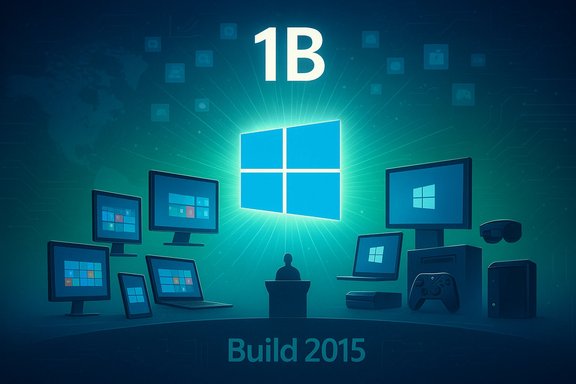
When Microsoft unveiled Windows 10 at Build 2015, the company publicly stated a goal: one billion Windows 10 devices within two to three years of release. That promise was part evangelism — to demonstrate scale to developers — and part strategy, aiming to accelerate upgrades from Windows 7/8 and to extend the operating system across PCs, tablets, Xbox consoles, HoloLens units, and other Windows‑powered hardware. The keynote message was explicit: broad device reach would make Windows 10 “the most attractive developer platform ever.” BetaNews reported the announcement at the time, noting the ambition and its developer‑focused rationale — free upgrades for qualifying Windows 7/8.1 customers during the first year and the consolidated Universal Windows Platform (UWP) as key accelerants. The coverage captured the mix of optimism and skepticism that greeted the pledge. Microsoft’s counting methodology was never strictly limited to consumer PCs. The company’s device totals explicitly include a wide range of hardware that runs Windows 10 variants: desktops and laptops, Surface devices, Xbox consoles, HoloLens headsets, Surface Hub units, and select IoT and industrial systems. That inclusive definition allowed Microsoft to present device totals at a scale not directly comparable to PC‑only market share measures commonly used by industry analysts.
Microsoft’s campaign succeeded at the ecosystem level: the company ultimately crossed the headline threshold and used that scale to accelerate enterprise adoption of its cloud and productivity services. Yet the slower cadence demonstrates that even the most powerful platform vendors cannot entirely control hardware replacement cycles or corporate upgrade budgets. The lesson: marketing targets must be backed by realistic operational plans and transparent measurement to preserve long‑term credibility.
For IT leaders and device managers, the real takeaway is less about corporate milestones and more about practical timelines and controls: inventory what you have, map compatibility, pilot upgrades, and ensure privacy and security policies are documented. For Microsoft and its partners, the experience illustrated the power of a bold target to rally an ecosystem — while also underlining the importance of transparent measurement and flexible timelines when real‑world hardware cycles and enterprise decision processes are the constraining factors.
(Consolidated editorial analysis and discussion of community perspectives appear frequently on Windows forums and community archives that tracked Windows 10’s rollout and the debate around Microsoft’s counting methodology and upgrade incentives. For additional community‑level commentary and historical posts, see archived forum threads and topical analysis collections.
Source: BetaNews https://betanews.com/article/microsoft-aiming-for-1-billion-windows-10-devices-in-2-3-years/]
 Background / Overview
When Microsoft unveiled Windows 10 at Build 2015, the company publicly stated a goal: one billion Windows 10 devices within two to three years of release. That promise was part evangelism — to demonstrate scale to developers — and part strategy, aiming to accelerate upgrades from Windows 7/8 and to extend the operating system across PCs, tablets, Xbox consoles, HoloLens units, and other Windows‑powered hardware. The keynote message was explicit: broad device reach would make Windows 10 “the most attractive developer platform ever.” BetaNews reported the announcement at the time, noting the ambition and its developer‑focused rationale — free upgrades for qualifying Windows 7/8.1 customers during the first year and the consolidated Universal Windows Platform (UWP) as key accelerants. The coverage captured the mix of optimism and skepticism that greeted the pledge. Microsoft’s counting methodology was never strictly limited to consumer PCs. The company’s device totals explicitly include a wide range of hardware that runs Windows 10 variants: desktops and laptops, Surface devices, Xbox consoles, HoloLens headsets, Surface Hub units, and select IoT and industrial systems. That inclusive definition allowed Microsoft to present device totals at a scale not directly comparable to PC‑only market share measures commonly used by industry analysts. What Microsoft promised, and why it mattered
The one‑billion target: more than marketing
The target did three things at once:- It set a headline‑friendly objective that focused developer attention on Windows as a platform worthy of investment.
- It justified Microsoft’s aggressive free‑upgrade offer (one year for qualifying Windows 7/8.1 devices), which removed a primary friction point for consumers and businesses.
- It framed Windows 10 as a cross‑device OS — a single base for apps and services that would simplify developer economics and enable new monetization channels through a unified Store.
Early skepticism and practical constraints
Observers immediately flagged two realities:- The timeframe (2–3 years) was optimistic given the installed base of legacy Windows systems and the natural pace of OEM refresh cycles.
- Counting choices (including niche devices and consoles) mean the one‑billion figure was not the same as a billion traditional PCs. Industry trackers that focus on desktop market share measure a narrower subset and therefore report different numbers.
The rollout: milestones, slippage, and the eventual result
Milestones on the road to one billion
Microsoft released periodic adoption updates that provide a clear timeline of how the goal evolved:- 2015: Target announced at Build — one billion devices in two to three years.
- 2017–2019: Microsoft posted incremental milestones — 700M, 800M (March 2019), and 900M (September 2019) as adoption continued but at a slower pace than originally projected. These updates reflected organic adoption plus enterprise migrations and OEM refresh cycles.
- March 2020: Microsoft announced it had surpassed one billion active Windows 10 devices and framed the milestone as proof that Windows 10 had finally hit the promised scale — albeit later than the original two‑to‑three year window. Yusuf Mehdi’s blog post made the claim official and Microsoft distributed press messaging across regional channels.
Why the target slipped, and what eventually pushed it over the line
Movement toward the billion mark slowed for reasons everyone could see: slower global PC replacement cycles, market headwinds in mobile, and structural limits on how fast large organizations can migrate OS fleets. Two practical accelerants helped bring the total to the target eventually: enterprise migrations driven by Windows 7 end‑of‑support timelines, and steady OEM shipments of Windows‑preinstalled machines. The result: Microsoft reached the number, but on a much longer timetable than originally promised.How Microsoft counted devices — and why the number is nuanced
The storytelling around “one billion devices” depends on three measurement choices:- Device scope: Microsoft’s totals include non‑PC hardware classes (Xbox, Surface Hub, HoloLens, IoT). That broad scope yields larger numbers than PC‑only metrics.
- Active vs. installed: Microsoft’s phrasing shifted between “devices” and “people,” and at times mixed “active” versus cumulative installs, which can confuse comparisons with independent market shares.
- Virtualization and Shadow Installs: Counting VMs, enterprise images, and transient cloud instances complicates reproducibility of the metric for independent trackers.
Strengths of the one‑billion ambition — strategic benefits
- Developer magnetism: A large prospective audience encourages investment in app development, modernizing legacy Win32 footprints, and prioritizing Windows‑native experiences. The unified UWP pitch and a single Windows Store simplified the go‑to‑market story for some developers.
- Ecosystem leverage: A broad device footprint gives Microsoft distribution and bundling leverage for cloud and productivity services, and strengthens the case for deeper integrations (Office, OneDrive, Microsoft Defender, Azure AD). In enterprise scenarios, Windows loyalty still drives endpoint security and device management revenues.
- Operational simplicity for users: A free upgrade window plus “Windows as a Service” incremental updates reduced the perceived risk of big‑bang migrations. The continuous delivery model allowed Microsoft to iterate faster and push critical fixes without waiting for multi‑year major releases.
Risks and downside: what the headline hid
- Measurement opacity: The inclusive counting methodology leaves room for misunderstandings, especially among journalists and procurement professionals comparing vendor claims to independent PC market reports. That opacity eroded trust in some quarters when Microsoft's timelines slipped.
- Upgrade friction and hardware limits: Not all devices are equally upgradeable. Even before Windows 11 introduced stricter hardware requirements, corporate inertia and device diversity slowed migrations. When Microsoft later pushed to Windows 11, a substantial portion of the installed base remained on Windows 10, illustrating the limits of software-only persuasion. Recent industry commentary shows hundreds of millions of PCs still running Windows 10 well after Microsoft set new OS milestones.
- Privacy and telemetry concerns: The “Windows as a Service” model relies on telemetry to manage updates responsibly; this tradeoff between operational reliability and user privacy raised concerns among privacy‑sensitive organizations and regulators. Microsoft tightened telemetry settings over time, but the debate persisted as an adoption friction point.
- Security exposure from long tails: When large populations of devices linger on older, unsupported OS versions, the entire ecosystem becomes more exposed. Extended Security Updates (ESU) programs buy time but also add cost and complexity for enterprises that postponed migrations. The end‑of‑support timeline for Windows 10 (October 14, 2025) made these risks concrete for organizations still running decade‑old machines.
The later reality: Windows 10’s life after the target
Microsoft hit the headline number — but not the original timetable
Microsoft ultimately announced that Windows 10 had passed the one‑billion‑device mark in March 2020, an achievement framed as validation of the Windows as a Service strategy. The company’s announcement used the language “over one billion people have chosen Windows 10 across 200 countries,” indicating both device counts and user reach. The milestone came roughly four and a half years after launch — significantly later than the original two‑to‑three year window.End of support and the stubborn Windows 10 base
Windows 10’s formal mainstream support schedule concluded on October 14, 2025, creating an inflection point for organizations and consumers. Microsoft published guidance encouraging upgrades to Windows 11 or enrollment in the Extended Security Updates (ESU) program for those unable to transition immediately. The ESU program offered a one‑year consumer bridge and commercial options to extend security coverage. Despite the deadline, industry reports through late 2025 indicated nearly a billion PCs continued to run Windows 10 — a function of hardware compatibility limits, organizational risk tolerance, and migration cost. Dell’s executive commentary during earnings calls quantified the challenge: roughly 500 million PCs could upgrade to Windows 11 but had not, while another 500 million were too old to support Windows 11. That split left Microsoft and its hardware partners facing both a security imperative and a commercial opportunity.Practical lessons for IT leaders and OEMs
- Treat vendor milestones as signals, not procurement specs. Microsoft’s one‑billion ambition served a strategic purpose; it is not a substitute for inventory‑level planning. Use asset discovery tools and ground‑truth telemetry for migration planning.
- Plan around lifecycle dates. The October 14, 2025 cutoff for Windows 10 support created a firm deadline. Organizations that delay upgrades face rising costs and security exposure. ESU is a stopgap, not a strategy.
- Prioritize compatibility and testing. Windows installations in the enterprise are heterogeneous. Thorough pilot programs, staged rollouts, and rollback plans reduce risk when upgrading at scale.
- Address privacy and telemetry upfront. Set clear telemetry baselines that satisfy compliance while maintaining operational visibility into update health. Document these choices for auditors and stakeholders.
The marketing‑engineering tradeoff: why big, public targets persist
Large, public goals — like Microsoft’s one‑billion aim — do important strategic work: they rally partners, attract developer attention, and create media momentum. But they also create pressure to deliver quickly, and when timelines slip the narrative can shift to questions about credibility and counting methodology.Microsoft’s campaign succeeded at the ecosystem level: the company ultimately crossed the headline threshold and used that scale to accelerate enterprise adoption of its cloud and productivity services. Yet the slower cadence demonstrates that even the most powerful platform vendors cannot entirely control hardware replacement cycles or corporate upgrade budgets. The lesson: marketing targets must be backed by realistic operational plans and transparent measurement to preserve long‑term credibility.
Breaking down the SEO‑friendly technical facts (quick reference)
- Goal announced: Windows 10 target of one billion devices within two–three years announced at Build 2015.
- Major milestones: 800M devices (March 2019), 900M (September 2019), 1B announced March 2020.
- Device scope: Totals include PCs, laptops, Xbox consoles, HoloLens, Surface Hub, and select IoT/embedded units — not purely traditional PCs.
- End of support: Windows 10 reached end of support on October 14, 2025; Extended Security Updates are available as a transitional option.
Critical analysis: did the target help or hurt Microsoft?
What Microsoft gained
- Ecosystem momentum: The ambition anchored a narrative that Windows remains central to device computing and developer economics, helping sustain investment in Windows apps and services.
- Enterprise leverage: The push to modernize fleets dovetailed with corporate security timelines (e.g., Windows 7 end‑of‑life), driving upgrade projects that supported Microsoft’s broader cloud offerings.
What it exposed
- Timeline credibility risk: Missing the original timeframe invited criticism and raised questions about how Microsoft calculates and communicates major metrics. That credibility cost was manageable but real.
- Operational complexity: The large installed base includes many machines that cannot be trivially migrated, highlighting the limits of software strategies when hardware refresh rates are the binding constraint.
Conclusion
The headline — “Microsoft aiming for one billion Windows 10 devices in two to three years” — was a strategic bet as much as a technical forecast. It compelled developers to notice Windows 10, helped rationalize a broad free‑upgrade policy, and established a long‑term narrative about Windows as an acquisitive, cross‑device platform. The company ultimately achieved the milestone, but on a lengthened timetable and with measurement nuances that matter to analysts and procurement teams.For IT leaders and device managers, the real takeaway is less about corporate milestones and more about practical timelines and controls: inventory what you have, map compatibility, pilot upgrades, and ensure privacy and security policies are documented. For Microsoft and its partners, the experience illustrated the power of a bold target to rally an ecosystem — while also underlining the importance of transparent measurement and flexible timelines when real‑world hardware cycles and enterprise decision processes are the constraining factors.
(Consolidated editorial analysis and discussion of community perspectives appear frequently on Windows forums and community archives that tracked Windows 10’s rollout and the debate around Microsoft’s counting methodology and upgrade incentives. For additional community‑level commentary and historical posts, see archived forum threads and topical analysis collections.
Source: BetaNews https://betanews.com/article/microsoft-aiming-for-1-billion-windows-10-devices-in-2-3-years/]
