

When the tech rumor mill threw a July release date into the mix for Windows 10, it set off the familiar cycle: excitement, cautious skepticism, and a flood of headlines. The eTeknix piece that circulated those claims pulled together bits from earlier briefings and third‑party sources to suggest Microsoft might ship Windows 10 as early as July — a possibility that would have accelerated OEM roll‑outs and given eager users immediate access to new features like DirectX 12. That rumor echoed parts of Microsoft’s own public messaging about a summer launch, but it conflated speculation with firm dates; Microsoft’s official timeline made the release day clear: Windows 10 reached general availability on July 29, 2015, with RTM‑era builds already flowing to insiders and OEM partners ahead of that GA date.
From the early Technical Previews in 2014 through spring 2015, Microsoft ran an unusually public development process under the Windows Insider program. That transparency both informed and muddied the waters: build numbers, feature toggles, and Insider ring distributions were widely reported, and they became raw material for outlets trying to predict the final ship date.
For enterprises, the story was different:
Source: eTeknix Rumours Hint at a July Launch for Windows 10
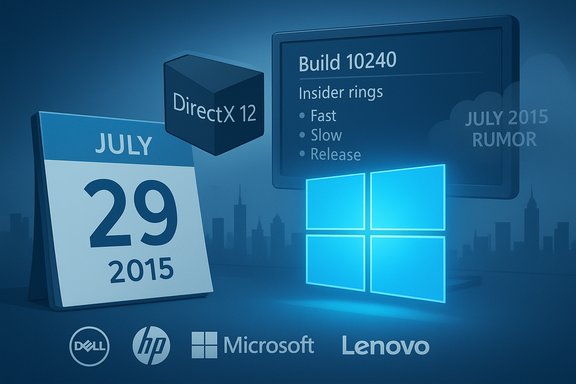 Background: rumor vs. reality
From the early Technical Previews in 2014 through spring 2015, Microsoft ran an unusually public development process under the Windows Insider program. That transparency both informed and muddied the waters: build numbers, feature toggles, and Insider ring distributions were widely reported, and they became raw material for outlets trying to predict the final ship date.- Microsoft signaled a summer release window and then formalized a launch date of July 29, 2015 — a global availability that included free upgrades for qualifying Windows 7 and Windows 8.1 systems. This was the company’s official public position going into summer.
- Insider previews continued up to and through mid‑July, with build 10240 (widely described as the RTM candidate) distributed to Insiders on July 15 and then used as the base for the July 29 public roll‑out. OEMs and device partners received release‑ready images in the same pre‑launch window to prepare new hardware.
- The rumor covered by eTeknix and credited to other outlets suggested a July release and even hinted at different RTM/release months; those particulars were inconsistent with Microsoft’s clear July 29 GA announcement and with the build timeline seen by Insiders and partners. It’s important to treat those rumor details as speculative unless corroborated by Microsoft or primary partner channels.
Overview: what the rumor claimed and why it mattered
The eTeknix story recycled a few high‑impact ideas that were attractive to readers and gamers:- A planned July release of Windows 10 (allowing immediate free upgrades for eligible Windows 7/8/8.1 users).
- The arrival of DirectX 12 as a Windows 10‑only graphics stack — which, if true, would push gamers and developers to adopt Windows 10 faster.
- The inclusion of features seen in early Insider builds (for example, Start Menu improvements, Cortana expansion, virtual desktops and UI tweaks in builds like 10041).
Timeline of key events (verified)
- Early technical previews and public feedback cycle through the Windows Insider program (2014–2015).
- Build 10041 (Technical Preview) — March 2015 — introduced visible UI refinements (transparent Start, network fly‑out, improved virtual desktops, Cortana expansion to additional markets).
- Build 10240 issued to Insiders (July 15, 2015) and recognized by media as the RTM candidate; this build formed the base for the July 29 launch.
- Windows 10 general availability — July 29, 2015 — free upgrade reservations began earlier and many reserved users received pre‑downloads to ease the day‑one load.
Deep dive: the technical claims in the rumor and their verification
Release cadence and the “RTM” question
The conventional RTM model — one build stamped “release” and then pushed to OEMs with a long lead time — was already evolving by 2015. Microsoft publicly described Windows 10 as a service and emphasized ongoing updates; nonetheless, the build that most outlets called the RTM candidate, 10.0.10240, was distributed to Insiders and to partners ahead of GA. Coverage from independent outlets tracked that flow and captured the practical effect: OEMs had a production‑ready image in mid‑July and consumers got the GA release on July 29. Treat the term “RTM” in the Windows 10 context as shorthand for the build selected as the initial factory image rather than a hard stop to development.DirectX 12: platform exclusivity and implications for gamers
One of the most consequential claims in the rumor was that DirectX 12 would be available only on Windows 10. That claim is accurate in the practical sense that DirectX 12 shipping at launch was included with Windows 10 and not distributed as a standalone runtime for Windows 7 or 8.1. Microsoft’s distribution model for modern DirectX releases (11.3/11.4/12 at the time) tied those updates to particular Windows versions and to Windows Update delivery; there is no separate all‑platform installer that retrofits older OS builds with the newer DirectX feature sets. For game developers and studios, that meant:- Targeting DirectX 12 features effectively implied targeting Windows 10 (or, later, compatible newer Windows versions).
- Some engine vendors and game studios would therefore ship DX12‑exclusive features on PC as a Windows‑10‑only option, at least initially.
- That reality created a market incentive for gamers who wanted the newest graphics APIs and titles to upgrade, but it also raised compatibility and support issues for enterprise and older‑hardware users.
Build 10041 and visible changes in the preview channel
The eTeknix summary listed user‑facing changes drawn from Technical Preview builds — many of which are documented in Microsoft’s own Insider posts and third‑party coverage. Build 10041 introduced:- A more polished Start experience, including transparency and easier drag‑and‑drop pinning.
- A new network fly‑out from the taskbar for quicker network access.
- Expanded Cortana support on desktop (additional markets beyond the U.S..
- Virtual desktop tweaks: the ability to drag windows to other desktops and taskbar filtering.
What the rumor got right — and where it misled
- Right: Microsoft planned a summer release for Windows 10 and publicly promised global availability across many languages and markets. Media reporting and community leaks correctly guessed the summer target window.
- Right: DirectX 12 was an important, headline‑worthy feature whose presence on Windows 10 would be a major incentive for gamers and developers.
- Misleading/unverified: precise dates and sequencing claimed in some rumors (e.g., RTM in August, retail in October) conflicted with Microsoft’s GA date of July 29 and the insider/OEM distribution timeline. Rumor pieces that mixed unconfirmed partner schedules or misdated RTM/GA sequencing should be viewed as speculative unless corroborated by a Microsoft statement or OEM release calendar.
Why the distinction mattered to end users and IT teams
For consumers and gamers, a July launch with DirectX 12 availability signaled immediate gains: new performance paths for engines, better multi‑core CPU usage in rendering, and potentially large graphical improvements in titles that adopted DX12 early.For enterprises, the story was different:
- Enterprises are conservative by design; a forced or rapid upgrade cycle creates compatibility headaches (legacy apps, management tools, driver certification).
- Microsoft’s messaging that Windows 10 was delivered as a service added operational complexity: updates would arrive more frequently and with cumulative servicing behavior that differed from the Windows 7/8 era.
- The interplay between OEM update schedules, driver support, and ISV testing meant that even on GA day many organizations preferred to delay broad deployments until patches and driver updates had matured.
Practical advice: how launch‑day dynamics played out (and what to learn)
- Reserve and pre‑download: Microsoft encouraged users to reserve upgrades and Microsoft, OEMs and retailers prepared point‑of‑sale upgrade experiences. Pre‑downloads helped smooth the load on launch day.
- Expect a day‑one patch: major OS launches typically ship with a substantial “day‑one” cumulative update; Windows 10 was no exception. That patch addressed last‑minute fixes and ensured a more reliable baseline for mass upgrades.
- Gaming readiness = drivers + Windows updates: having a DirectX‑12 capable GPU alone wasn’t enough. Stable DX12 experiences depended on up‑to‑date graphics drivers and OEM/driver support for Windows 10 — another reason for gamers to verify vendor driver releases before upgrading wholesale.
Editorial analysis: strengths, risks, and the legacy of the rumor cycle
Strengths: what Windows 10 brought and why the rumor mattered
- Unified platform narrative: Windows 10’s promise to run across PCs, tablets and Xbox was a strong strategic story that justified the urgency behind a summer roll‑out.
- DirectX 12 as a forcing function: when a next‑generation graphics API is tied to a new OS wave, it creates natural momentum for adoption by developers and, in turn, gamers.
- Open Insider process: the public preview program gave enthusiasts and partners a clear line of sight into feature progress, which helped build trust and early feedback loops.
Risks and downsides: what the rumor overlooked or understated
- Rumor‑driven expectation gaps: premature dates create a credibility cost when they fail to align with official plans; they also distort procurement and upgrade timelines for partners and businesses. The eTeknix rumor mixed useful signals with unconfirmed claims and thus risked misguiding users.
- Compatibility and driver volatility: tying major graphics features to a new OS increases short‑term friction; early adopters can face driver bugs, missing features, or suboptimal performance until vendors stabilize their Windows 10‑specific drivers.
- Privacy and telemetry concerns: the “Windows as a service” model meant more frequent data exchanges and feature telemetry. While many users benefitted from faster updates and security patches, privacy‑conscious and regulated organizations needed clear controls and documentation to manage the new model.
What this episode teaches about technology reporting
- Differentiate Microsoft’s official signals from secondary leaks. Official blog posts, KB articles, and Windows Insider communications should be the baseline for timeline confirmation.
- Treat API/platform exclusivity claims carefully: an API being available only on a particular OS at launch is verifiable (and often significant), but permanence of exclusivity is not a foregone conclusion. The initial DirectX 12 distribution model tied it to Windows 10 via Windows Update — factual at the time — but the broader landscape evolves.
- Contextualize rumors: they are useful for signaling partner sentiment and likely outcomes, but they are not a substitute for product‑level confirmation.
Conclusion
The eTeknix rumor that Windows 10 might arrive in July captured the core truth that Microsoft planned a summer launch and that DirectX 12 would be a headline feature. What the rumor failed to do consistently was distinguish speculation from the official schedule: Microsoft’s public timeline and Insider build flow made the July 29, 2015 general availability date the single authoritative moment for launch. The practical consequences of that release — especially for gaming, where DirectX 12 raised the bar — were real and immediate, but they also brought the predictable mix of driver teething problems, compatibility decisions, and a period of accelerated patching and updates. For readers, the takeaways are simple: watch primary channels for dates, verify upgrade prerequisites (drivers and hardware), and approach rumor‑based timelines with healthy caution.Source: eTeknix Rumours Hint at a July Launch for Windows 10
