

OEMs should stop treating Windows 10 WHCP certification as the default path for new and refreshed hardware: after Microsoft’s September 26, 2025 notice, Windows 10 certification began deprecating after Windows 10 reached end of support on October 14, 2025. The practical move is to keep Windows 10 validation only for products tied to Windows 10 LTSC 2021, HLK 22H2, Extended Security Updates, or supported Server/LTSC paths, while moving mainstream client certification, driver validation, and release gates to Windows 11 and Windows Server. In plain terms: Windows 10 WHCP is no longer the broad compatibility umbrella it used to be; it is now an exception-handling lane.
The Windows 10 end-of-support date was the headline consumers saw. For OEMs, ODMs, silicon vendors, peripheral makers, and driver teams, the more important line is buried deeper in the certification story: Microsoft says Windows 10 certification in the Windows Hardware Compatibility Program begins deprecating after that date. That changes the economics of hardware support.
The decision tree should start with one question: does this device, driver package, or platform SKU have a real contractual, regulatory, enterprise, or embedded reason to remain validated for Windows 10 LTSC 2021 or an ESU-supported Windows 10 22H2 path? If the answer is no, the default should be Windows 11 and Windows Server validation. If the answer is yes, Windows 10 remains a scoped support target, not a general-purpose certification checkbox.
That distinction matters because WHCP is not just a badge on a spec sheet. It shapes test lab priorities, HLK automation, dashboard submissions, release criteria, driver signing workflows, support matrices, and the language sales teams use when they tell customers what “supported” really means. Once Windows 10 certification starts deprecating, every extra Windows 10 target becomes an operational cost that must be justified.
The most useful portfolio rule is blunt: keep only those Windows 10 SKUs that map to Windows 10 LTSC 2021, HLK 22H2, ESU, or supported long-life customer commitments. Everything else should be retired from the certification matrix and moved to Windows 11 or Windows Server validation.
WHCP still describes a certification process that covers Windows 10 and Windows 11, but the practical priority order has changed. Before October 2025, Windows 10 could still function as a broad baseline for many hardware programs because it remained a supported mainstream client operating system. Afterward, it becomes a narrowing compatibility obligation.
That is the pivot OEMs need to internalize. Microsoft is not saying every historical Windows 10 device suddenly stops working. It is saying the certification program is moving with the supported Windows ecosystem. The test matrix that made sense when Windows 10 was still a mainstream client platform now risks becoming a museum of unsupported assumptions.
For a hardware vendor, that forces a portfolio conversation that often arrives too late. Product managers want broad compatibility claims. Sales teams want to keep legacy customers comfortable. Driver teams want fewer branches. Support teams want a clear answer when a customer asks whether a device is certified, merely compatible, or no longer in scope.
The mistake is to answer those questions SKU by SKU only after a customer escalates. The better answer is to rebuild the certification policy now: Windows 11 first, Windows Server where applicable, Windows 10 only where the support state is still defensible.
The first branch in the decision tree should be support state. Is the target Windows 10 environment still covered by Windows 10 LTSC 2021, HLK 22H2, ESU, or a supported long-term servicing scenario? If not, keeping Windows 10 WHCP as a release requirement is not customer empathy. It is a promise the certification ecosystem is moving away from.
The second branch should be product lifecycle. A shipping industrial controller, medical-adjacent workstation, point-of-sale peripheral, or ruggedized enterprise device may have a customer lifecycle that outlives mainstream Windows releases. Those products deserve a careful Windows 10 exception review. A consumer accessory, new notebook platform, gaming peripheral, or refreshed commodity component usually does not.
The third branch should be driver complexity. If a driver is shared across Windows 10, Windows 11, and Server targets, the vendor must decide whether Windows 10 testing still catches meaningful regressions or merely consumes lab cycles. If the code path is materially different on Windows 10, the support decision becomes more expensive and should be treated as such. If it is not materially different, Windows 11-first validation may provide the better signal.
The final branch is customer language. A product can be physically compatible with Windows 10 and still not be a current Windows 10 WHCP certification candidate. Vendors need to stop flattening “works,” “tested,” “supported,” and “certified” into one marketing sentence. After the deprecation notice, those words need legal and operational precision.
Products tied to Windows 10 LTSC 2021 deserve the first review. Microsoft’s notice preserves a supported path for Windows 10 LTSC 2021 and HLK 22H2 through ESU in 2026, which means those environments can still anchor legitimate validation plans. But that does not mean every Windows 10 22H2 consumer or commercial scenario remains equally valuable to certify.
The next category is hardware sold into enterprises that have explicitly purchased or planned around ESU. Those customers may not be ready to move everything to Windows 11, and in some sectors they may have good reasons. The question for OEMs is whether those customers are large enough, contractually important enough, or operationally constrained enough to justify maintaining Windows 10 validation.
Then come Server-adjacent products. Some device classes live closer to Windows Server than to consumer Windows, and their certification path may be shaped by Server support more than by client Windows 10’s end of support. Those products should be separated from mainstream client SKUs rather than buried in the same Windows 10 column.
Everything else belongs on the drop list. Not abandoned in the sense that old drivers must be yanked from customers who already have them, but dropped from the assumption that Windows 10 WHCP remains a broad default for ongoing certification work.
The first operational move is to split the validation matrix into active, exception, and archival lanes. Active lanes are Windows 11 and supported Windows Server targets. Exception lanes are Windows 10 LTSC 2021, HLK 22H2, and ESU-backed scenarios. Archival lanes are legacy compatibility checks that may be useful internally but should not block release unless a named support commitment says they must.
That split should be visible in CI. A failed Windows 11 certification gate should stop the release. A failed Windows 10 exception gate should stop the release only for products still in the approved Windows 10 support register. A failed archival Windows 10 smoke test should create an engineering signal, not automatically become a shipment blocker.
Many vendors will find that their automation does not currently express those distinctions. A test job is either green or red. A driver package either passes the release gate or does not. A dashboard submission either goes forward or waits. The deprecation plan makes that too crude.
The better model is policy-aware validation. The same driver build can have different release consequences depending on product family, target OS, customer contract, and support state. That is uncomfortable for teams that prefer one universal matrix, but it reflects the world Microsoft has created: Windows 10 is no longer a universal certification target.
OEMs should rewrite release criteria around named targets. Instead of “Windows 10 support,” use language such as “Windows 10 LTSC 2021 validation using HLK 22H2 where applicable” or “Windows 10 22H2 ESU customer-support validation only.” Instead of “Windows client certification,” distinguish Windows 11 certification from Windows 10 exception validation.
This will feel pedantic until the first escalated customer case. Then the precision becomes valuable. Support can tell whether the device was certified for a current Windows target, validated for an ESU scenario, or merely known to function on an unsupported client environment. Engineering can tell whether a failed test is a ship-stopper or a compatibility note. Sales can avoid selling a 2026 product with a 2023-era support claim.
The same cleanup belongs in driver release notes. Windows 10 should no longer appear as a casual blanket phrase. If a package supports Windows 10 only in LTSC or ESU contexts, say so. If a package is Windows 11-first and only retains best-effort Windows 10 compatibility, that should be clear before customers deploy it at scale.
This is not about making support pages longer. It is about preventing “Windows 10” from becoming a misleading shorthand after Microsoft has narrowed the certification path around it.
The first speed is preservation. Existing supported Windows 10 commitments should be mapped, documented, and maintained where they align with LTSC 2021, HLK 22H2, ESU, or supported Server paths. That preservation lane should be stable, conservative, and deliberately boring. Its job is to avoid breaking customers who have a legitimate reason to remain on Windows 10.
The second speed is forward certification. New hardware revisions, new device IDs, new platform launches, and new feature-bearing drivers should move to Windows 11 and Windows Server validation unless there is a named exception. This is where vendors should place their engineering energy, because it is where Microsoft’s compatibility program is headed.
The danger is letting the preservation lane dictate the forward lane. If every new feature must satisfy every old Windows 10 scenario, Windows 11 modernization slows down. If every customer request becomes a reason to keep Windows 10 certification broad, the exception lane becomes the default again.
A disciplined migration plan allows both truths to coexist. Some legacy products stay on life support because customers and support policy require it. New products stop pretending Windows 10 is still the center of the client hardware universe.
WindowsForum readers have already been tracking Microsoft’s broader tightening around driver certification, kernel-mode trust, and WHCP-centered validation. That larger shift matters here because Windows 10 certification deprecation is not an isolated cleanup item. It sits alongside Microsoft’s effort to make driver trust more structured, more accountable, and less dependent on legacy assumptions.
For OEMs, the practical question is not merely “can we still sign this?” It is “what does signing this package imply about the operating systems we support?” If Windows 10 remains in the INF targeting, release notes, catalog strategy, and customer-facing support matrix, the vendor needs to be able to defend that inclusion.
That defense should be written down. Is the package required for LTSC 2021? Is it needed by ESU customers? Is it attached to a long-life platform? Is it a shared driver where Windows 10 inclusion creates minimal additional risk? Or is it there because nobody removed it from last year’s template?
The last answer is the one that should worry management. Certification inertia is not a strategy.
OEMs should review how Windows 10 appears in downloadable driver packages, update utilities, enterprise deployment catalogs, and product support pages. The question is not simply whether the package installs. The question is whether the vendor is still claiming a certification or support posture that matches Microsoft’s post-October 2025 program direction.
This review should include old packages that are still linked from support pages. A 2024 driver may remain useful for a device sold years ago, but the page around it should not imply that Windows 10 WHCP is still a broad current certification target. The difference between historical availability and current certification support needs to be visible.
Enterprise customers will care about this distinction. They need to know whether a driver is suitable for a Windows 10 ESU fleet, a Windows 10 LTSC 2021 deployment, a Windows 11 migration wave, or a Server workload. If the vendor’s catalog does not answer that clearly, the customer’s deployment team will either delay the rollout or invent its own interpretation.
That is how support ambiguity becomes operational risk.
A product launched in 2026 that foregrounds Windows 10 certification may now look less future-proof, not more. Enterprise buyers will ask why Windows 11 is not the lead claim. Security teams will ask whether the driver model and certification path align with current Windows trust expectations. Procurement teams will ask whether the vendor is supporting the customer’s future platform or merely preserving the past.
That does not mean Windows 10 disappears from marketing. It means Windows 10 claims need context. A rugged industrial system sold for long lifecycle deployments can legitimately highlight Windows 10 LTSC support. A new consumer peripheral should probably lead with Windows 11 compatibility and mention Windows 10 only if the support state is still meaningful.
This is where OEMs need coordination between engineering, legal, sales, and marketing. The certification team may understand the nuance, but a product page can erase it in one sentence. After Microsoft’s deprecation notice, that sentence matters.
Every hardware product should be assigned to one of three categories: certify forward, preserve under exception, or retire from active Windows 10 validation. The category should be tied to support state, not nostalgia. A product with no LTSC, ESU, Server, or contractual justification should not keep consuming WHCP planning time as if Windows 10 were still a mainstream certification target.
Next, the validation team should update gates. Windows 11 and Server targets become the default blockers. Windows 10 LTSC 2021 and HLK 22H2 remain blockers only for products explicitly assigned to the exception lane. Unsupported Windows 10 checks can remain as non-blocking telemetry if they still provide useful compatibility information.
Then the release team should update package language. INFs, release notes, support pages, and internal catalog entries should say exactly which Windows versions and support states are in scope. “Windows 10” by itself is no longer precise enough for a professional hardware support claim.
Finally, the business owner should set a review date. Exception lanes have a habit of becoming permanent unless someone forces the conversation. Every Windows 10 exception should have an owner and a next review trigger, whether that trigger is a customer contract milestone, ESU planning cycle, product end-of-sale date, or successor platform launch.
The point is to turn deprecation into governance. Microsoft has moved the line; OEMs now need to move the process.
The useful follow-up is: compatible with which Windows 10 support state? Windows 10 22H2 under ESU? Windows 10 LTSC 2021? A historical driver package with no current certification path? A best-effort install that support will not stand behind? Those distinctions affect deployment risk.
For enterprise fleets still carrying Windows 10, the safest procurement posture is to require vendors to name the supported Windows 10 scenario explicitly. If the vendor cannot distinguish LTSC, ESU, and general Windows 10 compatibility, that is a warning sign. It may not mean the device will fail, but it does mean the support story is underdeveloped.
For enthusiasts, the message is similar but less formal. A device may continue to work on Windows 10 long after certification priority moves on. But “works on my machine” and “supported under a current WHCP path” are different claims. The further Windows 10 recedes from Microsoft’s certification center, the more that gap matters.
For administrators planning Windows 11 migrations, the deprecation notice can be used as leverage. Hardware vendors that still hedge around Windows 11 readiness should be pressed to explain their certification roadmap. If Windows 10 is no longer the broad default, Windows 11 support cannot remain an afterthought.
A realistic OEM checklist now looks like this:
The companies that handle this well will not be the ones with the longest compatibility matrix. They will be the ones with the clearest one. They will know which products are moving forward, which are being preserved for legitimate long-life customers, and which are being allowed to age out of the validation pipeline.
The Windows 10 era is not vanishing in a single administrative stroke; too much hardware, too many enterprise images, and too many long-life deployments remain in the field for that. But after October 14, 2025, Windows 10 WHCP certification is no longer the safe default position for OEMs. It is a managed exception, and the vendors that understand that now will spend less of 2026 arguing with their own test matrices.
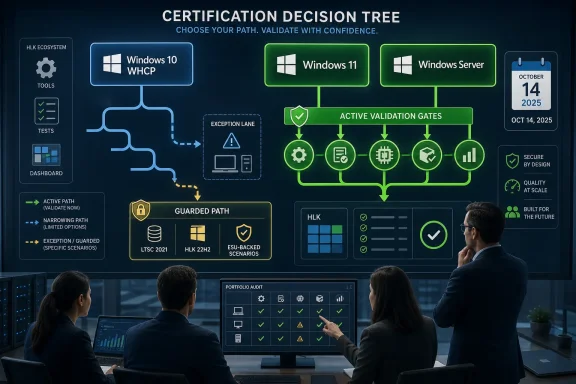 The Verdict Is Simple: Certify Forward, Preserve Backward Only Where the Contract Demands It
The Windows 10 end-of-support date was the headline consumers saw. For OEMs, ODMs, silicon vendors, peripheral makers, and driver teams, the more important line is buried deeper in the certification story: Microsoft says Windows 10 certification in the Windows Hardware Compatibility Program begins deprecating after that date. That changes the economics of hardware support.The decision tree should start with one question: does this device, driver package, or platform SKU have a real contractual, regulatory, enterprise, or embedded reason to remain validated for Windows 10 LTSC 2021 or an ESU-supported Windows 10 22H2 path? If the answer is no, the default should be Windows 11 and Windows Server validation. If the answer is yes, Windows 10 remains a scoped support target, not a general-purpose certification checkbox.
That distinction matters because WHCP is not just a badge on a spec sheet. It shapes test lab priorities, HLK automation, dashboard submissions, release criteria, driver signing workflows, support matrices, and the language sales teams use when they tell customers what “supported” really means. Once Windows 10 certification starts deprecating, every extra Windows 10 target becomes an operational cost that must be justified.
The most useful portfolio rule is blunt: keep only those Windows 10 SKUs that map to Windows 10 LTSC 2021, HLK 22H2, ESU, or supported long-life customer commitments. Everything else should be retired from the certification matrix and moved to Windows 11 or Windows Server validation.
Microsoft Did Not Just End an Operating System; It Narrowed a Certification Lane
Windows 10 version 22H2 was the final Windows 10 release, and support ended on October 14, 2025. That fact is now table stakes. The September 26, 2025 WHCP deprecation notice turns that lifecycle milestone into an engineering management problem.WHCP still describes a certification process that covers Windows 10 and Windows 11, but the practical priority order has changed. Before October 2025, Windows 10 could still function as a broad baseline for many hardware programs because it remained a supported mainstream client operating system. Afterward, it becomes a narrowing compatibility obligation.
That is the pivot OEMs need to internalize. Microsoft is not saying every historical Windows 10 device suddenly stops working. It is saying the certification program is moving with the supported Windows ecosystem. The test matrix that made sense when Windows 10 was still a mainstream client platform now risks becoming a museum of unsupported assumptions.
For a hardware vendor, that forces a portfolio conversation that often arrives too late. Product managers want broad compatibility claims. Sales teams want to keep legacy customers comfortable. Driver teams want fewer branches. Support teams want a clear answer when a customer asks whether a device is certified, merely compatible, or no longer in scope.
The mistake is to answer those questions SKU by SKU only after a customer escalates. The better answer is to rebuild the certification policy now: Windows 11 first, Windows Server where applicable, Windows 10 only where the support state is still defensible.
The OEM Decision Tree Starts With Support State, Not Market Demand
A familiar trap in hardware planning is to let installed base size drive certification decisions. Windows 10 still has users; therefore, the argument goes, Windows 10 should remain in the validation matrix. That is backwards after end of support.The first branch in the decision tree should be support state. Is the target Windows 10 environment still covered by Windows 10 LTSC 2021, HLK 22H2, ESU, or a supported long-term servicing scenario? If not, keeping Windows 10 WHCP as a release requirement is not customer empathy. It is a promise the certification ecosystem is moving away from.
The second branch should be product lifecycle. A shipping industrial controller, medical-adjacent workstation, point-of-sale peripheral, or ruggedized enterprise device may have a customer lifecycle that outlives mainstream Windows releases. Those products deserve a careful Windows 10 exception review. A consumer accessory, new notebook platform, gaming peripheral, or refreshed commodity component usually does not.
The third branch should be driver complexity. If a driver is shared across Windows 10, Windows 11, and Server targets, the vendor must decide whether Windows 10 testing still catches meaningful regressions or merely consumes lab cycles. If the code path is materially different on Windows 10, the support decision becomes more expensive and should be treated as such. If it is not materially different, Windows 11-first validation may provide the better signal.
The final branch is customer language. A product can be physically compatible with Windows 10 and still not be a current Windows 10 WHCP certification candidate. Vendors need to stop flattening “works,” “tested,” “supported,” and “certified” into one marketing sentence. After the deprecation notice, those words need legal and operational precision.
The Legacy SKU Keep List Should Be Short, Named, and Reviewed
The Windows 10 keep list should not be a spreadsheet full of wishful thinking. It should be a controlled exception register with owners, dates, support rationale, test coverage, and retirement criteria. If that sounds bureaucratic, it is still cheaper than discovering during a driver release that an unsupported Windows 10 target is blocking shipment.Products tied to Windows 10 LTSC 2021 deserve the first review. Microsoft’s notice preserves a supported path for Windows 10 LTSC 2021 and HLK 22H2 through ESU in 2026, which means those environments can still anchor legitimate validation plans. But that does not mean every Windows 10 22H2 consumer or commercial scenario remains equally valuable to certify.
The next category is hardware sold into enterprises that have explicitly purchased or planned around ESU. Those customers may not be ready to move everything to Windows 11, and in some sectors they may have good reasons. The question for OEMs is whether those customers are large enough, contractually important enough, or operationally constrained enough to justify maintaining Windows 10 validation.
Then come Server-adjacent products. Some device classes live closer to Windows Server than to consumer Windows, and their certification path may be shaped by Server support more than by client Windows 10’s end of support. Those products should be separated from mainstream client SKUs rather than buried in the same Windows 10 column.
Everything else belongs on the drop list. Not abandoned in the sense that old drivers must be yanked from customers who already have them, but dropped from the assumption that Windows 10 WHCP remains a broad default for ongoing certification work.
The Lab Matrix Is Where Policy Becomes Expensive
The real cost of this change lands in validation infrastructure. WHCP certification is the visible endpoint, but the daily work happens in HLK pools, CI jobs, driver packaging scripts, test result triage, catalog generation, and dashboard submission discipline. If those systems still treat Windows 10 as a default target, the organization will keep spending money on yesterday’s release policy.The first operational move is to split the validation matrix into active, exception, and archival lanes. Active lanes are Windows 11 and supported Windows Server targets. Exception lanes are Windows 10 LTSC 2021, HLK 22H2, and ESU-backed scenarios. Archival lanes are legacy compatibility checks that may be useful internally but should not block release unless a named support commitment says they must.
That split should be visible in CI. A failed Windows 11 certification gate should stop the release. A failed Windows 10 exception gate should stop the release only for products still in the approved Windows 10 support register. A failed archival Windows 10 smoke test should create an engineering signal, not automatically become a shipment blocker.
Many vendors will find that their automation does not currently express those distinctions. A test job is either green or red. A driver package either passes the release gate or does not. A dashboard submission either goes forward or waits. The deprecation plan makes that too crude.
The better model is policy-aware validation. The same driver build can have different release consequences depending on product family, target OS, customer contract, and support state. That is uncomfortable for teams that prefer one universal matrix, but it reflects the world Microsoft has created: Windows 10 is no longer a universal certification target.
Release Criteria Need New Words Before They Need New Tools
Tooling is only half the problem. The other half is release language. If a program manager writes “Windows 10/11 certified” into a launch checklist without naming the Windows 10 edition, version, HLK basis, or support path, the checklist is now too vague to be safe.OEMs should rewrite release criteria around named targets. Instead of “Windows 10 support,” use language such as “Windows 10 LTSC 2021 validation using HLK 22H2 where applicable” or “Windows 10 22H2 ESU customer-support validation only.” Instead of “Windows client certification,” distinguish Windows 11 certification from Windows 10 exception validation.
This will feel pedantic until the first escalated customer case. Then the precision becomes valuable. Support can tell whether the device was certified for a current Windows target, validated for an ESU scenario, or merely known to function on an unsupported client environment. Engineering can tell whether a failed test is a ship-stopper or a compatibility note. Sales can avoid selling a 2026 product with a 2023-era support claim.
The same cleanup belongs in driver release notes. Windows 10 should no longer appear as a casual blanket phrase. If a package supports Windows 10 only in LTSC or ESU contexts, say so. If a package is Windows 11-first and only retains best-effort Windows 10 compatibility, that should be clear before customers deploy it at scale.
This is not about making support pages longer. It is about preventing “Windows 10” from becoming a misleading shorthand after Microsoft has narrowed the certification path around it.
Mixed Windows 10 and Windows 11 Programs Need a Two-Speed Migration
The hardest portfolios are not pure legacy or pure future. They are mixed programs: one driver stack, several device revisions, a customer base split across Windows 10 and Windows 11, and a roadmap that already includes new hardware. These programs need a two-speed migration, not a cliff.The first speed is preservation. Existing supported Windows 10 commitments should be mapped, documented, and maintained where they align with LTSC 2021, HLK 22H2, ESU, or supported Server paths. That preservation lane should be stable, conservative, and deliberately boring. Its job is to avoid breaking customers who have a legitimate reason to remain on Windows 10.
The second speed is forward certification. New hardware revisions, new device IDs, new platform launches, and new feature-bearing drivers should move to Windows 11 and Windows Server validation unless there is a named exception. This is where vendors should place their engineering energy, because it is where Microsoft’s compatibility program is headed.
The danger is letting the preservation lane dictate the forward lane. If every new feature must satisfy every old Windows 10 scenario, Windows 11 modernization slows down. If every customer request becomes a reason to keep Windows 10 certification broad, the exception lane becomes the default again.
A disciplined migration plan allows both truths to coexist. Some legacy products stay on life support because customers and support policy require it. New products stop pretending Windows 10 is still the center of the client hardware universe.
Driver Signing Strategy Now Carries More Portfolio Meaning
Driver signing has always been treated as a compliance checkpoint, but in this transition it becomes a signal of portfolio intent. A driver package submitted through a modern certification path tells customers which Windows futures the vendor is prioritizing. A package that keeps dragging every old Windows 10 target along tells a different story.WindowsForum readers have already been tracking Microsoft’s broader tightening around driver certification, kernel-mode trust, and WHCP-centered validation. That larger shift matters here because Windows 10 certification deprecation is not an isolated cleanup item. It sits alongside Microsoft’s effort to make driver trust more structured, more accountable, and less dependent on legacy assumptions.
For OEMs, the practical question is not merely “can we still sign this?” It is “what does signing this package imply about the operating systems we support?” If Windows 10 remains in the INF targeting, release notes, catalog strategy, and customer-facing support matrix, the vendor needs to be able to defend that inclusion.
That defense should be written down. Is the package required for LTSC 2021? Is it needed by ESU customers? Is it attached to a long-life platform? Is it a shared driver where Windows 10 inclusion creates minimal additional risk? Or is it there because nobody removed it from last year’s template?
The last answer is the one that should worry management. Certification inertia is not a strategy.
Cataloging Becomes a Support-State Exercise
Driver catalogs, package metadata, and support matrices are easy to overlook because they feel like release engineering details. In reality, they become customer-facing truth once a package escapes into the field. If Windows 10 remains listed without qualification, customers will assume support is broader than it may be.OEMs should review how Windows 10 appears in downloadable driver packages, update utilities, enterprise deployment catalogs, and product support pages. The question is not simply whether the package installs. The question is whether the vendor is still claiming a certification or support posture that matches Microsoft’s post-October 2025 program direction.
This review should include old packages that are still linked from support pages. A 2024 driver may remain useful for a device sold years ago, but the page around it should not imply that Windows 10 WHCP is still a broad current certification target. The difference between historical availability and current certification support needs to be visible.
Enterprise customers will care about this distinction. They need to know whether a driver is suitable for a Windows 10 ESU fleet, a Windows 10 LTSC 2021 deployment, a Windows 11 migration wave, or a Server workload. If the vendor’s catalog does not answer that clearly, the customer’s deployment team will either delay the rollout or invent its own interpretation.
That is how support ambiguity becomes operational risk.
The Old Compatibility Badge Is Losing Its Marketing Value
For years, Windows 10 compatibility could function as a reassuring line in a product announcement. It told buyers the device fit into the Windows mainstream. After October 14, 2025, that line has a different weight.A product launched in 2026 that foregrounds Windows 10 certification may now look less future-proof, not more. Enterprise buyers will ask why Windows 11 is not the lead claim. Security teams will ask whether the driver model and certification path align with current Windows trust expectations. Procurement teams will ask whether the vendor is supporting the customer’s future platform or merely preserving the past.
That does not mean Windows 10 disappears from marketing. It means Windows 10 claims need context. A rugged industrial system sold for long lifecycle deployments can legitimately highlight Windows 10 LTSC support. A new consumer peripheral should probably lead with Windows 11 compatibility and mention Windows 10 only if the support state is still meaningful.
This is where OEMs need coordination between engineering, legal, sales, and marketing. The certification team may understand the nuance, but a product page can erase it in one sentence. After Microsoft’s deprecation notice, that sentence matters.
The Practical Cutover Plan Is a Portfolio Audit, Not a Panic Migration
The right response is not to rip out every Windows 10 test job overnight. It is to make Windows 10 earn its place in the pipeline. That starts with a portfolio audit.Every hardware product should be assigned to one of three categories: certify forward, preserve under exception, or retire from active Windows 10 validation. The category should be tied to support state, not nostalgia. A product with no LTSC, ESU, Server, or contractual justification should not keep consuming WHCP planning time as if Windows 10 were still a mainstream certification target.
Next, the validation team should update gates. Windows 11 and Server targets become the default blockers. Windows 10 LTSC 2021 and HLK 22H2 remain blockers only for products explicitly assigned to the exception lane. Unsupported Windows 10 checks can remain as non-blocking telemetry if they still provide useful compatibility information.
Then the release team should update package language. INFs, release notes, support pages, and internal catalog entries should say exactly which Windows versions and support states are in scope. “Windows 10” by itself is no longer precise enough for a professional hardware support claim.
Finally, the business owner should set a review date. Exception lanes have a habit of becoming permanent unless someone forces the conversation. Every Windows 10 exception should have an owner and a next review trigger, whether that trigger is a customer contract milestone, ESU planning cycle, product end-of-sale date, or successor platform launch.
The point is to turn deprecation into governance. Microsoft has moved the line; OEMs now need to move the process.
IT Pros Should Read Certification Claims More Skeptically
This is not only an OEM problem. Sysadmins and IT buyers need to change how they read hardware support claims. A vendor saying “Windows 10 compatible” in 2026 is not giving you enough information.The useful follow-up is: compatible with which Windows 10 support state? Windows 10 22H2 under ESU? Windows 10 LTSC 2021? A historical driver package with no current certification path? A best-effort install that support will not stand behind? Those distinctions affect deployment risk.
For enterprise fleets still carrying Windows 10, the safest procurement posture is to require vendors to name the supported Windows 10 scenario explicitly. If the vendor cannot distinguish LTSC, ESU, and general Windows 10 compatibility, that is a warning sign. It may not mean the device will fail, but it does mean the support story is underdeveloped.
For enthusiasts, the message is similar but less formal. A device may continue to work on Windows 10 long after certification priority moves on. But “works on my machine” and “supported under a current WHCP path” are different claims. The further Windows 10 recedes from Microsoft’s certification center, the more that gap matters.
For administrators planning Windows 11 migrations, the deprecation notice can be used as leverage. Hardware vendors that still hedge around Windows 11 readiness should be pressed to explain their certification roadmap. If Windows 10 is no longer the broad default, Windows 11 support cannot remain an afterthought.
The Windows 10 Exception Lane Has Only a Few Legitimate Passengers
The cleanest way to operationalize Microsoft’s change is to make the exception lane explicit and small. The broad Windows 10 era encouraged wide validation matrices. The post-support era rewards narrower, better-defended ones.A realistic OEM checklist now looks like this:
- New client hardware should default to Windows 11 certification unless a named support commitment justifies Windows 10 validation.
- Windows 10 validation should be retained for products tied to Windows 10 LTSC 2021, HLK 22H2, ESU-backed deployments, or supported Server/LTSC paths.
- CI and HLK automation should separate active certification blockers from Windows 10 exception gates and non-blocking legacy telemetry.
- Driver packages, catalogs, release notes, and support pages should stop using “Windows 10” as an unqualified support claim.
- Legacy SKUs should have named owners, documented retirement criteria, and a review cycle so that temporary exceptions do not become permanent defaults.
- IT buyers should ask vendors whether Windows 10 support means current certification, ESU/LTSC validation, historical compatibility, or best-effort installation.
The companies that handle this well will not be the ones with the longest compatibility matrix. They will be the ones with the clearest one. They will know which products are moving forward, which are being preserved for legitimate long-life customers, and which are being allowed to age out of the validation pipeline.
The Windows 10 era is not vanishing in a single administrative stroke; too much hardware, too many enterprise images, and too many long-life deployments remain in the field for that. But after October 14, 2025, Windows 10 WHCP certification is no longer the safe default position for OEMs. It is a managed exception, and the vendors that understand that now will spend less of 2026 arguing with their own test matrices.
References
- Primary source: learn.microsoft.com
Windows Hardware Compatibility Program Certification Process | Microsoft Learn
The Windows Hardware Compatibility Program lets you show customers that your hardware is reliably compatible with Windows 10 and Windows 11.learn.microsoft.com - Independent coverage: support.microsoft.com
Check if a device meets Windows 11 system requirements after changing device hardware - Microsoft Support
If hardware was changed on a Windows device in order to upgrade to Windows 11 and the system is not recognizing the change in a timely manner, this article explains how to initiate the assessment manually.support.microsoft.com - Independent coverage: techcommunity.microsoft.com
Windows Hardware Compatibility Program - Windows 10 Certification Deprecation Plan | Microsoft Community Hub
As part of our ongoing commitment to transparency and ecosystem readiness, we are sharing the Windows Hardware Compatibility Program (WHCP) and Hardware Lab... techcommunity.microsoft.com
- Independent coverage: microsoft.com
End of support for Windows 10, Windows 8.1, and Windows 7 | Microsoft Windows
Make a smooth transition to Windows 11 from your unsupported operating system with help from Microsoft. Enjoy the benefits of upgrading to a Windows 11 PC.www.microsoft.com - Primary source: WindowsForum
Microsoft's 2025 Updates Transform Windows Hardware Compatibility & Driver Certification | Windows Forum
Microsoft is moving decisively into the future of Windows compatibility and driver certification with a series of significant updates announced this May...windowsforum.com
