

Microsoft’s latest Windows 11 reset is a 2026 campaign to improve performance, reliability, updates, File Explorer, Search, Start, and the taskbar after years of user frustration, but it arrives after the operating system’s reputation hardened into a punchline. The company can still change minds, but not by winning a poll or shipping one unusually good Insider month. Windows 11’s problem is no longer merely technical. It is cultural, and culture only moves when behavior changes long enough that users stop expecting the next betrayal.
The most encouraging thing about Microsoft’s current Windows 11 posture is not any single feature. It is that the company appears to have rediscovered the difference between shipping more Windows and making Windows feel good to use.
That distinction matters because Windows 11 has spent much of its life as an operating system that often seemed to confuse activity with progress. New panels arrived. Copilot entry points multiplied. Settings pages changed shape. Widgets grew more insistent. Meanwhile, the daily irritants — sluggish File Explorer, inconsistent context menus, taskbar regressions, Start menu complaints, update anxiety, search embarrassment — remained stubbornly familiar.
For enthusiasts, the past few weeks have felt different because Microsoft’s attention has shifted toward the boring parts of the OS that users actually touch hundreds of times a day. File Explorer speed is not glamorous. A more dependable update pipeline does not make for a dazzling launch trailer. Start menu customization is not an AI keynote moment. But those are exactly the areas where Windows 11 earned its bad name.
That is why the current moment is more important than another feature drop. Microsoft is effectively admitting that Windows 11’s reputation cannot be repaired with novelty. It has to be repaired with craft.
That would have been easier to sell if the OS had immediately felt faster, cleaner, and more capable than Windows 10. Instead, many users saw a centered taskbar, a simplified Start menu, a redesigned context menu, and a File Explorer that looked modern but did not always feel modern. The pitch was aesthetic; the cost was practical.
The hardware requirements made the resentment worse. Microsoft had credible security arguments for raising the floor, especially as ransomware and firmware-level attacks became harder to ignore. But to a large part of the PC community, Windows 11 looked like a forced march away from perfectly usable hardware at a time when Windows 10 was stable, familiar, and still doing the job.
That early suspicion has never fully left the room. Every later annoyance — every ad-like prompt, every account nudge, every Copilot button, every broken update, every “recommended” tile — landed on top of a belief that Windows 11 was built around Microsoft’s priorities first and the user’s priorities second.
Users understood why Windows 10 existed. It restored the desktop bargain, brought back a Start experience that made sense to mouse-and-keyboard users, and gave Microsoft a platform that felt like a course correction. Even its “last version of Windows” framing, later abandoned in practice, helped sell the idea that Windows 10 was a stable foundation rather than another disruptive redesign.
Windows 11 never had that clean narrative. It did not rescue users from Windows 10. It asked them to leave Windows 10. That made every missing taskbar option and every rough edge feel less like an accident and more like an imposition.
This is the trap Microsoft now faces. Windows 11 has to be judged not only against its launch state, but against the memory of an operating system many users did not want to leave. When the predecessor is not widely hated, the successor has to justify itself every day.
Power users tend to be forgiving when complexity is hidden. They are much less forgiving when capability disappears. Windows has always been loved partly because it lets people work in inelegant, personalized, deeply specific ways. When Windows 11 narrowed those options, it felt less like modernization than domestication.
That is why the return of customization matters politically, not just practically. A taskbar that gives users more control tells the audience that Microsoft has started listening to the people who live in the OS, not just the designers who present it.
But the company should not confuse restoration with generosity. Returning expected behaviors after years of complaints does not create instant goodwill. It merely stops the bleeding.
Windows 11’s File Explorer has often looked better than it felt. Tabs, visual updates, and OneDrive integration gave it a modern shape, but performance complaints followed it around. Slow launches, inconsistent responsiveness, context menu friction, and dark mode roughness created a sense that Microsoft had renovated the lobby while leaving the plumbing suspect.
That is why reports of serious File Explorer performance work land differently from yet another AI sidebar. If Microsoft can make Explorer reliably fast — not just on a clean Copilot+ PC, but on the mixed fleet of desktops, laptops, docks, network drives, and aging SSDs that make up the real Windows world — it can change the emotional temperature around Windows 11.
Users do not need File Explorer to be exciting. They need it to stop reminding them that the OS is in the way.
Microsoft has tried to make Search more ambitious, but ambition is not the missing ingredient. Reliability is. Users do not want a metaphysical assistant when they type the name of an installed app. They want the thing they typed to appear immediately and open when selected.
The company’s newer search work, especially on modern AI-capable PCs, may eventually make natural-language discovery genuinely useful. But Microsoft must be careful here. If AI search becomes another reason the system feels heavier, cloudier, or less predictable, it will reinforce the very criticism the company is trying to outrun.
The correct order is simple: local first, fast first, trustworthy first. Intelligence can come later.
Windows 11’s update reputation has suffered from the accumulation of small failures as much as spectacular ones. A printer issue here, a VPN problem there, a Start menu glitch, a performance regression, a compatibility hold, a known issue rollback, a fixed bug that seems to reappear in another form. Individually, these are the ordinary mess of maintaining an enormous hardware and software ecosystem. Collectively, they teach users to flinch.
That is why Microsoft’s promises around quality, predictability, and control are central to any reputation repair. A better pause experience or more flexible update control is not just a convenience feature. It is an acknowledgment that users and admins need agency when the update train is moving faster than their confidence.
The danger is that Microsoft has made update-quality promises before. Windows as a service was supposed to make delivery smoother. Insider testing was supposed to catch more problems. Telemetry was supposed to reveal real-world failures faster. Those systems may have improved Windows in many ways, but they did not prevent the perception that updates are something done to users.
Rebuilding trust here means fewer dramatic promises and more uneventful months. The best Windows update is the one nobody talks about.
Users can forgive a crash if they believe the vendor is trying to fix it. They are less forgiving when the Start menu, Settings app, lock screen, Edge integration, Microsoft account prompts, OneDrive nags, and subscription suggestions make the OS feel like rented territory. Nothing makes a user more suspicious of an operating system than the sense that every quiet moment is an opportunity for upsell.
This matters because the Windows 11 reputation debate is often framed too narrowly around performance. Speed is necessary, but not sufficient. A fast operating system that keeps nudging users toward services they did not ask for still feels compromised.
Microsoft’s challenge is that Windows is both a product and a distribution channel. The company wants Windows to support Microsoft 365, Copilot, Game Pass, Edge, Bing, OneDrive, and the broader account ecosystem. But the more Windows behaves like a funnel, the less it feels like an operating system users control.
If Microsoft wants people to believe Windows 11 has changed, it will need to show restraint in places where restraint directly conflicts with monetization.
Microsoft spent the early Copilot era trying to make AI feel unavoidable at the same time users were asking for basic repairs. That created a brutal contrast. File Explorer was still a sore spot, Search was still unreliable, the Start menu was still contested, and the company appeared to be spending its political capital on buttons, branding, and assistant experiences.
In that environment, even potentially useful AI features were received as evidence of misaligned priorities. Users did not necessarily hate the idea of smarter help, better accessibility, improved search, or local summarization. They hated the feeling that Microsoft was adding a second brain to an OS whose first brain still forgot where the user’s files were.
Toning down AI emphasis, or at least making it more optional and less theatrical, is therefore wise. The company does not have to abandon AI in Windows. It has to stop presenting AI as the answer to complaints that are not about AI.
The future of AI in Windows depends on whether it becomes quiet infrastructure or loud decoration. Quiet infrastructure may win. Loud decoration will keep feeding the meme machine.
But a new number only works if the underlying experience is ready. If Windows 12 launches as Windows 11 with a new wallpaper, a new Copilot story, and the same update anxiety, Microsoft will not reset the narrative. It will confirm it.
There is also a practical problem. The PC ecosystem is already living through Windows 10’s end-of-support aftermath, enterprise migration planning, hardware refresh decisions, and AI PC positioning. Introducing another major version too soon could make Microsoft look restless rather than responsive.
The smarter path may be more old-fashioned: turn Windows 11 into the operating system it should have been, then decide whether a future Windows 12 deserves to exist as a genuine platform moment. A brand reset without a product reset is just marketing. A product reset, sustained long enough, can become a brand reset on its own.
That makes enthusiasts both harsh critics and early warning sensors. They punished Windows 11 because they could feel what had been removed. They may also be the first group to reward Microsoft if the OS becomes visibly more responsive, more configurable, and less obnoxious.
Normal users are different. They do not follow preview channels. They do not know whether a fix came from Canary, Dev, Beta, Release Preview, or a cumulative update. They simply notice whether their laptop feels faster, whether a prompt interrupts them, whether an update breaks something, whether the Start menu finds what they typed, and whether their PC feels more or less theirs.
This creates a lag between improvement and reputation. Microsoft may ship meaningful repairs in 2026 and still face months of skepticism because the broader public is not judging the latest build. It is judging the last several years.
Many organizations have already moved, are moving, or must move because Windows 10’s mainstream security era has ended for most users. That migration pressure gives Microsoft a large Windows 11 installed base whether or not the product is beloved. But enterprise adoption is not the same as trust.
Admins care about deployment predictability, policy control, application compatibility, security baselines, driver stability, and user disruption. A prettier Start menu is irrelevant if a monthly update causes tickets to spike. A clever AI feature is a liability if it complicates data governance or confuses users. A performance improvement matters most when it reduces complaints at scale.
This is where Microsoft has a chance to make the Windows 11 repair effort measurable. If update incidents decline, if known issues are handled transparently, if performance improves on existing hardware, and if management controls remain strong, enterprises will respond. They may not applaud publicly, but they will stop treating each release as a threat.
For Microsoft, that quieter form of trust may be more valuable than enthusiast praise.
But Windows 11 is not Vista. It did not fail in the same catastrophic way. It has shipped on hundreds of millions of systems, supports modern security requirements, and is now the default Windows experience for new PCs. Its problem is not that it is unusable. Its problem is that too many users believe it is less respectful than it should be.
That distinction matters. Vista needed rescue from technical and ecosystem immaturity. Windows 11 needs rescue from accumulated distrust.
The fix, then, is less dramatic but more difficult. Microsoft does not merely need to make Windows 11 work. It needs to make Windows 11 feel like the user is the customer again.
That would be a mistake. Trust is not rebuilt when File Explorer opens faster in a preview build. It is rebuilt when the stable channel feels better for months, when the next feature wave does not reintroduce clutter, when users stop hunting for registry hacks to undo design decisions, and when IT departments see fewer surprises.
The hardest part of this reset is discipline. Microsoft has no shortage of engineers capable of improving Windows. The question is whether the organization can keep product strategy, growth incentives, AI ambitions, and service promotion from overwhelming the operating system’s basic contract.
Windows should be the place where Microsoft earns permission to offer more, not the place where it assumes permission has already been granted.
Microsoft can change what people think about Windows 11, but it cannot argue them into it. The company has to make the OS faster, calmer, more configurable, and less thirsty for attention, then keep it that way long enough for the old story to expire. If Windows 11’s next chapter is defined by restraint rather than spectacle, the reputation may yet recover — not with a grand redemption moment, but with the quieter achievement of users opening their PCs each morning and finding fewer reasons to complain.
Source: Neowin Poll: Do you think Microsoft can change what people think about Windows 11?
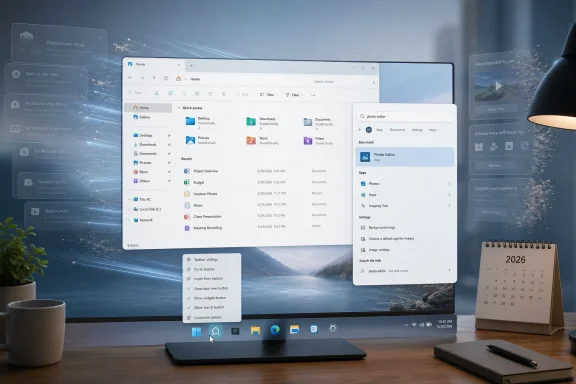 Microsoft Has Finally Found the Problem, Which Is Not the Same as Solving It
The most encouraging thing about Microsoft’s current Windows 11 posture is not any single feature. It is that the company appears to have rediscovered the difference between shipping more Windows and making Windows feel good to use.That distinction matters because Windows 11 has spent much of its life as an operating system that often seemed to confuse activity with progress. New panels arrived. Copilot entry points multiplied. Settings pages changed shape. Widgets grew more insistent. Meanwhile, the daily irritants — sluggish File Explorer, inconsistent context menus, taskbar regressions, Start menu complaints, update anxiety, search embarrassment — remained stubbornly familiar.
For enthusiasts, the past few weeks have felt different because Microsoft’s attention has shifted toward the boring parts of the OS that users actually touch hundreds of times a day. File Explorer speed is not glamorous. A more dependable update pipeline does not make for a dazzling launch trailer. Start menu customization is not an AI keynote moment. But those are exactly the areas where Windows 11 earned its bad name.
That is why the current moment is more important than another feature drop. Microsoft is effectively admitting that Windows 11’s reputation cannot be repaired with novelty. It has to be repaired with craft.
Windows 11 Was Born With a Trust Deficit
Windows 11 did not get a normal first impression. It launched as a visual refresh with unusually sharp hardware requirements, a narrower supported CPU list, TPM 2.0 requirements, and a user interface that removed or complicated behaviors Windows users had built into muscle memory.That would have been easier to sell if the OS had immediately felt faster, cleaner, and more capable than Windows 10. Instead, many users saw a centered taskbar, a simplified Start menu, a redesigned context menu, and a File Explorer that looked modern but did not always feel modern. The pitch was aesthetic; the cost was practical.
The hardware requirements made the resentment worse. Microsoft had credible security arguments for raising the floor, especially as ransomware and firmware-level attacks became harder to ignore. But to a large part of the PC community, Windows 11 looked like a forced march away from perfectly usable hardware at a time when Windows 10 was stable, familiar, and still doing the job.
That early suspicion has never fully left the room. Every later annoyance — every ad-like prompt, every account nudge, every Copilot button, every broken update, every “recommended” tile — landed on top of a belief that Windows 11 was built around Microsoft’s priorities first and the user’s priorities second.
The Windows 10 Comparison Still Haunts Everything
Windows 10 had its own sins. It pushed hard on telemetry, blurred the line between service and operating system, and normalized a more aggressive update cadence. But it also had a clear historical role: it was the repair job after Windows 8.Users understood why Windows 10 existed. It restored the desktop bargain, brought back a Start experience that made sense to mouse-and-keyboard users, and gave Microsoft a platform that felt like a course correction. Even its “last version of Windows” framing, later abandoned in practice, helped sell the idea that Windows 10 was a stable foundation rather than another disruptive redesign.
Windows 11 never had that clean narrative. It did not rescue users from Windows 10. It asked them to leave Windows 10. That made every missing taskbar option and every rough edge feel less like an accident and more like an imposition.
This is the trap Microsoft now faces. Windows 11 has to be judged not only against its launch state, but against the memory of an operating system many users did not want to leave. When the predecessor is not widely hated, the successor has to justify itself every day.
The Taskbar Became the Symbol of a Broader Mistake
The Windows 11 taskbar controversy was never just about dragging icons or moving the bar to the side of the screen. It became a symbol of Microsoft’s willingness to break mature workflows in pursuit of a cleaner surface.Power users tend to be forgiving when complexity is hidden. They are much less forgiving when capability disappears. Windows has always been loved partly because it lets people work in inelegant, personalized, deeply specific ways. When Windows 11 narrowed those options, it felt less like modernization than domestication.
That is why the return of customization matters politically, not just practically. A taskbar that gives users more control tells the audience that Microsoft has started listening to the people who live in the OS, not just the designers who present it.
But the company should not confuse restoration with generosity. Returning expected behaviors after years of complaints does not create instant goodwill. It merely stops the bleeding.
File Explorer Is Where Windows 11’s Polish Claims Went to Die
Nothing exposes an operating system’s priorities like its file manager. File Explorer is not a niche tool. It is the place where ordinary users rename downloads, copy photos, move work documents, unzip archives, browse cloud folders, and discover whether the system feels responsive.Windows 11’s File Explorer has often looked better than it felt. Tabs, visual updates, and OneDrive integration gave it a modern shape, but performance complaints followed it around. Slow launches, inconsistent responsiveness, context menu friction, and dark mode roughness created a sense that Microsoft had renovated the lobby while leaving the plumbing suspect.
That is why reports of serious File Explorer performance work land differently from yet another AI sidebar. If Microsoft can make Explorer reliably fast — not just on a clean Copilot+ PC, but on the mixed fleet of desktops, laptops, docks, network drives, and aging SSDs that make up the real Windows world — it can change the emotional temperature around Windows 11.
Users do not need File Explorer to be exciting. They need it to stop reminding them that the OS is in the way.
Windows Search Is the Joke Microsoft Can No Longer Afford
Windows Search has been a punchline for so long that many users have built entire habits around avoiding it. Some pin everything. Some install third-party launchers. Some use File Explorer workarounds. Some press Start, type an app name, wait a beat, and wonder why the world’s dominant desktop OS is worse at finding a local program than a web browser is at guessing a half-remembered restaurant.Microsoft has tried to make Search more ambitious, but ambition is not the missing ingredient. Reliability is. Users do not want a metaphysical assistant when they type the name of an installed app. They want the thing they typed to appear immediately and open when selected.
The company’s newer search work, especially on modern AI-capable PCs, may eventually make natural-language discovery genuinely useful. But Microsoft must be careful here. If AI search becomes another reason the system feels heavier, cloudier, or less predictable, it will reinforce the very criticism the company is trying to outrun.
The correct order is simple: local first, fast first, trustworthy first. Intelligence can come later.
The Update Story Is Where Consumer Pain Meets Enterprise Fear
For home users, a bad Windows update is an evening ruined. For IT departments, it is a help desk spike, a blocked deployment ring, a rollback meeting, and a fresh reminder that “evergreen” software can mean “ever-anxious” operations.Windows 11’s update reputation has suffered from the accumulation of small failures as much as spectacular ones. A printer issue here, a VPN problem there, a Start menu glitch, a performance regression, a compatibility hold, a known issue rollback, a fixed bug that seems to reappear in another form. Individually, these are the ordinary mess of maintaining an enormous hardware and software ecosystem. Collectively, they teach users to flinch.
That is why Microsoft’s promises around quality, predictability, and control are central to any reputation repair. A better pause experience or more flexible update control is not just a convenience feature. It is an acknowledgment that users and admins need agency when the update train is moving faster than their confidence.
The danger is that Microsoft has made update-quality promises before. Windows as a service was supposed to make delivery smoother. Insider testing was supposed to catch more problems. Telemetry was supposed to reveal real-world failures faster. Those systems may have improved Windows in many ways, but they did not prevent the perception that updates are something done to users.
Rebuilding trust here means fewer dramatic promises and more uneventful months. The best Windows update is the one nobody talks about.
Ads and Prompts Poison the Well Faster Than Bugs
Microsoft’s most self-defeating Windows behavior has not been an isolated bug. It has been the slow conversion of system surfaces into persuasion surfaces.Users can forgive a crash if they believe the vendor is trying to fix it. They are less forgiving when the Start menu, Settings app, lock screen, Edge integration, Microsoft account prompts, OneDrive nags, and subscription suggestions make the OS feel like rented territory. Nothing makes a user more suspicious of an operating system than the sense that every quiet moment is an opportunity for upsell.
This matters because the Windows 11 reputation debate is often framed too narrowly around performance. Speed is necessary, but not sufficient. A fast operating system that keeps nudging users toward services they did not ask for still feels compromised.
Microsoft’s challenge is that Windows is both a product and a distribution channel. The company wants Windows to support Microsoft 365, Copilot, Game Pass, Edge, Bing, OneDrive, and the broader account ecosystem. But the more Windows behaves like a funnel, the less it feels like an operating system users control.
If Microsoft wants people to believe Windows 11 has changed, it will need to show restraint in places where restraint directly conflicts with monetization.
AI Was Never the Core Problem, but It Became the Perfect Scapegoat
The backlash to AI in Windows is not simply anti-AI sentiment. It is a reaction to timing, placement, and trust.Microsoft spent the early Copilot era trying to make AI feel unavoidable at the same time users were asking for basic repairs. That created a brutal contrast. File Explorer was still a sore spot, Search was still unreliable, the Start menu was still contested, and the company appeared to be spending its political capital on buttons, branding, and assistant experiences.
In that environment, even potentially useful AI features were received as evidence of misaligned priorities. Users did not necessarily hate the idea of smarter help, better accessibility, improved search, or local summarization. They hated the feeling that Microsoft was adding a second brain to an OS whose first brain still forgot where the user’s files were.
Toning down AI emphasis, or at least making it more optional and less theatrical, is therefore wise. The company does not have to abandon AI in Windows. It has to stop presenting AI as the answer to complaints that are not about AI.
The future of AI in Windows depends on whether it becomes quiet infrastructure or loud decoration. Quiet infrastructure may win. Loud decoration will keep feeding the meme machine.
Windows 12 Would Not Magically Launder the Brand
The tempting argument is that Microsoft should give up on the Windows 11 name and ship Windows 12 as a giant repair release. There is historical logic to that. Windows 7 helped bury Vista. Windows 10 helped bury Windows 8. A new number can give users permission to reconsider.But a new number only works if the underlying experience is ready. If Windows 12 launches as Windows 11 with a new wallpaper, a new Copilot story, and the same update anxiety, Microsoft will not reset the narrative. It will confirm it.
There is also a practical problem. The PC ecosystem is already living through Windows 10’s end-of-support aftermath, enterprise migration planning, hardware refresh decisions, and AI PC positioning. Introducing another major version too soon could make Microsoft look restless rather than responsive.
The smarter path may be more old-fashioned: turn Windows 11 into the operating system it should have been, then decide whether a future Windows 12 deserves to exist as a genuine platform moment. A brand reset without a product reset is just marketing. A product reset, sustained long enough, can become a brand reset on its own.
Enthusiasts Can Be Won Back Before Normal Users Even Notice
The Neowin poll question captures an enthusiast dilemma: can Microsoft change what people think about Windows 11? Among enthusiasts, yes — and faster than many assume. This audience watches Insider builds, reads changelogs, tests preview features, notices performance deltas, and understands when engineering priorities shift.That makes enthusiasts both harsh critics and early warning sensors. They punished Windows 11 because they could feel what had been removed. They may also be the first group to reward Microsoft if the OS becomes visibly more responsive, more configurable, and less obnoxious.
Normal users are different. They do not follow preview channels. They do not know whether a fix came from Canary, Dev, Beta, Release Preview, or a cumulative update. They simply notice whether their laptop feels faster, whether a prompt interrupts them, whether an update breaks something, whether the Start menu finds what they typed, and whether their PC feels more or less theirs.
This creates a lag between improvement and reputation. Microsoft may ship meaningful repairs in 2026 and still face months of skepticism because the broader public is not judging the latest build. It is judging the last several years.
Enterprise IT Will Believe the Telemetry After It Believes the Help Desk
In business environments, Windows 11’s reputation is less emotional but more consequential. IT departments do not need to love the OS. They need it to behave.Many organizations have already moved, are moving, or must move because Windows 10’s mainstream security era has ended for most users. That migration pressure gives Microsoft a large Windows 11 installed base whether or not the product is beloved. But enterprise adoption is not the same as trust.
Admins care about deployment predictability, policy control, application compatibility, security baselines, driver stability, and user disruption. A prettier Start menu is irrelevant if a monthly update causes tickets to spike. A clever AI feature is a liability if it complicates data governance or confuses users. A performance improvement matters most when it reduces complaints at scale.
This is where Microsoft has a chance to make the Windows 11 repair effort measurable. If update incidents decline, if known issues are handled transparently, if performance improves on existing hardware, and if management controls remain strong, enterprises will respond. They may not applaud publicly, but they will stop treating each release as a threat.
For Microsoft, that quieter form of trust may be more valuable than enthusiast praise.
The Vista Lesson Is Useful, but Only Up to a Point
Windows watchers love historical analogies, and Vista is the obvious one. Vista launched with heavy requirements, driver pain, performance complaints, and a reputation that never recovered. Windows 7 arrived as the refined, faster, more acceptable version of the same broad architectural direction.But Windows 11 is not Vista. It did not fail in the same catastrophic way. It has shipped on hundreds of millions of systems, supports modern security requirements, and is now the default Windows experience for new PCs. Its problem is not that it is unusable. Its problem is that too many users believe it is less respectful than it should be.
That distinction matters. Vista needed rescue from technical and ecosystem immaturity. Windows 11 needs rescue from accumulated distrust.
The fix, then, is less dramatic but more difficult. Microsoft does not merely need to make Windows 11 work. It needs to make Windows 11 feel like the user is the customer again.
The Repair Plan Has to Survive Its Own Success
If Microsoft’s 2026 Windows work succeeds, the company will face a familiar temptation: declare victory and resume the old habits.That would be a mistake. Trust is not rebuilt when File Explorer opens faster in a preview build. It is rebuilt when the stable channel feels better for months, when the next feature wave does not reintroduce clutter, when users stop hunting for registry hacks to undo design decisions, and when IT departments see fewer surprises.
The hardest part of this reset is discipline. Microsoft has no shortage of engineers capable of improving Windows. The question is whether the organization can keep product strategy, growth incentives, AI ambitions, and service promotion from overwhelming the operating system’s basic contract.
Windows should be the place where Microsoft earns permission to offer more, not the place where it assumes permission has already been granted.
The Reputation Meter Will Move Only When the Daily Irritations Disappear
The concrete signs of a real Windows 11 turnaround are not mysterious. They are mundane, testable, and visible in daily use.- File Explorer needs to feel consistently fast on ordinary PCs, not merely improved on fresh installations and premium hardware.
- Windows Search needs to find local apps, settings, and files quickly enough that users stop reaching for third-party replacements.
- The Start menu and taskbar need to restore meaningful choice without making users wait years for behaviors that should never have disappeared.
- Windows Update needs to produce fewer user-visible failures and give people enough control that updates feel managed rather than imposed.
- Microsoft needs to reduce promotional clutter across system surfaces so Windows feels like an OS again, not a billboard for adjacent services.
- AI features need to be useful, optional, and quiet enough that they do not become the new face of old frustrations.
Microsoft can change what people think about Windows 11, but it cannot argue them into it. The company has to make the OS faster, calmer, more configurable, and less thirsty for attention, then keep it that way long enough for the old story to expire. If Windows 11’s next chapter is defined by restraint rather than spectacle, the reputation may yet recover — not with a grand redemption moment, but with the quieter achievement of users opening their PCs each morning and finding fewer reasons to complain.
Source: Neowin Poll: Do you think Microsoft can change what people think about Windows 11?
