

Windows 11 version 24H2 drew a line that Rufus, registry edits, and installer-file swaps cannot cross: PCs whose processors lack the POPCNT and SSE4.2 instruction support cannot boot the operating system at all. XDA’s latest look at the issue is right about the practical distinction, but the “dangerous precedent” is more complicated than a new Microsoft policy switch.
For years, Windows 11’s most controversial requirements—TPM 2.0, Secure Boot, RAM, storage, and Microsoft’s supported-CPU list—were mostly enforced during setup and upgrade assessment. That left room for tools such as Rufus, as well as manual installation methods, to suppress or bypass compatibility checks. The resulting Windows installation remained unsupported, but it ran.
The 24H2 barrier is fundamentally different. A processor missing the requisite instructions cannot execute code that Windows now expects from the earliest stages of startup. There is no installer screen to modify if the boot environment or kernel itself cannot run on the hardware.
Microsoft’s own Windows telemetry documentation acknowledges POPCNT as a processor requirement for newer Windows releases, while the company’s compatibility materials separately track SSE4.2 support. Reporting from Tom’s Hardware and other outlets established in 2024 that the restriction had appeared in Insider builds before the Windows 11 2024 Update reached general availability on October 1, 2024.
That makes this a real compatibility floor—not merely another warning dialog users can click past.
The Windows 11 launch requirements generated lasting confusion because “unsupported” has covered several very different situations. A seventh-generation Intel Core processor, for example, may be capable of running Windows 11 smoothly while being outside Microsoft’s official supported CPU list. A machine without TPM 2.0 might still be able to install Windows 11 after an installer bypass.
Neither condition means the CPU is incapable of running the OS. It means Microsoft does not want to certify, support, or necessarily update that configuration.
POPCNT and SSE4.2 move the question down another layer. POPCNT—short for population count—is a CPU instruction used to count the number of set bits in a value. SSE4.2 is a set of processor extensions that became common on mainstream x86 PCs long before Windows 11 existed. Windows 11 24H2 now assumes that baseline exists.
The practical impact is limited to genuinely old systems. Intel’s first-generation Core processors generally support the needed instructions, as do AMD FX-era processors and newer hardware. The systems at risk tend to be pre-2008 Intel Core 2 machines, early AMD platforms, and some unusual legacy installations that were already far beyond Microsoft’s official Windows 11 support boundary.
That does not make the lockout imaginary. It does mean that it is not a fresh obstacle for the typical 2015 desktop that fails Windows 11’s official CPU-generation test. Many of those ostensibly unsupported PCs still have POPCNT and SSE4.2, and can run 24H2 or later releases if their owners accept the support trade-offs.
Once a Windows component includes an instruction that the processor does not implement, the processor cannot simply continue. The machine faults or fails early in startup. Replacing setup files, changing registry values under
That is why calling the 24H2 block “unbreakable” needs a small qualification. In computing, almost nothing is metaphysically impossible: emulation, virtualization, source-level changes, or extensive binary patching can sometimes make old hardware run software it was never meant to run. But none of those approaches is a realistic path to a stable, updateable, bare-metal Windows 11 system for ordinary users or enterprise administrators.
For real-world purposes, the wall is solid. A PC without the instruction support should be treated as unable to run Windows 11 24H2, Windows 11 25H2, or any release that retains the same execution baseline.
A modern operating system must eventually assume certain hardware capabilities. Otherwise, every kernel, driver, compiler target, test suite, and security feature inherits a permanent compatibility burden. The decisive question is not whether Microsoft can establish a hard floor; it is whether the company uses one responsibly, with long notice periods and a threshold that maps to meaningful technical needs.
So far, the evidence does not show a rolling campaign of new unbootable Windows 11 requirements. The POPCNT restriction emerged with 24H2 in 2024. Microsoft’s current Windows release information lists Windows 11 version 25H2 as the mainstream feature update for existing devices, while version 26H1 is scoped for new PCs and is not offered as an in-place update from 24H2 or 25H2. There has been no comparable public announcement that 25H2 imposed another CPU-instruction barrier on otherwise bootable 24H2 devices.
That is important context. The hard baseline did not turn into an annual forced-retirement mechanism over the following two years.
Microsoft’s official supported processor lists still remain far narrower than the POPCNT/SSE4.2 floor. In other words, the company continues to distinguish between devices it will officially validate and devices that are technically capable of booting a current Windows 11 release. Enthusiasts retain room to run Windows 11 on many unsupported-but-modern-enough systems, even if Microsoft offers no guarantee of updates or support.
That risk already exists in softer forms. Virtualization-based security, Memory Integrity, Windows Hello enhancements, Copilot+ PC features, and AI acceleration each have hardware implications. Most are optional or feature-specific today. The concern begins when a formerly optional capability becomes a kernel or servicing prerequisite.
Administrators should separate three groups rather than treat every “unsupported Windows 11 PC” as the same problem:
The more immediate lesson is that installer success is no longer enough to judge upgrade feasibility. Before approving a 24H2-or-later image for legacy hardware, administrators and enthusiasts should verify CPU instruction support—not just TPM status, Secure Boot settings, and the PC Health Check result.
Microsoft has room to avoid the precedent becoming hostile. It can publish hardware-baseline changes early, explain the engineering rationale, and preserve predictable support windows. For now, POPCNT and SSE4.2 remain a floor aimed at hardware old enough that replacement planning was already overdue. The next true test will be whether a future Windows release raises that floor against machines that are still common, secure, and productive.
For years, Windows 11’s most controversial requirements—TPM 2.0, Secure Boot, RAM, storage, and Microsoft’s supported-CPU list—were mostly enforced during setup and upgrade assessment. That left room for tools such as Rufus, as well as manual installation methods, to suppress or bypass compatibility checks. The resulting Windows installation remained unsupported, but it ran.
The 24H2 barrier is fundamentally different. A processor missing the requisite instructions cannot execute code that Windows now expects from the earliest stages of startup. There is no installer screen to modify if the boot environment or kernel itself cannot run on the hardware.
Microsoft’s own Windows telemetry documentation acknowledges POPCNT as a processor requirement for newer Windows releases, while the company’s compatibility materials separately track SSE4.2 support. Reporting from Tom’s Hardware and other outlets established in 2024 that the restriction had appeared in Insider builds before the Windows 11 2024 Update reached general availability on October 1, 2024.
That makes this a real compatibility floor—not merely another warning dialog users can click past.
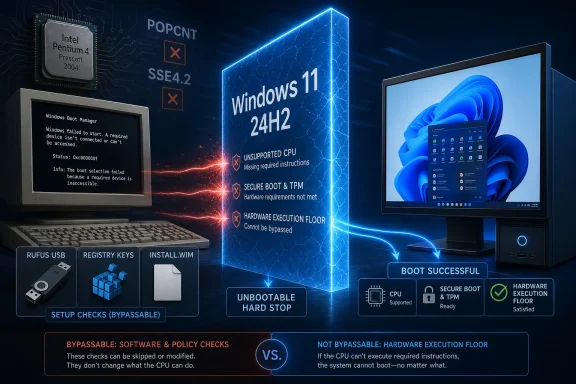 The Difference Between Unsupported and Unbootable
The Windows 11 launch requirements generated lasting confusion because “unsupported” has covered several very different situations. A seventh-generation Intel Core processor, for example, may be capable of running Windows 11 smoothly while being outside Microsoft’s official supported CPU list. A machine without TPM 2.0 might still be able to install Windows 11 after an installer bypass.Neither condition means the CPU is incapable of running the OS. It means Microsoft does not want to certify, support, or necessarily update that configuration.
POPCNT and SSE4.2 move the question down another layer. POPCNT—short for population count—is a CPU instruction used to count the number of set bits in a value. SSE4.2 is a set of processor extensions that became common on mainstream x86 PCs long before Windows 11 existed. Windows 11 24H2 now assumes that baseline exists.
The practical impact is limited to genuinely old systems. Intel’s first-generation Core processors generally support the needed instructions, as do AMD FX-era processors and newer hardware. The systems at risk tend to be pre-2008 Intel Core 2 machines, early AMD platforms, and some unusual legacy installations that were already far beyond Microsoft’s official Windows 11 support boundary.
That does not make the lockout imaginary. It does mean that it is not a fresh obstacle for the typical 2015 desktop that fails Windows 11’s official CPU-generation test. Many of those ostensibly unsupported PCs still have POPCNT and SSE4.2, and can run 24H2 or later releases if their owners accept the support trade-offs.
Rufus Can Change Setup, Not Rewrite Silicon
Rufus remains useful because it can create Windows installation media that removes or relaxes checks for TPM, Secure Boot, Microsoft account sign-in, and supported CPU families. That is an intervention in the deployment path. It is not CPU emulation.Once a Windows component includes an instruction that the processor does not implement, the processor cannot simply continue. The machine faults or fails early in startup. Replacing setup files, changing registry values under
LabConfig, or using an older appraiser DLL does not alter the instructions inside the Windows kernel and boot components.That is why calling the 24H2 block “unbreakable” needs a small qualification. In computing, almost nothing is metaphysically impossible: emulation, virtualization, source-level changes, or extensive binary patching can sometimes make old hardware run software it was never meant to run. But none of those approaches is a realistic path to a stable, updateable, bare-metal Windows 11 system for ordinary users or enterprise administrators.
For real-world purposes, the wall is solid. A PC without the instruction support should be treated as unable to run Windows 11 24H2, Windows 11 25H2, or any release that retains the same execution baseline.
Microsoft Has Not Used the New Floor to Cull Modern PCs
This is where XDA’s precedent argument deserves scrutiny. Microsoft has proven that it can raise a Windows hardware baseline in a way users cannot bypass with installation media. That matters. But Windows already has architectural baselines, and it cannot indefinitely preserve support for every CPU instruction set ever sold.A modern operating system must eventually assume certain hardware capabilities. Otherwise, every kernel, driver, compiler target, test suite, and security feature inherits a permanent compatibility burden. The decisive question is not whether Microsoft can establish a hard floor; it is whether the company uses one responsibly, with long notice periods and a threshold that maps to meaningful technical needs.
So far, the evidence does not show a rolling campaign of new unbootable Windows 11 requirements. The POPCNT restriction emerged with 24H2 in 2024. Microsoft’s current Windows release information lists Windows 11 version 25H2 as the mainstream feature update for existing devices, while version 26H1 is scoped for new PCs and is not offered as an in-place update from 24H2 or 25H2. There has been no comparable public announcement that 25H2 imposed another CPU-instruction barrier on otherwise bootable 24H2 devices.
That is important context. The hard baseline did not turn into an annual forced-retirement mechanism over the following two years.
Microsoft’s official supported processor lists still remain far narrower than the POPCNT/SSE4.2 floor. In other words, the company continues to distinguish between devices it will officially validate and devices that are technically capable of booting a current Windows 11 release. Enthusiasts retain room to run Windows 11 on many unsupported-but-modern-enough systems, even if Microsoft offers no guarantee of updates or support.
The Bigger Risk Is Silent Dependency Growth
The concern for IT professionals is not that an old Core 2 Duo can no longer be revived with a customized 24H2 USB stick. It is the possibility that important Windows features may increasingly acquire dependencies on newer CPU capabilities, security features, or firmware behavior without a clean, visible lifecycle policy for unsupported fleets.That risk already exists in softer forms. Virtualization-based security, Memory Integrity, Windows Hello enhancements, Copilot+ PC features, and AI acceleration each have hardware implications. Most are optional or feature-specific today. The concern begins when a formerly optional capability becomes a kernel or servicing prerequisite.
Administrators should separate three groups rather than treat every “unsupported Windows 11 PC” as the same problem:
- PCs outside Microsoft’s supported CPU list but with POPCNT and SSE4.2 can generally remain viable from a technical boot perspective, though they remain unsupported configurations.
- PCs able to run Windows 11 23H2 but lacking POPCNT or SSE4.2 have reached a genuine architectural endpoint at 24H2.
- PCs still on Windows 10 need a retirement or extended-support strategy that does not assume Windows 11 can be installed on every asset.
A Hard Floor Needs a Clearer Contract
Windows 11 24H2 did establish something new in practice: the first widely visible Windows 11 restriction where bypassing the compatibility assessment does not help because the operating system requires processor functionality at runtime. But it is not evidence, by itself, that Microsoft is preparing to strand otherwise capable Windows 11 PCs every year.The more immediate lesson is that installer success is no longer enough to judge upgrade feasibility. Before approving a 24H2-or-later image for legacy hardware, administrators and enthusiasts should verify CPU instruction support—not just TPM status, Secure Boot settings, and the PC Health Check result.
Microsoft has room to avoid the precedent becoming hostile. It can publish hardware-baseline changes early, explain the engineering rationale, and preserve predictable support windows. For now, POPCNT and SSE4.2 remain a floor aimed at hardware old enough that replacement planning was already overdue. The next true test will be whether a future Windows release raises that floor against machines that are still common, secure, and productive.
References
- Primary source: XDA
Published: 2026-07-17T00:00:10+00:00
For the first time, Windows 11 has a wall that workarounds can't break, and it sets a dangerous precedent
Windows 11's system requriements used to be easy to bypass, but Microsoft has found a way to lock old PCs out for good. www.xda-developers.com