

Microsoft’s new Windows 11 build landed in early 2026, but for most people it isn’t an update at all — it’s a factory image for a narrow set of new ARM PCs and will not be offered through Windows Update to existing Intel or AMD machines. (learn.microsoft.com)
Windows releases have, for years, followed a clear cadence: feature updates in the second half of the year (H2) with servicing and quality updates in between. The recent announcement and Canary-channel testing around Windows 11, version 26H1 breaks that expectation in an important way. Microsoft has explicitly described 26H1 as a hardware‑optimized, platform release that will be available exclusively as a preinstalled experience on select new devices beginning in early 2026. The company clarifies that 26H1 “is not intended as a feature update for existing devices and will not be offered through Windows Update.” (learn.microsoft.com)
Internally the branch is being reported under the platform codename Bromine, and Canary builds for this branch show visible version strings at the build range beginning with 28000. That numeric shift — from the 261xx–262xx builds used for 24H2/25H2 up to the 28000 series — signals that Microsoft has created a platform baseline that is architecturally distinct from the Germanium platform used by recent H2 feature releases.
Why the change? The short answer is scheduling and technical necessity: new ARM‑based SoCs (notably Qualcomm’s Snapdragon X2 family) require deep, low‑level OS changes — kernel, scheduler, power management, NPU runtimes and attestation hooks — that are risky or impractical to bolt into the mainstream servicing branch while OEMs need a validated, factory‑flashable image for devices that must ship. Microsoft’s approach preserves the annual H2 feature cadence for the broad Windows population while letting OEMs ship new silicon on a Bromine/26H1 image that already includes the required plumbing.
Not eligible (initial scenario):
These dates mean 26H1 carries a normal Microsoft Modern Lifecycle-style support window despite being a device‑scoped image; devices shipped with Bromine will continue to receive monthly quality and security updates while following their own servicing lane until the platform tracks are unified in a future release. Microsoft has said those devices will have an upgrade path in a later Windows release, but the company has not tied the migration to a specific version number in public documentation. That lack of a concrete migration plan is a planning uncertainty for IT teams. (learn.microsoft.com)
For most users: this is low‑impact. If your PC is Intel or AMD today, you will see no immediate change in how updates are delivered and you should continue to treat 24H2/25H2 as the mainstream servicing baseline. For enterprise purchasers and early ARM buyers: treat Bromine devices as a distinct category — test thoroughly, confirm OEM support, and demand explicit migration and lifecycle guarantees before adopting at scale. (learn.microsoft.com)
Microsoft has provided the technical rationale: new silicon with different instruction sets, NPUs and firmware flows require platform‑level changes that are best validated in a device‑scoped image. That explanation is solid — but the success of Bromine will hinge on the clarity of migration guidance, the quality of OEM co‑validation, and Microsoft’s ability to avoid long‑term servicing divergence. The next big test will be the 26H2/H2 consumer release later in 2026 and how seamless Microsoft makes the eventual unification (if and when it arrives) between Bromine devices and the broader Windows ecosystem.
Conclusion
Windows 11 version 26H1 is real, but it is not the universal feature update its name implies — it’s a targeted platform image to enable a new generation of ARM silicon. That makes it important for OEMs and early ARM adopters, but largely irrelevant for the majority of Windows users today. If you’re managing fleets or buying hardware, treat Bromine devices as a special case: validate, demand clarity, and don’t postpone mainstream procurement decisions expecting a cross‑cutting consumer feature set from 26H1. (learn.microsoft.com)
Source: MakeUseOf Windows 11 version 26H1 is here already, but you probably can't install it
 Background / Overview
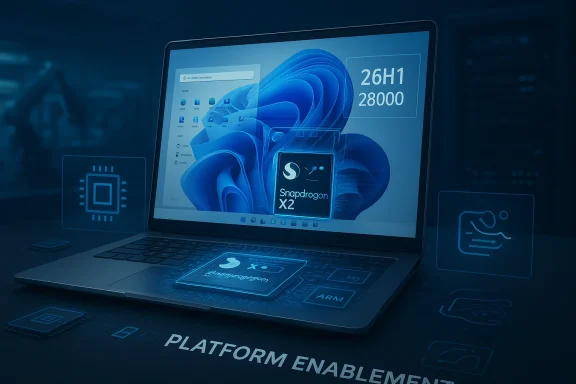
Windows releases have, for years, followed a clear cadence: feature updates in the second half of the year (H2) with servicing and quality updates in between. The recent announcement and Canary-channel testing around Windows 11, version 26H1 breaks that expectation in an important way. Microsoft has explicitly described 26H1 as a hardware‑optimized, platform release that will be available exclusively as a preinstalled experience on select new devices beginning in early 2026. The company clarifies that 26H1 “is not intended as a feature update for existing devices and will not be offered through Windows Update.” (learn.microsoft.com)Internally the branch is being reported under the platform codename Bromine, and Canary builds for this branch show visible version strings at the build range beginning with 28000. That numeric shift — from the 261xx–262xx builds used for 24H2/25H2 up to the 28000 series — signals that Microsoft has created a platform baseline that is architecturally distinct from the Germanium platform used by recent H2 feature releases.
Why the change? The short answer is scheduling and technical necessity: new ARM‑based SoCs (notably Qualcomm’s Snapdragon X2 family) require deep, low‑level OS changes — kernel, scheduler, power management, NPU runtimes and attestation hooks — that are risky or impractical to bolt into the mainstream servicing branch while OEMs need a validated, factory‑flashable image for devices that must ship. Microsoft’s approach preserves the annual H2 feature cadence for the broad Windows population while letting OEMs ship new silicon on a Bromine/26H1 image that already includes the required plumbing.
What 26H1 actually is — and is not
- 26H1 is a platform enablement build: under‑the‑hood plumbing to support specific new silicon, not a consumer feature wave. (learn.microsoft.com)
- It’s OEM‑shipped and factory‑installed on qualifying new devices, starting with certain Snapdragon X2 SKUs. Existing devices on 24H2 or 25H2 will not be offered 26H1 through Windows Update. (learn.microsoft.com)
- The visible experience for users (UI, feature set) is largely the same as 25H2 — most changes live in kernel/subsystem layers rather than surface features. Independent reporting confirms feature parity for now while highlighting substantial platform-level work.
- Build numbers for Bromine/26H1 are in the 28000 series; Microsoft’s release history lists OS build 28000.1575 as a February 2026 patch.
Why ARM silicon forces a different OS baseline
Modern ARM SoCs deployed in Windows devices are not simply “another CPU.” They combine heterogeneous core layouts, NPUs (neural processing units), distinct firmware attestation models, and mobile-derived power/thermal behaviors that diverge from decades of x86 tuning. The Bromine branch addresses these structural differences in ways that incremental servicing patches would struggle to do safely.Key technical reasons Bromine exists
- Heterogeneous core scheduling: Many ARM SoCs use a variant of the big.LITTLE or bi.LITTLE topology — several efficiency cores paired with higher‑performance cores. Scheduling decisions (which thread runs where) live in the OS kernel and must be re‑tuned for those specific core arrangements to avoid performance and battery anomalies.
- Power and thermal governance: ARM laptop silicon borrows mobile power management paradigms: aggressive sleep states, rapid clock ramping, and fine‑grained power gating. Coordinating CPU, GPU, NPU, radios and peripherals requires new governors and telemetry hooks the stock Germanium baseline wasn’t built to expect.
- NPU runtimes and attestation: On‑device AI workloads require trusted execution, signed model manifests, and secure runtime stacks. These surface new kernel and driver interfaces that must be tested and validated with OEM firmware and silicon vendors. Bromine creates a validated path for those runtime stacks to exist safely on shipping devices.
- Driver and platform bundles: New GPUs, ISPs, and media pipelines for these SoCs often ship with vendor‑specific DCH driver bundles and firmware — the Bromine image allows Microsoft and OEMs to bind those driver packages, WHCP/HLK validation, and attestation rules into a factory image that won’t be pushed to incompatible hardware. (learn.microsoft.com)
Who will get 26H1 (initially) — and who won’t
Microsoft’s published guidance and industry reporting align: the initial wave of 26H1 devices are ARM laptops using Qualcomm’s new Snapdragon X2 platform. Early reporting and OEM briefings identify multiple X2 variants planned for launch (commonly referenced as X2 Plus, X2 Elite, and X2 Elite Extreme), and Microsoft’s support text explicitly ties 26H1 to “next‑generation silicon” from partners. (learn.microsoft.com)Not eligible (initial scenario):
- Most existing Intel and AMD PCs.
- First‑generation ARM Copilot+ devices that used earlier Snapdragon silicon.
- Any PC not factory‑flashed with the Bromine/26H1 image.
- New OEM SKUs that ship with Bromine/26H1 factory images, primarily Snapdragon X2‑based laptops shipping in early 2026.
Lifecycle and servicing — concrete dates you should know
Microsoft’s lifecycle pages include explicit dates for 26H1. The version’s availability date is listed as 2026‑02‑10, and the Home/Pro servicing cutoff is shown as 2028‑03‑14. Enterprise and Education editions have a longer servicing window, ending 2029‑03‑13. These are real, published support anchors organizations should consider when procuring hardware or planning refresh cycles.These dates mean 26H1 carries a normal Microsoft Modern Lifecycle-style support window despite being a device‑scoped image; devices shipped with Bromine will continue to receive monthly quality and security updates while following their own servicing lane until the platform tracks are unified in a future release. Microsoft has said those devices will have an upgrade path in a later Windows release, but the company has not tied the migration to a specific version number in public documentation. That lack of a concrete migration plan is a planning uncertainty for IT teams. (learn.microsoft.com)
Practical guidance: consumers, power users and IT admins
If you manage devices or buy PCs for work, these are the practical takeaways.For consumers and everyday users
- If you own an Intel or AMD laptop today, you will not receive 26H1 via Windows Update and nothing about your current servicing lane changes. Stay on 24H2 or 25H2 and expect the normal H2 feature release later in 2026. (learn.microsoft.com)
- If you are shopping for a new ultra‑portable ARM laptop and the vendor advertises 26H1 out of the box, that’s expected — but don’t assume that means more consumer features. 26H1’s value is platform enablement for the device’s silicon.
For IT administrators and procurement teams
- Don’t delay purchases of mainstream Intel/AMD hardware waiting for 26H1 — it’s not a broad feature rollout and Microsoft explicitly recommends 24H2/25H2 for enterprise deployments. (learn.microsoft.com)
- If you plan to buy X2‑based devices, ask OEMs which Windows image ships on the SKU, whether it’s Bromine/26H1, and get written answers about driver, firmware and vendor support commitments. Treat 26H1 devices as a separate endpoint class for the near term.
- Validate images in a lab. If you intend to deploy Bromine devices into production, test image compatibility with imaging/MDM tools, enterprise software, AV, and driver update flows before large rollouts. Bromine’s different core could interact unexpectedly with edge tools.
- Plan for mixed fleets. Until Microsoft publicly documents a migration/unification approach, assume Bromine devices will follow a separate servicing path and plan patching and compliance monitoring accordingly.
Benefits and the upside
- Faster OEM time‑to‑market: Bromine allows OEMs to ship devices on the vendor’s hardware schedule without waiting for an H2 mainstream release. That reduces delays for products with new silicon.
- Tighter co‑validation: Factory images let OEMs, silicon vendors, and Microsoft co‑validate firmware, drivers, and attestation flows, reducing the likelihood of day‑one driver breakage on the target SKUs.
- Platform readiness for on‑device AI: Bromine’s added hooks for NPU runtimes and attestation pave the way for secure, local AI features at the silicon level, which many vendors see as strategically important.
Risks, friction points and why this matters beyond early adopters
While the tactical reasons for Bromine are rational, the decision carries real risks that affect users, IT teams, and the wider Windows ecosystem.Fragmentation and support complexity
Splitting the platform baseline creates two concurrent servicing lanes with different build numbers, driver mixes and validation matrices. That increases the scope of QA Microsoft and OEMs must run and can create confusion in help desks and enterprise support workflows. Expect device drivers and security tooling that assume one kernel baseline to encounter compatibility gaps early on.Upgrade path ambiguity
Microsoft has stated Bromine devices will have a path to update in a future release, but the company hasn’t published a detailed migration mechanism. Organizations need clarity: will migration be an in‑place conversion, a reimage, or a special migration package? The lack of specifics complicates procurement and long‑term lifecycle planning. (learn.microsoft.com)Patch‑timing and divergence risk
Running two platform histories can introduce timing discrepancies in patch availability and the sequencing of security hardening. While Microsoft will publish monthly updates for Bromine, the coordination cost across OEM and silicon partners is higher and could expose transient windows of uneven coverage if not carefully managed.Perception and marketing confusion
The 26H1 label suggests a first‑half feature release, and the name alone has already caused confusion among consumers and some press outlets. Microsoft’s decision to reuse the H1/H2 style while running a platform‑scoped image risks miscommunication. Clear OEM messaging will be vital to prevent customer support headaches.How to test 26H1 safely (short checklist)
- Obtain a vendor‑shipped Bromine/26H1 device from OEM evaluation channels rather than trying to shoehorn Canary builds onto production machines.
- Validate imaging and MDM enrollment flows, driver updates, and AV/endpoint security tooling in a controlled lab.
- Run representative application workloads — especially those that touch GPU, media, USB, and networking stacks — to reveal driver or firmware edge cases.
- Verify patching and telemetry flows for compliance reporting and integration into existing SCCM/Intune processes.
Final assessment — what this decision says about Microsoft’s approach to silicon
Microsoft’s Bromine/26H1 move is a pragmatic engineering response to a new era where silicon timelines and OS assumptions diverge. It’s a sign that Windows is still negotiating the balance between supporting a wide hardware base and enabling rapid innovation on specific platforms (especially AI‑centric ARM chips). The approach reduces the risk of shipping unvalidated hardware, but it raises legitimate concerns about fragmentation, lifecycle complexity, and upgrade transparency.For most users: this is low‑impact. If your PC is Intel or AMD today, you will see no immediate change in how updates are delivered and you should continue to treat 24H2/25H2 as the mainstream servicing baseline. For enterprise purchasers and early ARM buyers: treat Bromine devices as a distinct category — test thoroughly, confirm OEM support, and demand explicit migration and lifecycle guarantees before adopting at scale. (learn.microsoft.com)
Microsoft has provided the technical rationale: new silicon with different instruction sets, NPUs and firmware flows require platform‑level changes that are best validated in a device‑scoped image. That explanation is solid — but the success of Bromine will hinge on the clarity of migration guidance, the quality of OEM co‑validation, and Microsoft’s ability to avoid long‑term servicing divergence. The next big test will be the 26H2/H2 consumer release later in 2026 and how seamless Microsoft makes the eventual unification (if and when it arrives) between Bromine devices and the broader Windows ecosystem.
Conclusion
Windows 11 version 26H1 is real, but it is not the universal feature update its name implies — it’s a targeted platform image to enable a new generation of ARM silicon. That makes it important for OEMs and early ARM adopters, but largely irrelevant for the majority of Windows users today. If you’re managing fleets or buying hardware, treat Bromine devices as a special case: validate, demand clarity, and don’t postpone mainstream procurement decisions expecting a cross‑cutting consumer feature set from 26H1. (learn.microsoft.com)
Source: MakeUseOf Windows 11 version 26H1 is here already, but you probably can't install it
