

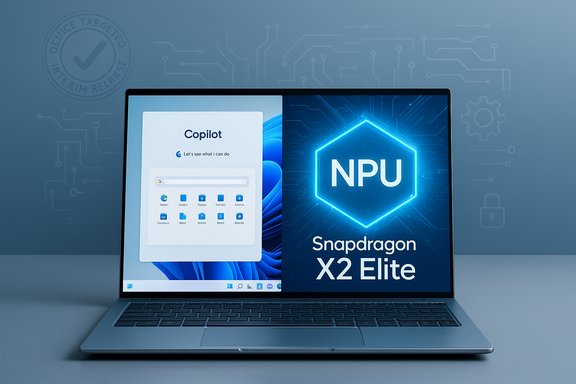
Microsoft appears to be preparing a device‑targeted interim Windows release — widely reported in community channels as “26H1” — that would arrive early in 2026 on Qualcomm’s new Snapdragon X2‑powered Copilot+ laptops, delivering tuned drivers, Hexagon NPU runtimes and other platform changes first on certified hardware while the broader Windows fleet receives the same user‑facing features later in the normal H2 cadence.
The rumor thread tying Windows “26H1” to Snapdragon X2 began when community investigators discovered an internal servicing artifact — a Known Issue Rollback (KIR) token associated with Microsoft’s October 2025 cumulative update (KB5066791) — that appears to reference a Windows 11 branch labeled in a machine‑readable string as something like SUPPORTED_Windows_11_0_26H1_Only. That breadcrumb, combined with Canary‑channel flight metadata that points at a “br_release” (Bromine) lab and 27xxx builds, generated a credible engineering signal: Microsoft is actively working on a Bromine/26H1 branch inside its engineering pipelines. Treat the internal token as strong operational evidence but not a consumer announcement; Microsoft has not published a public statement naming or committing to a consumer release called Windows 11 26H1. Qualcomm’s Snapdragon X2 Elite and X2 Elite Extreme family — unveiled at the Snapdragon Summit and positioned for premium Windows laptops — is the alleged hardware trigger. Qualcomm publicly marketed the X2 family with dramatic on‑device AI figures (headline Hexagon NPU numbers around 80 TOPS in vendor materials) and aggressive CPU/GPU claims, and multiple independent outlets reported first‑wave devices will appear in the first half of 2026. Those hardware changes (bigger NPUs, new Oryon CPU cores, revised GPU stacks and memory/I/O changes) create genuine integration work for Windows, OEMs and driver stacks, which is the practical rationale for a device‑targeted platform image.
Microsoft’s servicing machinery gives the company the technical tools to ship platform‑specific images and then broaden feature exposure later, and Qualcomm’s Snapdragon X2 claims supply a plausible hardware motive for such an approach. The crucial point for readers, buyers and IT pros is to treat the 26H1 signals as credible engineering evidence but not to conflate them with a customer‑facing, final product commitment. Verify OEM shipping images, insist on clear SKU/servicing metadata, and plan pilot validation before making procurement or deployment decisions.
Conclusion: the Windows ecosystem may be about to get a controlled, hardware‑first testbed for richer on‑device AI — a sensible engineering move if done transparently and with enterprise‑grade documentation. If Microsoft and partners communicate clearly, an X2 device rollout could deliver meaningful local AI benefits while staying manageable for enterprises and ISVs; if they do not, the result could be confusion, fractured experiences and unnecessary support load.
Source: iHeart WW 957: Selectively Transparent - Windows 26H1 Aims For Snapdragon X2 PCs - Windows Weekly (Audio) | iHeart
 Background / Overview
The rumor thread tying Windows “26H1” to Snapdragon X2 began when community investigators discovered an internal servicing artifact — a Known Issue Rollback (KIR) token associated with Microsoft’s October 2025 cumulative update (KB5066791) — that appears to reference a Windows 11 branch labeled in a machine‑readable string as something like SUPPORTED_Windows_11_0_26H1_Only. That breadcrumb, combined with Canary‑channel flight metadata that points at a “br_release” (Bromine) lab and 27xxx builds, generated a credible engineering signal: Microsoft is actively working on a Bromine/26H1 branch inside its engineering pipelines. Treat the internal token as strong operational evidence but not a consumer announcement; Microsoft has not published a public statement naming or committing to a consumer release called Windows 11 26H1. Qualcomm’s Snapdragon X2 Elite and X2 Elite Extreme family — unveiled at the Snapdragon Summit and positioned for premium Windows laptops — is the alleged hardware trigger. Qualcomm publicly marketed the X2 family with dramatic on‑device AI figures (headline Hexagon NPU numbers around 80 TOPS in vendor materials) and aggressive CPU/GPU claims, and multiple independent outlets reported first‑wave devices will appear in the first half of 2026. Those hardware changes (bigger NPUs, new Oryon CPU cores, revised GPU stacks and memory/I/O changes) create genuine integration work for Windows, OEMs and driver stacks, which is the practical rationale for a device‑targeted platform image. What the 26H1 scenario actually says — engineering facts vs. public claims
The core engineering signal
- An internal KIR artifact tied to KB5066791 contains a token that reads like a Windows 11 26H1 identifier; community investigators extracted and publicized that artifact. That is an engineering breadcrumb, not a PR release.
- Microsoft’s servicing model supports this pattern: the company routinely ships feature binaries in the servicing stream and uses small enablement packages (eKBs) or targeted servicing to flip features on for qualifying devices later. The enablement‑package model is a documented Microsoft practice and the technical mechanism that makes a device‑targeted preview feasible without shipping a wholly separate servicing trunk.
What the rumor does not prove
- The presence of an internal tag does not prove Microsoft will publicly market a product called “Windows 11 26H1,” nor does it guarantee the final distribution mechanics, feature set or timing. Microsoft can (and often does) rename branches, rewrite servicing metadata, or consolidate work into the next H2 release before any public announcement. Consider the 26H1 label a plausible but unconfirmed engineering milestone.
Why Microsoft might ship a device‑targeted build for Snapdragon X2
The technical case for a narrow, OEM‑tied image is straightforward:- New silicon generations require vendor‑validated DCH drivers, tuned firmware/ISP stacks, and new runtime libraries (especially NPU/Hexagon runtimes) that must be co‑engineered between Microsoft, Qualcomm and OEMs to avoid early‑ship regressions.
- On‑device AI features (Copilot+, Recall‑style indexing, local agents, privacy‑sensitive inferences) depend on secure attestation, signed model manifests and stable NPU runtimes. Validating those chains on a controlled set of certified hardware reduces risk and helps preserve Microsoft’s privacy/performance promises.
- A device‑gated image simplifies retail launches: OEMs can ship a tested image preloaded with drivers and enabled (or pre‑enabled) hardware‑dependent features while Microsoft holds the broader enablement flag until the ecosystem proves stable.
Snapdragon X2: verified specs and what they mean for Windows on Arm
Key vendor claims about the X2 family — corroborated in independent press coverage — include:- A redesigned CPU complex built on a modern 3‑nm‑class process and new Oryon microarchitecture, scaling to as many as 18 cores on top SKUs.
- Aggressive single‑thread boost claims for select SKUs (vendor slides referenced boost clocks up to ~5.0 GHz on top bins in initial coverage). Treat boost‑clock claims as vendor‑provided until independent benchmarks appear on retail devices.
- A dramatically larger Hexagon NPU marketed at roughly 80 TOPS (INT8) for higher‑throughput on‑device model execution compared with prior Snapdragon X parts. Independent outlets reproduced Qualcomm’s slides and echoed the 80 TOPS headline figure. That NPU scale is the main justification for gating certain on‑device AI features to X2 hardware, since local inference workloads will run far more effectively on an 80‑TOPS NPU than on earlier or smaller NPUs.
- Memory and I/O upgrades (LPDDR5x, higher bandwidth figures reported in vendor slides) and improved Adreno X2 GPU performance per watt claims.
What 26H1 would likely contain — realistic technical expectations
If Microsoft ships a device‑targeted 26H1 image for Snapdragon X2 laptops, engineering work will concentrate on platform enablement rather than broad UI redesign. Expect:- Device and vendor driver bundles tuned to X2 thermal/power profiles (GPU, NPU runtime, Wi‑Fi 7 / FastConnect stacks, storage controllers and ISP/camera firmwares).
- Hexagon NPU runtimes, secure model manifests, attestation hooks and on‑device model orchestration logic that let Windows schedule sensitive inference tasks locally.
- Compatibility and emulation fixes for Windows on Arm, including improvements to x64 translation paths, AVX emulation tuning, and workarounds for anticheat/DRM that commonly trouble first‑wave Arm laptops.
- Servicing metadata and tiny enablement packages (eKBs) or device‑targeted updates that can flip features on for certified X2 SKUs without forcing a full servicing branch split.
Risks, fragmentation and messaging hazards
A device‑first 26H1 offers advantages but also visible downsides:- Fragmentation and perception risk. Public headlines using “Windows 26H1” could mislead consumers and IT teams who expect a universal update. Microsoft must explain clearly which devices get what and when. Poor messaging creates help‑desk load spikes and social backlash.
- Operational complexity for enterprises. Device‑targeted images complicate WSUS/Intune reporting and asset inventory unless OEMs and Microsoft provide distinct SKU metadata and clear servicing catalogs. IT departments need advance notice, KIR/GPO details, and guidance for pilot rings.
- Early driver/firmware regressions. First waves frequently surface corner cases (biometrics, docking, security agents). Expect more rapid firmware/driver updates for early adopters and additional validation overhead for enterprise pilots.
- Privacy and feature‑parity nuance. Heavy NPU workloads that run locally on X2 devices may fall back to cloud execution or reduced local modes on older hardware — changing latency and privacy properties. Compliance and legal teams must audit where data is processed.
- Perception of two‑tier access. Consumers and businesses sensitive to feature parity could view early X2 access as preferential treatment. Messaging and clear upgrade paths to reach parity in 26H2 are essential.
How this should change buying, deployment and developer decisions
For consumers and early adopters
- If your top priority is the absolute earliest on‑device AI (low latency, local Copilot+ experiences), an X2‑powered Copilot+ laptop may deliver the best day‑one experience — but expect more frequent firmware updates and early driver churn.
- If you prefer rock‑solid stability, wait for the broader 26H2 rollout (or for several weeks/months of field telemetry on X2 units). The initial few weeks of any new platform often reveal edge‑case regressions.
- Confirm with the OEM whether advertised features ship pre‑enabled on the device image or are gated behind an enablement package. That determines out‑of‑box behavior and early update cadence.
For enterprise IT administrators
- Treat any 26H1‑like image as a vendor‑specific OEM image, not a fleet‑wide update.
- Set up a pilot ring and validate core security agents, VPNs, MDM/Intune policies, and line‑of‑business applications on X2 hardware before broad deployment.
- Coordinate with OEM partners about driver signing, update channels, and how devices report SKU/servicing metadata so inventory systems can distinguish images.
- Prepare to use Known Issue Rollback (KIR) Group Policy templates in enterprise scenarios if Microsoft issues KIRs for early regressions. Microsoft documents KIR mechanics and enterprise deployment patterns on its troubleshooting pages.
For developers and ISVs
- Prioritize Arm64 native builds where practical and validate kernel‑mode code, DRM, anticheat, and low‑level hooks on Arm hardware early.
- Design graceful fallbacks so functionality can shift to CPU or cloud when NPU acceleration is unavailable (preserving privacy and performance expectations).
- Test model runtimes and attestations against vendor Hexagon runtimes; larger NPUs create new concurrency and memory constraints that must be validated in production scenarios.
How to read the evidence responsibly — verification checklist
- Confirmed, cross‑checked items:
- Qualcomm publicly announced the Snapdragon X2 family and presented headline specs (including an 80 TOPS Hexagon NPU figure) at its public Summit; multiple independent outlets reproduced those claims.
- Community investigators found an internal token inside a Known Issue Rollback tied to KB5066791 that appears to reference a 26H1 engineering branch; Canary manifests and flight trackers show a br_release/Bromine lab.
- Microsoft’s KIR mechanism and enablement‑package model are documented and are the exact tools Microsoft would use to stage device‑specific rollouts.
- Unverified or conditional items to flag:
- There is no public Microsoft announcement that confirms “Windows 11 26H1” as a consumer release name or that specifies distribution mechanics. Treat the 26H1 label as an engineering milestone until Microsoft communicates otherwise.
- Qualcomm’s performance and TOPS numbers are vendor claims presented in marketing materials; independent verification requires retail device testing. Consider these figures indicative, not definitive.
Practical timeline expectations and what could derail this plan
- Current public reporting and vendor statements place X2 devices in the first half of 2026. Microsoft could choose to ship a device‑targeted image to coincide with that window; the enablement flip for the broader user base would then plausibly occur in the normal H2 release later in the year. Multiple outlets reported the early‑2026 availability window; Qualcomm’s own materials set the expectation for an H1 2026 device wave.
- Potential derailers:
- OEM firmware/driver readiness delays (signed firmware, WHQL/partner tests).
- Unacceptable driver regressions discovered in early field telemetry.
- Microsoft or OEMs deciding for messaging/marketing reasons to fold the work into a single H2 release rather than using a device‑targeted interim image.
Bottom line — cautious optimism
A device‑targeted 26H1 image for Snapdragon X2 hardware is a plausible, engineerable path that aligns with Microsoft’s prior practice of gating hardware‑dependent AI features to certified Copilot+ devices first. The technical rationale is strong: an 80‑TOPS Hexagon NPU, new Oryon cores and revised driver/firmware requirements legitimately demand co‑engineering between Microsoft, Qualcomm and OEMs. If executed well, this path can give early buyers a credible on‑device AI experience while protecting the broader Windows population from early regressions. However, the plan carries nontrivial operational and messaging risks. Microsoft must be explicit — early and clearly — about which devices are targeted, how features will be enabled for general users, and the differences in privacy/performance characteristics between X2 devices and older hardware. Without crisp communication and enterprise-facing documentation (SKU mappings, KIR guidance, enablement package notes), community confusion and IT friction are likely.Quick checklist — what to ask and verify before you buy or pilot an X2 PC
- Ask the OEM: Which Windows image ships on this device? Are Copilot+ features pre‑enabled or gated?
- Request documentation: Driver and firmware update cadence; how are updates delivered (OEM catalog, Windows Update, or both)?
- For IT: Does the device report a unique SKU that lets WSUS/Intune distinguish 26H1 images from standard servicing?
- For developers: Can you run Arm64 native builds end‑to‑end on the target device, and have kernel‑mode components been validated?
- For privacy teams: Where does heavy model inference occur (NPU vs. cloud)? Ask for attestation and local‑processing guarantees before assuming data locality.
Microsoft’s servicing machinery gives the company the technical tools to ship platform‑specific images and then broaden feature exposure later, and Qualcomm’s Snapdragon X2 claims supply a plausible hardware motive for such an approach. The crucial point for readers, buyers and IT pros is to treat the 26H1 signals as credible engineering evidence but not to conflate them with a customer‑facing, final product commitment. Verify OEM shipping images, insist on clear SKU/servicing metadata, and plan pilot validation before making procurement or deployment decisions.
Conclusion: the Windows ecosystem may be about to get a controlled, hardware‑first testbed for richer on‑device AI — a sensible engineering move if done transparently and with enterprise‑grade documentation. If Microsoft and partners communicate clearly, an X2 device rollout could deliver meaningful local AI benefits while staying manageable for enterprises and ISVs; if they do not, the result could be confusion, fractured experiences and unnecessary support load.
Source: iHeart WW 957: Selectively Transparent - Windows 26H1 Aims For Snapdragon X2 PCs - Windows Weekly (Audio) | iHeart
