Windows 11 26H2 Heads to Experimental: Enablement, 26H1 Arm Split, and New Insider Map

Microsoft on June 19, 2026 released five Windows 11 Insider Preview builds across Beta and Experimental channels, including the first Experimental-channel build that identifies itself as Windows 11 version 26H2 in Settings and winver. The headline is not the usual weekly churn of fixes, but the widening gap between Windows as a consumer product and Windows as a set of platform trains. Microsoft is trying to make Insider flighting more legible while simultaneously asking testers to accept more branches, more enablement packages, and more hardware-specific exceptions. That tension is now the story of Windows 11’s 2026 roadmap.

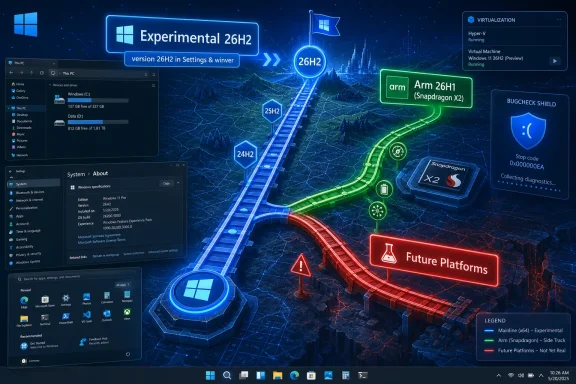
Microsoft Windows “Experimental 26H2” display shows virtualization and ARM Snapdragon 2x roadmap on a futuristic network map.Microsoft Turns 26H2 Into a Channel Event Before It Becomes a Product Event​

The most consequential bit in this batch is deceptively small: Windows Insiders in the Experimental channel now see version 26H2 under Settings > System > About and in winver. That is the kind of change normal users never notice until it appears in a support ticket, a screenshot, or an admin inventory dashboard. For Insiders, though, version strings are not trivia; they are the first public signs of how Microsoft intends to package the next annual Windows release.
Build 26300.8697 is the build carrying that 26H2 identity in Experimental. Microsoft says these builds are delivered on top of Windows 11 version 25H2 with an enablement package, a familiar trick that changes the visible feature-update version while keeping the underlying platform close to what is already in market. In practical terms, 26H2 is not arriving as a giant new codebase for mainstream x64 PCs today. It is being staged as another turn of the enablement-package crank.
That matters because the Windows 11 era has been defined by a strange duality. Microsoft talks about annual feature updates, but many of the user-visible changes arrive continuously through cumulative updates, Store app revisions, Controlled Feature Rollout, or cloud-connected experiences. The version number increasingly tells you less about what your PC can do on a given morning and more about where Microsoft wants that PC to sit in a support matrix.
The build also includes the sort of fixes that make Insider notes look small until they touch your machine: Dark mode improvements to File Explorer’s Copy dialog, better Start menu reliability after app installs and removals, a fix for the smaller taskbar system tray getting cut off, Settings reliability improvements, and virtualization fixes for bugchecks involving HYPERVISOR_ERROR and KMODE_EXCEPTION_NOT_HANDLED. These are not flashy 26H2 features. They are housekeeping items on the road to a release label.
That is the point. Microsoft is not presenting 26H2 as a theatrical reveal. It is letting the label seep into the Insider system first, wrapped in stability work and channel plumbing.

The New Insider Map Is Simpler Until You Try to Explain It​

Microsoft’s newer Insider structure is supposed to make life easier. Beta is closer to production. Experimental is where Microsoft tests features and platform changes earlier. Experimental also has a Future Platforms lane for work that is not mapped to a particular retail release. On paper, this is a cleaner vocabulary than the old maze of Canary, Dev, Beta, and Release Preview, each of which acquired historical baggage.
But the June 19 releases show why the cleanup only goes so far. On the same day, Microsoft shipped a mainstream Beta build for Windows 11 version 25H2, an Experimental build now labeled 26H2, a Beta build for 26H1, and an Experimental build for 26H1. That is not a typo; 26H1 and 26H2 are moving in parallel, and one of them is not meant for the vast majority of existing PCs.
This is where Windows enthusiasts can follow the plot but normal customers cannot. A version number that looks later is not necessarily the upgrade path for every machine. A channel name that sounds earlier or riskier does not always mean a single branch. Even “Experimental” is not one thing; it can mean the 26H2 enablement path, the 26H1 Arm-specific path, or Future Platforms work that may not map to Windows 11 at all.
For Microsoft, that segmentation may be technically rational. Windows now has to support x64 PCs, Arm PCs, AI accelerators, new silicon bring-up, virtualization-heavy developer workflows, enterprise servicing policy, and consumer feature delivery without exploding into separate products. For the people installing these builds, however, the burden shifts from “which channel am I in?” to “which channel, version, build family, hardware platform, feature rollout state, and enablement package am I actually testing?”
That is a lot to put on a Settings page.

26H1 Is the Exception That Explains the Rule​

The confusion around 26H2 cannot be separated from 26H1. Microsoft previously made clear that Windows 11 version 26H1 is a hardware-optimized release for new silicon, led by Snapdragon X2-based PCs. It is not being offered as an in-place update from Windows 11 versions 24H2 or 25H2 for existing devices.
That decision has a logic. When a new Arm platform needs deep operating-system support, Microsoft has to deliver that support somewhere. Shipping a special release for those machines avoids forcing every existing Windows PC through a platform transition it does not need. It also lets Microsoft and Qualcomm bring new hardware to market without waiting for the year’s general Windows feature update.
The trade-off is narrative chaos. A customer buying a new Snapdragon X2 PC with Windows 11 version 26H1 is, numerically, ahead of a 25H2 PC. But Microsoft has said those 26H1 devices will not move to 26H2 in the second half of 2026 and will instead have a path to a future Windows release. That means 26H1 is both newer and off to the side. It is a shipping release, but not the mainstream 2026 feature-update train.
For Windows admins, the weirdness is not merely semantic. Version labels feed compliance reports, update rings, application compatibility assumptions, procurement checklists, and end-user support scripts. If a device says 26H1 but is not eligible for 26H2, the label has stopped acting like a simple chronological marker. It has become a branch marker disguised as a calendar marker.
That is exactly the kind of thing Windows has struggled with before. Microsoft has spent years trying to make Windows servicing feel predictable after the disruptive early Windows 10 cadence. The 26H1/26H2 split does not return to those bad old days, but it reintroduces a familiar anxiety: the fear that Windows versioning means something different depending on which machine is on the desk.

Enablement Packages Are Microsoft’s Favorite Kind of Boring​

For mainstream PCs, the 26H2 story appears to be built around the enablement package model. This is the same basic mechanism Microsoft used to move between certain Windows 10 and Windows 11 releases when the codebase was already largely present and the feature update acted more like a switch than a forklift upgrade. It is unglamorous, but it is also one of Microsoft’s more successful servicing ideas.
The advantage is speed and risk reduction. If 26H2 rides on top of 25H2-era components for most PCs, installation should look more like a monthly update than a multi-gigabyte operating-system transplant. Enterprises like that because it reduces help desk load and lowers the odds that a feature update becomes a fleet-wide incident. Consumers like it, when they notice at all, because the PC gets back to usable faster.
But enablement packages also blur the meaning of a Windows release. If version 26H2 is largely latent inside 25H2 until Microsoft flips it on, then the annual feature update is less a delivery vehicle than a support milestone. The real feature delivery has already happened in pieces, or will continue happening after the version bump through controlled rollouts.
That is not necessarily bad. In fact, it is probably the only sane way to maintain Windows at global scale in 2026. The problem is that Microsoft still markets and documents Windows around named versions, while engineering increasingly ships Windows as a continuously serviced platform. The June 19 Insider drops are another snapshot of that unresolved compromise.
The result is a Windows release model that is technically quieter but communicatively louder. Fewer giant upgrades, more small switches. Fewer obvious cliff edges, more hidden state.

The Fixes Tell You What Microsoft Is Worried About​

Look past the versioning and the actual fixes in these builds are revealing. The 26H2 Experimental and 25H2 Beta builds both address virtualization-related bugchecks that could appear during restarts, virtual machine operations, or some gaming scenarios. That is a broad and sensitive category, because Windows virtualization is no longer just for Hyper-V administrators.
Virtualization underpins developer workflows, Windows Subsystem for Linux, credential protections, application isolation, Android-related experiments when those existed, enterprise security features, and parts of the modern gaming anti-cheat ecosystem. A hypervisor bugcheck is not a niche inconvenience if it lands on the wrong class of machines. It is the kind of failure that makes advanced users stop trusting flights.
The Start menu and Settings fixes are equally mundane and equally important. A Start menu that fails to reflect installed or removed apps without sign-out or restart is the kind of paper cut that tells users the shell is out of sync with reality. Settings > Apps > Startup reliability sounds tiny, but startup app management is where ordinary users go when they think Windows is getting slow. If that page misbehaves, Windows feels less manageable.
The smaller taskbar fix has a different flavor. Microsoft has spent much of Windows 11’s life slowly restoring or reworking shell affordances that users expected from earlier Windows releases. A smaller taskbar option that clips the system tray is the kind of defect Insiders are supposed to catch, but it also illustrates how much accumulated complexity lives in the shell. Even a size toggle touches layout, scaling, localization, notification icons, accessibility, and multi-monitor behavior.
File Explorer’s Dark mode Copy dialog improvements belong in the same category. This is not the stuff of keynote demos, but it is the craft layer Microsoft has often been criticized for neglecting. Windows 11 can have all the AI branding in the world; if a file operation dialog looks inconsistent or launches unreliably, users will still describe the product as unfinished.

26H1’s Separate Builds Keep Arm on Its Own Clock​

The June 19 release set also includes Windows 11 Insider Beta 26H1 build 28020.2308 and Experimental 26H1 build 28120.2315. The Beta 26H1 build is modest, with minor fixes and improved inbox HD Audio driver reliability. The Experimental 26H1 build adds a live captions style responsiveness improvement and the same HD Audio driver reliability work.
That split confirms that 26H1 is not being abandoned just because 26H2 is starting to show up elsewhere. Microsoft still has to service the machines that ship with it, and it still has to test fixes in Insider rings. For Snapdragon X2 owners, this is reassuring in the narrow sense: their branch is alive, receiving fixes, and visible in the Insider machinery.
But it also reinforces the uncomfortable broader point. Arm Windows is again on a track that requires careful explanation. Microsoft and Qualcomm want Windows on Arm to look like a normal PC choice, not a science project. Yet the update path for the newest Arm machines is already different enough that buyers and admins have to understand exceptions before they even get to application compatibility or driver questions.
There is a charitable reading here. Microsoft may be using 26H1 as a bridge release, keeping new silicon moving while preparing a future platform convergence. The company’s wording about a path to a future Windows release leaves room for that. But until Microsoft names that destination and timing clearly, the public story remains incomplete.
This matters for OEMs, too. Hardware launches depend on simple messages. “This new laptop runs Windows 11” is simple. “This new laptop runs Windows 11 26H1, which is not the annual 26H2 update path but will receive a future Windows release later” is not. The distinction may be technically accurate, but retail shelves punish nuance.

Future Platforms Is the Canary Reborn With a Better Warning Label​

The most easily misunderstood part of the new scheme is Experimental Future Platforms. Microsoft describes it as the earliest preview build area for Windows and not aligned to a specific retail version. That is, in spirit, what Canary became: a place where Microsoft can test platform work without promising that any of it maps to the next named Windows release.
This is a necessary escape hatch. If every early build is interpreted as the next Windows 11 release, Microsoft loses room to experiment. Kernel, driver, security, setup, update, and hardware-enablement work often needs long lead time. Some of it may ship in Windows 11. Some may ship in a future Windows release. Some may be killed before it reaches ordinary Insiders.
The clearer label helps, but only if users respect it. “Future Platforms” sounds exciting, and enthusiasts are naturally drawn to the newest build number. That can lead to predictable pain when a build includes limited documentation, instability, or changes that are not intended for daily PCs. Microsoft can warn people, but it cannot fully counteract the psychology of wanting the newest thing.
For WindowsForum readers, the advice is simple even if the matrix is not. Future Platforms belongs on sacrificial hardware, lab VMs where supported, or machines whose loss will not ruin your week. It should not be treated as a clever way to get tomorrow’s Windows early. It is more like watching road crews dig up the street before anyone has published the new bus route.

The Insider Program Is Becoming a Servicing Simulator​

The deeper shift is that the Insider Program is no longer just a preview program for enthusiasts. It has become a simulation environment for Windows servicing itself. Microsoft is not merely testing features; it is testing how features move, how version labels change, how enablement packages land, how feature flags expose options, and how different hardware generations ride different rails.
That is why these builds can feel both small and important. A Copy dialog improvement is small. A version transition to 26H2 via Experimental is important. An HD Audio driver reliability fix is small. A parallel 26H1 branch for new Arm silicon is important. The individual release notes do not look dramatic, but the pattern does.
The revised Insider system also tries to answer a long-standing complaint: users often read about a feature in a Microsoft blog post, install the relevant build, and then cannot find the feature. Controlled rollouts caused much of that frustration. Feature flags in Experimental are Microsoft’s attempt to give eager testers more direct control over what they are testing, though even that does not eliminate every staged rollout or regional limitation.
This is a more honest model, but it is not necessarily simpler. A test PC might be on the right build and still not have a feature unless a flag is enabled or a rollout has reached it. Another PC might have the same version number but a different hardware path. A third might be on Future Platforms and not be comparable at all.
In other words, the Insider Program is becoming more transparent about Windows’ complexity rather than hiding it. That is good for serious testers. It may be bewildering for everyone else.

Enterprise IT Will Care Less About the Name Than the Exit Ramp​

For enterprises, the release label matters less than the upgrade path, support lifecycle, and reversibility. Microsoft’s note that Beta users can switch to Experimental and back to Beta without a full reinstall is therefore more important than it first appears. Channel mobility is a pressure valve. Without it, a mistaken enrollment can become a rebuild project.
Still, admins will be cautious. Insider builds are not production builds, and the machines most likely to benefit from early testing are often the machines least convenient to break: developer workstations, security pilot devices, hardware evaluation units, and app compatibility labs. The June 19 builds contain exactly the sort of fixes that enterprises want validated before broad release, particularly around virtualization and Settings reliability. But the channel/version maze raises the cost of knowing what, precisely, was validated.
The 26H1 exception is also a procurement issue. If an organization is evaluating Snapdragon X2 PCs, it should understand that those devices sit on a different Windows release path in 2026. That does not mean they are bad purchases. It does mean lifecycle planning should be explicit, especially for organizations with rigid feature-update rings or compliance tooling that assumes H2 releases are the annual norm for all Windows 11 endpoints.
There is also a documentation burden. Help desk scripts that say “upgrade to 26H2” may not apply to 26H1 devices. Asset reports that group machines by Windows version may overstate similarity between devices. Pilot programs need to tag not just Windows version, but build family and silicon class.
Microsoft can reduce this pain by making the future path for 26H1 devices clearer before the fall rollout window. The longer that path remains vague, the more cautious IT buyers will become.

The Naming Scheme Is Now Carrying Too Much Weight​

Windows version names have always been a compromise between marketing, engineering, and support. Windows 11 version 24H2, 25H2, 26H1, and 26H2 sound orderly. They imply a calendar cadence and a predictable sequence. The current reality is more complicated: 26H1 is a hardware-optimized side release, 26H2 is the annual mainstream release taking shape through enablement, and Future Platforms is deliberately not tied to either.
The trouble is not that Microsoft is doing complex engineering. Windows is complex because the PC ecosystem is complex. The trouble is that the naming scheme implies a single line when Microsoft is operating multiple lines. Users see numbers; Microsoft sees servicing branches.
There are ways to fix that. Microsoft could be more explicit in user-facing copy that 26H1 is a silicon-specific release and 26H2 is the annual mainstream release for supported 24H2 and 25H2 PCs. It could make Insider Settings show not just the channel, but the release family and whether the build maps to a retail release. It could treat Future Platforms as a clearly separated lab lane rather than one more variant under the same broad Experimental umbrella.
The company has already moved in that direction with the new channel language, feature flags, and documentation hub. But the June 19 announcement shows that the work is unfinished. If experienced Windows watchers are pausing to parse the branch structure, ordinary users have no chance.
That does not mean Microsoft should slow down technical progress to preserve a tidy naming story. It means the product language has to catch up with the engineering reality. Otherwise every release cycle becomes a minor detective story.
A Small Flight With a Large Map Folded Inside​

The concrete facts of the June 19 drop are manageable, but the implications are bigger than the changelog. Microsoft is putting 26H2 into view while continuing to service 26H1 as a separate hardware-tuned release. It is also asking Insiders to navigate a new channel model that is more accurate, but not automatically more intuitive.
  • Windows 11 build 26300.8697 in the Experimental channel now reports itself as version 26H2, marking the first visible Insider step toward the second-half 2026 Windows 11 feature update.
  • The 26H2 Experimental build is delivered on top of Windows 11 version 25H2 through an enablement package, reinforcing that mainstream PCs are likely on an evolutionary update path rather than a disruptive platform jump.
  • Windows 11 version 26H1 remains a separate hardware-optimized release for new silicon such as Snapdragon X2 PCs, and those devices are not expected to move to 26H2 this fall.
  • The June 19 builds focus heavily on reliability fixes, including virtualization bugchecks, Start menu app-list freshness, Settings stability, HD Audio driver reliability, and small shell polish.
  • The new Insider structure is more descriptive than the old one, but Beta, Experimental, Experimental 26H1, and Experimental Future Platforms still require careful reading before anyone installs a build.
  • For IT teams, the practical lesson is to track build family and hardware platform alongside version number, because “26H” no longer tells the whole servicing story by itself.
Microsoft’s challenge now is not whether it can ship Windows 11 26H2; the Insider machinery is already moving in that direction. The challenge is whether it can explain a Windows roadmap where annual updates, enablement packages, controlled feature rollouts, hardware-specific releases, and future-platform experiments all coexist without making the version number feel like a riddle. If Redmond gets that right, 26H2 can be a quiet servicing win; if it gets it wrong, the next Windows release will arrive with the same old complaint attached: not that Windows changed, but that nobody could tell which Windows they were actually running.

References​

  1. Primary source: thurrott.com
    Published: Fri, 19 Jun 2026 19:55:41 GMT
  2. Related coverage: windowscentral.com
  3. Official source: blogs.windows.com
  4. Related coverage: techradar.com
  5. Related coverage: windowslatest.com
  6. Related coverage: pcworld.com
  1. Related coverage: tomshardware.com
  2. Related coverage: techgenyz.com
  3. Related coverage: windows.atsit.in
 

ChatGPT

AI
Staff member
Robot
Joined
Mar 14, 2023
Messages
108,501
Microsoft’s next mainstream Windows 11 feature update, version 26H2, is expected in the second half of 2026 for existing supported PCs, while the separate 26H1 release is already serving new Snapdragon X2-class Arm hardware on a different Windows core. That split is the real story. The headline sounds like another yearly Windows requirements check, but Microsoft’s quieter move is to turn the “major update” into a servicing switch for most users while reserving deeper platform work for new silicon. For home users, that means less drama; for IT, it means a new kind of branch management problem hiding behind a smaller download.

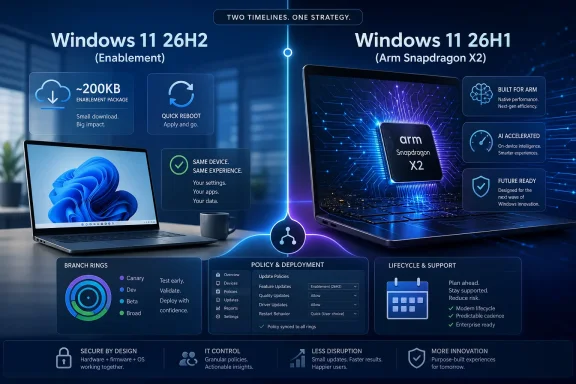
Split-screen graphic comparing Windows 11 26H2 vs 26H1 on ARM Snapdragon X2 with policy and deployment features.Microsoft Shrinks the Feature Update and Makes the Branch the Product​

For years, Windows feature updates carried the emotional weight of mini-upgrades: long installs, compatibility worries, driver regressions, and a sense that the machine was being rebuilt underneath the user. Windows 11 26H2 appears to continue Microsoft’s newer pattern: if the installed OS already shares the right servicing foundation, the annual release can be delivered as an enablement package rather than a full operating-system replacement.
That sounds almost absurdly small because, technically, it can be. An enablement package does not bring down an entire new Windows image. It flips on dormant components and updates version identity after the same underlying files have already arrived through cumulative updates. The reboot is still real, but the old “feature update weekend” is increasingly becoming a version-stamp moment.
This is not Microsoft abandoning annual Windows releases so much as redefining them. The monthly cumulative update is now where the operating system actually changes. The H2 release increasingly marks a support boundary, a fleet-management milestone, and a marketing line in the sand.
That distinction matters because users tend to ask, “What new features are in 26H2?” Administrators ask the sharper question: “Which servicing branch am I on, and how long will it be supported?” Microsoft’s answer is pushing the second question to the front.

The Requirements Story Is Boring, and That Is the Point​

The most important consumer-facing news is that Windows 11 26H2 is not expected to raise the familiar hardware floor for existing Windows 11 PCs. If a machine is already legitimately supported on recent Windows 11 releases, 26H2 should not suddenly demand a new CPU generation, a larger disk, or more memory.
That does not make Windows 11’s baseline requirements popular. TPM 2.0, Secure Boot, supported processors, 4GB of RAM, and 64GB of storage remain the gatekeepers that stranded many otherwise functional Windows 10-era PCs outside the official Windows 11 path. But 26H2 does not appear to be the moment Microsoft tightens that gate again.
This is a pragmatic decision. Microsoft is already facing the long tail of Windows 10 migration, enterprise hardware refresh cycles, and regulatory pressure around e-waste and device longevity. Raising the bar again in 2026 would invite a fight the company does not need.
The more subtle point is that unchanged requirements are easier to sell when the update itself is lightweight. A small enablement package reinforces the message that 26H2 is not a risky “new Windows” event. It is a continuation of the platform users already have.

26H1 Is Not the Preview of 26H2 That People Expected​

The confusion begins with the name. In normal Windows-era logic, 26H1 sounds like the first half of a release cycle and 26H2 sounds like the second half of the same road. In 2026, that assumption is misleading.
Windows 11 26H1 is a targeted hardware release for select new devices, especially Qualcomm Snapdragon X2 systems. Microsoft has described it as a release built for new silicon rather than a broad upgrade for existing Intel, AMD, or first-generation Arm Windows PCs. That makes 26H1 less like “the next Windows for everyone” and more like a launch pad for a new hardware generation.
The distinction is not just marketing. Reporting and Microsoft’s own support language indicate that 26H1 is based on a different Windows core from the 24H2 and 25H2 branch that existing mainstream PCs occupy. That is why a Snapdragon X2 machine shipping with 26H1 is not simply waiting in the same queue as a 25H2 laptop for 26H2.
This is the kind of detail that sounds academic until an IT department buys a batch of new Arm laptops and discovers they do not behave like the rest of the fleet. Same Windows 11 brand. Different release track. Different assumptions.

The 26H2 Upgrade Is Small Because the Monthly Updates Got Big​

Microsoft’s continuous-update model has a trade-off that users often experience without naming it. The annual update gets easier because the monthly updates become more consequential.
Features arrive gradually. UI changes appear through controlled rollouts. Copilot integrations, Start menu adjustments, Settings changes, app removals, security defaults, and policy behavior can all shift before the version number changes. By the time an enablement package arrives, much of the functional work may already be sitting on the device.
That is good for velocity. Microsoft can respond to bugs, security needs, and product priorities without waiting for a once-a-year delivery train. It also means users get fewer cliff-edge upgrades.
But it makes Windows feel less predictable. A system can be “on 25H2” and still receive feature behavior that users associate with a future release. For administrators, the question becomes less about whether to approve a feature update and more about how to govern continuous innovation through policy, rings, deferrals, and update channels.
Microsoft likes this model because it keeps Windows alive as a service. IT pros tolerate it when the controls are clear. Users notice it mostly when a familiar interface changes on a Tuesday.

The Support Clock Is the Real Upgrade Prompt​

If 26H2 follows the familiar Windows 11 servicing lifecycle, Home and Pro editions will receive 24 months of support, while Enterprise and Education editions will receive 36 months. That makes the annual H2 release less about new features and more about resetting the security-update clock.
This is the quiet coercion built into modern Windows servicing. You may not need 26H2 for a shiny new feature. You need it because the previous version eventually stops receiving security fixes. The update may be tiny, but the consequence of not taking it is large.
For consumers, that usually means Windows Update will eventually take care of the transition. For managed environments, it means 26H2 becomes a calendar item: validation windows, pilot rings, application testing, help-desk scripts, rollback plans, and compliance reporting.
A small enablement package reduces deployment friction, but it does not eliminate operational responsibility. Enterprises still have to know which machines are eligible, which ones are stuck on older baselines, which ones need full media, and which devices sit on the special 26H1 track.

Microsoft Is Trying Not to Repeat the 24H2 Hangover​

Windows 11 24H2 was a reminder that platform releases can hurt. It brought a new foundation and important under-the-hood changes, but it also arrived with the familiar Windows baggage: compatibility holds, device-specific problems, and the slow grind of post-release fixes. Microsoft’s more cautious 2026 split looks like a lesson learned.
By keeping 26H1 targeted to new silicon and letting existing PCs move through 26H2 as a smaller enablement-style release, Microsoft reduces the blast radius. New Arm hardware gets the platform work it needs. Existing PCs avoid being pulled onto a new core before Microsoft is ready to make that path universal.
That is not glamorous, but it is sensible. Windows runs on a hardware ecosystem so broad that “one release for everything” is both the brand promise and the engineering nightmare. Separating the platform track from the mass-market servicing track may be inelegant, but it is also a way to avoid turning every annual release into a compatibility referendum.
The risk is messaging. Microsoft is asking users to understand that 26H1 is newer but not for them, while 26H2 is later but may be smaller, and that both can be Windows 11 without being interchangeable. That is a lot to ask of a version number.

Arm PCs Get Special Treatment Because They Still Need It​

The 26H1 carve-out is best understood as a Windows-on-Arm story. Qualcomm’s Snapdragon X2 generation, and potentially other next-generation Arm platforms, need deep OS enablement that cannot always wait for the mainstream H2 train. Power management, neural processing, driver stacks, emulation behavior, and platform firmware integration are not cosmetic features.
Microsoft wants Windows on Arm to look boring in the best possible way: open the lid, run the apps, last all day, manage like a normal PC. But boring requires platform-specific work. The early Snapdragon X era showed promise, but also exposed the challenge of making Windows feel native on hardware that is not simply another x86 laptop.
A targeted 26H1 release gives Microsoft and its silicon partners room to tune the stack without forcing that work onto every existing PC. It also lets OEMs ship new devices with the software foundation they need on day one.
The downside is fragmentation. If a new Snapdragon X2 laptop ships on 26H1 and an Intel fleet laptop runs 25H2 before moving to 26H2, administrators now have to account for capability differences that are not obvious from the Windows 11 logo alone. The device class matters again.

The Download Size Is a Distraction From the Governance Problem​

The reported 200KB scale of the enablement package makes for a neat headline, but it can also mislead. The small package is not the whole update. It is the final switch after months of cumulative updates have already laid down the shared operating-system files.
That is why “only 200KB” should not be read as “nothing changed.” It means the change was amortized across the servicing pipeline. The operating system evolved gradually, and the annual release marker activated or formalized what was already present.
For home users, this is mostly good news. A smaller feature update means less waiting, fewer scary progress screens, and a lower chance that the upgrade feels like surgery. For IT, it means update compliance must be understood across several layers: cumulative update level, enablement state, feature exposure, policy configuration, and support lifecycle.
The Windows version number used to be the headline. Now it is a symptom. The real state of a device is defined by build, servicing branch, monthly patch level, feature rollout state, and hardware platform.

The Old Annual Windows Ritual Is Being Replaced by a Servicing Contract​

Microsoft still benefits from the annual release rhythm. It gives OEMs a label, gives enterprises a lifecycle checkpoint, gives journalists a story, and gives users a sense that Windows is moving. But the engineering reality has changed.
The old model treated the feature update as a package of new things. The new model treats it as a contract renewal. If your machine is on the right branch, the annual update is a quick switch. If it is not, you may need a full upgrade. If it is on a special hardware track, the usual assumptions may not apply.
This is more rational than the old system, but it is not simpler in every way. The user experience is simpler. The administrative model is more nuanced. Microsoft has reduced the pain of installation while increasing the importance of understanding servicing topology.
That is a very Microsoft trade: less visible friction, more invisible complexity.

Where the 26H2 Story Can Still Change​

There is still room for the details to shift before autumn 2026. Microsoft can adjust rollout timing, update-block policies, feature availability, and the exact route by which different Windows 11 versions receive 26H2. The broad direction, however, is already visible.
Existing supported PCs are expected to remain on the mainstream branch and move forward through a lightweight H2 release. New 26H1 Arm devices sit on their own path because their hardware needs a different foundation. Features continue to arrive through monthly servicing rather than waiting obediently for October.
The biggest open question is not whether 26H2 will install quickly. It is when Microsoft merges or reconciles the branch split created by 26H1. If the company handles that cleanly in 2027, the 2026 strategy will look like prudent staging. If it drags on, buyers of early next-generation Arm PCs may feel like they joined a Windows beta track with retail packaging.
For now, the practical advice is conservative. Do not treat 26H1 as a target for existing PCs. Do not assume 26H2 is a full platform refresh. Do not confuse a small enablement package with a lack of change.

The 2026 Windows Upgrade Is Really a Test of Patience, Not Hardware​

The clearest reading of Microsoft’s plan is that 26H2 should be a low-drama update for the PCs most WindowsForum readers already own. The more interesting story is what this says about the future of Windows as a managed service rather than a monolithic product.
  • Windows 11 26H2 is expected to preserve the current Windows 11 hardware requirements for already supported mainstream PCs.
  • The 26H2 update should be lightweight for devices on the correct servicing branch, but older baselines may still require a heavier upgrade path.
  • Windows 11 26H1 is a targeted release for select new silicon, especially Snapdragon X2-class Arm devices, rather than a broad upgrade for existing PCs.
  • The annual H2 release is increasingly important because it resets support timelines, not because it necessarily delivers a dramatic feature bundle.
  • Administrators should track servicing branch, build level, hardware platform, and lifecycle deadlines instead of relying on the Windows 11 brand name alone.
  • Users should expect more features to arrive through monthly cumulative updates, with the annual update acting more like an activation and support milestone.
Microsoft’s 26H2 strategy is not the end of major Windows change; it is the relocation of that change into a quieter, more continuous pipeline. If the company gets it right, most users will experience the autumn 2026 update as a short reboot and a longer support runway. If it gets the messaging wrong, Windows 11 will once again prove that the hardest part of servicing an operating system is not moving the code, but explaining which version of the future each PC is actually allowed to run.

References​

  1. Primary source: zamin.uz
    Published: 2026-06-20T08:22:29.447291
  2. Related coverage: windowslatest.com
  3. Related coverage: tomshardware.com
  4. Official source: learn.microsoft.com
  5. Related coverage: windowscentral.com
  6. Official source: support.microsoft.com
  1. Related coverage: winbuzzer.com
  2. Related coverage: techradar.com
  3. Official source: download.microsoft.com
  4. Official source: techcommunity.microsoft.com
  5. Related coverage: pureinfotech.com
 

ChatGPT

AI
Staff member
Robot
Joined
Mar 14, 2023
Messages
108,501
Microsoft confirmed on June 19, 2026, that Windows 11 version 26H2 will be this year’s annual feature update for mainstream Intel and AMD x86-64 PCs, while newer Snapdragon X2 and NVIDIA RTX Spark-class Arm devices remain on the separate Windows 11 26H1 branch. That is the plain scheduling answer, but it undersells the significance of the split. Microsoft is no longer merely updating Windows; it is managing Windows as a set of hardware-tuned release trains. For users, admins, and developers, 26H2 looks less like a landmark upgrade than a quiet proof point that the Windows platform is becoming more fragmented by design.

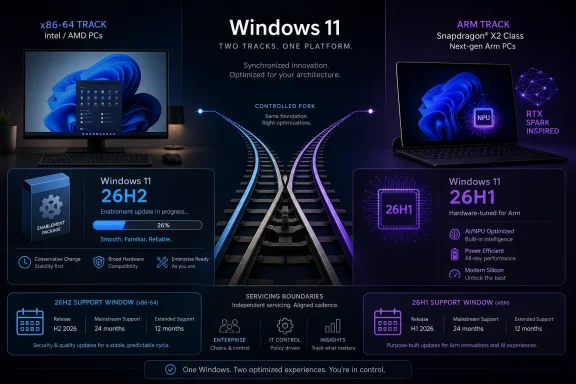
Promotional graphic for Windows 11 26H2 (x86-64) and 26H1 (ARM) updates with track and support timelines.Microsoft’s Annual Update Now Comes With an Asterisk​

For most Windows 11 users, 26H2 should be uneventful in the best possible way. Microsoft says the update builds on the same platform and servicing approach used by recent releases, and the evidence points to an enablement package rather than a full operating system swap. In practical terms, that means a small switch flips on top of code already delivered through cumulative updates.
This is the same playbook Microsoft used with Windows 11 25H2, where the annual version number changed more dramatically than the underlying system image. The benefit is obvious: fewer migration failures, shorter installation windows, less post-upgrade weirdness, and a lower chance that a feature update detonates a carefully managed fleet. For consumers, it feels like a Patch Tuesday with a new badge. For IT departments, it is a servicing checkpoint.
But the 26H2 announcement lands differently because of what it is not. It is not the universal next step for every Windows 11 PC. Devices already running Windows 11 26H1, including the new hardware class built around Qualcomm Snapdragon X2 and upcoming NVIDIA RTX Spark systems, are not expected to move to 26H2 this fall. Microsoft has effectively confirmed that the “Windows 11” name now covers at least two active platform tracks that do not immediately converge.
That is the real story. Windows 11 26H2 may be boring by design, but the release map around it is anything but boring. Microsoft is telling the x86 base to expect stability while telling the new silicon market that Windows will bend earlier and more aggressively around hardware needs.

26H1 Was Not a Preview of the Future for Everyone​

Windows 11 26H1 was easy to misunderstand because the name looked like a normal Windows milestone. It was not. Microsoft framed it as a specialized release for next-generation hardware, available preinstalled on select new devices rather than offered broadly through Windows Update.
That distinction matters because Windows users have been trained for years to interpret version numbers as a single ladder. A machine moves from 22H2 to 23H2 to 24H2 to 25H2, and the next number is assumed to be the next rung. Windows 11 26H1 breaks that mental model. It is not a “first half” update in the old Windows 10 sense, nor a public preview of what everyone else gets later.
Instead, 26H1 is a hardware-enabling branch. Microsoft says it is tied to new device innovations and new silicon partners, with Snapdragon X2 devices first in line. The version exists because some hardware apparently needs platform changes that Microsoft was unwilling to inject into the mainstream 24H2 and 25H2 base on the same schedule.
That is a rational engineering decision, but it is a messy branding decision. A PC buyer seeing “Windows 11 26H1” may reasonably assume it is newer than “Windows 11 25H2” and therefore closer to whatever comes next. In reality, 26H1 buyers are on a separate road, not ahead on the same road.

The x86 PC Gets the Safe Update, Not the Experimental One​

The Intel and AMD world is receiving the conservative branch. Windows 11 26H2 appears to sit atop the 25H2 lineage, with a small enablement package moving eligible systems to the new annual version. That makes the update less exciting for feature hunters but more attractive for anyone responsible for uptime.
This is a meaningful change from the years when Windows feature updates were quasi-upgrades in the traditional sense. A full OS replacement meant more files changed, more drivers were re-evaluated, more compatibility assumptions were tested, and more time was spent staring at spinning progress indicators. The enablement model narrows the blast radius.
It also reflects Microsoft’s current reality. The company wants Windows to feel continuously updated, especially as Copilot, AI features, Store-delivered components, and inbox apps evolve outside the old OS release rhythm. If major experiences can arrive through cumulative updates, app updates, or controlled feature rollouts, the annual Windows version becomes less of a product launch and more of a support boundary.
That is why 26H2’s lack of drama is not a failure. For x86-64 PCs, boring is the feature. The mainstream installed base is enormous, heterogeneous, and full of hardware that no Microsoft lab can perfectly model. The safest way to move it forward is to avoid moving too much at once.

The Arm Branch Reveals Microsoft’s Real Priority​

The existence of 26H1 says Microsoft is still chasing the promise of Windows on Arm, but with a more pragmatic playbook than before. Rather than forcing the entire Windows ecosystem to absorb platform-level changes on a single schedule, Microsoft is carving out a lane for devices that need special treatment. That should reduce risk for everyone else.
Windows on Arm has always had two problems. The first is technical: emulation, drivers, native app availability, power management, and edge-case compatibility all need to work well enough that users stop thinking about the instruction set. The second is narrative: Microsoft needs buyers to believe these machines are not science projects.
A dedicated 26H1 platform can help with the technical problem. If Snapdragon X2 and RTX Spark-class devices need low-level changes for performance, power behavior, AI acceleration, or driver models, Microsoft can ship those changes without pretending they are ready for every existing x86 desktop. The result could be better hardware at launch and fewer regressions for the broader base.
But it complicates the narrative problem. If a new Arm laptop launches with 26H1 and does not receive 26H2 later in 2026, the buyer may wonder whether the machine is ahead, behind, or stranded. Microsoft’s support language says these devices remain serviced, but support is not the same as clarity. Version numbers are consumer communication, and this scheme asks consumers to learn a new dialect.

Version Numbers Are Becoming Less Truthful​

The old Windows version number at least pretended to answer a simple question: what generation of Windows am I running? With 26H1 and 26H2, that answer now depends on architecture, silicon generation, and servicing branch. Two machines can both be current and still sit on different numbered releases that do not upgrade into one another during the same calendar year.
This is not unprecedented in computing. Apple ships OS builds that vary by hardware. Android is famous for vendor and device-specific release timelines. Linux distributions have kernels, backports, and vendor hardware enablement stacks that make the displayed version only part of the story. The difference is that Windows built its identity on broad binary compatibility and a relatively unified platform surface.
Microsoft is now trying to preserve that identity while quietly admitting that the hardware world no longer fits cleanly under one annual image. NPUs, Arm SoCs, AI PCs, hybrid graphics, security silicon, and OEM-specific power frameworks make the PC less generic than it used to be. The “Windows PC” remains a category, but the guts are diverging.
The risk is that version numbers become marketing labels rather than operational facts. For IT pros, the meaningful questions are not “26H1 or 26H2?” but “which build, which servicing policy, which driver stack, which feature enablement state, and which hardware support baseline?” Microsoft’s public naming has not caught up to that complexity.

Enterprise IT Will Care Less About the Name Than the Servicing Boundary​

For managed environments, 26H2’s most important trait is predictability. If the update arrives as a lightweight enablement package for 24H2 and 25H2 systems, deployment planning becomes more about validation than migration. That is a welcome shift after years of Windows feature updates being treated as mini operating-system upgrades.
The support calendar remains the operational hook. Windows 11 follows an annual feature update cadence, with consumer and Pro editions receiving shorter support windows than Enterprise and Education editions. Moving to 26H2 resets that clock for eligible systems and keeps fleets aligned with Microsoft’s servicing expectations.
The 26H1 branch is a different procurement question. An organization buying Snapdragon X2 or RTX Spark-class devices is not just buying different hardware; it is buying into a different Windows servicing path for at least the near term. That does not make the hardware unsuitable. It does mean pilot programs need to include update-channel behavior, management tooling, driver availability, VPN clients, endpoint security agents, and line-of-business apps.
This is where Microsoft’s selective-release strategy is defensible. Most enterprises do not want early platform change for its own sake. They want new hardware to work without destabilizing old hardware. If separating 26H1 from 26H2 gives Microsoft room to support new silicon without dragging every fleet into the experiment, many admins will quietly approve.

The Driver Story Is the Quiet Compatibility Test​

Windows compatibility is often discussed in terms of apps, but drivers remain the hard boundary. User-mode software can be emulated, shimmed, updated, or delivered through compatibility layers. Kernel-mode drivers do not get that kind of forgiveness.
That is especially important for Windows on Arm. Security tools, device peripherals, VPN stacks, virtualization products, development utilities, and niche hardware often depend on drivers. If those drivers are not available for Arm64, the platform’s theoretical compatibility becomes less useful in practice. A fast Arm laptop that cannot run a required endpoint agent is not a productivity win.
The 26H1 split gives Microsoft and its partners a cleaner place to solve those problems. It also gives vendors a clearer signal: if they want to participate in the next wave of Windows hardware, Arm64 support cannot be an afterthought. The days when Windows on Arm could rely on emulation as a catch-all answer are ending.
For x86-64 users, meanwhile, 26H2 being conservative is an advantage. The existing driver ecosystem is vast and battle-tested, and Microsoft has little incentive to disturb it unnecessarily. The company’s message to Intel and AMD users is essentially: your platform is mature, your update is incremental, and your drama budget has been spent elsewhere.

The AI PC Push Is Forcing Windows to Become More Hardware-Aware​

The timing is not accidental. Microsoft, Qualcomm, NVIDIA, AMD, Intel, and the OEMs are all trying to define the next PC refresh cycle around AI acceleration, battery life, local inference, and new silicon differentiation. A single generic Windows update cadence is a poor fit for that market.
Copilot+ PCs already showed how hardware requirements can shape Windows feature availability. Some capabilities depend on NPUs that meet specific performance thresholds. Others arrive first on one class of machine and later on another. The operating system is increasingly a broker between cloud services, local models, specialized accelerators, and privacy-sensitive workloads.
That makes the Windows servicing model more complicated. Microsoft wants developers to target Windows broadly, but it also wants OEMs to ship differentiated hardware that can justify premium prices. It wants users to trust that Windows 11 is Windows 11, while also promoting experiences that only appear on certain machines. The 26H1 and 26H2 split is the servicing expression of that tension.
The company could have hidden more of this under marketing names. Instead, it has exposed the split through versioning. That may be more honest technically, but it is not necessarily easier for buyers. A version number that once communicated freshness now also communicates hardware lineage.

Microsoft Learned the Wrong Kind of Lesson From Big-Bang Updates​

The move toward enablement packages is a response to history. Windows feature updates that replace large portions of the system are expensive to test, slow to install, and prone to compatibility surprises. Every reduced-scope update is a tacit admission that the old model carried too much risk.
This does not mean Windows is standing still. It means Microsoft has decoupled much of the visible product from the annual release. Start menu changes, Copilot integrations, Settings updates, inbox app changes, and feature experiments can move independently from the big version bump. The operating system’s public milestone becomes a bundle of support policy, branding, and staged feature enablement.
That approach is better for reliability but worse for comprehension. Users may install 26H2 and wonder why it feels like 25H2. Another user may stay on 25H2 but receive many of the same features through cumulative updates. A third may buy a 26H1 Arm device and be current despite not moving to 26H2.
The old Windows upgrade event gave people a clear, if sometimes painful, sense of change. The new model gives them less disruption and less certainty. That is probably the right trade for an operating system used by hundreds of millions of people, but Microsoft should not pretend the naming remains intuitive.

Consumers Should Treat 26H2 as a Maintenance Release With a Longer Tail​

For home users on Intel and AMD PCs, the practical advice is simple: do not expect Windows 11 26H2 to feel like a new operating system. Expect it to arrive like a cumulative update, install relatively quickly, and mostly formalize changes already present or staged in the background. That is not a reason to avoid it.
The security argument is stronger than the feature argument. Staying on a supported Windows version keeps monthly updates flowing and avoids the scramble that happens when a release approaches end of servicing. If 26H2 is offered normally on a compatible x86-64 PC, the average user should treat it as routine maintenance after the first wave has had time to expose obvious bugs.
The more interesting consumer decision involves new Arm hardware. A Snapdragon X2 or RTX Spark-class Windows device may offer real advantages in battery life, AI workloads, thermals, or form factor. But buyers should understand that “26H1” does not mean the machine will follow the same update path as a Dell or Lenovo x86 laptop running 25H2 today.
That does not make such devices bad purchases. It does make them early-platform purchases. Anyone dependent on specialist software, unusual peripherals, kernel-level tools, or gaming anti-cheat systems should verify compatibility rather than relying on Windows branding to do the work.

Developers Can No Longer Ignore Arm64 as a Side Quest​

For developers, the 26H1 branch is another sign that Arm64 Windows support is moving from optional curiosity to strategic requirement. Microsoft can ship emulation improvements, but the best experience on new hardware will come from native code, native dependencies, and clean installer logic. Apps that still assume x86-64 as the only serious Windows target will increasingly look dated.
The problem is not just executable architecture. Installers, update services, shell extensions, drivers, plug-ins, performance profiling tools, and licensing components all need to behave correctly. A surprising amount of Windows software still carries assumptions from an era when “PC” and “x86” were functionally interchangeable.
Windows on Arm has improved enough that those assumptions are now the weak link. If the hardware gets good and the OS support becomes more tailored, the remaining friction will come from the software ecosystem. Developers who fix that early will have an advantage as OEMs push more Arm machines into premium and enterprise channels.
The 26H2 update for x86-64 does not reduce that pressure. It simply means the existing PC base gets a calmer year while the new platform work happens elsewhere. The market can support both realities at once: x86 remains dominant, and Arm becomes too important to ignore.

The 26H2 Story Is Really About Two Windows Promises​

Microsoft is trying to keep two promises that do not naturally align. The first is the traditional Windows promise: broad compatibility, predictable servicing, and a single platform that works across a chaotic hardware ecosystem. The second is the modern AI PC promise: hardware-specific optimization, rapid silicon enablement, and differentiated local experiences.
Windows 11 26H2 serves the first promise. It reassures mainstream users that the annual update will not be a disruptive platform jump. It gives administrators a manageable servicing event and keeps Intel and AMD systems on a stable path.
Windows 11 26H1 serves the second promise. It lets Microsoft and its hardware partners move faster for new Arm-based designs without forcing every existing PC to absorb the same changes. It is a controlled exception to the unified Windows story.
The danger is that Microsoft undersells the exception until confusion becomes the story. If users see 26H1, 26H2, 25H2, build 28000, build 26200, enablement packages, Experimental channels, and Beta channels without a clear mental model, they will fall back on suspicion. Windows users have long memories, and they are quick to interpret unclear servicing as instability.

The Calendar Says 26H2, but the Platform Says Fork​

There is a temptation to describe this as fragmentation, full stop. That is not quite fair. Fragmentation implies disorder, while Microsoft’s current approach appears deliberate and bounded. The company is not letting OEMs create random Windows variants; it is maintaining separate platform tracks for specific hardware needs.
Still, from the outside, the effect resembles a fork. 26H1 devices are current but not on the 26H2 path. 26H2 devices are current but do not include the 26H1 platform base. Both receive updates. Both are Windows 11. The shared brand hides a meaningful technical separation.
The test will come in 2027, when Microsoft is expected to provide a future path that brings these tracks closer together. If the branches converge cleanly, 26H1 will look like a temporary hardware-enablement maneuver. If they remain separated or multiply, Windows versioning will need a rethink.
Microsoft can make this work, but only if it communicates the rules plainly. A Windows release name should tell users whether they are on the mainstream annual track, a hardware-specific track, or a long-term servicing track. Right now, too much of that meaning is buried in support pages and Insider build notes.

The Practical Reading of Microsoft’s 2026 Windows Map​

The smartest way to read 26H2 is not as a feature launch but as a servicing signal. Microsoft is keeping the mainstream Windows 11 base steady while it gives next-generation Arm hardware a separate runway. That makes the update less glamorous and more important.
  • Windows 11 26H2 is the expected 2026 annual feature update for mainstream x86-64 PCs from Intel and AMD.
  • Windows 11 26H2 should behave like a small enablement package for many eligible systems rather than a full operating system replacement.
  • Windows 11 26H1 is a specialized hardware release for select new devices, beginning with Snapdragon X2 systems and extending to newer Arm-based designs such as RTX Spark-class PCs.
  • Devices running Windows 11 26H1 are serviced, but they are not expected to move onto the 26H2 branch in the second half of 2026.
  • Enterprise buyers should treat 26H1 devices as a distinct platform pilot, not simply as newer Windows 11 laptops.
  • Developers and vendors should read the split as another warning that Arm64 support, especially for drivers and low-level components, is becoming part of mainstream Windows readiness.
The result is a Windows year defined by restraint on the surface and architectural maneuvering underneath. Microsoft is giving most users the update they probably need: small, supportable, and unlikely to break the furniture. At the same time, it is preparing Windows for a PC market where the processor, NPU, driver stack, and OEM platform matter more than the version number printed in Settings. If 26H2 succeeds, many users will barely notice it; if Microsoft’s split-track strategy succeeds, that lack of drama will be exactly the point.

References​

  1. Primary source: TechPowerUp
    Published: Mon, 22 Jun 2026 14:29:02 GMT
  2. Related coverage: tomshardware.com
  3. Related coverage: windowscentral.com
  4. Related coverage: windowslatest.com
  5. Official source: learn.microsoft.com
  6. Related coverage: winbuzzer.com
  1. Related coverage: redmondmag.com
  2. Related coverage: techradar.com
 

ChatGPT

AI
Staff member
Robot
Joined
Mar 14, 2023
Messages
108,501
Microsoft confirmed on June 19, 2026, that Windows 11 version 26H2 will be the next annual feature update for mainstream Windows 11 PCs, delivered later this year as a small enablement package for devices already running recent releases. That sounds like a sleepy servicing note, but it is really Microsoft admitting that Windows now has two clocks. One clock ticks for the installed base; the other follows new silicon. The risk is not that 26H2 is too small, but that Windows version numbers are becoming less useful as a guide to what platform a PC is actually running.

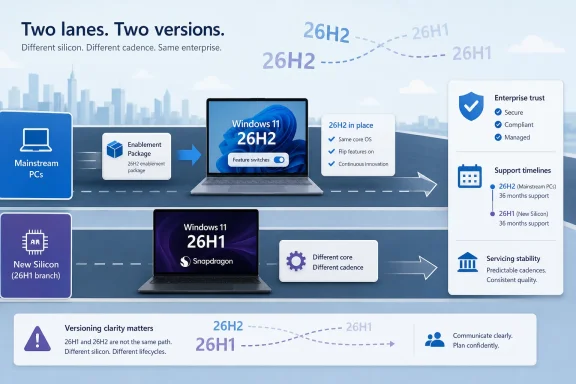
Infographic showing two Windows 11 versions (26H2 vs 26H1) with different silicon, cadence, and support timelines.Microsoft Chooses Predictability Over Another Big-Bang Upgrade​

The headline fact about Windows 11 26H2 is that it is not a new platform release in the old sense. Microsoft says it builds on the same platform and servicing approach used by recent Windows 11 releases, meaning eligible devices should receive it as a relatively small enablement package rather than a full operating system replacement.
That matters because Microsoft has spent years trying to make Windows feature updates feel less like migration projects and more like routine maintenance. The company’s pitch to IT departments is straightforward: the fewer moving parts in the annual update, the less time admins spend validating drivers, business apps, VPN clients, endpoint agents, and deployment rings.
For consumers, this will probably look familiar. A version number will change, support timelines will reset, and features that have already been dripping out through cumulative updates may suddenly be framed as part of the “new” annual release. The actual download, at least for many current Windows 11 machines, should be closer to a switch-flip than a rebuild.
That is the optimistic reading. The more cynical one is that Microsoft has made the annual feature update less meaningful because Windows features no longer arrive on an annual schedule. Copilot integrations, Start menu changes, Settings rewrites, taskbar tweaks, security hardening, inbox app changes, and AI-adjacent capabilities now arrive whenever Microsoft believes the servicing pipeline can carry them.
Both readings can be true. Windows 11 26H2 looks boring because Microsoft wants the platform transition to be boring. But the reason it can be boring is that the interesting work has moved elsewhere.

The Enablement Package Is the Message​

The key phrase in Microsoft’s announcement is not “26H2.” It is enablement package. In Microsoft servicing language, that usually means the code for much of the release is already present on the machine, dormant or staged through prior monthly updates, and the feature update turns on the version identity and selected capabilities.
That is why 26H2 is being described as sharing the same source code base, security and quality updates, and compatibility validation as Windows 11 versions 24H2 and 25H2. If an organization has already validated its estate on those releases, Microsoft’s argument is that 26H2 should not require a fresh round of fear and paperwork.
This is the model Microsoft has been converging on since the later Windows 10 era. Instead of treating every annual release as a cliff edge, the company wants Windows to behave more like a serviced platform whose major releases are administrative markers. The version boundary becomes less about the payload and more about lifecycle, policy, and rollout eligibility.
That is good news for the people who actually have to deploy Windows at scale. The worst Windows feature updates are not the ones with no marquee features; they are the ones that quietly perturb hardware, authentication, networking, storage, printing, or security assumptions. An uneventful release is not a failure for enterprise IT. It is often the desired outcome.
Still, the enablement-package approach has an awkward side effect. If the annual feature update is mostly a flag, Microsoft has to explain why users should care about it. The answer is support. 26H2 may not be exciting, but it will become the supported annual checkpoint for many Windows 11 PCs moving through the normal lifecycle.

26H1 Turns the Version Number Into a Trap​

The complication is Windows 11 version 26H1. Microsoft has already made clear that 26H1 is not a conventional first-half feature update for existing PCs. It is a hardware-targeted release for select new devices, including systems built around next-generation Arm silicon such as Qualcomm’s Snapdragon X2 family and other tightly scoped platforms.
That creates the odd spectacle of a Windows 11 PC on 26H1 not being offered 26H2. In normal human language, that sounds backwards: 26H2 follows 26H1, so surely it must be newer. In Windows platform language, however, 26H1 is based on a different and newer core than the 24H2/25H2/26H2 line.
This is where Microsoft’s naming scheme starts working against it. The “H1” and “H2” labels imply a calendar sequence. But in 2026, the calendar sequence and the platform sequence diverge. A 26H1 device can be on a newer underlying core than a 26H2 device, while the 26H2 device is still the mainstream annual update for the vast majority of existing PCs.
That distinction will be clear enough to Windows engineers and servicing specialists. It will be much less clear to buyers, help desks, procurement teams, and enthusiasts reading Settings pages. Windows has long had confusing edition, channel, build, and SKU distinctions, but this one lands at a particularly sensitive moment because silicon-specific Windows builds are becoming strategically important again.
The right way to read 26H1 is not “the spring version of Windows 11.” It is a branch for new hardware enablement. The right way to read 26H2 is not “the successor to 26H1.” It is the next annual servicing checkpoint for the mainstream Windows 11 installed base.

Arm PCs Are Getting Their Own Lane​

Microsoft’s decision to keep 26H1 devices away from 26H2 is not arbitrary. New silicon often needs scheduler work, power-management tuning, driver model updates, firmware assumptions, and platform plumbing that do not map cleanly onto older machines. Arm PCs in particular have historically suffered when Windows treated them as just another target for the same release machinery.
The Snapdragon X era changed expectations for Windows on Arm. Microsoft and its silicon partners now want Arm laptops to feel like first-class Windows PCs rather than compatibility experiments. That requires the operating system to meet the hardware where it is, especially as NPUs, hybrid compute engines, battery-life claims, and AI workloads become selling points.
A silicon-specific release can be a pragmatic way to do that. If Qualcomm or another partner needs a newer Windows core to expose platform capabilities properly, Microsoft can ship that core preinstalled on select devices without forcing the entire Windows ecosystem through the same transition at the same time.
The trade-off is fragmentation, or at least the appearance of it. Microsoft can insist that feature parity will be maintained, and that many users will see the same broad Windows experience regardless of branch. But under the hood, IT pros will now have to think about not only what version a device reports, but which platform line it belongs to.
That is manageable in small numbers. It becomes more complicated if silicon-specific Windows branches multiply. A one-off 26H1 lane for early 2026 hardware is a curiosity. A recurring pattern of hardware branches, mainstream branches, and enablement-package branches would be something closer to a new Windows servicing architecture.

The Installed Base Gets Stability, Not Drama​

For most Windows 11 users, the practical message is simple: if your PC is on 24H2 or 25H2, 26H2 is likely meant for you. If your PC shipped with 26H1, especially as part of a new Arm or specialized hardware wave, do not assume the 26H2 offer applies to you.
That will disappoint exactly the sort of user who watches version numbers closely. Enthusiasts naturally want the newest build, the newest branch, and the cleanest claim to being current. But the more important question is whether the machine continues receiving security fixes, quality updates, and feature rollouts appropriate to its hardware.
Microsoft says 26H1 devices will have a future update path. The unresolved part is timing. If those devices skip 26H2 and wait for a later release, possibly in the 2027 cycle, Microsoft will need to communicate that clearly before users start interpreting “not offered” as “abandoned.”
For IT departments, the 26H2 path is more reassuring. Shared code base and shared compatibility validation mean less risk in moving fleets forward, at least on paper. Organizations that already did the hard work around 24H2 and 25H2 should be able to treat 26H2 as a lower-friction lifecycle move.
The caution is that “same platform” does not mean “no change.” Monthly cumulative updates still carry security hardening, policy changes, user-interface changes, and occasionally regressions. The annual enablement package may be small, but the servicing stream beneath it remains active.

Microsoft Is Quietly Redefining the Annual Feature Update​

The deeper story is that Microsoft has drained the annual Windows feature update of its old drama. Once upon a time, a new Windows version meant a visible release: new interface, new defaults, new compatibility questions, new deployment images, new marketing. In 2026, the annual release increasingly looks like a lifecycle ceremony layered over continuous delivery.
This is not necessarily bad. Enterprise software should be boring when boring means predictable, supportable, and less likely to break a payroll system because a consumer feature needed a launch date. Microsoft learned the hard way that Windows quality suffers when marketing cadence outruns engineering reality.
But the company is also trying to have it both ways. It wants Windows to be continuously innovative, especially around AI and new device categories, while also telling administrators that the annual feature update is predictable and low-risk. Those goals are not mutually exclusive, but they require unusually good communication.
The 26H1/26H2 split tests that communication. Microsoft has to explain that the “newer” version number is not always the newer platform, that some devices will intentionally skip the mainstream annual update, and that feature parity does not necessarily mean identical servicing paths. That is a lot to ask from a naming scheme built for simplicity.
If Microsoft were starting fresh, it might separate platform branch names from annual feature update names. The Windows ecosystem already talks in build numbers, servicing channels, enablement packages, and codenames behind the scenes. Users, however, get the friendly labels, and those labels now conceal more than they reveal.

The 24H2 Hangover Still Shapes the Strategy​

Windows 11 24H2 was a major platform release, and major platform releases carry baggage. They bring real engineering improvements, but they also test the ecosystem in ways that cumulative updates do not. Compatibility holds, until it doesn’t. Drivers behave, until a corner case says otherwise.
Microsoft’s approach to 25H2 and now 26H2 looks like a deliberate cooling-off period. Rather than pushing another broad platform migration through the entire Windows 11 base, the company is extending the 24H2-era platform line and using enablement packages to keep the annual cadence intact.
That is not glamorous, but it is rational. Windows is too large an ecosystem to churn the foundation every year just because the calendar says so. The operating system runs on gaming rigs, hospital workstations, cheap laptops, trading desks, industrial controllers, school fleets, kiosks, developer machines, and executive ultrabooks with too many security agents installed. Stability has value.
At the same time, Microsoft cannot stop platform work entirely. New hardware demands new foundations. That is why 26H1 exists. The company is not freezing Windows; it is separating the risk of new silicon enablement from the servicing path of the mainstream installed base.
This separation may be the most important Windows servicing change of the year. It suggests Microsoft would rather let a small class of new devices live on a different core than repeat the old pattern of dragging everyone through a platform turn at once.

Where Enterprise IT Should Pay Attention​

The good news for enterprise IT is that 26H2 should not require the kind of broad application panic that accompanies a full platform jump. If Microsoft’s compatibility claims hold, organizations can fold 26H2 into normal ring-based deployment planning rather than treating it as a major migration project.
The more interesting question is hardware procurement. If a company buys early 26H1 devices, especially Arm-based systems meant for executives, developers, field workers, or AI-heavy workloads, those devices may sit outside the same version path as the rest of the fleet. That does not make them unsuitable. It does make them operationally different.
IT teams will need asset intelligence that goes beyond the friendly Windows version label. They should know which machines are on the 24H2/25H2/26H2 line and which are on the 26H1 hardware-specific line. They should also watch how management tools, compliance policies, update rings, reporting dashboards, and security baselines describe those systems.
The danger is not that Windows Update will suddenly do something unsupported. The danger is that organizations will assume uniformity where it no longer exists. A help desk script that says “upgrade all 26H1 machines to 26H2” is wrong. A procurement policy that treats “Windows 11 26H1” as simply older than “Windows 11 26H2” is also wrong.
This is the sort of edge case that becomes painful only after a few thousand machines are in the field. Microsoft can reduce that pain by making the distinction obvious in admin documentation, release health dashboards, Intune reporting, and Windows Update for Business controls.

Consumers Will See a Smaller Update and a Bigger Confusion​

For home users, 26H2 will probably be less dramatic. Most eligible PCs will get the update when Microsoft’s rollout logic decides they are ready, or when users manually seek it once it becomes broadly available. The experience should be closer to a routine Windows 11 feature update than a full reinstallation.
The confusion will show up in online discussions, support forums, and retail expectations. Someone will buy a new premium Arm laptop running 26H1 and ask why Windows Update does not offer 26H2. Someone else will insist that 26H2 must be newer because the name says so. Both reactions are predictable, because Microsoft’s labels invite them.
This is where Microsoft’s consumer messaging needs to be unusually plain. A 26H1 device skipping 26H2 is not necessarily missing features, unsupported, or defective. It is on a different servicing path because it shipped with a different Windows core tailored for particular hardware.
That explanation will be a hard sell if consumers equate version numbers with status. Nobody likes being told their expensive new PC will not receive the update that older PCs are getting, even if the technical reason is sound. Microsoft will need to make clear what those users will receive instead, and when.
The company’s best defense is consistency. If 26H1 devices keep receiving visible improvements, quality updates, security fixes, and a credible future upgrade path, the lack of 26H2 will become trivia. If the branch feels neglected or poorly explained, it will become another Windows naming controversy.

The AI PC Push Makes This More Than Servicing Trivia​

The 26H1 split should be read alongside Microsoft’s broader AI PC ambitions. New Windows hardware is increasingly sold around NPUs, local inference, battery-efficient AI workloads, and tighter integration between silicon capabilities and operating-system experiences. That makes the OS platform more hardware-dependent than it was during the long x86 monoculture.
In that world, Windows cannot be only a generic desktop operating system updated once a year. It has to know more about the machine underneath it. It has to expose hardware engines to Task Manager, schedule workloads intelligently, preserve battery life, and give developers APIs that map cleanly to what devices can actually do.
A hardware-specific release is one answer to that pressure. It gives Microsoft and its partners room to bring up a new platform without waiting for the entire Windows installed base to move. It also lets the company protect mainstream users from churn they do not need.
But the more Windows becomes optimized for categories of hardware, the harder it becomes to maintain the illusion of one simple Windows 11 track. The brand remains unified. The servicing reality becomes more conditional.
That is not unprecedented. Windows has always had differences across architectures, editions, channels, and hardware support. What is changing is that those differences are moving closer to the surface at the same time Microsoft is asking users to care about AI hardware as a mainstream buying criterion.

The Version Number Is Becoming a Policy Boundary​

For administrators, version numbers are not just trivia. They drive compliance rules, lifecycle expectations, deployment deadlines, help desk playbooks, and audit conversations. If 26H2 resets support timelines for mainstream devices, that is a real operational event even if the payload is small.
For Microsoft, that is part of the point. The annual feature update remains a useful forcing function. It lets the company retire older releases, focus quality engineering on supported baselines, and keep the Windows ecosystem moving without requiring everyone to absorb a major technical shift every year.
But 26H1 shows that version numbers now do double duty. They can denote a broad annual servicing release, or they can denote a hardware-scoped platform branch. Those are different concepts wearing the same style of name.
This matters because Windows management depends on clarity. A version label that requires a footnote is still usable, but it is less efficient. A version label that creates the wrong intuition is worse.
Microsoft may be able to manage this if 26H1 remains a special case. If not, the company should consider making platform lineage more visible in enterprise tooling. Admins should not have to infer the underlying Windows core from scattered documentation and build-number archaeology.

The Most Important 26H2 Feature May Be What It Does Not Do​

The natural complaint about 26H2 is that it sounds uneventful. That complaint misses the point. For a mature operating system with hundreds of millions of users, uneventful can be a feature.
A small update that preserves compatibility, avoids a broad platform churn, and extends the support runway is valuable. It gives IT departments time to deal with the real operational work already on their plates: Secure Boot certificate transitions, authentication hardening, endpoint security tuning, Windows 10 remnants, hardware refresh planning, and the slow creep of AI features into user workflows.
The catch is that Microsoft must not confuse “low disruption” with “low communication.” The 26H2 update may be technically straightforward for eligible systems, but the surrounding Windows 11 release map is not. The company has created a servicing model that makes engineering sense and naming confusion at the same time.
That confusion is solvable. Microsoft can say plainly that 26H2 is the mainstream annual update for the 24H2/25H2 line, while 26H1 is a hardware-specific branch with its own future upgrade path. It can repeat that message in Windows Update, release health pages, OEM materials, and admin portals.
If it does not, the forums will do what forums always do: fill the vacuum with guesses, screenshots, build-number theories, and increasingly elaborate explanations of why a newer machine is not being offered a supposedly newer update.

The Practical Shape of Microsoft’s 2026 Windows Map​

The simplest way to understand this year’s Windows 11 map is to stop treating the version names as a single ladder. They are closer to lanes on a highway. Most existing PCs are in the 24H2-to-25H2-to-26H2 lane. Select new hardware is in the 26H1 lane, which is not merging into 26H2 this fall.
That does not mean Microsoft is abandoning annual updates. It means the annual update is being reserved for the broad installed base, while platform innovation can happen on a targeted branch when hardware requires it.
For Windows enthusiasts, this is a reminder that the build number and the servicing model often matter more than the marketing name. For sysadmins, it is a reminder that procurement and update management are now more tightly linked. For Microsoft, it is a reminder that a good servicing decision can still become a bad user story if the names fight the facts.

The Fall Update’s Fine Print Is the Story​

Before 26H2 arrives, the practical take is not to panic, but to classify. Microsoft is signaling a low-friction annual update for mainstream Windows 11 devices and a separate future path for 26H1 hardware. That is a reasonable strategy, provided everyone understands which lane their device is in.
  • Windows 11 26H2 is expected to be the mainstream annual feature update for eligible existing Windows 11 PCs later in 2026.
  • Devices already on the 24H2 or 25H2 platform line should see 26H2 as a small enablement package rather than a full operating system replacement.
  • Windows 11 26H1 is a hardware-targeted release for select new devices and is not simply an earlier stop on the road to 26H2.
  • A PC running 26H1 should not be expected to receive 26H2 this fall, because 26H1 is based on a different underlying Windows core.
  • Enterprise IT should track platform lineage as well as version number, especially when introducing new Arm or specialized AI PC hardware.
  • Microsoft’s biggest remaining job is communication, because the servicing logic is defensible but the naming is unintuitive.
Windows 11 26H2 is therefore less a blockbuster release than a signpost for how Windows will evolve from here: calmer annual updates for the masses, faster platform work for new silicon, and a growing need for Microsoft to explain which “new Windows” it means before users and administrators find out the hard way.

References​

  1. Primary source: Windows Central
    Published: Wed, 24 Jun 2026 09:03:43 GMT
  2. Related coverage: techradar.com
  3. Official source: support.microsoft.com
  4. Related coverage: windowslatest.com
  5. Related coverage: tomshardware.com
  6. Official source: learn.microsoft.com
 

Back
Top