
Microsoft confirmed on June 19, 2026, that Windows 11 version 26H2 will be this year’s annual feature update for mainstream Intel and AMD x86-64 PCs, while newer Snapdragon X2 and NVIDIA RTX Spark-class Arm devices remain on the separate Windows 11 26H1 branch. That is the plain scheduling answer, but it undersells the significance of the split. Microsoft is no longer merely updating Windows; it is managing Windows as a set of hardware-tuned release trains. For users, admins, and developers, 26H2 looks less like a landmark upgrade than a quiet proof point that the Windows platform is becoming more fragmented by design.
For most Windows 11 users, 26H2 should be uneventful in the best possible way. Microsoft says the update builds on the same platform and servicing approach used by recent releases, and the evidence points to an enablement package rather than a full operating system swap. In practical terms, that means a small switch flips on top of code already delivered through cumulative updates.
This is the same playbook Microsoft used with Windows 11 25H2, where the annual version number changed more dramatically than the underlying system image. The benefit is obvious: fewer migration failures, shorter installation windows, less post-upgrade weirdness, and a lower chance that a feature update detonates a carefully managed fleet. For consumers, it feels like a Patch Tuesday with a new badge. For IT departments, it is a servicing checkpoint.
But the 26H2 announcement lands differently because of what it is not. It is not the universal next step for every Windows 11 PC. Devices already running Windows 11 26H1, including the new hardware class built around Qualcomm Snapdragon X2 and upcoming NVIDIA RTX Spark systems, are not expected to move to 26H2 this fall. Microsoft has effectively confirmed that the “Windows 11” name now covers at least two active platform tracks that do not immediately converge.
That is the real story. Windows 11 26H2 may be boring by design, but the release map around it is anything but boring. Microsoft is telling the x86 base to expect stability while telling the new silicon market that Windows will bend earlier and more aggressively around hardware needs.
That distinction matters because Windows users have been trained for years to interpret version numbers as a single ladder. A machine moves from 22H2 to 23H2 to 24H2 to 25H2, and the next number is assumed to be the next rung. Windows 11 26H1 breaks that mental model. It is not a “first half” update in the old Windows 10 sense, nor a public preview of what everyone else gets later.
Instead, 26H1 is a hardware-enabling branch. Microsoft says it is tied to new device innovations and new silicon partners, with Snapdragon X2 devices first in line. The version exists because some hardware apparently needs platform changes that Microsoft was unwilling to inject into the mainstream 24H2 and 25H2 base on the same schedule.
That is a rational engineering decision, but it is a messy branding decision. A PC buyer seeing “Windows 11 26H1” may reasonably assume it is newer than “Windows 11 25H2” and therefore closer to whatever comes next. In reality, 26H1 buyers are on a separate road, not ahead on the same road.
This is a meaningful change from the years when Windows feature updates were quasi-upgrades in the traditional sense. A full OS replacement meant more files changed, more drivers were re-evaluated, more compatibility assumptions were tested, and more time was spent staring at spinning progress indicators. The enablement model narrows the blast radius.
It also reflects Microsoft’s current reality. The company wants Windows to feel continuously updated, especially as Copilot, AI features, Store-delivered components, and inbox apps evolve outside the old OS release rhythm. If major experiences can arrive through cumulative updates, app updates, or controlled feature rollouts, the annual Windows version becomes less of a product launch and more of a support boundary.
That is why 26H2’s lack of drama is not a failure. For x86-64 PCs, boring is the feature. The mainstream installed base is enormous, heterogeneous, and full of hardware that no Microsoft lab can perfectly model. The safest way to move it forward is to avoid moving too much at once.
Windows on Arm has always had two problems. The first is technical: emulation, drivers, native app availability, power management, and edge-case compatibility all need to work well enough that users stop thinking about the instruction set. The second is narrative: Microsoft needs buyers to believe these machines are not science projects.
A dedicated 26H1 platform can help with the technical problem. If Snapdragon X2 and RTX Spark-class devices need low-level changes for performance, power behavior, AI acceleration, or driver models, Microsoft can ship those changes without pretending they are ready for every existing x86 desktop. The result could be better hardware at launch and fewer regressions for the broader base.
But it complicates the narrative problem. If a new Arm laptop launches with 26H1 and does not receive 26H2 later in 2026, the buyer may wonder whether the machine is ahead, behind, or stranded. Microsoft’s support language says these devices remain serviced, but support is not the same as clarity. Version numbers are consumer communication, and this scheme asks consumers to learn a new dialect.
This is not unprecedented in computing. Apple ships OS builds that vary by hardware. Android is famous for vendor and device-specific release timelines. Linux distributions have kernels, backports, and vendor hardware enablement stacks that make the displayed version only part of the story. The difference is that Windows built its identity on broad binary compatibility and a relatively unified platform surface.
Microsoft is now trying to preserve that identity while quietly admitting that the hardware world no longer fits cleanly under one annual image. NPUs, Arm SoCs, AI PCs, hybrid graphics, security silicon, and OEM-specific power frameworks make the PC less generic than it used to be. The “Windows PC” remains a category, but the guts are diverging.
The risk is that version numbers become marketing labels rather than operational facts. For IT pros, the meaningful questions are not “26H1 or 26H2?” but “which build, which servicing policy, which driver stack, which feature enablement state, and which hardware support baseline?” Microsoft’s public naming has not caught up to that complexity.
The support calendar remains the operational hook. Windows 11 follows an annual feature update cadence, with consumer and Pro editions receiving shorter support windows than Enterprise and Education editions. Moving to 26H2 resets that clock for eligible systems and keeps fleets aligned with Microsoft’s servicing expectations.
The 26H1 branch is a different procurement question. An organization buying Snapdragon X2 or RTX Spark-class devices is not just buying different hardware; it is buying into a different Windows servicing path for at least the near term. That does not make the hardware unsuitable. It does mean pilot programs need to include update-channel behavior, management tooling, driver availability, VPN clients, endpoint security agents, and line-of-business apps.
This is where Microsoft’s selective-release strategy is defensible. Most enterprises do not want early platform change for its own sake. They want new hardware to work without destabilizing old hardware. If separating 26H1 from 26H2 gives Microsoft room to support new silicon without dragging every fleet into the experiment, many admins will quietly approve.
That is especially important for Windows on Arm. Security tools, device peripherals, VPN stacks, virtualization products, development utilities, and niche hardware often depend on drivers. If those drivers are not available for Arm64, the platform’s theoretical compatibility becomes less useful in practice. A fast Arm laptop that cannot run a required endpoint agent is not a productivity win.
The 26H1 split gives Microsoft and its partners a cleaner place to solve those problems. It also gives vendors a clearer signal: if they want to participate in the next wave of Windows hardware, Arm64 support cannot be an afterthought. The days when Windows on Arm could rely on emulation as a catch-all answer are ending.
For x86-64 users, meanwhile, 26H2 being conservative is an advantage. The existing driver ecosystem is vast and battle-tested, and Microsoft has little incentive to disturb it unnecessarily. The company’s message to Intel and AMD users is essentially: your platform is mature, your update is incremental, and your drama budget has been spent elsewhere.
Copilot+ PCs already showed how hardware requirements can shape Windows feature availability. Some capabilities depend on NPUs that meet specific performance thresholds. Others arrive first on one class of machine and later on another. The operating system is increasingly a broker between cloud services, local models, specialized accelerators, and privacy-sensitive workloads.
That makes the Windows servicing model more complicated. Microsoft wants developers to target Windows broadly, but it also wants OEMs to ship differentiated hardware that can justify premium prices. It wants users to trust that Windows 11 is Windows 11, while also promoting experiences that only appear on certain machines. The 26H1 and 26H2 split is the servicing expression of that tension.
The company could have hidden more of this under marketing names. Instead, it has exposed the split through versioning. That may be more honest technically, but it is not necessarily easier for buyers. A version number that once communicated freshness now also communicates hardware lineage.
This does not mean Windows is standing still. It means Microsoft has decoupled much of the visible product from the annual release. Start menu changes, Copilot integrations, Settings updates, inbox app changes, and feature experiments can move independently from the big version bump. The operating system’s public milestone becomes a bundle of support policy, branding, and staged feature enablement.
That approach is better for reliability but worse for comprehension. Users may install 26H2 and wonder why it feels like 25H2. Another user may stay on 25H2 but receive many of the same features through cumulative updates. A third may buy a 26H1 Arm device and be current despite not moving to 26H2.
The old Windows upgrade event gave people a clear, if sometimes painful, sense of change. The new model gives them less disruption and less certainty. That is probably the right trade for an operating system used by hundreds of millions of people, but Microsoft should not pretend the naming remains intuitive.
The security argument is stronger than the feature argument. Staying on a supported Windows version keeps monthly updates flowing and avoids the scramble that happens when a release approaches end of servicing. If 26H2 is offered normally on a compatible x86-64 PC, the average user should treat it as routine maintenance after the first wave has had time to expose obvious bugs.
The more interesting consumer decision involves new Arm hardware. A Snapdragon X2 or RTX Spark-class Windows device may offer real advantages in battery life, AI workloads, thermals, or form factor. But buyers should understand that “26H1” does not mean the machine will follow the same update path as a Dell or Lenovo x86 laptop running 25H2 today.
That does not make such devices bad purchases. It does make them early-platform purchases. Anyone dependent on specialist software, unusual peripherals, kernel-level tools, or gaming anti-cheat systems should verify compatibility rather than relying on Windows branding to do the work.
The problem is not just executable architecture. Installers, update services, shell extensions, drivers, plug-ins, performance profiling tools, and licensing components all need to behave correctly. A surprising amount of Windows software still carries assumptions from an era when “PC” and “x86” were functionally interchangeable.
Windows on Arm has improved enough that those assumptions are now the weak link. If the hardware gets good and the OS support becomes more tailored, the remaining friction will come from the software ecosystem. Developers who fix that early will have an advantage as OEMs push more Arm machines into premium and enterprise channels.
The 26H2 update for x86-64 does not reduce that pressure. It simply means the existing PC base gets a calmer year while the new platform work happens elsewhere. The market can support both realities at once: x86 remains dominant, and Arm becomes too important to ignore.
Windows 11 26H2 serves the first promise. It reassures mainstream users that the annual update will not be a disruptive platform jump. It gives administrators a manageable servicing event and keeps Intel and AMD systems on a stable path.
Windows 11 26H1 serves the second promise. It lets Microsoft and its hardware partners move faster for new Arm-based designs without forcing every existing PC to absorb the same changes. It is a controlled exception to the unified Windows story.
The danger is that Microsoft undersells the exception until confusion becomes the story. If users see 26H1, 26H2, 25H2, build 28000, build 26200, enablement packages, Experimental channels, and Beta channels without a clear mental model, they will fall back on suspicion. Windows users have long memories, and they are quick to interpret unclear servicing as instability.
Still, from the outside, the effect resembles a fork. 26H1 devices are current but not on the 26H2 path. 26H2 devices are current but do not include the 26H1 platform base. Both receive updates. Both are Windows 11. The shared brand hides a meaningful technical separation.
The test will come in 2027, when Microsoft is expected to provide a future path that brings these tracks closer together. If the branches converge cleanly, 26H1 will look like a temporary hardware-enablement maneuver. If they remain separated or multiply, Windows versioning will need a rethink.
Microsoft can make this work, but only if it communicates the rules plainly. A Windows release name should tell users whether they are on the mainstream annual track, a hardware-specific track, or a long-term servicing track. Right now, too much of that meaning is buried in support pages and Insider build notes.
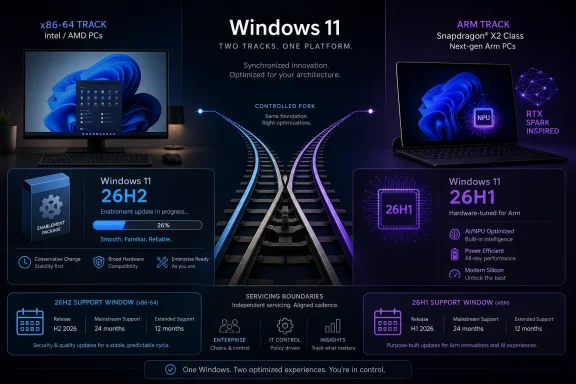 Microsoft’s Annual Update Now Comes With an Asterisk
For most Windows 11 users, 26H2 should be uneventful in the best possible way. Microsoft says the update builds on the same platform and servicing approach used by recent releases, and the evidence points to an enablement package rather than a full operating system swap. In practical terms, that means a small switch flips on top of code already delivered through cumulative updates.This is the same playbook Microsoft used with Windows 11 25H2, where the annual version number changed more dramatically than the underlying system image. The benefit is obvious: fewer migration failures, shorter installation windows, less post-upgrade weirdness, and a lower chance that a feature update detonates a carefully managed fleet. For consumers, it feels like a Patch Tuesday with a new badge. For IT departments, it is a servicing checkpoint.
But the 26H2 announcement lands differently because of what it is not. It is not the universal next step for every Windows 11 PC. Devices already running Windows 11 26H1, including the new hardware class built around Qualcomm Snapdragon X2 and upcoming NVIDIA RTX Spark systems, are not expected to move to 26H2 this fall. Microsoft has effectively confirmed that the “Windows 11” name now covers at least two active platform tracks that do not immediately converge.
That is the real story. Windows 11 26H2 may be boring by design, but the release map around it is anything but boring. Microsoft is telling the x86 base to expect stability while telling the new silicon market that Windows will bend earlier and more aggressively around hardware needs.
26H1 Was Not a Preview of the Future for Everyone
Windows 11 26H1 was easy to misunderstand because the name looked like a normal Windows milestone. It was not. Microsoft framed it as a specialized release for next-generation hardware, available preinstalled on select new devices rather than offered broadly through Windows Update.That distinction matters because Windows users have been trained for years to interpret version numbers as a single ladder. A machine moves from 22H2 to 23H2 to 24H2 to 25H2, and the next number is assumed to be the next rung. Windows 11 26H1 breaks that mental model. It is not a “first half” update in the old Windows 10 sense, nor a public preview of what everyone else gets later.
Instead, 26H1 is a hardware-enabling branch. Microsoft says it is tied to new device innovations and new silicon partners, with Snapdragon X2 devices first in line. The version exists because some hardware apparently needs platform changes that Microsoft was unwilling to inject into the mainstream 24H2 and 25H2 base on the same schedule.
That is a rational engineering decision, but it is a messy branding decision. A PC buyer seeing “Windows 11 26H1” may reasonably assume it is newer than “Windows 11 25H2” and therefore closer to whatever comes next. In reality, 26H1 buyers are on a separate road, not ahead on the same road.
The x86 PC Gets the Safe Update, Not the Experimental One
The Intel and AMD world is receiving the conservative branch. Windows 11 26H2 appears to sit atop the 25H2 lineage, with a small enablement package moving eligible systems to the new annual version. That makes the update less exciting for feature hunters but more attractive for anyone responsible for uptime.This is a meaningful change from the years when Windows feature updates were quasi-upgrades in the traditional sense. A full OS replacement meant more files changed, more drivers were re-evaluated, more compatibility assumptions were tested, and more time was spent staring at spinning progress indicators. The enablement model narrows the blast radius.
It also reflects Microsoft’s current reality. The company wants Windows to feel continuously updated, especially as Copilot, AI features, Store-delivered components, and inbox apps evolve outside the old OS release rhythm. If major experiences can arrive through cumulative updates, app updates, or controlled feature rollouts, the annual Windows version becomes less of a product launch and more of a support boundary.
That is why 26H2’s lack of drama is not a failure. For x86-64 PCs, boring is the feature. The mainstream installed base is enormous, heterogeneous, and full of hardware that no Microsoft lab can perfectly model. The safest way to move it forward is to avoid moving too much at once.
The Arm Branch Reveals Microsoft’s Real Priority
The existence of 26H1 says Microsoft is still chasing the promise of Windows on Arm, but with a more pragmatic playbook than before. Rather than forcing the entire Windows ecosystem to absorb platform-level changes on a single schedule, Microsoft is carving out a lane for devices that need special treatment. That should reduce risk for everyone else.Windows on Arm has always had two problems. The first is technical: emulation, drivers, native app availability, power management, and edge-case compatibility all need to work well enough that users stop thinking about the instruction set. The second is narrative: Microsoft needs buyers to believe these machines are not science projects.
A dedicated 26H1 platform can help with the technical problem. If Snapdragon X2 and RTX Spark-class devices need low-level changes for performance, power behavior, AI acceleration, or driver models, Microsoft can ship those changes without pretending they are ready for every existing x86 desktop. The result could be better hardware at launch and fewer regressions for the broader base.
But it complicates the narrative problem. If a new Arm laptop launches with 26H1 and does not receive 26H2 later in 2026, the buyer may wonder whether the machine is ahead, behind, or stranded. Microsoft’s support language says these devices remain serviced, but support is not the same as clarity. Version numbers are consumer communication, and this scheme asks consumers to learn a new dialect.
Version Numbers Are Becoming Less Truthful
The old Windows version number at least pretended to answer a simple question: what generation of Windows am I running? With 26H1 and 26H2, that answer now depends on architecture, silicon generation, and servicing branch. Two machines can both be current and still sit on different numbered releases that do not upgrade into one another during the same calendar year.This is not unprecedented in computing. Apple ships OS builds that vary by hardware. Android is famous for vendor and device-specific release timelines. Linux distributions have kernels, backports, and vendor hardware enablement stacks that make the displayed version only part of the story. The difference is that Windows built its identity on broad binary compatibility and a relatively unified platform surface.
Microsoft is now trying to preserve that identity while quietly admitting that the hardware world no longer fits cleanly under one annual image. NPUs, Arm SoCs, AI PCs, hybrid graphics, security silicon, and OEM-specific power frameworks make the PC less generic than it used to be. The “Windows PC” remains a category, but the guts are diverging.
The risk is that version numbers become marketing labels rather than operational facts. For IT pros, the meaningful questions are not “26H1 or 26H2?” but “which build, which servicing policy, which driver stack, which feature enablement state, and which hardware support baseline?” Microsoft’s public naming has not caught up to that complexity.
Enterprise IT Will Care Less About the Name Than the Servicing Boundary
For managed environments, 26H2’s most important trait is predictability. If the update arrives as a lightweight enablement package for 24H2 and 25H2 systems, deployment planning becomes more about validation than migration. That is a welcome shift after years of Windows feature updates being treated as mini operating-system upgrades.The support calendar remains the operational hook. Windows 11 follows an annual feature update cadence, with consumer and Pro editions receiving shorter support windows than Enterprise and Education editions. Moving to 26H2 resets that clock for eligible systems and keeps fleets aligned with Microsoft’s servicing expectations.
The 26H1 branch is a different procurement question. An organization buying Snapdragon X2 or RTX Spark-class devices is not just buying different hardware; it is buying into a different Windows servicing path for at least the near term. That does not make the hardware unsuitable. It does mean pilot programs need to include update-channel behavior, management tooling, driver availability, VPN clients, endpoint security agents, and line-of-business apps.
This is where Microsoft’s selective-release strategy is defensible. Most enterprises do not want early platform change for its own sake. They want new hardware to work without destabilizing old hardware. If separating 26H1 from 26H2 gives Microsoft room to support new silicon without dragging every fleet into the experiment, many admins will quietly approve.
The Driver Story Is the Quiet Compatibility Test
Windows compatibility is often discussed in terms of apps, but drivers remain the hard boundary. User-mode software can be emulated, shimmed, updated, or delivered through compatibility layers. Kernel-mode drivers do not get that kind of forgiveness.That is especially important for Windows on Arm. Security tools, device peripherals, VPN stacks, virtualization products, development utilities, and niche hardware often depend on drivers. If those drivers are not available for Arm64, the platform’s theoretical compatibility becomes less useful in practice. A fast Arm laptop that cannot run a required endpoint agent is not a productivity win.
The 26H1 split gives Microsoft and its partners a cleaner place to solve those problems. It also gives vendors a clearer signal: if they want to participate in the next wave of Windows hardware, Arm64 support cannot be an afterthought. The days when Windows on Arm could rely on emulation as a catch-all answer are ending.
For x86-64 users, meanwhile, 26H2 being conservative is an advantage. The existing driver ecosystem is vast and battle-tested, and Microsoft has little incentive to disturb it unnecessarily. The company’s message to Intel and AMD users is essentially: your platform is mature, your update is incremental, and your drama budget has been spent elsewhere.
The AI PC Push Is Forcing Windows to Become More Hardware-Aware
The timing is not accidental. Microsoft, Qualcomm, NVIDIA, AMD, Intel, and the OEMs are all trying to define the next PC refresh cycle around AI acceleration, battery life, local inference, and new silicon differentiation. A single generic Windows update cadence is a poor fit for that market.Copilot+ PCs already showed how hardware requirements can shape Windows feature availability. Some capabilities depend on NPUs that meet specific performance thresholds. Others arrive first on one class of machine and later on another. The operating system is increasingly a broker between cloud services, local models, specialized accelerators, and privacy-sensitive workloads.
That makes the Windows servicing model more complicated. Microsoft wants developers to target Windows broadly, but it also wants OEMs to ship differentiated hardware that can justify premium prices. It wants users to trust that Windows 11 is Windows 11, while also promoting experiences that only appear on certain machines. The 26H1 and 26H2 split is the servicing expression of that tension.
The company could have hidden more of this under marketing names. Instead, it has exposed the split through versioning. That may be more honest technically, but it is not necessarily easier for buyers. A version number that once communicated freshness now also communicates hardware lineage.
Microsoft Learned the Wrong Kind of Lesson From Big-Bang Updates
The move toward enablement packages is a response to history. Windows feature updates that replace large portions of the system are expensive to test, slow to install, and prone to compatibility surprises. Every reduced-scope update is a tacit admission that the old model carried too much risk.This does not mean Windows is standing still. It means Microsoft has decoupled much of the visible product from the annual release. Start menu changes, Copilot integrations, Settings updates, inbox app changes, and feature experiments can move independently from the big version bump. The operating system’s public milestone becomes a bundle of support policy, branding, and staged feature enablement.
That approach is better for reliability but worse for comprehension. Users may install 26H2 and wonder why it feels like 25H2. Another user may stay on 25H2 but receive many of the same features through cumulative updates. A third may buy a 26H1 Arm device and be current despite not moving to 26H2.
The old Windows upgrade event gave people a clear, if sometimes painful, sense of change. The new model gives them less disruption and less certainty. That is probably the right trade for an operating system used by hundreds of millions of people, but Microsoft should not pretend the naming remains intuitive.
Consumers Should Treat 26H2 as a Maintenance Release With a Longer Tail
For home users on Intel and AMD PCs, the practical advice is simple: do not expect Windows 11 26H2 to feel like a new operating system. Expect it to arrive like a cumulative update, install relatively quickly, and mostly formalize changes already present or staged in the background. That is not a reason to avoid it.The security argument is stronger than the feature argument. Staying on a supported Windows version keeps monthly updates flowing and avoids the scramble that happens when a release approaches end of servicing. If 26H2 is offered normally on a compatible x86-64 PC, the average user should treat it as routine maintenance after the first wave has had time to expose obvious bugs.
The more interesting consumer decision involves new Arm hardware. A Snapdragon X2 or RTX Spark-class Windows device may offer real advantages in battery life, AI workloads, thermals, or form factor. But buyers should understand that “26H1” does not mean the machine will follow the same update path as a Dell or Lenovo x86 laptop running 25H2 today.
That does not make such devices bad purchases. It does make them early-platform purchases. Anyone dependent on specialist software, unusual peripherals, kernel-level tools, or gaming anti-cheat systems should verify compatibility rather than relying on Windows branding to do the work.
Developers Can No Longer Ignore Arm64 as a Side Quest
For developers, the 26H1 branch is another sign that Arm64 Windows support is moving from optional curiosity to strategic requirement. Microsoft can ship emulation improvements, but the best experience on new hardware will come from native code, native dependencies, and clean installer logic. Apps that still assume x86-64 as the only serious Windows target will increasingly look dated.The problem is not just executable architecture. Installers, update services, shell extensions, drivers, plug-ins, performance profiling tools, and licensing components all need to behave correctly. A surprising amount of Windows software still carries assumptions from an era when “PC” and “x86” were functionally interchangeable.
Windows on Arm has improved enough that those assumptions are now the weak link. If the hardware gets good and the OS support becomes more tailored, the remaining friction will come from the software ecosystem. Developers who fix that early will have an advantage as OEMs push more Arm machines into premium and enterprise channels.
The 26H2 update for x86-64 does not reduce that pressure. It simply means the existing PC base gets a calmer year while the new platform work happens elsewhere. The market can support both realities at once: x86 remains dominant, and Arm becomes too important to ignore.
The 26H2 Story Is Really About Two Windows Promises
Microsoft is trying to keep two promises that do not naturally align. The first is the traditional Windows promise: broad compatibility, predictable servicing, and a single platform that works across a chaotic hardware ecosystem. The second is the modern AI PC promise: hardware-specific optimization, rapid silicon enablement, and differentiated local experiences.Windows 11 26H2 serves the first promise. It reassures mainstream users that the annual update will not be a disruptive platform jump. It gives administrators a manageable servicing event and keeps Intel and AMD systems on a stable path.
Windows 11 26H1 serves the second promise. It lets Microsoft and its hardware partners move faster for new Arm-based designs without forcing every existing PC to absorb the same changes. It is a controlled exception to the unified Windows story.
The danger is that Microsoft undersells the exception until confusion becomes the story. If users see 26H1, 26H2, 25H2, build 28000, build 26200, enablement packages, Experimental channels, and Beta channels without a clear mental model, they will fall back on suspicion. Windows users have long memories, and they are quick to interpret unclear servicing as instability.
The Calendar Says 26H2, but the Platform Says Fork
There is a temptation to describe this as fragmentation, full stop. That is not quite fair. Fragmentation implies disorder, while Microsoft’s current approach appears deliberate and bounded. The company is not letting OEMs create random Windows variants; it is maintaining separate platform tracks for specific hardware needs.Still, from the outside, the effect resembles a fork. 26H1 devices are current but not on the 26H2 path. 26H2 devices are current but do not include the 26H1 platform base. Both receive updates. Both are Windows 11. The shared brand hides a meaningful technical separation.
The test will come in 2027, when Microsoft is expected to provide a future path that brings these tracks closer together. If the branches converge cleanly, 26H1 will look like a temporary hardware-enablement maneuver. If they remain separated or multiply, Windows versioning will need a rethink.
Microsoft can make this work, but only if it communicates the rules plainly. A Windows release name should tell users whether they are on the mainstream annual track, a hardware-specific track, or a long-term servicing track. Right now, too much of that meaning is buried in support pages and Insider build notes.
The Practical Reading of Microsoft’s 2026 Windows Map
The smartest way to read 26H2 is not as a feature launch but as a servicing signal. Microsoft is keeping the mainstream Windows 11 base steady while it gives next-generation Arm hardware a separate runway. That makes the update less glamorous and more important.- Windows 11 26H2 is the expected 2026 annual feature update for mainstream x86-64 PCs from Intel and AMD.
- Windows 11 26H2 should behave like a small enablement package for many eligible systems rather than a full operating system replacement.
- Windows 11 26H1 is a specialized hardware release for select new devices, beginning with Snapdragon X2 systems and extending to newer Arm-based designs such as RTX Spark-class PCs.
- Devices running Windows 11 26H1 are serviced, but they are not expected to move onto the 26H2 branch in the second half of 2026.
- Enterprise buyers should treat 26H1 devices as a distinct platform pilot, not simply as newer Windows 11 laptops.
- Developers and vendors should read the split as another warning that Arm64 support, especially for drivers and low-level components, is becoming part of mainstream Windows readiness.
References
- Primary source: TechPowerUp
Published: Mon, 22 Jun 2026 14:29:02 GMT
Microsoft Confirms Windows 11 26H2 Update for x86-64 PCs | TechPowerUp
Microsoft late last week confirmed this year's update to Windows 11, version 26H2. This update would be exclusive to PCs powered by x86-64 processors (compatible processors from Intel and AMD); as devices based on Qualcomm Snapdragon Elite and NVIDIA RTX Spark are now on a separate update...www.techpowerup.com - Related coverage: tomshardware.com
Microsoft confirms Windows 11 26H1 will be for Arm devices only at launch — Snapdragon X2-powered devices officially shipping with 26H1 | Tom's Hardware
It's 24H2 all over again, but with the caveat that 26H1 will only support specific hardware for its entire lifecycle. Devices running 26H1 will not be able to upgrade to 26H2.www.tomshardware.com - Related coverage: windowscentral.com
Microsoft confirms that Windows 11 version 26H1 will not be updated to version 26H2 this fall — won't get a new version until 2027 | Windows Central
Microsoft's special offshoot version of Windows 11 that's exclusive to Snapdragon X2 devices won't be getting an upgrade to version 26H2 this fall. Here's whywww.windowscentral.com - Related coverage: windowslatest.com
Microsoft releases Windows 11 26H1, but it's not for existing PCs. Windows 11 26H2 is coming for all PCs
Microsoft reached out to Windows Latest to confirm Windows 11 26H1 is real and rolling out. Existing PCs get version 26H2. www.windowslatest.com
- Official source: learn.microsoft.com
Windows 11, version 26H1 known issues and notifications | Microsoft Learn
View announcements and review known issues and fixes for Windows 11, version 26H1learn.microsoft.com - Related coverage: winbuzzer.com
Windows 11 26H1 Won't Get 26H2 Update Until 2027
Microsoft has confirmed Windows 11 version 26H1 devices cannot move to 26H2 in 2026, forcing Snapdragon X2 PCs onto a separate update branch until 2027. winbuzzer.com
- Related coverage: redmondmag.com
Windows 11 Version 26H1 Targets ARM Devices, Won't Receive H2 2026 Update -- Redmondmag.com
Windows 11, version 26H1 will arrive exclusively on ARM-based hardware in early 2026 and is not being offered as an in-place update for existing installations, Microsoft said Tuesday.redmondmag.com - Related coverage: techradar.com
Microsoft confirms Windows 11 26H1 update won't be coming to your current PC — here's why that's actually great news | TechRadar
It's all about avoiding another 24H2 disaster for existing PCs, which will stay on 25H2 and not get 26H1www.techradar.com
