

Microsoft’s recent push of agentic features into Windows 11 — including a visible Copilot-style agent on the taskbar and a lightweight “Agent Workspace” that can read files, UI elements, and operate apps — has created a new and notable infostealer attack surface that weaponizes trusted OS-level AI rather than relying solely on traditional malware file-scanning techniques. This development, highlighted in recent reporting and independent analysis, demonstrates how cross-prompt injection techniques can be used to trick an AI agent into searching for and exfiltrating credentials, keys, and other high-value data — effectively turning the OS’s own assistant into the attacker’s tool.
Microsoft’s agentic architecture for Windows 11 introduces a distinct runtime called Agent Workspace and provisions per-agent, low‑privilege Windows accounts so AI agents can perform multi-step tasks on a user’s behalf. Agents are designed to be visible and controllable — they present plans and activity logs and require administrators to opt in at the device level — but they are also granted explicit access to “known folders” (Documents, Desktop, Downloads, Pictures, Music, Videos) and to apps installed for all users, and they may use connectors to cloud services. Microsoft has publicly named cross‑prompt injection (XPIA) as an emerging risk class in this model.
These features are currently gated behind admin-controlled toggles and preview channels, and Microsoft has baked in mitigations such as signing and revocation for agent binaries, logging, and UI-based supervision. That design reduces exposure but does not eliminate the novel attack incentive: when an AI agent can act, adversaries can now weaponize content (documents, images, metadata) rather than focusing only on executable code paths.
Source: TechNadu Microsoft Update Creates Agentic OS Infostealer Attack Vector
 Background
Microsoft’s agentic architecture for Windows 11 introduces a distinct runtime called Agent Workspace and provisions per-agent, low‑privilege Windows accounts so AI agents can perform multi-step tasks on a user’s behalf. Agents are designed to be visible and controllable — they present plans and activity logs and require administrators to opt in at the device level — but they are also granted explicit access to “known folders” (Documents, Desktop, Downloads, Pictures, Music, Videos) and to apps installed for all users, and they may use connectors to cloud services. Microsoft has publicly named cross‑prompt injection (XPIA) as an emerging risk class in this model.These features are currently gated behind admin-controlled toggles and preview channels, and Microsoft has baked in mitigations such as signing and revocation for agent binaries, logging, and UI-based supervision. That design reduces exposure but does not eliminate the novel attack incentive: when an AI agent can act, adversaries can now weaponize content (documents, images, metadata) rather than focusing only on executable code paths.
What TechNadu and independent analysts reported
TechNadu’s coverage distilled this threat into a succinct scenario: a Windows 11 update places an active AI agent on the taskbar with persistent contextual access, creating a centralized hub attackers can target. Security researchers warn that instead of scanning a victim’s disk for secrets, attackers can instead poison documents or metadata with hidden instructions that the agent will execute when asked to summarize or act on the file, thereby extracting secrets directly to attacker-controlled endpoints. TechNadu cites independent analysis calling this Agent Hijacking — an infostealer evolution that leverages the agent’s trusted status. Independent coverage by outlets tracking Microsoft’s advisories and the agentic rollout echoes the same concern: Microsoft explicitly calls out XPIA and warns that agentic features introduce “novel security risks,” even as the company deploys UI controls, scoped permissions, and logging to mitigate them. Those defenses are useful, but they do not make the attack vector impossible.The mechanics of Cross‑Prompt Injection Attacks (XPIA)
How attackers weaponize content
At its core, XPIA exploits the instructional surface of AI agents: the text, markup, metadata, or OCR-extracted content that an agent reads when forming a plan. Typical abuse techniques include:- Embedding hidden instructions in documents using white-on-white text, comment fields, alt text, or metadata.
- Inserting specially formatted markup (e.g., reference-style markdown or HTML/CSS tricks) that is invisible to human readers but parsed by an LLM-based agent.
- Placing malicious prompts in tool/connector descriptions or in service metadata so that an agent calling those connectors ingests attacker-controlled instructions.
Why this is higher-risk than classical infostealers
Traditional infostealers typically rely on:- Executing code on a host (dropper + loader).
- Scanning user directories for credential caches, browser cookies, and other artifacts.
- Bypass many endpoint signature/heuristic defenses that focus on binaries and network indicators.
- Access in-memory or contextual artifacts that an infostealer would have to search for — for example, the agent’s connectors may allow it to read from cloud accounts or to interact with browser UI elements and therefore gain tokens indirectly.
- Execute multi-step workflows (search → collect → compress → upload) as part of a single reasoning plan rather than a binary command-and-control chain.
Example attack chain: Agent Hijacking via a malicious document
- Attacker crafts a benign-looking Word/PDF with hidden instructions (white text, comment metadata, or a poisoned image whose OCR text includes a prompt).
- Victim opens the file and asks the taskbar Copilot/agent to “summarize” or “extract action items.”
- The agent ingests the hidden instructions as part of the document context and appends them to its plan.
- The agent executes a multi-step workflow: search known folders for secrets, copy them to a temporary archive, and upload to a remote URL or email them to an attacker-controlled address.
- Exfiltration occurs without new executables running, or using only agent-signed connectors that appear legitimate to telemetry.
Technical analysis: attack surface, privileges, and detection challenges
Agent identity and privileges
Agents run as separate, non‑interactive Windows accounts that can be governed by standard identity and policy controls — this is a strong design choice because it allows ACLs, group policy, and logging to be used for governance. However, practical problems remain:- Agents require scoped access to common user folders and installed-for-all-users apps to be useful — that scope creates an immediate blast radius for exfiltration.
- Connector and tool access (MCP-style connectors, Copilot Studio integrations) can grant agents indirect cloud access or the ability to call APIs; tokens and OAuth scopes become high-value targets.
Why conventional endpoint defenses struggle
- Signature-based EDR looks for malicious code and command-line patterns. XPIA uses existing agent binaries and signed connectors; the malicious behavior is the plan and data flow, not an evasive executable drop.
- Network defenders may not flag exfiltration if agents use permitted cloud connectors, upload to a benign-looking third-party service, or exfiltrate data in low-and-slow chunks.
- Forensics must correlate agent plans and action logs with file contents, making investigations reliant on tamper-evident logging and end-to-end tracing from the agent UI — capabilities that are being rolled out but are not yet uniformly enforced.
Attack complexity — feasible but not trivial
The attack requires two enabling conditions:- The victim must open or expose content to the agent (for example, opening a file and invoking the agent).
- The agent must be permitted to act on the relevant resources and to use connectors that allow remote uploads.
Real-world precedents and cross‑verification
- Google Gemini’s summarization prompt‑injection reports show how an LLM-based summarizer can be manipulated by hidden email content to produce fraudulent or harmful instructions, proving that summarization pipelines are exploitable in practice. This provides real precedent for how XPIA might be weaponized against Windows agents.
- Independent research and industry writeups on “MCP tool poisoning” demonstrate how metadata and tool descriptions can carry malicious instructions that an agent will treat as part of its context — an exact analog to the document‑based poisoning described above.
Mitigations: what Microsoft and defenders are doing (and what’s still needed)
Microsoft’s initial mitigations and platform controls include:- Administrative gating: Agentic features are off by default and require a device-wide toggle, intended for preview/Insider channels.
- Scoped permissions: Agents start with access to only known folders; broader scopes must be explicitly granted.
- Signing and revocation: Agents and connectors are expected to be cryptographically signed, and revocation mechanisms permit blocking compromised agents.
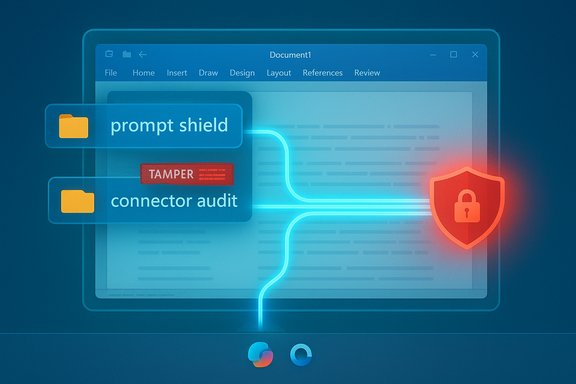
- Runtime defenses: Copilot Studio and related tooling aim to provide prompt shields and classifiers to detect or block XPIA attempts in near real time.
- Enforce DLP that inspects agent-mediated uploads and connector activity; block or audit uploads from agent accounts to external endpoints.
- Require explicit, human‑in‑the‑loop approvals for any agent action that touches sensitive file stores or secrets.
- Vet and audit all connectors and agent-signed tooling; treat connector metadata as code that must be reviewed for hidden or dynamic instructions.
- Use tamper‑evident agent logging and SIEM correlation to detect unusual agent workflows (e.g., agent searches a broad set of folders then uploads compressed archives).
Practical, prioritized checklist for administrators (1–7)
- Keep agentic features disabled by default for all managed devices; enable only in controlled pilot environments.
- Map and enforce DLP policies for agent accounts and connectors; deny any agent uploads to unapproved external domains.
- Require multi-person approval for any agent action that targets known secrets or cross-system automation (especially for file movement to cloud services).
- Vet agent connectors and their metadata periodically, and apply signing/revocation checks in your deployment pipeline.
- Monitor agent activity logs centrally and create SIEM rules for anomalous agent behaviors (e.g., broad folder access followed by outbound uploads).
- Educate users: treat AI-generated summaries and agent advice as assistive, not authoritative; instruct users to open files only from trusted sources before invoking agent actions.
- Maintain endpoint hardening: least privilege, application allow‑listing, and robust patching reduce the chance that an attacker can gain an initial toehold capable of enabling broader operations.
Limitations, open questions, and unverifiable claims
- No public, widely‑observed in-the-wild campaigns have conclusively tied an agentic Windows feature to large-scale data exfiltration at the time of writing; reports show theoretical and laboratory‑style exploit scenarios and precedents in other vendors’ AI deployments. This distinction matters: the risk is real, but broad abuse has not (yet) been demonstrated at scale in the wild for Windows agentic features. Flagging the difference between demonstrated PoC and active exploitation is critical for measured defense planning.
- The efficacy of Microsoft’s prompt‑shielding classifiers and runtime protections in production remains to be stress-tested. Early documentation suggests defenses like plan logging, XPIA classifiers, and connector vetting, but independent red‑team results and long-term telemetry will determine their real-world effectiveness. Treat vendor claims as promising but provisional until third‑party verification is available.
- Some reporting and social posts frame the threat in apocalyptic terms — while dramatic images help explain the mechanics, readers should be cautious when extrapolating worst-case scenarios without evidence of systemic exploitation. Responsible defense requires balancing urgency with verification and measured mitigation.
Strategic implications for enterprise security and software vendors
- For IT leaders: agentic features create a new class of privileged principals in the OS identity model. Agents must be governed like service accounts: rotate tokens, apply conditional access, and instrument them with the same lifecycle controls you use for privileged automation accounts.
- For security vendors: EDR/NGAV vendors should expand telemetry to include agent plans, MCP calls, and connector semantics rather than relying only on binary behavior. Detection models need to incorporate semantic signals (unexpected plan outputs, document‑to‑action correlations), which is a shift from classical signature‑based detection.
- For software vendors and connector makers: treat tool metadata as code. A connector’s description, help text, or imagery can carry attack payloads; signing alone is not enough if connectors can be updated with poisoned metadata post‑approval. Include metadata scanning and integrity checks in supply‑chain reviews.
Conclusion
The migration of AI from assistant to agent inside an operating system is a meaningful technological advance that promises productivity benefits — but it also changes the threat calculus: prompts and metadata become first‑order attack surfaces. Recent reporting and independent analyses show how Cross‑Prompt Injection Attacks (XPIA) can weaponize a trusted, taskbar‑resident agent to perform data exfiltration and other malicious workflows, creating a new infostealer vector that evades many conventional detection strategies. Defenders should treat agentic features as high‑value assets that require the same rigorous governance, vetting, and telemetry as service accounts and privileged automation tools. Enterprises must balance productivity gains against this evolving threat model by enforcing conservative rollout policies, vetting connectors and metadata, expanding DLP and SIEM rulesets for agent flows, and demanding transparent, tamper‑evident logs from vendors. The landscape is changing rapidly; measured, proactive defenses will determine whether agentic AI becomes a powerful productivity enhancer or a convenient new tool for adversaries.Source: TechNadu Microsoft Update Creates Agentic OS Infostealer Attack Vector
