

Windows 11 posted notably stronger results in several local AI tests than Ubuntu 26.04 LTS and CachyOS on Razer’s Blade 18 RZ09-0582, but the broader 99-test comparison does not support a blanket Windows victory.
Phoronix tested the three operating systems on the same high-end laptop, fitted with an Intel Core Ultra 9 290HX Plus processor and Nvidia GeForce RTX 5090 Laptop GPU. Windows 11 was the Razer factory installation; Ubuntu used Linux 7.0, while the rolling CachyOS build used Linux 7.1. The Windows and Ubuntu systems used Nvidia’s R595 driver, while CachyOS shipped with the newer R610 branch.
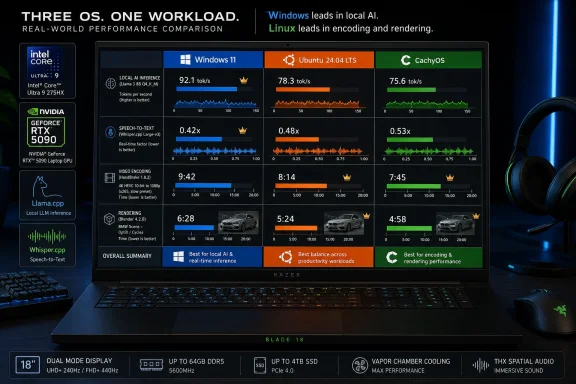
The clearest Windows advantage appeared in Llama.cpp tests using the CPU OpenBLAS backend. According to Phoronix, Windows 11 was fastest in every tested text-generation and prompt-processing run across Qwen, GPT-OSS, and GLM models. That is meaningful for users running quantized local models on the CPU rather than offloading inference entirely to the GPU.
Results were more mixed with Llama.cpp’s Vulkan backend. CachyOS led text-generation tests for several models, while Windows 11 was quickest at prompt processing with two of the tested models. Phoronix described overall Vulkan performance as similar across Windows and Linux.
Windows also led the Whisper.cpp-based Whisperfile speech-to-text tests with both Small and Medium models. The publication called the gap unexpectedly large, though the results apply to this particular hardware, driver stack, and benchmark configuration—not every local transcription tool or model runtime.
The picture was not uniform even within video work. Windows 11 was fastest in several 1080p Kvazaar H.265 encodes, while CachyOS led the 4K slow and medium presets. Linux also delivered faster results in CPU rendering and several GPU-accelerated rendering benchmarks, although Windows won the Nvidia RTX GPU test in Chaos V-Ray.
That aggregate should be treated cautiously. CachyOS is explicitly performance-tuned and was tested with a newer kernel, compiler, and Nvidia driver than the other two platforms. It is a useful real-world comparison of current out-of-box environments, but not a tightly matched operating-system-only experiment.
For Windows users, the practical result is straightforward: Windows 11 is a credible—and in some CPU-based Llama.cpp and Whisper workloads superior—platform for local AI on this hardware, while Linux remains the better choice for several open video-encoding and rendering workflows.
Phoronix tested the three operating systems on the same high-end laptop, fitted with an Intel Core Ultra 9 290HX Plus processor and Nvidia GeForce RTX 5090 Laptop GPU. Windows 11 was the Razer factory installation; Ubuntu used Linux 7.0, while the rolling CachyOS build used Linux 7.1. The Windows and Ubuntu systems used Nvidia’s R595 driver, while CachyOS shipped with the newer R610 branch.
 Windows takes the CPU AI wins
The clearest Windows advantage appeared in Llama.cpp tests using the CPU OpenBLAS backend. According to Phoronix, Windows 11 was fastest in every tested text-generation and prompt-processing run across Qwen, GPT-OSS, and GLM models. That is meaningful for users running quantized local models on the CPU rather than offloading inference entirely to the GPU.Results were more mixed with Llama.cpp’s Vulkan backend. CachyOS led text-generation tests for several models, while Windows 11 was quickest at prompt processing with two of the tested models. Phoronix described overall Vulkan performance as similar across Windows and Linux.
Windows also led the Whisper.cpp-based Whisperfile speech-to-text tests with both Small and Medium models. The publication called the gap unexpectedly large, though the results apply to this particular hardware, driver stack, and benchmark configuration—not every local transcription tool or model runtime.
Linux retains the media-workload edge
Ubuntu and CachyOS were generally faster in OpenAPV encoding, while SVT-AV1 encoding “typically” performed best on Linux in the test suite. CachyOS took most of those wins, with Ubuntu leading one of the AV1 cases.The picture was not uniform even within video work. Windows 11 was fastest in several 1080p Kvazaar H.265 encodes, while CachyOS led the 4K slow and medium presets. Linux also delivered faster results in CPU rendering and several GPU-accelerated rendering benchmarks, although Windows won the Nvidia RTX GPU test in Chaos V-Ray.
Overall: CachyOS narrowly leads
CachyOS finished first in 51% of the 99 benchmarks, Windows 11 in 38%, and Ubuntu in 10%, per Phoronix. Windows was last in roughly half of the tests. On the geometric-mean aggregate, CachyOS narrowly won, with Windows just ahead of Ubuntu.That aggregate should be treated cautiously. CachyOS is explicitly performance-tuned and was tested with a newer kernel, compiler, and Nvidia driver than the other two platforms. It is a useful real-world comparison of current out-of-box environments, but not a tightly matched operating-system-only experiment.
For Windows users, the practical result is straightforward: Windows 11 is a credible—and in some CPU-based Llama.cpp and Whisper workloads superior—platform for local AI on this hardware, while Linux remains the better choice for several open video-encoding and rendering workflows.
References
- Primary source: Windows Report
Published: 2026-07-20T07:43:35+00:00
Windows 11 Outperforms Ubuntu and CachyOS in AI Tests
A Windows 11 vs Linux test shows Microsoft’s OS leading in local AI workloads, while Ubuntu and CachyOS dominate video encoding. windowsreport.com
- Related coverage: phoronix.com
Ubuntu 26.04 LTS vs. Windows 11 vs. CachyOS Performance On A $5399 Laptop - Phoronix Forums
Phoronix: Ubuntu 26.04 LTS vs. Windows 11 vs. CachyOS Performance On A $5399 Laptop Earlier this month on Phoronix I reviewed the Razer Blade 18 RZ09-0582 as the first laptop Razer is certifying for Linux use via Canonical's hardware certification program for Linux. It offered very nice...www.phoronix.com
