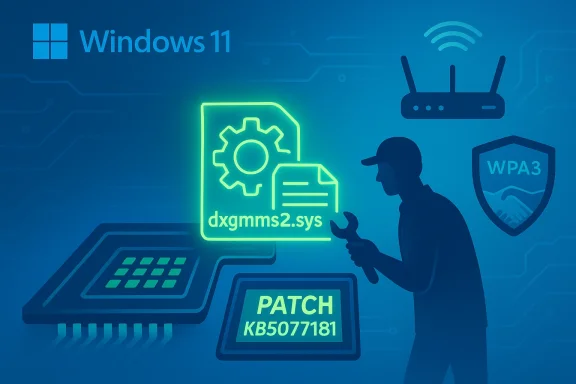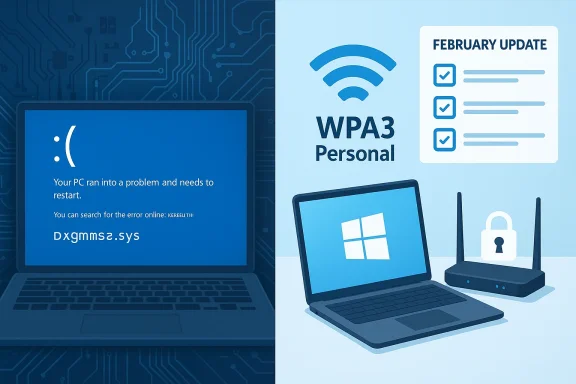
Microsoft has confirmed that this month’s Windows 11 updates introduced two distinct, user-visible regressions — a blue/black screen system error tied to certain GPU configurations and a separate networking issue that prevented some devices from connecting to WPA3‑Personal Wi‑Fi networks — and says fixes are already rolling out as part of February’s cumulative releases and targeted mitigations.
Background / Overview
On February 10, 2026 Microsoft published its monthly cumulative updates for Windows 11 and, as is common, those rollups bundled a mix of security patches, quality fixes from preview releases, and targeted reliability changes. In the days after the release, users and OEMs reported two clusters of problems: (1) systems with particular graphics configurations experiencing a kernel crash related to the DirectX graphics subsystem and (2) intermittent failures to join some WPA3‑Personal wireless networks on devices that had previously been working.Microsoft’s release notes for the February updates explicitly list both items among the addressed issues, and a companion update for the new 26H1 branch calls out a graphics fix that names dxgmms2.sys and the KERNEL_SECURITY_CHECK_FAILURE symptom. At the same time the company acknowledged the WPA3 regression and folded a repair into the February cumulative. Where appropriate Microsoft is using targeted rollout techniques and Known Issue Rollback (KIR) behavior to limit further impact and to push mitigations to affected devices.
What happened: two different regressions, one update window
GPU-related crash: dxgmms2.sys → KERNEL_SECURITY_CHECK_FAILURE
Beginning with the early February packages and a January preview before them, some Windows 11 systems started to show a stop error stemming from the DirectX graphics memory manager — the dxgmms2.sys component. The observable failure mode was a kernel stop code indicating a KERNEL_SECURITY_CHECK_FAILURE; on modern Windows releases Microsoft has been rolling out subtle visual changes to crash screens (some vendors call them “black screen of death” variants), but the technical reality remained: an unexpected kernel-exit condition that forced a reboot and, in many cases, user intervention.Notably the publicly posted fixes describe the problem as tied to certain GPU configurations, not all GPUs or all systems. That phrasing typically signals a narrow interaction — often a specific GPU family, driver version, firmware combination, or OEM-supplied kernel-mode driver that only appears on a subset of hardware.
WPA3-Personal connectivity broken for some devices
Independently, Microsoft’s change log for the February rollup also calls out a networking fix: an issue that “prevented some devices from connecting to certain WPA3‑Personal Wi‑Fi networks.” Reports showed varying symptoms — from networks not appearing in the SSID list to failed authentication/association attempts on WPA3‑only access points. Microsoft traces the regression to interactions introduced by a prior update (a January package referenced in Microsoft’s notes), and the February release explicitly lists a correction for that behavior.Microsoft’s response and how the fix is being delivered
Microsoft’s approach in situations like this is multi-pronged:- For the WPA3 connectivity regression the February cumulative update contains the corrective logic; installing the KB associated with February’s Patch Tuesday brings systems back to the expected behavior for affected WPA3‑Personal networks.
- For the graphics/kernel crash the fix appears in an update for the newer build branch and in the 26H1 technical notes; Microsoft indicates the change addresses a dxgmms2.sys‑related system error that could result in KERNEL_SECURITY_CHECK_FAILURE. The company is also known to use Known Issue Rollback (KIR) as a server-side mitigation when urgent changes cause unacceptable regressions — KIR can disable or revert a faulty change without requiring a full client-side reinstallation.
- Microsoft is phasing certificate and boot-manager changes tied to Secure Boot at the same time; that rollout uses telemetry gating to reduce blast radius, and administrators should be mindful that firmware/UEFI interactions create a separate class of post‑patch risk.
Technical analysis: dxgmms2.sys, kernel checks, and what usually goes wrong
What dxgmms2.sys does
dxgmms2.sys is a kernel component in the Windows graphics stack that handles memory management services for DirectX (the DirectX Graphics Memory Management Subsystem). It is deeply involved in video memory allocation, sharing between user-mode and kernel-mode graphics components, GPU scheduling interactions, and the handling of graphics device interrupts.When dxgmms2.sys encounters inconsistent state — for example, corrupted memory descriptors, mismatched expectations between the kernel and a GPU driver, or an invalid pointer returned during a memory validation pass — Windows enforces kernel integrity by triggering a stop condition. The KERNEL_SECURITY_CHECK_FAILURE stop code is a catch-all that indicates Windows detected a condition that violates expected kernel memory/structure invariants.
Why this often shows up only on "certain GPU configurations"
- Third‑party drivers: GPU vendors regularly ship kernel-mode drivers. If the OS change modifies dxgmms2.sys behavior or expectations, a vendor driver compiled against an earlier contract can fail to meet the new checks.
- OEM firmware: Laptop and desktop BIOS/UEFI blobs can alter hardware state and expose timing or capability differences that only show up on specific motherboard+GPU combos.
- Feature gating and hardware paths: Newer GPUs or uncommon hybrid setups (integrated GPU + discrete GPU with special multiplexing) exercise code paths that are rarely used in lab testing, so regressions can be missed until wide deployment.
- Anti-cheat or virtualization filters: Kernel drivers from anti-cheat, security products, or virtualization stacks may interact with the graphics stack and cause edge-case failures when the OS updates its invariants.
Scope and scale: who’s most likely affected
- The heat map for this incident is not a mass‑market outage affecting all GPUs. Microsoft’s language — “certain GPU configurations” — and the targeted fix indicate a smaller population of devices.
- Systems that received the January/preview packages or had drivers that weren’t updated in lockstep with OEM firmware are more likely to have encountered the condition.
- The WPA3 regression affected devices that had updated to a specific pre‑February package and were connecting to WPA3‑Personal networks. Because WPA3 is still not universal in consumer routers and some AP firmware implementations vary, the failure surface is inherently environmental: affected device + specific AP configuration + prior update state.
- Enterprise fleets with tightly controlled driver rollouts may be insulated, but they must still verify compatibility because the Secure Boot certificate and boot manager changes Microsoft is staging separately add complexity to recovery/rollback.
Immediate user and admin guidance (what to do right now)
If your system has already crashed with a kernel stop after a recent update
- Don’t panic — verify the symptom. If you see a KERNEL_SECURITY_CHECK_FAILURE or a restart loop after graphics activity (video playback, GPU‑accelerated apps), the February fixes are intended to address those exact cases.
- Before applying any repair, ensure you have a known-good backup or system image, and confirm BitLocker recovery keys are accessible if BitLocker is enabled.
- Install February’s cumulative updates via Windows Update, Windows Update for Business, or the standalone MSU packages from your internal catalog. If your device cannot boot, use WinRE to access recovery and then apply offline remediation if your environment requires it.
- If the system is unstable and you cannot complete an update, consult your OEM’s recovery guidance — some laptop vendors provide platform-specific drivers/firmware that complement Microsoft’s fixes.
If you cannot connect to WPA3‑Personal networks after recent updates
- Check for the February cumulative update and install it; Microsoft lists a correction for devices that previously failed to connect.
- If you manage the access point, verify the AP firmware supports WPA3‑Personal correctly (mixed-mode and transition modes are historically inconsistent across vendors).
- As a temporary measure, enable WPA2/WPA3 mixed mode on the AP if policy permits, to let affected devices fall back while you deploy the Windows fix.
For IT administrators and help desks
- Deploy the February cumulative to a representative pilot group first, focusing on machines with dedicated graphics hardware, gaming rigs, and machines with nonstandard kernel-mode drivers (security or virtualization filters).
- Export and record UEFI/Secure Boot variable configuration for devices where you manage firmware, because Microsoft’s concurrent Secure Boot certificate replacement is gated and may complicate recovery paths in rare cases.
- Ensure your patch rollouts include coordinated GPU driver updates from OEM/Vendor channels — mismatched OS and driver timelines are often root causes.
Troubleshooting checklist (step‑by‑step)
- Confirm OS build and KB status: Settings → System → About; compare build to the February update build numbers before/after installing.
- Update GPU drivers: Use the vendor’s certified drivers (NVIDIA, AMD, Intel) that match your OS build; avoid beta drivers during recovery.
- Apply the February cumulative update (or targeted KB) and reboot.
- If crashes persist:
- Boot to Safe Mode or WinRE.
- Check Event Viewer for dxgmms2.sys references and memory dump files.
- Use Device Manager to roll back to a previous display driver, if necessary.
- If anti-cheat or kernel-mode security products are present, temporarily disable/uninstall to test.
- For WPA3 network problems:
- Reboot the access point and ensure firmware is current.
- Verify SSID security settings (WPA3‑Personal only vs mixed-mode).
- On the client, forget the network and reconnect after the February update.
- If recovery requires a rollback but the uninstall fails: use System Restore (if available), or restore from image — note that some servicing stack changes complicate clean uninstalls.
Why these incidents keep happening and what Microsoft is doing to reduce risk
Windows is a massive compatibility ecosystem: every cumulative update touches deep OS contracts that kernel-mode drivers and firmware depend on. There are several structural reasons regressions persist:- Complex interdependencies: A change intended to harden the kernel or to support new hardware can break a driver that relied on undefined behavior.
- OEM-specific hardware paths: Variations in UEFI, firmware, or board-level wiring exercise code paths rarely seen in lab testing.
- Rapid feature rollouts: Microsoft’s cadence of monthly cumulative updates plus preview packages creates more frequent integration points where interactions can surface.
- Driver/firmware lag: GPU vendors and OEMs may take their own release timelines, which creates windows of incompatibility.
- Telemetry gating for risky changes, which allows phased rollouts based on device health signals.
- Known Issue Rollbacks (KIR) that can disable a change server-side without a full client patch.
- Stronger test harnesses and partnerships with major OEMs and silicon vendors, though edge cases remain inevitable.
The longer-term takeaway for users and IT teams
- Patch promptly, but patch smart. For most users, applying the February cumulative update will fix the two issues described here. For administrators, follow a staged deployment: pilot → broader ring → general deployment.
- Maintain driver and firmware hygiene. GPU driver and BIOS/UEFI updates can be as critical as the OS rollup itself. Coordinate vendor driver updates with OS patching.
- Preserve recovery readiness. Always keep backups, ensure BitLocker recovery keys are accessible, and have recovery media available for systems that may hit firmware/boot path complications.
- Encourage vendors to publish tested driver builds for new OS releases and, when possible, rely on vendor-signed drivers distributed through OEM channels rather than generic late-stage betas.
Strengths and risks of Microsoft’s handling
Notable strengths
- Rapid acknowledgement and targeted remediation: Microsoft documented the WPA3 regression and the graphics/kernel issue in release notes and shipped corrective code within the next maintenance window.
- Use of KIR and phased telemetry gating: These tools reduce the chance of wide-scale regressions and allow rolling back problematic changes without waiting for a full monthly cycle.
- Clear messaging about Secure Boot certificate transitions: Microsoft’s transparency around the certificate updates and the precautions administrators should take is valuable for preventing boot‑level surprises.
Remaining risks and limitations
- Edge cases persist: Narrow hardware and driver combinations keep producing high-impact, low‑volume failures that are hard to fully squash before public rollout.
- Rollback complexity: Servicing stack updates and combined SSU+LCU packages complicate rollback steps; administrators should not assume simple uninstalls will restore prior state.
- Communication lag: While Microsoft documents fixes in KB notes, the average user may not parse build numbers or KB IDs; better in-client explanations and guided rollbacks would reduce support overhead.
Final recommendations (practical checklist)
- For home users:
- Install February 2026 cumulative updates and then reboot.
- Update GPU drivers from the vendor’s stable channel.
- If you use WPA3‑Personal routers and experience failures, check for router firmware updates or temporarily enable mixed-mode to restore connectivity while you update Windows.
- For IT teams:
- Pilot the February rollups on a representative subset, prioritizing machines with discrete GPUs and systems that connect to WPA3‑Personal networks.
- Verify backups, recovery media, and BitLocker key availability before broad deployment.
- Coordinate with OEMs for any firmware or driver updates that vendors identify as required.
- For power users and gamers:
- Watch for vendor driver updates that explicitly state compatibility with the February Windows builds.
- If you rely on anti-cheat or virtualization drivers, confirm their vendor has validated compatibility with the latest KBs.
Microsoft’s February patches are an example of the delicate balancing act in modern OS maintenance: security hardening and feature servicing must coexist with a sprawling, heterogeneous hardware ecosystem. The company has acknowledged the two regressions covered here and has already pushed corrective measures; for most users the steps are straightforward (install the February cumulative, update GPU drivers, and verify wireless configuration). For administrators and power users, the incident is a reminder to test in controlled rings, keep recovery plans current, and coordinate OS and driver rollouts rather than treating them as independent tasks. Conscientious patching plus vendor coordination remains the best defense against these kinds of high‑impact but narrow regressions.
Source: Windows Latest https://www.windowslatest.com/2026/...-wpa3-wi%E2%80%91fi-but-a-fix-is-rolling-out/