

Microsoft’s latest promise to make Windows 11 a noticeably better platform for PC gaming — with a broad “cross‑stack” effort rolling into 2026 — has reignited debates that are at once technical and cultural: can Microsoft actually deliver measurable, system‑level frame‑rate and stutter fixes across the sprawling Windows ecosystem, and will players accept the tradeoffs that come with deeper OS integration of features such as precompiled shaders and on‑device AI upscaling? The announcement, and the community reaction that followed, capture both a believable engineering roadmap and a familiar distrust from a segment of gamers who say Windows updates have often delivered promises that didn’t translate to real‑world, consistent gains. The original report that stirred the conversation is included in the material provided for this feature and mirrors the broader online discourse.
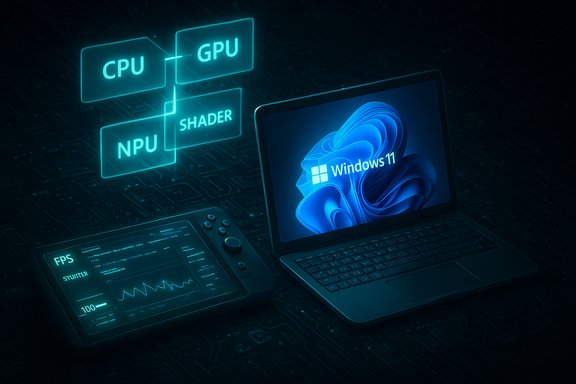
Over the past year Microsoft has shifted from marketing individual gaming features toward coordinated platform engineering aimed at the entire Windows gaming stack. The scope is not limited to a single tweak; the public roadmap covers multiple pillars:
Key concerns raised by players and independent observers:
For now the sensible posture for players and IT pros is pragmatic: watch for measurable milestones, test optional updates like the AMD branch‑prediction backport when appropriate, and expect iterative improvements rather than a single transformative update. The 2026 horizon is credible if Microsoft continues the cross‑vendor coordination it’s already demonstrated, but skepticism from the community is not merely nostalgia — it’s a demand for reproducible, platform‑level results.
Source: happygamer.com Microsoft Promises a Major Windows 11 Gaming Performance Upgrade for 2026 | Happy Gamer
 Background: what Microsoft is promising and why it matters
Over the past year Microsoft has shifted from marketing individual gaming features toward coordinated platform engineering aimed at the entire Windows gaming stack. The scope is not limited to a single tweak; the public roadmap covers multiple pillars:- Background workload management to reduce or pause non‑essential system tasks while a game is in the foreground.
- Power and scheduler improvements to prevent clock and thermal oscillations on battery‑powered devices (notably handhelds).
- Graphics stack optimizations, including runtime and driver interactions.
- Updated driver delivery and tooling (the Agility SDK and related APIs) to let developers ship precompiled shader databases and other runtime optimizations.
What Microsoft has already shipped (and what’s rolling out in previews)
Xbox Full Screen Experience (FSE)
Microsoft has already expanded the Xbox Full Screen Experience — a controller‑first, console‑style shell for Windows 11 — from a handheld novelty to a broader preview for laptops, desktops and tablets. FSE is designed to “bootstrap” a gaming session into a leaner runtime: Explorer and many background surfaces are deferred or disabled, memory pressure is reduced, and task switching is optimized for controller navigation. This feature is available in Insider previews and has started rolling to supported handhelds. Practical effect:- Tangible memory savings on eligible devices.
- Fewer background callbacks likely to interfere with latency‑sensitive apps.
- A more console‑like entry point for casual users who want a lean gaming UI.
Advanced Shader Delivery (ASD)
The DirectX/Agility SDK team introduced Advanced Shader Delivery as a platform feature that allows stores and installers to register precompiled shader databases (PSDBs) so games can ship with shader code compiled ahead of first run. The idea: avoid JIT shader compilation during gameplay by providing matching precompiled shaders at install/download time, dramatically cutting first‑run stalls. This is implemented as tooling in the Agility SDK (SODB/PSDB formats, offline compilers, and registration APIs). Early implementations are already shipping on select handhelds and titles. Why this is significant:- Shader compilation during gameplay is one of the most visible causes of frame hitches on modern PC titles.
- Precompiling shaders removes that source of variance and reduces battery/thermal cost on initial runs.
- This requires ecosystem coordination (stores, installers, GPU vendors) to be broadly effective.
Auto Super Resolution (Auto SR)
Microsoft is previewing Auto Super Resolution — an OS‑level upscaler that runs on on‑device NPUs and transparently upscales lower internal render resolutions to sharper outputs. Because it sits in the OS stack, it does not require per‑game integration (unlike DLSS or FSR), enabling a universal upscaler that can help increase frame rates on lower‑powered devices. Auto SR has shipped on Copilot+ devices with certain NPUs and is slated for preview on specific handhelds in early 2026. Limitations to be aware of:- Upscaling quality depends on NPU capability and driver maturity.
- Not a substitute for engine‑level temporal upscalers; results will vary by scene type and motion.
The technical case: where real wins are likely
Microsoft has targeted concrete bottlenecks that are amenable to platform‑level fixes. The engineering rationale is sound:- Shader compilation is inherently a build/driver issue. If a title ships with a comprehensive precompiled shader set compatible with a driver, the expensive compile work can be avoided on‑device. This isn’t magic — it’s a matter of changing the distribution workflow — but it requires widespread adoption by stores and studios to be fully effective. The DirectX team’s Agility SDK release includes the APIs and tooling to support that.
- Background task noise is measurable. Windows runs numerous scheduled maintenance and telemetry jobs that occasionally take CPU cycles. Creating a mode (or stronger prioritization heuristics) where foreground interactive games are protected from non‑urgent system work can reduce occasional millisecond‑scale jitter. FSE is Microsoft’s user‑facing manifestation of this idea; the system‑level background workload controls are described in Microsoft’s platform posts.
- Power/scheduler oscillations on handhelds and thin‑and‑light laptops are a real source of perceptible unevenness. Per‑process power profiles and scheduler improvements tuned for handhelds can reduce “power‑shift” events that cause sudden clock throttles; that’s a classic systems engineering problem that can be mitigated by OS-level policies rather than per‑game hacks.
The skeptical case: why many gamers aren’t convinced
Community reaction to the 2026 timeline has been blunt and familiar: promises are cheap; consistent delivery across the chaotic Windows ecosystem is hard. The provided reporting captured that skepticism, where users blamed Windows 11 for FPS regressions and bloat, and expressed frustration with what they see as feature‑creep (especially around AI).Key concerns raised by players and independent observers:
- Trust deficit — Many gamers say similar commitments were made in past Windows updates without consistent, cross‑system improvements. The cultural memory of shaky rollouts and regressions colors expectations.
- Bloat and telemetry — There’s worry that new features will inject background services (often AI‑adjacent) that increase resource usage, rather than reduce it.
- Heterogeneous hardware — Windows runs on an enormous range of devices and third‑party drivers. A platform patch that helps one set of configurations (e.g., AMD Zen 5 + certain drivers) might have no effect — or a negative one — in others.
- Dependency on vendors and storefronts — ASD requires game distributors and GPU vendors to cooperate. Without buy‑in from Steam, Epic, EA, or AAA publishers, precompiled shader delivery will remain limited to a subset of titles and clients.
The politics of AI and "bloat": perception vs reality
A notable thread in community feedback is anger toward the perceived proliferation of AI features across Windows — some users fear these will be enabled system‑wide by default, consuming network and compute resources. There’s a clear distinction between:- OS‑level AI features that help performance (for example, an efficient NPU upscaler that reduces GPU load), and
- AI features that add background services or telemetry (for instance, always‑on assistants doing inference in the background).
Linux, SteamOS and the exit option: is the “threat” real?
Some gamers responded to Microsoft’s pledge by saying they’re simply switching to Linux/SteamOS. That reaction is amplifying a real trend: Steam’s hardware survey and other trackers show modest but meaningful growth for Linux gaming, driven largely by the Steam Deck and Proton improvements. Linux still represents a single‑digit share of Steam users, but the growth is visible and sustained. For users who prioritize a minimal, low‑noise system, SteamOS (and some lightweight desktop distributions) have become practical alternatives — especially for handheld‑style devices. Reality check:- Linux’s growth is meaningful but incremental; Windows remains overwhelmingly dominant for PC gaming.
- Anti‑cheat and platform dependencies still block a subset of multiplayer titles on Linux.
- For many players, Linux is now an option for single‑player and Valve‑friendly titles, while switching remains impractical for users whose libraries include anti‑cheat‑protected multiplayer games.
How to judge success: measurable milestones and what to watch for
Microsoft’s 2026 promise is measurable — which is rare and good. Here are concrete milestones and signals to judge progress:- ASD adoption rate — Number of major PC stores and big‑budget titles shipping with PSDB/ASD support.
- First‑run stutter metrics — Independent benchmarks measuring shader compile stalls before and after ASD on identical hardware.
- Frame‑time variance — Benchmarks tracking 0.1% and 1% lows across a device matrix (desktop, laptop, handheld) to see whether micro‑stutters fall.
- Power/clocks stability on handhelds — long‑run telemetry showing fewer “power‑shift” events during sustained gameplay.
- User‑facing toggles and telemetry transparency — whether Microsoft publishes clear opt‑outs and resource‑usage summaries for Auto SR and similar features.
Practical advice for gamers today
While Microsoft works on platform fixes, there are practical steps players can take immediately to reduce stutter and maximize performance:- Use the Windows Game Mode and ensure Full Screen Experience is enabled where supported for leaner runtime behaviour. The FSE toggle is already available in Insider builds and rolling to handhelds; enthusiasts can enable it today in previews.
- For AMD users, check Optional Updates for KB5041587 (and similar optimizations) and test with your titles; results will vary but some users have seen improvements.
- Keep GPU drivers and the Xbox/Store clients updated — driver/tooling improvements are part of the equation.
- If first‑run shader stalls are a major annoyance, look for ASD‑enabled titles or use community shader caching where available, though the official solution will be superior when broadly adopted.
- For handheld users, prefer games with native optimizations for variable resolution or built‑in temporal upscalers; Auto SR will help, but engine‑level support remains best.
Risks, gaps and the path to credibility
Microsoft’s plan addresses the right problems, but execution risk remains high. The main obstacles:- Ecosystem coordination — ASD only helps if storefronts, studios and GPU vendors adopt the pipeline. Microsoft’s tooling lowers the friction, but adoption is not guaranteed.
- Hardware fragmentation — Windows runs on a huge diversity of hardware and drivers; even well‑engineered OS changes can have unintended regressions on lesser‑tested configurations.
- Transparency and control — Without clear user controls and resource visibility for AI features, skepticism will turn into resistance.
- Measurement and independent verification — Microsoft and partners must enable public benchmarks and reproducible tests if they want the community to believe the 2026 promise.
Conclusion: realistic optimism with guardrails
Microsoft’s engineering roadmap for Windows 11 gaming — spanning Advanced Shader Delivery, the Xbox Full Screen Experience, OS‑level upscaling and scheduler/power tuning — is technically coherent and addresses well‑known causes of stutter and inconsistent performance on modern PCs and handhelds. The pieces are in place: the Agility SDK, DirectX runtime changes, and device previews show real, deployable engineering work has been done. But the promise’s value will be decided not by press releases but by measurable results across a wide variety of titles and hardware. Independent benchmarking, broad ecosystem adoption (stores, studios, GPU vendors), transparent user controls for AI features, and cautious rollout strategies will determine whether this effort becomes a genuine platform win — or another set of well‑intentioned but spotty improvements.For now the sensible posture for players and IT pros is pragmatic: watch for measurable milestones, test optional updates like the AMD branch‑prediction backport when appropriate, and expect iterative improvements rather than a single transformative update. The 2026 horizon is credible if Microsoft continues the cross‑vendor coordination it’s already demonstrated, but skepticism from the community is not merely nostalgia — it’s a demand for reproducible, platform‑level results.
Source: happygamer.com Microsoft Promises a Major Windows 11 Gaming Performance Upgrade for 2026 | Happy Gamer
