

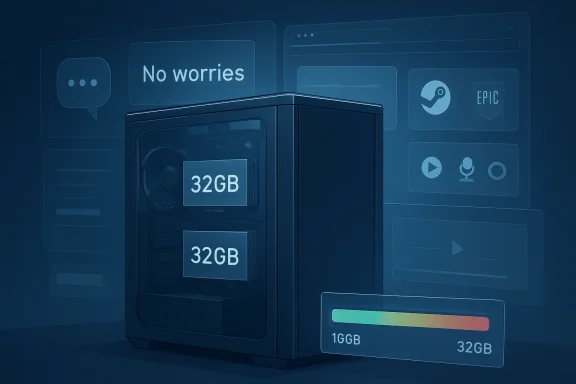
Microsoft’s Windows marketing pages now describe 16GB of RAM as the baseline for a Windows 11 gaming PC and 32GB as the “no worries” upgrade for players who keep Discord, browsers, streaming tools, and launchers open alongside their games. That phrasing matters because it turns a long-running enthusiast rule of thumb into an official buying signal. Microsoft is not declaring 16GB dead, but it is quietly admitting that the modern Windows gaming stack has grown beyond the old definition of “enough.” The result is a recommendation that feels both sensible and damning: gamers need more memory partly because games are bigger, and partly because Windows has allowed everything around the game to become heavier.
For years, the practical advice for PC gaming was easy: 8GB was survival, 16GB was comfort, and 32GB was for streamers, modders, workstation users, or people who simply liked overbuilding. Microsoft’s new wording shifts that ladder upward without the drama of a formal specification change. A “no worries” tier is not a benchmark result; it is a psychological sell.
That distinction is important. Microsoft’s official minimum requirement for Windows 11 remains 4GB of RAM, and mainstream buyers still encounter 8GB systems in the broader PC market. But minimum requirements are not lived experience, and gaming PCs are sold on the promise of not feeling minimum.
The company’s argument is not that every game suddenly needs 32GB to launch. It is that the gaming session is no longer just the game. It is Discord, a browser, Steam or Epic or Xbox, a capture tool, a hardware control panel, an overlay, cloud sync, RGB utilities, anticheat, telemetry, and the always-present background noise of Windows itself.
That is why the phrase lands harder than a spec-sheet recommendation. “32GB is ideal” sounds aspirational. “32GB is no worries” sounds like the old normal has become a source of anxiety.
This is the context Microsoft chose to emphasize. The justification for 32GB is not framed around one monster game gobbling all available memory; it is framed around multitasking. That is the right diagnosis, even if Microsoft has every incentive not to say the quiet part too loudly.
A 16GB system can still be perfectly playable. Plenty of games run well within that envelope, especially when paired with a decent GPU and enough VRAM. But the margin is thinner, and thin margins are where stutter lives.
Memory pressure rarely announces itself like a GPU bottleneck. It shows up as uneven frame pacing, delayed alt-tabs, browser reloads, background apps closing themselves, or a game hitching just as the system starts paging to storage. In raw average FPS charts, 16GB may appear fine; in the messier reality of a long session, it can feel fragile.
The company has spent years pushing modern app frameworks, web-backed experiences, and Edge WebView2 as the connective tissue for Windows and Microsoft 365. Developers followed the incentive structure. The result is a desktop where too many “native” experiences behave like small browsers wearing Windows clothing.
This is not only a Microsoft problem. Discord is famously heavy. Electron apps won because they were fast to build, not because they were kind to memory-constrained systems. Game launchers, storefronts, overlays, and peripheral suites have all learned to treat RAM as cheap ambient oxygen.
But Microsoft owns the platform experience. If the OS vendor tells gamers to buy more RAM because of background multitasking, users are entitled to ask why the background became so expensive in the first place.
That compromise depends heavily on the machine. A desktop with upgradeable DIMM slots is a different proposition from a thin laptop with soldered memory. A system with a 12GB or 16GB graphics card behaves differently from one with limited VRAM that spills more pressure into system memory. A player who closes browsers before launching a game lives in a different world from someone who streams to friends, records clips, and keeps twenty tabs open.
Game selection matters too. Competitive esports titles, older games, and lighter indie releases can remain happy on 16GB. Large open-world games, heavily modded titles, simulation games, and creator-adjacent workflows are much more likely to expose the ceiling.
This is why Microsoft’s phrasing is clever. It does not say 16GB is broken. It says 32GB removes a category of concern. That is the kind of argument that sells PCs without needing to win a forum fight over one specific benchmark.
AI demand has distorted the memory supply chain, and consumers are seeing the consequences in higher DRAM and storage prices. Data center buyers, GPU vendors, and AI infrastructure projects can absorb costs that ordinary PC builders cannot. When the industry’s richest customers compete for memory, the gaming desktop becomes collateral damage.
That makes Microsoft’s message technically reasonable and economically irritating. Yes, 32GB is a better target for a new gaming PC. No, users are not imagining the pain when that target costs more than it did a year or two ago.
The frustration is sharper for laptop buyers. Many modern systems ship with soldered RAM, which turns the initial configuration into a long-term sentence. A buyer choosing between 16GB and 32GB is not merely deciding what they need this month; they are deciding how much regret they can afford three years from now.
For decades, Windows minimums lagged far behind comfortable use. That gap is now more visible because Microsoft is segmenting the PC market into experience tiers. A machine can technically run Windows 11 with far less memory than Microsoft wants in its showcase devices.
This creates a strange split-screen. On one side, Windows 11’s published minimum remains modest. On the other, Microsoft’s premium messaging increasingly assumes 16GB as the floor and 32GB as the relaxed choice for gaming.
Gamers understand this better than most buyers because they already live with tiered requirements. Minimum, recommended, ultra, ray tracing, high-resolution texture packs, mods, and streaming setups all imply different machines. Microsoft is now applying the same logic to Windows itself, even if it avoids saying that directly.
But the more interesting shift is that games are being blamed for the whole session. A player may buy 32GB “for gaming” when the actual pressure comes from a browser, a chat client, a recording tool, and Windows services layered around it. The game becomes the visible culprit because it is the app that stutters.
That distinction matters because it changes what optimization means. If the answer is always “buy more RAM,” developers and platform vendors get a pass. If the answer is “make the surrounding software less wasteful,” then Microsoft, Discord, launcher makers, peripheral vendors, and web-app developers all have homework.
The honest answer is both. Hardware expectations rise over time, and nobody should expect a 2026 gaming rig to feel like a 2016 one. But software bloat is not a law of physics. It is an accumulation of decisions.
Native software is not automatically efficient, and web technology is not automatically bad. The problem is using browser-heavy architecture everywhere, including places where users expect immediacy and low overhead. A Start menu, settings panel, widget surface, or inbox utility should not feel like it is negotiating with a miniature web stack before responding.
Gamers are an unforgiving audience for this because latency and stutter are emotionally obvious. A productivity user may tolerate sluggishness as background annoyance. A gamer notices a hitch in the exact moment it costs them a match.
If Microsoft wants Windows 11 to be the best place to play, memory recommendations are the easy part. The harder part is making the OS feel less like another competitor for the resources users bought for their games.
Teams, browsers, security agents, management tools, collaboration apps, endpoint monitoring, VPN clients, and line-of-business software all pile onto corporate machines. The employee may not be running a AAA game, but they are often running a workload that looks suspiciously like the multitasking scenario Microsoft describes.
That is why 8GB business laptops have become increasingly hard to defend for serious work. They may be cheap on a procurement spreadsheet and expensive in lost time. A machine that spends three years struggling under normal multitasking is not a bargain; it is deferred frustration.
The gaming market often reveals consumer hardware truth earlier because enthusiasts complain loudly and measure obsessively. But the same memory curve reaches office users eventually. Today’s “no worries” gaming tier has a way of becoming tomorrow’s normal corporate spec.
The installed base always changes more slowly than buying advice. Millions of gamers will keep using 16GB systems because those systems still work, because RAM is expensive, or because their laptops cannot be upgraded. That does not contradict Microsoft’s recommendation; it explains why the recommendation is carefully worded.
A new PC purchase is different from a current PC assessment. If you already own a 16GB machine and your games feel smooth, panic is unnecessary. If you are buying a Windows 11 gaming PC in 2026 and plan to keep it for several years, 32GB is increasingly the rational default.
That is the real dividing line. Microsoft is not telling every gamer to rip out their memory today. It is telling buyers that the safe configuration has changed.
But headroom changes the feel of a machine under imperfect conditions. It lets a browser stay open without punishment. It lets Discord misbehave without becoming a crisis. It lets Windows Update, indexing, cloud sync, and capture software coexist with a demanding game without immediately forcing compromises.
That is why 32GB can be both overkill and sensible depending on the moment. On a clean benchmark run, it may sit unused. In a real weekend session with voice chat, guides, mods, screenshots, downloads, and a half-forgotten browser window, it becomes the difference between invisible comfort and nagging friction.
The industry often sells hardware upgrades as speed. Microsoft’s wording sells calm. That may be more persuasive because it matches how people actually experience PCs: not as average frame rates, but as interruptions avoided.
For a budget gaming desktop, 16GB can still make sense if the price difference is painful and the games are modest. But the buyer should treat it as a starting point, not a forever configuration. For a midrange or premium gaming PC, 32GB is now the cleaner recommendation.
For handhelds and compact gaming systems, the analysis gets trickier because unified memory, power limits, and vendor-specific designs complicate direct comparisons. Still, the same principle applies: shared resources make headroom more valuable, not less.
The worst configuration in 2026 is not necessarily the cheapest one. It is the one that saves a little money by locking the user into a memory ceiling they cannot escape.
But the recommendation also exposes Microsoft’s vulnerability. Windows is supposed to be the platform that unlocks PC gaming’s flexibility. Increasingly, it also feels like one of the reasons that flexibility requires more hardware than users expected.
The company cannot control every bloated launcher or chat client, but it can control Windows’ own appetite and incentives. It can make native performance a priority. It can stop treating every surface as a delivery vehicle for services. It can make “best place to play” mean more than compatibility and marketing partnerships.
If Microsoft wants gamers to accept 32GB as the comfortable norm, it should also prove that the extra memory is being used for richer experiences rather than absorbed by avoidable overhead.
Source: Windows Latest Microsoft says 32GB of RAM is the “no-worries” upgrade for Windows 11 gaming
 Microsoft Moves 32GB From Luxury to Seatbelt
For years, the practical advice for PC gaming was easy: 8GB was survival, 16GB was comfort, and 32GB was for streamers, modders, workstation users, or people who simply liked overbuilding. Microsoft’s new wording shifts that ladder upward without the drama of a formal specification change. A “no worries” tier is not a benchmark result; it is a psychological sell.That distinction is important. Microsoft’s official minimum requirement for Windows 11 remains 4GB of RAM, and mainstream buyers still encounter 8GB systems in the broader PC market. But minimum requirements are not lived experience, and gaming PCs are sold on the promise of not feeling minimum.
The company’s argument is not that every game suddenly needs 32GB to launch. It is that the gaming session is no longer just the game. It is Discord, a browser, Steam or Epic or Xbox, a capture tool, a hardware control panel, an overlay, cloud sync, RGB utilities, anticheat, telemetry, and the always-present background noise of Windows itself.
That is why the phrase lands harder than a spec-sheet recommendation. “32GB is ideal” sounds aspirational. “32GB is no worries” sounds like the old normal has become a source of anxiety.
The Game Is No Longer the Whole Workload
The modern PC gamer does not sit in a clean boot environment, launch a game, and disappear into it. They alt-tab. They watch guides. They keep Discord voice chat open. They stream, record, clip, monitor temperatures, browse wikis, run launchers, and let half a dozen update agents idle in the tray.This is the context Microsoft chose to emphasize. The justification for 32GB is not framed around one monster game gobbling all available memory; it is framed around multitasking. That is the right diagnosis, even if Microsoft has every incentive not to say the quiet part too loudly.
A 16GB system can still be perfectly playable. Plenty of games run well within that envelope, especially when paired with a decent GPU and enough VRAM. But the margin is thinner, and thin margins are where stutter lives.
Memory pressure rarely announces itself like a GPU bottleneck. It shows up as uneven frame pacing, delayed alt-tabs, browser reloads, background apps closing themselves, or a game hitching just as the system starts paging to storage. In raw average FPS charts, 16GB may appear fine; in the messier reality of a long session, it can feel fragile.
Windows 11’s Real Problem Is the Stuff Around Windows
Microsoft’s recommendation would be easier to swallow if Windows 11 felt like a lean foundation. Instead, many users experience it as a platform increasingly surrounded by web surfaces, companion services, widgets, recommendations, account prompts, and AI-adjacent plumbing. Some of that is useful. Much of it is contested.The company has spent years pushing modern app frameworks, web-backed experiences, and Edge WebView2 as the connective tissue for Windows and Microsoft 365. Developers followed the incentive structure. The result is a desktop where too many “native” experiences behave like small browsers wearing Windows clothing.
This is not only a Microsoft problem. Discord is famously heavy. Electron apps won because they were fast to build, not because they were kind to memory-constrained systems. Game launchers, storefronts, overlays, and peripheral suites have all learned to treat RAM as cheap ambient oxygen.
But Microsoft owns the platform experience. If the OS vendor tells gamers to buy more RAM because of background multitasking, users are entitled to ask why the background became so expensive in the first place.
The 16GB Era Is Ending Unevenly, Not Suddenly
The mistake would be to treat Microsoft’s wording as a hard cliff. A 16GB gaming PC is not obsolete on May 1, 2026, and anyone saying otherwise is selling upgrades too aggressively. The more accurate statement is that 16GB has moved from “safe default” to “managed compromise.”That compromise depends heavily on the machine. A desktop with upgradeable DIMM slots is a different proposition from a thin laptop with soldered memory. A system with a 12GB or 16GB graphics card behaves differently from one with limited VRAM that spills more pressure into system memory. A player who closes browsers before launching a game lives in a different world from someone who streams to friends, records clips, and keeps twenty tabs open.
Game selection matters too. Competitive esports titles, older games, and lighter indie releases can remain happy on 16GB. Large open-world games, heavily modded titles, simulation games, and creator-adjacent workflows are much more likely to expose the ceiling.
This is why Microsoft’s phrasing is clever. It does not say 16GB is broken. It says 32GB removes a category of concern. That is the kind of argument that sells PCs without needing to win a forum fight over one specific benchmark.
Memory Prices Turn Sensible Advice Into Bad Timing
The awkward part is timing. The move toward 32GB would feel almost boring if memory were cheap and every desktop still had open slots. But the PC market is not operating in that world.AI demand has distorted the memory supply chain, and consumers are seeing the consequences in higher DRAM and storage prices. Data center buyers, GPU vendors, and AI infrastructure projects can absorb costs that ordinary PC builders cannot. When the industry’s richest customers compete for memory, the gaming desktop becomes collateral damage.
That makes Microsoft’s message technically reasonable and economically irritating. Yes, 32GB is a better target for a new gaming PC. No, users are not imagining the pain when that target costs more than it did a year or two ago.
The frustration is sharper for laptop buyers. Many modern systems ship with soldered RAM, which turns the initial configuration into a long-term sentence. A buyer choosing between 16GB and 32GB is not merely deciding what they need this month; they are deciding how much regret they can afford three years from now.
Copilot+ PCs Made 16GB the New Respectable Minimum
Microsoft’s broader hardware messaging has already been moving in this direction. Copilot+ PCs require at least 16GB of RAM, alongside other hardware requirements such as an NPU capable of running local AI workloads. That does not make every Copilot+ PC a gaming machine, but it does reset consumer expectations.For decades, Windows minimums lagged far behind comfortable use. That gap is now more visible because Microsoft is segmenting the PC market into experience tiers. A machine can technically run Windows 11 with far less memory than Microsoft wants in its showcase devices.
This creates a strange split-screen. On one side, Windows 11’s published minimum remains modest. On the other, Microsoft’s premium messaging increasingly assumes 16GB as the floor and 32GB as the relaxed choice for gaming.
Gamers understand this better than most buyers because they already live with tiered requirements. Minimum, recommended, ultra, ray tracing, high-resolution texture packs, mods, and streaming setups all imply different machines. Microsoft is now applying the same logic to Windows itself, even if it avoids saying that directly.
The Blame Does Not Belong to Games Alone
It is tempting to say games are simply bigger now, which is true. Textures are larger, worlds are denser, shader compilation is more complex, and open-world engines often keep huge amounts of data close at hand. Mods can turn a reasonable memory footprint into a bottomless pit.But the more interesting shift is that games are being blamed for the whole session. A player may buy 32GB “for gaming” when the actual pressure comes from a browser, a chat client, a recording tool, and Windows services layered around it. The game becomes the visible culprit because it is the app that stutters.
That distinction matters because it changes what optimization means. If the answer is always “buy more RAM,” developers and platform vendors get a pass. If the answer is “make the surrounding software less wasteful,” then Microsoft, Discord, launcher makers, peripheral vendors, and web-app developers all have homework.
The honest answer is both. Hardware expectations rise over time, and nobody should expect a 2026 gaming rig to feel like a 2016 one. But software bloat is not a law of physics. It is an accumulation of decisions.
Microsoft’s Native-App Turn Cannot Arrive Soon Enough
There are signs Microsoft understands the backlash. Recent comments from Microsoft engineers about native Windows apps returning, along with reports that parts of the Windows shell are being rebuilt more natively, suggest a course correction. If that work is real and sustained, it could matter more to day-to-day performance than another round of vague “AI PC” branding.Native software is not automatically efficient, and web technology is not automatically bad. The problem is using browser-heavy architecture everywhere, including places where users expect immediacy and low overhead. A Start menu, settings panel, widget surface, or inbox utility should not feel like it is negotiating with a miniature web stack before responding.
Gamers are an unforgiving audience for this because latency and stutter are emotionally obvious. A productivity user may tolerate sluggishness as background annoyance. A gamer notices a hitch in the exact moment it costs them a match.
If Microsoft wants Windows 11 to be the best place to play, memory recommendations are the easy part. The harder part is making the OS feel less like another competitor for the resources users bought for their games.
Enterprise IT Will Hear a Different Message
For IT departments, Microsoft’s 32GB gaming language is not just consumer advice. It is another sign that Windows hardware baselines are drifting upward across the board. Gaming PCs are not enterprise fleets, but the same app trends hit both markets.Teams, browsers, security agents, management tools, collaboration apps, endpoint monitoring, VPN clients, and line-of-business software all pile onto corporate machines. The employee may not be running a AAA game, but they are often running a workload that looks suspiciously like the multitasking scenario Microsoft describes.
That is why 8GB business laptops have become increasingly hard to defend for serious work. They may be cheap on a procurement spreadsheet and expensive in lost time. A machine that spends three years struggling under normal multitasking is not a bargain; it is deferred frustration.
The gaming market often reveals consumer hardware truth earlier because enthusiasts complain loudly and measure obsessively. But the same memory curve reaches office users eventually. Today’s “no worries” gaming tier has a way of becoming tomorrow’s normal corporate spec.
The Steam Survey Tells a Messier, Useful Story
Steam’s hardware survey has shown the transition in motion, even if monthly swings can be noisy. In 2025, 16GB remained extremely common, while 32GB gained share and looked increasingly mainstream among active PC gamers. Early 2026 survey movements have been volatile enough to invite caution, but the direction of travel is not mysterious.The installed base always changes more slowly than buying advice. Millions of gamers will keep using 16GB systems because those systems still work, because RAM is expensive, or because their laptops cannot be upgraded. That does not contradict Microsoft’s recommendation; it explains why the recommendation is carefully worded.
A new PC purchase is different from a current PC assessment. If you already own a 16GB machine and your games feel smooth, panic is unnecessary. If you are buying a Windows 11 gaming PC in 2026 and plan to keep it for several years, 32GB is increasingly the rational default.
That is the real dividing line. Microsoft is not telling every gamer to rip out their memory today. It is telling buyers that the safe configuration has changed.
The “No-Worries” Pitch Is Really About Headroom
Headroom is underrated because it rarely shows up in marketing charts. More RAM does not automatically make a game faster. If the system already has enough memory, adding more will not magically boost the GPU.But headroom changes the feel of a machine under imperfect conditions. It lets a browser stay open without punishment. It lets Discord misbehave without becoming a crisis. It lets Windows Update, indexing, cloud sync, and capture software coexist with a demanding game without immediately forcing compromises.
That is why 32GB can be both overkill and sensible depending on the moment. On a clean benchmark run, it may sit unused. In a real weekend session with voice chat, guides, mods, screenshots, downloads, and a half-forgotten browser window, it becomes the difference between invisible comfort and nagging friction.
The industry often sells hardware upgrades as speed. Microsoft’s wording sells calm. That may be more persuasive because it matches how people actually experience PCs: not as average frame rates, but as interruptions avoided.
The Buyer’s Map Has Changed
The practical advice is now less about one universal number and more about avoiding dead ends. Desktop builders have flexibility, especially if they choose motherboards with enough slots and avoid filling every channel with tiny modules. Laptop buyers need to be more cautious because soldered RAM turns “I’ll upgrade later” into a fantasy.For a budget gaming desktop, 16GB can still make sense if the price difference is painful and the games are modest. But the buyer should treat it as a starting point, not a forever configuration. For a midrange or premium gaming PC, 32GB is now the cleaner recommendation.
For handhelds and compact gaming systems, the analysis gets trickier because unified memory, power limits, and vendor-specific designs complicate direct comparisons. Still, the same principle applies: shared resources make headroom more valuable, not less.
The worst configuration in 2026 is not necessarily the cheapest one. It is the one that saves a little money by locking the user into a memory ceiling they cannot escape.
Microsoft’s Recommendation Is Right for the Wrongly Built Future
Microsoft deserves some credit for saying plainly what many PC builders already believed. A modern Windows 11 gaming PC with 32GB of RAM is simply easier to recommend. It gives the system room to absorb messy real-world behavior.But the recommendation also exposes Microsoft’s vulnerability. Windows is supposed to be the platform that unlocks PC gaming’s flexibility. Increasingly, it also feels like one of the reasons that flexibility requires more hardware than users expected.
The company cannot control every bloated launcher or chat client, but it can control Windows’ own appetite and incentives. It can make native performance a priority. It can stop treating every surface as a delivery vehicle for services. It can make “best place to play” mean more than compatibility and marketing partnerships.
If Microsoft wants gamers to accept 32GB as the comfortable norm, it should also prove that the extra memory is being used for richer experiences rather than absorbed by avoidable overhead.
The 2026 Gaming PC Spec Now Has a Memory Honesty Test
The useful lesson is not that every gamer must upgrade today. It is that Microsoft has aligned its public advice with the reality many Windows users already feel: 16GB works, but 32GB is where the system stops asking you to manage around it.- A 16GB Windows 11 gaming PC remains viable, especially for lighter games, esports titles, and users who keep background apps under control.
- A 32GB configuration is now the safer default for new gaming PCs intended to last several years.
- Microsoft’s “no worries” language is about multitasking headroom more than raw frame-rate gains.
- Soldered-memory laptops make the 16GB-versus-32GB decision more consequential than it is on upgradeable desktops.
- Windows, launchers, browsers, chat clients, and web-based app frameworks all share responsibility for making modern gaming sessions heavier.
- Microsoft’s renewed interest in native Windows components will matter only if it produces measurable reductions in everyday overhead.
Source: Windows Latest Microsoft says 32GB of RAM is the “no-worries” upgrade for Windows 11 gaming
