

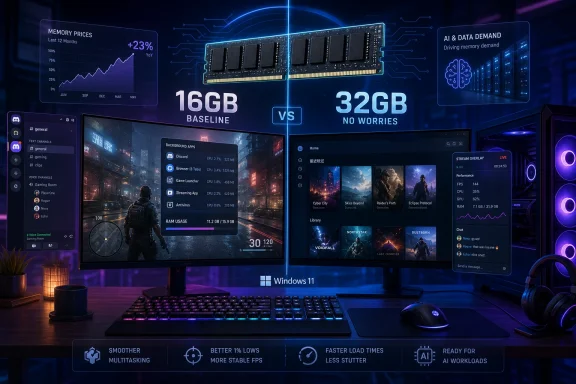
Microsoft’s April 9, 2026 Windows gaming guidance says 16GB of RAM remains the practical baseline for Windows 11 gaming PCs, while 32GB is the preferred “no worries” upgrade for players who keep Discord, browsers, launchers, or streaming tools open while they play. That is not a new minimum requirement, and it is not a mandate from Redmond. It is something more revealing: Microsoft is publicly admitting that the real Windows gaming workload is no longer just the game.
The timing is awkward enough to be almost comic. Just as Microsoft tells PC gamers that the sensible target has moved upward, DRAM prices are being dragged into the AI infrastructure boom, with consumer memory competing against data-center demand, HBM production priorities, and OEM allocation battles. The result is a recommendation that is technically reasonable, economically painful, and strategically useful for Microsoft’s broader effort to sell Windows 11 as the platform where modern gaming still belongs.
The important distinction is that Microsoft did not say Windows 11 gaming now requires 32GB of RAM. The official Windows 11 minimum remains far lower, and even Microsoft’s gaming page still treats 16GB as the baseline. But baseline is a carefully chosen word: it means “you can start here,” not “you should stop here.”
That language matters because PC gaming has long survived on a folk wisdom version of system requirements. For years, 8GB was “enough,” then 16GB became the sensible default, and 32GB was treated as a luxury for streamers, modders, workstation users, or people who simply hated closing Chrome. Microsoft’s new phrasing formalizes a shift that enthusiasts have already felt in practice: 16GB is no longer comfortable headroom. It is the floor.
This is a subtle but meaningful change in how Windows gaming is being framed. Microsoft is not merely talking about the minimum memory a game can address. It is talking about the lived reality of PC gaming on Windows 11: the game, the launcher, the anti-cheat layer, the overlay, Discord, a browser with build guides or YouTube open, RGB utilities, capture software, cloud sync clients, telemetry, and whatever the GPU driver now insists must run in the tray.
That is the modern gaming session, and it is messier than any minimum-spec table printed on a Steam page. Microsoft’s 32GB recommendation is really an admission that the PC is not a console, and Windows gaming does not happen in a clean-room environment.
That logic has not disappeared. A well-managed 16GB gaming desktop can still run many titles perfectly well, especially at 1080p or 1440p, especially if the user is disciplined about background apps, and especially in esports titles that are built to scale across enormous hardware ranges. Anyone claiming that 16GB is suddenly useless is selling panic, not advice.
But the center of gravity has moved. Big open-world games, simulation-heavy titles, shader compilation, high-resolution assets, modded installs, and PC ports with uneven optimization all put more pressure on system memory. At the same time, the non-game side of gaming has become heavier. Discord is not a tiny chat client. Browsers are not lightweight accessories. Launchers and overlays are not invisible.
The consequence is not always a dramatic FPS collapse. More often it is the sort of problem that makes users say a game “feels bad”: hitching, tab-out lag, stutter after long sessions, texture pop-in, slow recovery after alt-tabbing, or the sudden indignity of Windows quietly leaning harder on the page file. These are not always RAM problems, but RAM pressure can turn every other bottleneck into a worse one.
That is why Microsoft’s “no worries” phrase is doing so much work. It is not promising higher benchmark numbers. It is promising fewer interruptions, fewer edge cases, and less need to curate your background processes like a sysadmin nursing an aging file server.
To be fair, unused RAM is not morally superior RAM. Modern operating systems cache, prefetch, compress, and opportunistically use memory to make the system feel faster. A machine showing high memory usage is not automatically struggling. Windows is supposed to use available resources.
But users do not experience this as an architecture lecture. They experience it as Task Manager reporting several gigabytes consumed before a game launches, followed by a stack of resident processes whose purpose may be legitimate, opaque, redundant, or vendor-inflicted. A clean Windows install and a typical gaming laptop image are very different creatures.
That is the hidden tension in Microsoft’s recommendation. On one hand, 32GB is a practical answer to how people actually use gaming PCs. On the other, it lets the platform escape a harder question: how much of the burden should be solved by asking users to buy more memory, and how much should be solved by making Windows and its ecosystem less hungry?
Microsoft has been trying to answer that through features such as windowed-game optimizations, Auto HDR, improved scheduling, DirectStorage, Game Mode, and broader work around modern hardware. But performance features and resource discipline are not the same thing. A gaming OS can reduce latency and still feel bloated. It can improve presentation models and still ask users to tolerate an expanding background workload.
That matters because handheld gaming PCs expose Windows’ weaknesses brutally. Every watt, every background service, every update prompt, every launcher tantrum, and every unnecessary process feels more obvious on a battery-powered device with constrained thermals and shared memory. Windows remains the compatibility king, but compatibility is not the same as elegance.
Microsoft clearly knows this. Its recent gaming messaging has increasingly emphasized polish, simplicity, and platform features rather than merely “Windows runs everything.” The company has also been under pressure to make Windows better suited to handhelds, controller-first interfaces, and SteamOS-like experiences. When Microsoft talks about optimizing the platform further, it is speaking to a market where “just install Windows” is no longer the automatic enthusiast answer.
The 32GB RAM guidance fits into that battle. A Windows gaming PC with ample memory can paper over a lot of rough edges. A Windows handheld or budget laptop cannot. If Microsoft wants Windows 11 to remain the default gaming OS across desktops, laptops, and handhelds, it has to do more than recommend higher specs. It has to make the platform feel leaner where hardware cannot simply brute-force the problem.
That is not the world PC buyers are living in now. The AI buildout has turned memory into a strategic commodity. High-bandwidth memory for accelerators, server DRAM, NAND pressure, and long-term hyperscaler commitments have changed the economics of supply allocation. Even when consumer DDR5 is not the same product as HBM, it exists inside the same industry capacity fight.
This is why the recommendation stings. Microsoft is not wrong that 32GB is the better target. It is simply making that statement at a moment when memory is unusually expensive and likely to stay volatile. For gamers trying to stretch a build budget, the old advice was easy: buy 16GB now, upgrade later. In 2026, “later” may not be cheaper.
OEM buyers face an even more frustrating version of the same problem. Many laptops ship with soldered RAM, limited configurations, or brutal upgrade pricing. A desktop builder can wait for a kit to drop or reuse memory across a platform. A laptop buyer often has to make the memory decision at checkout, where 32GB may be locked behind a higher-tier CPU, GPU, display, or storage bundle.
That turns Microsoft’s “no worries” upgrade into a class marker. Enthusiasts with desktops can treat it as sensible planning. Budget buyers and laptop shoppers may experience it as another reminder that the comfortable Windows experience is drifting upward in cost.
Console memory is not equivalent to desktop system RAM. Current consoles use unified memory pools shared by CPU and GPU, with fixed hardware targets, tightly managed software environments, and games optimized for a known configuration. A PlayStation or Xbox does not need to accommodate arbitrary launchers, browser tabs, capture utilities, motherboard software, desktop widgets, third-party antivirus suites, and twenty years of Windows compatibility baggage.
PCs win because they are flexible. They lose efficiency for the same reason. A Windows gaming PC must be general-purpose before it is gaming-specific, and that general-purpose identity is exactly what makes extra RAM valuable. It is not simply that PC games “need” twice as much memory as console games. It is that PC gaming is surrounded by more stuff.
This also complicates speculation about future consoles. It would not be surprising if next-generation machines increase memory capacity substantially, especially with larger worlds, higher-resolution assets, AI-driven features, and longer platform lifecycles in mind. But Microsoft’s Windows recommendation is not evidence that an Xbox successor must ship with 32GB of memory. Console economics, memory bandwidth, unified architecture, and bill-of-materials constraints follow a different logic.
The more relevant console lesson is not capacity. It is discipline. Consoles are constrained, so platform holders and developers optimize against hard limits. PCs are elastic, so the industry often lets hardware absorb inefficiency until users complain.
Developers may take it as confirmation that high-end PC configurations can assume more breathing room. That does not mean minimum specs immediately jump, because the installed base still matters and 16GB remains common. But recommended specs have already been creeping upward in demanding PC releases, and Microsoft’s statement gives that trend a platform-holder gloss.
Publishers may use 32GB recommendations to deflect criticism of rough PC ports. If a game hitches badly on a 16GB system, the answer may increasingly become “the recommended experience is 32GB,” even when the underlying issue is shader compilation, asset streaming, VRAM pressure, CPU contention, or poor memory management. More RAM can mask bad engineering, but it does not absolve it.
OEMs will use the language differently. Expect more “32GB gaming ready” stickers, more upsell tiers, and more midrange systems marketed around memory capacity as much as GPU class. In a sane market, that might be good. In a shortage-driven market, it risks becoming another way to make buyers pay more for what used to be enthusiast comfort.
There is also a danger for Windows itself. If users internalize the idea that Windows gaming really wants 32GB to feel effortless, then lightweight alternatives become more appealing wherever compatibility is good enough. Microsoft can win the high-end desktop by brute force. It cannot win every handheld, laptop, and budget build that way.
If you already have 16GB, the answer depends on what you play and how you use your PC. If your games run smoothly, your background workload is light, and your system is not paging heavily, there is no emergency. If you regularly keep Discord, a browser, streaming tools, recording software, and demanding modern games open together, the upgrade is more likely to be felt in consistency than in peak frame rates.
The harder call is for laptop buyers. If memory is soldered, 32GB is not merely an upgrade; it is insurance. A 16GB soldered gaming laptop bought in 2026 may still be fine for many users, but it has less room to age gracefully. A desktop with two open DIMM slots is forgiving. A sealed laptop is a bet.
That is where Microsoft’s guidance is most useful. It is not a command to replace your RAM today. It is a warning about where the comfort line is moving.
Windows gives gamers unmatched access to titles, anti-cheat support, drivers, stores, mods, peripherals, and legacy software. That ecosystem is why it remains dominant. But the cost of that dominance is complexity, and complexity consumes memory.
Some of that cost is unavoidable. Some of it is vendor nonsense. Some of it is Microsoft’s own appetite for services, cloud hooks, ads, widgets, AI features, and “experiences” that users may not have asked for. When the answer becomes “buy 32GB,” it is fair for users to ask how much of that upgrade is for games and how much is for the world around the games.
This is not an argument for nostalgia. Windows XP was not a better gaming platform because it used less RAM. Modern security, drivers, display stacks, HDR, storage APIs, scheduling, and hardware support are vastly more sophisticated now. But sophistication should not become a blank check.
Microsoft wants credit for making Windows 11 the modern gaming platform. It should also accept responsibility for making that platform feel efficient, especially as memory prices punish users for every extra gigabyte.
A PC with 32GB of RAM and a weak GPU is still a weak gaming PC. A machine starved for VRAM will not be saved by system memory except in ugly fallback scenarios. A slow SSD, poor cooling, a low-end CPU, or a badly configured system can all produce stutter that more RAM will not fix. Microsoft’s own broader advice points to GPU matching, CPU bottlenecks, SSDs, cooling, and power delivery because memory is only one piece of the experience.
Still, memory has become one of the pieces that users notice when it is missing. The old “just close your browser” answer is increasingly out of touch with how people play. The PC is a social, streaming, multitasking, second-screen-adjacent gaming machine. A recommendation that assumes otherwise is pretending the last decade did not happen.
So the sanest read is this: 16GB remains acceptable, 32GB is the comfort target, and anything below 16GB should be avoided for a new Windows 11 gaming PC unless the machine is strictly casual or cloud-oriented. The old enthusiast hierarchy still applies, but the memory line has shifted upward.
Source: Tech4Gamers Microsoft Declares 32GB RAM New Sweet Spot For Windows 11 Gaming
The timing is awkward enough to be almost comic. Just as Microsoft tells PC gamers that the sensible target has moved upward, DRAM prices are being dragged into the AI infrastructure boom, with consumer memory competing against data-center demand, HBM production priorities, and OEM allocation battles. The result is a recommendation that is technically reasonable, economically painful, and strategically useful for Microsoft’s broader effort to sell Windows 11 as the platform where modern gaming still belongs.
 Microsoft Moves the Goalposts Without Calling It a Requirement
The important distinction is that Microsoft did not say Windows 11 gaming now requires 32GB of RAM. The official Windows 11 minimum remains far lower, and even Microsoft’s gaming page still treats 16GB as the baseline. But baseline is a carefully chosen word: it means “you can start here,” not “you should stop here.”That language matters because PC gaming has long survived on a folk wisdom version of system requirements. For years, 8GB was “enough,” then 16GB became the sensible default, and 32GB was treated as a luxury for streamers, modders, workstation users, or people who simply hated closing Chrome. Microsoft’s new phrasing formalizes a shift that enthusiasts have already felt in practice: 16GB is no longer comfortable headroom. It is the floor.
This is a subtle but meaningful change in how Windows gaming is being framed. Microsoft is not merely talking about the minimum memory a game can address. It is talking about the lived reality of PC gaming on Windows 11: the game, the launcher, the anti-cheat layer, the overlay, Discord, a browser with build guides or YouTube open, RGB utilities, capture software, cloud sync clients, telemetry, and whatever the GPU driver now insists must run in the tray.
That is the modern gaming session, and it is messier than any minimum-spec table printed on a Steam page. Microsoft’s 32GB recommendation is really an admission that the PC is not a console, and Windows gaming does not happen in a clean-room environment.
The Old 16GB Consensus Was Built for a Simpler PC
The 16GB standard became popular because it was a rational compromise. It gave Windows breathing room, let most games run without constant paging, and left enough memory for voice chat and a few background tasks. For a long stretch, spending more on RAM often delivered less benefit than putting the money into a better GPU, a faster SSD, or a stronger CPU.That logic has not disappeared. A well-managed 16GB gaming desktop can still run many titles perfectly well, especially at 1080p or 1440p, especially if the user is disciplined about background apps, and especially in esports titles that are built to scale across enormous hardware ranges. Anyone claiming that 16GB is suddenly useless is selling panic, not advice.
But the center of gravity has moved. Big open-world games, simulation-heavy titles, shader compilation, high-resolution assets, modded installs, and PC ports with uneven optimization all put more pressure on system memory. At the same time, the non-game side of gaming has become heavier. Discord is not a tiny chat client. Browsers are not lightweight accessories. Launchers and overlays are not invisible.
The consequence is not always a dramatic FPS collapse. More often it is the sort of problem that makes users say a game “feels bad”: hitching, tab-out lag, stutter after long sessions, texture pop-in, slow recovery after alt-tabbing, or the sudden indignity of Windows quietly leaning harder on the page file. These are not always RAM problems, but RAM pressure can turn every other bottleneck into a worse one.
That is why Microsoft’s “no worries” phrase is doing so much work. It is not promising higher benchmark numbers. It is promising fewer interruptions, fewer edge cases, and less need to curate your background processes like a sysadmin nursing an aging file server.
Windows 11 Is Both the Platform and Part of the Load
Microsoft’s argument would be easier to swallow if Windows itself were not part of the memory story. Windows 11 is a modern, secure, compatibility-heavy operating system that supports an enormous range of hardware and software. That flexibility has a cost.To be fair, unused RAM is not morally superior RAM. Modern operating systems cache, prefetch, compress, and opportunistically use memory to make the system feel faster. A machine showing high memory usage is not automatically struggling. Windows is supposed to use available resources.
But users do not experience this as an architecture lecture. They experience it as Task Manager reporting several gigabytes consumed before a game launches, followed by a stack of resident processes whose purpose may be legitimate, opaque, redundant, or vendor-inflicted. A clean Windows install and a typical gaming laptop image are very different creatures.
That is the hidden tension in Microsoft’s recommendation. On one hand, 32GB is a practical answer to how people actually use gaming PCs. On the other, it lets the platform escape a harder question: how much of the burden should be solved by asking users to buy more memory, and how much should be solved by making Windows and its ecosystem less hungry?
Microsoft has been trying to answer that through features such as windowed-game optimizations, Auto HDR, improved scheduling, DirectStorage, Game Mode, and broader work around modern hardware. But performance features and resource discipline are not the same thing. A gaming OS can reduce latency and still feel bloated. It can improve presentation models and still ask users to tolerate an expanding background workload.
The SteamOS Shadow Is Now Impossible to Ignore
The reason this recommendation lands with extra force is that Windows is no longer competing only with older versions of itself. It is competing with the idea that gaming PCs can feel more appliance-like. Valve’s Steam Deck did not dethrone Windows gaming, but it changed expectations by proving that a curated Linux-based gaming environment could be good enough, friendly enough, and efficient enough for a mass-market handheld.That matters because handheld gaming PCs expose Windows’ weaknesses brutally. Every watt, every background service, every update prompt, every launcher tantrum, and every unnecessary process feels more obvious on a battery-powered device with constrained thermals and shared memory. Windows remains the compatibility king, but compatibility is not the same as elegance.
Microsoft clearly knows this. Its recent gaming messaging has increasingly emphasized polish, simplicity, and platform features rather than merely “Windows runs everything.” The company has also been under pressure to make Windows better suited to handhelds, controller-first interfaces, and SteamOS-like experiences. When Microsoft talks about optimizing the platform further, it is speaking to a market where “just install Windows” is no longer the automatic enthusiast answer.
The 32GB RAM guidance fits into that battle. A Windows gaming PC with ample memory can paper over a lot of rough edges. A Windows handheld or budget laptop cannot. If Microsoft wants Windows 11 to remain the default gaming OS across desktops, laptops, and handhelds, it has to do more than recommend higher specs. It has to make the platform feel leaner where hardware cannot simply brute-force the problem.
The AI Memory Crunch Makes Good Advice Feel Like Bad Timing
Under normal market conditions, telling enthusiasts to buy 32GB of RAM would be almost boring. DDR5 prices fluctuate, but memory has often been one of the easier upgrades to justify. For desktop builders, moving from 16GB to 32GB has frequently been a modest price delta compared with a GPU upgrade.That is not the world PC buyers are living in now. The AI buildout has turned memory into a strategic commodity. High-bandwidth memory for accelerators, server DRAM, NAND pressure, and long-term hyperscaler commitments have changed the economics of supply allocation. Even when consumer DDR5 is not the same product as HBM, it exists inside the same industry capacity fight.
This is why the recommendation stings. Microsoft is not wrong that 32GB is the better target. It is simply making that statement at a moment when memory is unusually expensive and likely to stay volatile. For gamers trying to stretch a build budget, the old advice was easy: buy 16GB now, upgrade later. In 2026, “later” may not be cheaper.
OEM buyers face an even more frustrating version of the same problem. Many laptops ship with soldered RAM, limited configurations, or brutal upgrade pricing. A desktop builder can wait for a kit to drop or reuse memory across a platform. A laptop buyer often has to make the memory decision at checkout, where 32GB may be locked behind a higher-tier CPU, GPU, display, or storage bundle.
That turns Microsoft’s “no worries” upgrade into a class marker. Enthusiasts with desktops can treat it as sensible planning. Budget buyers and laptop shoppers may experience it as another reminder that the comfortable Windows experience is drifting upward in cost.
Console Comparisons Hide More Than They Reveal
The Tech4Gamers framing notes that modern consoles ship with 16GB of memory, which makes Microsoft’s 32GB recommendation look like a dramatic doubling. The comparison is useful, but only up to a point.Console memory is not equivalent to desktop system RAM. Current consoles use unified memory pools shared by CPU and GPU, with fixed hardware targets, tightly managed software environments, and games optimized for a known configuration. A PlayStation or Xbox does not need to accommodate arbitrary launchers, browser tabs, capture utilities, motherboard software, desktop widgets, third-party antivirus suites, and twenty years of Windows compatibility baggage.
PCs win because they are flexible. They lose efficiency for the same reason. A Windows gaming PC must be general-purpose before it is gaming-specific, and that general-purpose identity is exactly what makes extra RAM valuable. It is not simply that PC games “need” twice as much memory as console games. It is that PC gaming is surrounded by more stuff.
This also complicates speculation about future consoles. It would not be surprising if next-generation machines increase memory capacity substantially, especially with larger worlds, higher-resolution assets, AI-driven features, and longer platform lifecycles in mind. But Microsoft’s Windows recommendation is not evidence that an Xbox successor must ship with 32GB of memory. Console economics, memory bandwidth, unified architecture, and bill-of-materials constraints follow a different logic.
The more relevant console lesson is not capacity. It is discipline. Consoles are constrained, so platform holders and developers optimize against hard limits. PCs are elastic, so the industry often lets hardware absorb inefficiency until users complain.
Game Developers Will Read the Signal Too
Hardware recommendations do not just describe the market. They help shape it. When Microsoft says 32GB is the preferred multitasking target for Windows 11 gaming, developers, publishers, OEMs, and peripheral vendors all hear a slightly different message.Developers may take it as confirmation that high-end PC configurations can assume more breathing room. That does not mean minimum specs immediately jump, because the installed base still matters and 16GB remains common. But recommended specs have already been creeping upward in demanding PC releases, and Microsoft’s statement gives that trend a platform-holder gloss.
Publishers may use 32GB recommendations to deflect criticism of rough PC ports. If a game hitches badly on a 16GB system, the answer may increasingly become “the recommended experience is 32GB,” even when the underlying issue is shader compilation, asset streaming, VRAM pressure, CPU contention, or poor memory management. More RAM can mask bad engineering, but it does not absolve it.
OEMs will use the language differently. Expect more “32GB gaming ready” stickers, more upsell tiers, and more midrange systems marketed around memory capacity as much as GPU class. In a sane market, that might be good. In a shortage-driven market, it risks becoming another way to make buyers pay more for what used to be enthusiast comfort.
There is also a danger for Windows itself. If users internalize the idea that Windows gaming really wants 32GB to feel effortless, then lightweight alternatives become more appealing wherever compatibility is good enough. Microsoft can win the high-end desktop by brute force. It cannot win every handheld, laptop, and budget build that way.
The Real Upgrade Path Is Not the Same for Every Gamer
For WindowsForum readers, the practical advice is less dramatic than the headline. If you are building a new gaming desktop in 2026 and your budget allows it, 32GB should be the default target. Not because 16GB is dead, but because the marginal comfort is real and the lifespan argument is strong.If you already have 16GB, the answer depends on what you play and how you use your PC. If your games run smoothly, your background workload is light, and your system is not paging heavily, there is no emergency. If you regularly keep Discord, a browser, streaming tools, recording software, and demanding modern games open together, the upgrade is more likely to be felt in consistency than in peak frame rates.
The harder call is for laptop buyers. If memory is soldered, 32GB is not merely an upgrade; it is insurance. A 16GB soldered gaming laptop bought in 2026 may still be fine for many users, but it has less room to age gracefully. A desktop with two open DIMM slots is forgiving. A sealed laptop is a bet.
That is where Microsoft’s guidance is most useful. It is not a command to replace your RAM today. It is a warning about where the comfort line is moving.
Microsoft’s New Sweet Spot Is Also a Windows Tax
There is an uncomfortable phrase hovering over the whole discussion: the Windows tax. Not the old licensing-cost complaint, but the resource overhead that comes with choosing the most compatible, most widely supported PC gaming platform.Windows gives gamers unmatched access to titles, anti-cheat support, drivers, stores, mods, peripherals, and legacy software. That ecosystem is why it remains dominant. But the cost of that dominance is complexity, and complexity consumes memory.
Some of that cost is unavoidable. Some of it is vendor nonsense. Some of it is Microsoft’s own appetite for services, cloud hooks, ads, widgets, AI features, and “experiences” that users may not have asked for. When the answer becomes “buy 32GB,” it is fair for users to ask how much of that upgrade is for games and how much is for the world around the games.
This is not an argument for nostalgia. Windows XP was not a better gaming platform because it used less RAM. Modern security, drivers, display stacks, HDR, storage APIs, scheduling, and hardware support are vastly more sophisticated now. But sophistication should not become a blank check.
Microsoft wants credit for making Windows 11 the modern gaming platform. It should also accept responsibility for making that platform feel efficient, especially as memory prices punish users for every extra gigabyte.
The Buying Advice Hidden Inside the Marketing Copy
The least useful response to Microsoft’s guidance is outrage. The most useful response is triage. Not every gamer needs to run out and buy memory at inflated prices, and not every 32GB system is automatically better balanced than a 16GB one.A PC with 32GB of RAM and a weak GPU is still a weak gaming PC. A machine starved for VRAM will not be saved by system memory except in ugly fallback scenarios. A slow SSD, poor cooling, a low-end CPU, or a badly configured system can all produce stutter that more RAM will not fix. Microsoft’s own broader advice points to GPU matching, CPU bottlenecks, SSDs, cooling, and power delivery because memory is only one piece of the experience.
Still, memory has become one of the pieces that users notice when it is missing. The old “just close your browser” answer is increasingly out of touch with how people play. The PC is a social, streaming, multitasking, second-screen-adjacent gaming machine. A recommendation that assumes otherwise is pretending the last decade did not happen.
So the sanest read is this: 16GB remains acceptable, 32GB is the comfort target, and anything below 16GB should be avoided for a new Windows 11 gaming PC unless the machine is strictly casual or cloud-oriented. The old enthusiast hierarchy still applies, but the memory line has shifted upward.
Redmond’s 32GB Message Leaves Buyers With Five Hard Rules
The practical story is narrower than the headline, but it is still important. Microsoft has not made 32GB mandatory; it has made 32GB the clearest dividing line between “this will run” and “this will feel comfortable” for the way many people actually game on Windows 11.- A new Windows 11 gaming desktop bought or built in 2026 should target 32GB of RAM if the budget can absorb it without sacrificing the GPU class.
- A current 16GB system does not need an emergency upgrade unless games are hitching, multitasking is heavy, or Windows is leaning on the page file during play.
- A gaming laptop with soldered memory should be treated more cautiously, because choosing 16GB at purchase may mean living with 16GB for the machine’s entire useful life.
- More RAM will not fix every stutter problem, and users should still check VRAM limits, SSD performance, thermals, CPU bottlenecks, drivers, and game-specific issues.
- Microsoft’s guidance is technically sensible, but the company still has to prove that Windows 11 can become leaner rather than merely asking hardware to absorb the platform’s sprawl.
Source: Tech4Gamers Microsoft Declares 32GB RAM New Sweet Spot For Windows 11 Gaming
