

Microsoft’s June 23, 2026 preview update for Windows 11 moved GIF search in the emoji panel from Google’s Tenor service to GIPHY after Tenor’s older API was deprecated, preventing affected users from seeing a “GIF service is not available” error after June 30. The failure looked, to ordinary users, like another small Windows regression. Microsoft’s explanation is more interesting than that: a built-in Windows feature had been quietly dependent on a third-party consumer web service, and when that dependency changed, the operating system had to change with it.
That is the real story hiding behind a missing GIF picker. Windows 11 increasingly behaves less like a sealed desktop operating system and more like a client shell for cloud-fed experiences, partner services, search endpoints, widgets, recommendations, and account-bound content. When one of those pieces breaks, users do not experience a clean boundary between “Windows” and “not Windows.” They just press Windows + period, click GIF, and blame the thing on the screen.
The Windows emoji panel is not new, and for many users it is not even a daily feature. Pressing Windows + period opens a small input surface for emoji, symbols, kaomoji, clipboard history, and GIF search. It is the kind of convenience layer Microsoft has been adding across Windows for years: lightweight, discoverable by shortcut, and meant to make the desktop feel closer to the mobile keyboards and chat apps people use everywhere else.
But GIF search was always different from inserting a Unicode emoji. Emoji are standardized characters rendered by the operating system and applications. GIFs are searchable media objects served from a remote catalog, filtered by provider rules, ranked by search algorithms, and delivered over a network. That distinction matters because the emoji panel sits inside Windows, but the GIF experience was never entirely of Windows.
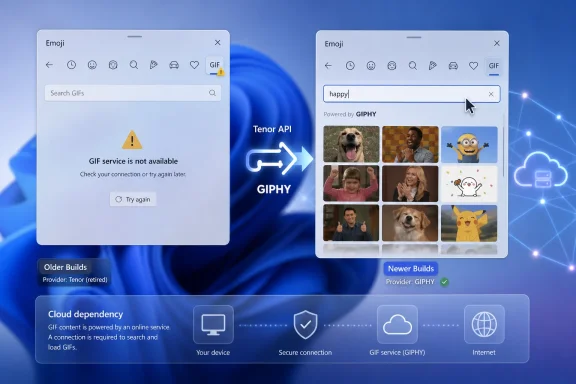
Microsoft’s release notes for KB5095093 make the dependency explicit. The emoji panel now uses GIPHY for GIF content following the deprecation of Google’s Tenor API. Starting June 30, 2026, devices without the latest update may see the “GIF service is not available” message when trying to use GIFs through the panel. That language is unusually plain: the old service path is gone, so the client needs a new provider.
For users, the remedy is simple enough. Install KB5095093 or a later Windows update, and the GIF panel should return with results supplied by GIPHY rather than Tenor. For administrators and Windows watchers, the incident is a reminder that even trivial-seeming shell features can be bound to external service contracts, API deadlines, and content-provider choices that are invisible until they fail.
That distinction is technically fair and practically incomplete. The feature appeared in Windows, used a Windows keyboard shortcut, and failed inside a Microsoft-designed interface. Users do not audit backend ownership before assigning responsibility. If the Start menu search box, Widgets board, Store page, emoji panel, or Copilot entry point fails, the experience is filed under Windows, even when the broken link in the chain sits elsewhere.
This is the bargain Microsoft has made by integrating more web-backed surfaces into the operating system. The company gets fresher content, richer search experiences, monetizable or partner-driven endpoints, and the ability to update behavior without rebuilding the entire OS. But it also inherits the fragility of service dependencies that age, move, or disappear.
The Tenor-to-GIPHY switch is especially tidy because Microsoft had a replacement ready. KB5095093 lands before the June 30 cutoff Microsoft describes, which means supported devices that take the preview update or a later cumulative update can glide past the break with little drama. The messier lesson is what happens when the next provider migration is not so clean, or when a regulated enterprise cannot take a preview update just to preserve a minor user-facing feature.
That changes the operational assumptions. A Unicode symbol list can be shipped with the OS. Clipboard history can operate locally. A GIF search catalog requires a network service, ranking backend, content moderation, provider availability, and policy decisions about what users can search for and paste. Once Windows includes that as a built-in capability, a consumer internet dependency becomes part of the perceived reliability of the desktop.
This is not unique to Microsoft. Modern operating systems are full of these seams. Apple, Google, and Microsoft all blend local shell features with remote content systems, cloud accounts, app stores, search providers, personalization feeds, and AI endpoints. The difference on Windows is that the platform still carries the expectations of a general-purpose PC operating system used in hospitals, schools, factories, government offices, air-gapped-ish networks, and domain-managed fleets.
That makes even a GIF outage more than a meme-worthy inconvenience. It illustrates how much of the Windows user experience now depends on service continuity outside the machine. If a feature is built into the shell but cannot be fully explained without naming a third-party API, it belongs in a different category from the old Control Panel applet or Notepad executable.
That matters because the GIF fix sits in a slightly awkward lane. The issue is not a security vulnerability. It does not demand emergency patching. But after June 30, the old Tenor-backed experience no longer works, so a non-security preview update becomes the practical path to preserving a built-in feature on time.
For home users, this is mostly a Windows Update nudge: install the latest available update if GIFs in the emoji panel matter to you. For IT departments, it lands in the familiar gray zone between “optional” and “users will complain.” Many organizations do not broadly deploy preview cumulative updates because they prefer the more predictable cadence of Patch Tuesday. A broken GIF picker is unlikely to justify breaking that policy, but it can still generate help desk noise.
This is where Microsoft’s servicing model collides with service-backed features. A cloud dependency can expire on a provider’s calendar, not on Patch Tuesday. If the remediation requires client changes, Microsoft either has to ship them early in a preview release, wait for the next cumulative update, or mitigate server-side if the architecture allows it. In this case, the fix exists; the question is how quickly different classes of devices will receive it.
Tenor is owned by Google. GIPHY has had its own complicated corporate history, including ownership and regulatory scrutiny in the social-media ecosystem. Neither is just a dumb file host. These are searchable content platforms with ranking systems and commercial relationships. When Microsoft picks one as the backend for a Windows feature, it is making a product decision that affects what users see when they search for a reaction image from the desktop shell.
The change may also alter network and compliance considerations. Some organizations block consumer media services by default. Others allow Windows endpoints but restrict third-party content domains. If an environment previously permitted the Tenor-backed experience and now needs to permit GIPHY-backed traffic, the fix may not be as simple as installing the update. The operating system can change provider, but enterprise networks still decide what leaves the building.
That is not an argument that Microsoft should build its own GIF platform. It is an argument that web-backed shell features need clearer administrative visibility. If Windows includes consumer content integrations, administrators should be able to understand the dependency, control it, disable it, or route users away from it without spelunking through undocumented behavior.
But it still leaves the user with no useful next step. The message does not say the Tenor API was deprecated. It does not say to install the latest Windows update. It does not say whether the problem is network filtering, a regional outage, a Microsoft service issue, or an outdated build. It describes the symptom, not the remedy.
That gap matters because Windows error messages increasingly mediate between local software and remote dependencies. A modern error in the shell often has multiple possible causes: local build state, account state, cloud service health, regional rollout, policy settings, third-party provider changes, or network controls. The old model of “restart the app” or “run the troubleshooter” is not enough when the failing feature is really a contract between client code and a web API.
Microsoft’s public release notes supply the missing context, but release notes are not user interface. The people who read KB pages are not necessarily the people staring at the broken panel. If service-backed Windows features are here to stay, the OS needs better in-product diagnostics that connect visible breakage to actionable update, policy, or service-health information.
The old Windows contract was blunt but comprehensible. You installed a version, you got a set of features, and those features generally remained local unless they were obviously internet-dependent. Windows 11 has softened those lines. Search can surface web results. Widgets are service-driven. The Store is a delivery channel. Copilot and AI features depend on cloud availability and account policy. Even a small input panel can depend on an external media API.
None of this is inherently wrong. Users expect modern operating systems to integrate with online services. A desktop that never talks to the web would feel archaic to many people. The problem is disclosure and resilience: Windows often presents service-backed features as native conveniences without making their dependency model clear until something breaks.
That is why the GIF outage is useful as a case study. It is low stakes enough to analyze without panic, but visible enough to show the architecture. Nobody should treat a broken GIF picker like a system failure. But nobody should dismiss it as meaningless either. Small failures reveal where the seams are.
That distinction matters for accurate troubleshooting. A user on a mainstream 24H2 or 25H2 machine should be looking for KB5095093 or a later cumulative update. A user on a 26H1 experimental build may receive the same provider change through a different package. A managed enterprise device may not see preview updates at all. A machine behind strict network controls may install the update and still fail to load GIF results if the new provider is blocked.
The Windows ecosystem is large enough that “update Windows” is both correct and incomplete. It is correct because the client needs the new GIPHY-backed behavior. It is incomplete because the route to that behavior depends on channel, version, policy, and rollout timing.
Microsoft’s public wording also suggests that many users would eventually encounter the problem if they stayed on builds wired to the deprecated Tenor path. That is the long tail of Windows servicing in miniature. Cloud-backed dependencies create deadlines; Windows devices update on staggered schedules; users experience the mismatch as a random failure.
But it is worth noting in support documentation and help desk scripts. If users report that GIFs no longer load in the Windows 11 emoji panel and the message says the service is unavailable, the first checks are build level, update availability, and network access to the new provider. The second check is whether the organization wants this feature working at all.
Some environments may prefer that the GIF tab stay broken or be blocked. Consumer GIF search inside a corporate desktop is not a business-critical capability. It can raise concerns about distraction, bandwidth, content appropriateness, data flow, and third-party services. Microsoft’s decision to include it by default does not mean every organization must preserve it.
The better enterprise ask is control. Administrators should not have to depend on broken APIs to suppress unwanted consumer integrations. They should have documented policy switches for service-backed shell features, clear network dependency lists, and error states that distinguish “blocked by policy” from “provider unavailable” from “client out of date.”
In software development, this is normal. Developers know APIs change. They plan migrations, pin versions, read deprecation notices, and maintain fallback paths. Consumers do not think that way about the operating system. They expect Windows to be Windows, not a bundle of service agreements wearing a familiar taskbar.
Microsoft cannot avoid every dependency. In many cases, partnering is faster and better than building. GIPHY and Tenor exist because searchable GIF catalogs are their own specialized ecosystems. But the company can design Windows features so the failure of a provider does not feel like mysterious OS rot.
That means graceful degradation, clearer messaging, provider abstraction, and more transparent release notes. It also means avoiding overstatement when cloud-fed features are marketed as native Windows improvements. If a feature requires a third-party service to function, the product story should admit that dependency somewhere other than a KB article after the fact.
But the structural issue remains. Windows has another external provider in the chain. If GIPHY changes terms, suffers an outage, alters its catalog, faces regional restrictions, or becomes undesirable for Microsoft, the same class of problem returns. The provider name changes; the architectural exposure does not.
This is not a prediction that GIPHY will fail Windows users. It is a recognition that provider-backed features require ongoing maintenance. Every such integration adds another line item to the Windows reliability ledger. Some are worth it. Some are decorative. All of them need owners.
There is also a user-experience question. GIPHY results are not Tenor results. People who use GIF search often search for specific memes, reactions, or cultural shorthand. If the catalog changes, “fixed” may not mean “same.” Microsoft solved availability, but users may still notice differences in relevance and tone.
The weakness is that users only learn about the dependency because it broke. That has been a recurring tension in Windows 11. Microsoft wants the OS to feel alive, connected, and continuously improved, but the more it does that, the more Windows needs the operational transparency of a cloud service. A desktop feature can no longer be judged only by whether the local code is stable.
The company already knows how to communicate service health for Microsoft 365 and Azure. Windows, especially consumer Windows, is less mature in this regard. When shell experiences depend on remote systems, users and admins need clearer answers: Is this a known issue? Is it my build? Is it my region? Is it my network? Is it a third-party service? Is there a policy to turn it off?
A GIF outage does not demand a full service-health dashboard for every tiny feature. But it points in that direction. The boundary between operating system and service platform is already blurred. Support models need to catch up.
When a built-in panel depends on a remote provider, Microsoft needs a migration path before the provider deadline. When a provider changes, administrators need to know whether network rules must change. When a feature breaks, users need an error message that points to an update or policy reality. When the feature is nonessential, organizations need a supported way to disable it.
That is product management, not crisis management. The Windows shell is too visible to be casual about dependencies. A broken GIF tab may be harmless, but it still trains users to see Windows as flaky. Enough harmless failures become a reputation.
Microsoft avoided the worst outcome here. The fix is in flight, the explanation is public, and the failure is narrow. But the episode should push the company toward more disciplined handling of cloud-adjacent shell features, especially as Windows absorbs more AI, search, content, and account-connected experiences.
That is the real story hiding behind a missing GIF picker. Windows 11 increasingly behaves less like a sealed desktop operating system and more like a client shell for cloud-fed experiences, partner services, search endpoints, widgets, recommendations, and account-bound content. When one of those pieces breaks, users do not experience a clean boundary between “Windows” and “not Windows.” They just press Windows + period, click GIF, and blame the thing on the screen.
 A Tiny Feature Exposes a Very Modern Windows Problem
The Windows emoji panel is not new, and for many users it is not even a daily feature. Pressing Windows + period opens a small input surface for emoji, symbols, kaomoji, clipboard history, and GIF search. It is the kind of convenience layer Microsoft has been adding across Windows for years: lightweight, discoverable by shortcut, and meant to make the desktop feel closer to the mobile keyboards and chat apps people use everywhere else.But GIF search was always different from inserting a Unicode emoji. Emoji are standardized characters rendered by the operating system and applications. GIFs are searchable media objects served from a remote catalog, filtered by provider rules, ranked by search algorithms, and delivered over a network. That distinction matters because the emoji panel sits inside Windows, but the GIF experience was never entirely of Windows.
Microsoft’s release notes for KB5095093 make the dependency explicit. The emoji panel now uses GIPHY for GIF content following the deprecation of Google’s Tenor API. Starting June 30, 2026, devices without the latest update may see the “GIF service is not available” message when trying to use GIFs through the panel. That language is unusually plain: the old service path is gone, so the client needs a new provider.
For users, the remedy is simple enough. Install KB5095093 or a later Windows update, and the GIF panel should return with results supplied by GIPHY rather than Tenor. For administrators and Windows watchers, the incident is a reminder that even trivial-seeming shell features can be bound to external service contracts, API deadlines, and content-provider choices that are invisible until they fail.
Microsoft Did Not Break GIFs, But It Owned the Experience
Microsoft is right to say this was not a traditional Windows bug. A Windows bug would imply that Microsoft shipped broken client code, mishandled an internal component, or introduced a regression in the emoji panel itself. Here, the proximate cause was the retirement of the Tenor API path that Windows had relied on for GIF content.That distinction is technically fair and practically incomplete. The feature appeared in Windows, used a Windows keyboard shortcut, and failed inside a Microsoft-designed interface. Users do not audit backend ownership before assigning responsibility. If the Start menu search box, Widgets board, Store page, emoji panel, or Copilot entry point fails, the experience is filed under Windows, even when the broken link in the chain sits elsewhere.
This is the bargain Microsoft has made by integrating more web-backed surfaces into the operating system. The company gets fresher content, richer search experiences, monetizable or partner-driven endpoints, and the ability to update behavior without rebuilding the entire OS. But it also inherits the fragility of service dependencies that age, move, or disappear.
The Tenor-to-GIPHY switch is especially tidy because Microsoft had a replacement ready. KB5095093 lands before the June 30 cutoff Microsoft describes, which means supported devices that take the preview update or a later cumulative update can glide past the break with little drama. The messier lesson is what happens when the next provider migration is not so clean, or when a regulated enterprise cannot take a preview update just to preserve a minor user-facing feature.
The Emoji Panel Has Become a Cloud Client in Disguise
Windows users tend to think of the emoji panel as part of the input stack. That mental model is only partly correct. The panel is an input surface, but its GIF tab behaves more like a tiny media-search application embedded into the shell.That changes the operational assumptions. A Unicode symbol list can be shipped with the OS. Clipboard history can operate locally. A GIF search catalog requires a network service, ranking backend, content moderation, provider availability, and policy decisions about what users can search for and paste. Once Windows includes that as a built-in capability, a consumer internet dependency becomes part of the perceived reliability of the desktop.
This is not unique to Microsoft. Modern operating systems are full of these seams. Apple, Google, and Microsoft all blend local shell features with remote content systems, cloud accounts, app stores, search providers, personalization feeds, and AI endpoints. The difference on Windows is that the platform still carries the expectations of a general-purpose PC operating system used in hospitals, schools, factories, government offices, air-gapped-ish networks, and domain-managed fleets.
That makes even a GIF outage more than a meme-worthy inconvenience. It illustrates how much of the Windows user experience now depends on service continuity outside the machine. If a feature is built into the shell but cannot be fully explained without naming a third-party API, it belongs in a different category from the old Control Panel applet or Notepad executable.
The Optional Update Is Doing Mandatory Work
KB5095093 is a preview cumulative update for Windows 11 version 24H2 and 25H2, released on June 23, 2026. Preview updates, commonly called C-releases, are not the same thing as Patch Tuesday security updates. They let Microsoft ship non-security fixes and quality improvements ahead of the next mandatory monthly cycle.That matters because the GIF fix sits in a slightly awkward lane. The issue is not a security vulnerability. It does not demand emergency patching. But after June 30, the old Tenor-backed experience no longer works, so a non-security preview update becomes the practical path to preserving a built-in feature on time.
For home users, this is mostly a Windows Update nudge: install the latest available update if GIFs in the emoji panel matter to you. For IT departments, it lands in the familiar gray zone between “optional” and “users will complain.” Many organizations do not broadly deploy preview cumulative updates because they prefer the more predictable cadence of Patch Tuesday. A broken GIF picker is unlikely to justify breaking that policy, but it can still generate help desk noise.
This is where Microsoft’s servicing model collides with service-backed features. A cloud dependency can expire on a provider’s calendar, not on Patch Tuesday. If the remediation requires client changes, Microsoft either has to ship them early in a preview release, wait for the next cumulative update, or mitigate server-side if the architecture allows it. In this case, the fix exists; the question is how quickly different classes of devices will receive it.
Tenor, GIPHY, and the Politics of Invisible Providers
Most users do not care whether their GIFs come from Tenor or GIPHY until the results change. But provider swaps are not neutral. GIF search quality varies, catalogs differ, moderation policies differ, regional availability can differ, and workplace filtering rules may treat services differently.Tenor is owned by Google. GIPHY has had its own complicated corporate history, including ownership and regulatory scrutiny in the social-media ecosystem. Neither is just a dumb file host. These are searchable content platforms with ranking systems and commercial relationships. When Microsoft picks one as the backend for a Windows feature, it is making a product decision that affects what users see when they search for a reaction image from the desktop shell.
The change may also alter network and compliance considerations. Some organizations block consumer media services by default. Others allow Windows endpoints but restrict third-party content domains. If an environment previously permitted the Tenor-backed experience and now needs to permit GIPHY-backed traffic, the fix may not be as simple as installing the update. The operating system can change provider, but enterprise networks still decide what leaves the building.
That is not an argument that Microsoft should build its own GIF platform. It is an argument that web-backed shell features need clearer administrative visibility. If Windows includes consumer content integrations, administrators should be able to understand the dependency, control it, disable it, or route users away from it without spelunking through undocumented behavior.
The Error Message Was Accurate and Still Not Good Enough
“GIF service is not available” is not a terrible error message. It tells the user the feature cannot reach or use the backend service. It is much better than a blank panel, spinning progress indicator, or generic “Something went wrong.”But it still leaves the user with no useful next step. The message does not say the Tenor API was deprecated. It does not say to install the latest Windows update. It does not say whether the problem is network filtering, a regional outage, a Microsoft service issue, or an outdated build. It describes the symptom, not the remedy.
That gap matters because Windows error messages increasingly mediate between local software and remote dependencies. A modern error in the shell often has multiple possible causes: local build state, account state, cloud service health, regional rollout, policy settings, third-party provider changes, or network controls. The old model of “restart the app” or “run the troubleshooter” is not enough when the failing feature is really a contract between client code and a web API.
Microsoft’s public release notes supply the missing context, but release notes are not user interface. The people who read KB pages are not necessarily the people staring at the broken panel. If service-backed Windows features are here to stay, the OS needs better in-product diagnostics that connect visible breakage to actionable update, policy, or service-health information.
This Is the Kind of Breakage Windows 11 Invites
The GIF incident fits a broader pattern in Windows 11’s design. Microsoft has been moving the operating system toward a continuously serviced desktop where features are delivered, revised, and retired through a mix of cumulative updates, Store updates, feature flags, cloud configuration, and controlled rollouts. The result is a more dynamic Windows, but also a harder one to reason about.The old Windows contract was blunt but comprehensible. You installed a version, you got a set of features, and those features generally remained local unless they were obviously internet-dependent. Windows 11 has softened those lines. Search can surface web results. Widgets are service-driven. The Store is a delivery channel. Copilot and AI features depend on cloud availability and account policy. Even a small input panel can depend on an external media API.
None of this is inherently wrong. Users expect modern operating systems to integrate with online services. A desktop that never talks to the web would feel archaic to many people. The problem is disclosure and resilience: Windows often presents service-backed features as native conveniences without making their dependency model clear until something breaks.
That is why the GIF outage is useful as a case study. It is low stakes enough to analyze without panic, but visible enough to show the architecture. Nobody should treat a broken GIF picker like a system failure. But nobody should dismiss it as meaningless either. Small failures reveal where the seams are.
The Support Matrix Is Already Messier Than the Message
The user-facing fix sounds simple: install the latest Windows 11 update. In practice, Windows 11 now exists across multiple active releases, release channels, hardware eligibility boundaries, and deployment policies. KB5095093 is tied to Windows 11 24H2 and 25H2 builds, while 26H1 appears in Insider or experimental contexts with its own update path.That distinction matters for accurate troubleshooting. A user on a mainstream 24H2 or 25H2 machine should be looking for KB5095093 or a later cumulative update. A user on a 26H1 experimental build may receive the same provider change through a different package. A managed enterprise device may not see preview updates at all. A machine behind strict network controls may install the update and still fail to load GIF results if the new provider is blocked.
The Windows ecosystem is large enough that “update Windows” is both correct and incomplete. It is correct because the client needs the new GIPHY-backed behavior. It is incomplete because the route to that behavior depends on channel, version, policy, and rollout timing.
Microsoft’s public wording also suggests that many users would eventually encounter the problem if they stayed on builds wired to the deprecated Tenor path. That is the long tail of Windows servicing in miniature. Cloud-backed dependencies create deadlines; Windows devices update on staggered schedules; users experience the mismatch as a random failure.
IT Pros Will See a Nuisance, Not an Emergency
For administrators, the right response is proportional. This is not a security issue. It does not require out-of-band patching. It does not justify loosening update rings or rushing a preview cumulative update into production without testing.But it is worth noting in support documentation and help desk scripts. If users report that GIFs no longer load in the Windows 11 emoji panel and the message says the service is unavailable, the first checks are build level, update availability, and network access to the new provider. The second check is whether the organization wants this feature working at all.
Some environments may prefer that the GIF tab stay broken or be blocked. Consumer GIF search inside a corporate desktop is not a business-critical capability. It can raise concerns about distraction, bandwidth, content appropriateness, data flow, and third-party services. Microsoft’s decision to include it by default does not mean every organization must preserve it.
The better enterprise ask is control. Administrators should not have to depend on broken APIs to suppress unwanted consumer integrations. They should have documented policy switches for service-backed shell features, clear network dependency lists, and error states that distinguish “blocked by policy” from “provider unavailable” from “client out of date.”
The Consumer Desktop Is Becoming a Bundle of Contracts
The Tenor retirement also underlines an uncomfortable truth for platform vendors: third-party APIs are promises with expiration dates. They can be deprecated, repriced, restricted, rebranded, merged, regulated, or shut down. When an operating system feature depends on one, the OS inherits that lifecycle.In software development, this is normal. Developers know APIs change. They plan migrations, pin versions, read deprecation notices, and maintain fallback paths. Consumers do not think that way about the operating system. They expect Windows to be Windows, not a bundle of service agreements wearing a familiar taskbar.
Microsoft cannot avoid every dependency. In many cases, partnering is faster and better than building. GIPHY and Tenor exist because searchable GIF catalogs are their own specialized ecosystems. But the company can design Windows features so the failure of a provider does not feel like mysterious OS rot.
That means graceful degradation, clearer messaging, provider abstraction, and more transparent release notes. It also means avoiding overstatement when cloud-fed features are marketed as native Windows improvements. If a feature requires a third-party service to function, the product story should admit that dependency somewhere other than a KB article after the fact.
GIPHY Fixes the Immediate Failure, Not the Structural One
The switch to GIPHY should restore the practical experience for updated devices. Users press Windows + period, choose GIF, search, and insert animated results where supported. The visible failure goes away.But the structural issue remains. Windows has another external provider in the chain. If GIPHY changes terms, suffers an outage, alters its catalog, faces regional restrictions, or becomes undesirable for Microsoft, the same class of problem returns. The provider name changes; the architectural exposure does not.
This is not a prediction that GIPHY will fail Windows users. It is a recognition that provider-backed features require ongoing maintenance. Every such integration adds another line item to the Windows reliability ledger. Some are worth it. Some are decorative. All of them need owners.
There is also a user-experience question. GIPHY results are not Tenor results. People who use GIF search often search for specific memes, reactions, or cultural shorthand. If the catalog changes, “fixed” may not mean “same.” Microsoft solved availability, but users may still notice differences in relevance and tone.
Microsoft’s Best Argument Is Also Its Weakness
Microsoft’s best defense is that it responded before the deadline with a straightforward fix. The company documented the change, named the old and new providers, explained the error message, and shipped the new behavior through Windows Update. By the standards of minor Windows breakage, that is a relatively clean handling.The weakness is that users only learn about the dependency because it broke. That has been a recurring tension in Windows 11. Microsoft wants the OS to feel alive, connected, and continuously improved, but the more it does that, the more Windows needs the operational transparency of a cloud service. A desktop feature can no longer be judged only by whether the local code is stable.
The company already knows how to communicate service health for Microsoft 365 and Azure. Windows, especially consumer Windows, is less mature in this regard. When shell experiences depend on remote systems, users and admins need clearer answers: Is this a known issue? Is it my build? Is it my region? Is it my network? Is it a third-party service? Is there a policy to turn it off?
A GIF outage does not demand a full service-health dashboard for every tiny feature. But it points in that direction. The boundary between operating system and service platform is already blurred. Support models need to catch up.
The Smallest Windows Features Now Need Real Lifecycle Management
The practical lesson from this episode is not that users should care deeply about GIF infrastructure. It is that Microsoft has to care deeply about the lifecycle of anything it places inside the Windows shell. A feature does not become low-risk just because it is playful.When a built-in panel depends on a remote provider, Microsoft needs a migration path before the provider deadline. When a provider changes, administrators need to know whether network rules must change. When a feature breaks, users need an error message that points to an update or policy reality. When the feature is nonessential, organizations need a supported way to disable it.
That is product management, not crisis management. The Windows shell is too visible to be casual about dependencies. A broken GIF tab may be harmless, but it still trains users to see Windows as flaky. Enough harmless failures become a reputation.
Microsoft avoided the worst outcome here. The fix is in flight, the explanation is public, and the failure is narrow. But the episode should push the company toward more disciplined handling of cloud-adjacent shell features, especially as Windows absorbs more AI, search, content, and account-connected experiences.
The GIF Panel Gave Away the Plot
The useful thing about this incident is that it compresses a big Windows 11 debate into a tiny failure. Here is what matters for users and administrators now:- Windows 11 GIF search in the emoji panel depended on Google’s Tenor API, and that dependency stopped being viable after the API deprecation.
- Microsoft moved the emoji panel’s GIF provider to GIPHY in the June 23, 2026 KB5095093 preview update for Windows 11 24H2 and 25H2.
- Devices that remain on older builds may show “GIF service is not available” when users try to access GIFs from the Windows + period panel.
- The issue is not a security flaw, but it is a visible user-experience failure that can generate support requests.
- Managed environments should treat the fix as a normal servicing decision while checking whether GIPHY access is allowed or desired on corporate networks.
- The incident is a reminder that built-in Windows features can depend on third-party services whose timelines are not controlled by the local PC.
References
- Primary source: Windows Report
Published: 2026-07-01T10:59:49.150129
Loading…
windowsreport.com - Official source: learn.microsoft.com
Loading…
learn.microsoft.com - Official source: support.microsoft.com
- Related coverage: windowslatest.com
Loading…
www.windowslatest.com - Official source: techcommunity.microsoft.com
Loading…
techcommunity.microsoft.com - Related coverage: digitbin.com
Windows 11 Point-in-Time Restore Does What System Restore Never Could
Windows 11 KB5095093 adds Point-in-Time Restore, rolling back your entire PC in minutes. Here is what it does that System Restore never could.www.digitbin.com

- Related coverage: windowsforum.com
Loading…
windowsforum.com - Related coverage: windowscentral.com
Loading…
www.windowscentral.com - Related coverage: windows-faq.de
Loading…
www.windows-faq.de - Related coverage: techyorker.com
Loading…
techyorker.com - Related coverage: ntcompatible.com
Windows 11 June 2026 Update KB5095093 Preview: Point-in-Time Restore, Widget Tweaks, and GIF Fix
Microsoft’s June 2026 cumulative update for Windows 11, KB5095093, delivers production-quality fixes alongside a flexible point-in-time system restore feature.www.ntcompatible.com - Related coverage: mindcron.com
Windows 11 KB5095093: What Changes and What Clocks Down
Windows 11 KB5095093 preview adds Point-in-Time Restore and voice access in three languages, with 2026 deadlines for the Emoji panel and 24H2 Home and Pro.mindcron.com - Related coverage: razorman.net
Loading…
www.razorman.net - Related coverage: nichepcgamer.com
Loading…
www.nichepcgamer.com