

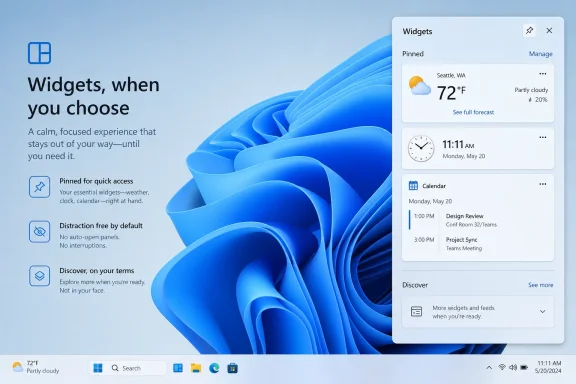
Microsoft confirmed on May 1, 2026, that Windows 11 Insider Preview Build 26300.8346 will make Widgets quieter by default by disabling hover launch, turning off taskbar badging, limiting alerts, and opening first to widgets rather than the MSN Discover feed. That is a small settings change with a larger admission behind it. For years, Windows 11 has treated attention as something the operating system could harvest; now Microsoft is testing whether restraint can win back trust. The Widgets board is becoming a referendum on whether Windows is still primarily a tool for users or a surface for Microsoft’s engagement machinery.
The striking thing about the new Widgets defaults is not that they are technically ambitious. They are almost embarrassingly simple. Do not open a giant panel because a mouse happened to drift over the weather icon; do not throw red badges onto the taskbar for news alerts; do not animate the taskbar until the user has shown interest; do not make MSN Discover the first thing a person sees when they were probably checking the weather.
That simplicity is exactly why the change matters. Windows users have complained about the Widgets board not because they misunderstood it, but because they understood it too well. It was a weather button that behaved like a trapdoor into Microsoft’s content business.
Microsoft’s language is carefully sanded down. The company says it wants to reduce “unexpected alerts and visual interruptions” and make Widgets feel less “distracting and overwhelming.” Translated from Redmondese, the company is acknowledging that the default behavior crossed a line.
This is not Microsoft removing Widgets. It is not even Microsoft removing the Discover feed. It is Microsoft changing the presumption: the user must now do more to invite the feed in, and the system must do less to shove it forward.
That distinction is the whole fight over modern Windows.
The problem was never the widget. The problem was the feed.
In practice, Windows 11’s Widgets board fused useful personal cards with MSN Discover, a scrollable content stream of headlines, recommendations, and sponsored material. For many users, the experience felt less like a productivity panel and more like a miniature portal site smuggled into the taskbar.
The “open on hover” behavior made that worse. A weather indicator in the bottom-left corner of the taskbar is easy to brush accidentally, especially on multi-monitor setups or during normal pointer travel. When that hover opened a large board full of algorithmic news and promotional tiles, Windows felt less like it was responding to intent and more like it was waiting for a chance.
That is why the new default is significant. Microsoft is not merely moving a toggle. It is conceding that accidental invocation is not engagement. It is interruption.
The old design treated the user’s attention as a renewable resource. The new design, if it survives testing, treats attention as something that must be earned.
For the user, the board was a convenience feature with baggage. For Microsoft, it was also a surface that could reinforce MSN, Bing, Edge, Microsoft Start, Microsoft accounts, personalization signals, and ad inventory. That made every design choice suspect. Was this here because it helped me, or because it helped Microsoft route me through Microsoft services?
That suspicion has become one of Windows 11’s defining product problems. The operating system has many real improvements: better window snapping, stronger security baselines, a more coherent settings migration, better HDR work, a healthier ARM story, and a more modern app platform. But those gains are constantly undermined when the shell behaves like a storefront.
The Widgets board embodied the tension. The useful part was the pinned widget grid. The contentious part was the feed wrapped around it. By opening first to the widget experience, Microsoft is implicitly separating the two: tools first, content later.
That should have been the hierarchy from day one.
In Windows, what has been lost is not market share in the dramatic, cliff-edge sense. Windows remains the default PC operating system for most people and businesses. The erosion is more subtle: patience, goodwill, and the assumption that Microsoft knows when to stop.
That is why the Widgets change is more revealing than a glossy AI demo. Anyone can put Copilot into another panel. It takes a different kind of discipline to make a surface less aggressive by default, especially when that surface likely supports downstream revenue.
Windows fans, particularly the kind who read Insider build notes and forum threads, have become allergic to promises of “delight.” They have heard that word before. What they want is friction removed, defaults respected, performance improved, and ads kept away from core workflows.
If Microsoft wants to prove that “fundamentals” is not just the new quarterly talking point, Widgets is a good place to start. It is visible, widely disliked in its current form, and easy to judge. Either the taskbar gets calmer or it does not.
A calm operating system is one that understands the difference between ambient information and interruption. Weather on the taskbar can be ambient. A red badge for a news story is interruption. A widget panel opened by a click is a tool. A widget panel opened by accidental hover is a hijack.
That is where consent becomes the real design principle. Users may choose to see alerts. They may choose to keep MSN Discover. They may choose to pin stocks, sports, traffic, photos, or Microsoft 365 cards. The problem is not that those options exist; it is that Windows has too often treated Microsoft’s preferred engagement path as the starting point.
The new Insider behavior flips some of those assumptions. Taskbar badging is off by default. Hover launch is off by default. Taskbar alerts are limited until the user has engaged with Widgets. First launch opens to the widgets experience, not the feed.
None of this prevents Microsoft from offering the feed. It simply makes the feed less parasitic on the taskbar.
That uncertainty cuts both ways. Microsoft deserves credit for testing calmer defaults, but it has not yet earned credit for shipping them broadly. Windows history is littered with reasonable Insider experiments that either took too long to arrive, arrived partially, or were softened by commercial compromise.
For IT pros, the practical question is not whether the Widgets board looks better in a screenshot. It is whether Microsoft will expose reliable policy controls, respect existing enterprise configurations, and avoid reintroducing noisy defaults through later updates, regional experiments, or account-based personalization.
Consumers have a different concern. They want to know whether Windows will stay fixed after they fix it. One of the most exhausting parts of modern operating systems is the feeling that preferences are provisional. A cumulative update, feature update, account prompt, or “new experience” can make the same fight return under new branding.
The Widgets change will matter most if it is durable. A calmer default that survives one preview cycle is nice. A calmer default that survives the next product planning meeting is news.
This separation is also a tacit admission that the combined experience was too crowded. The old board often felt visually claustrophobic: cards, headlines, promotional modules, photos, buttons, and personalization controls competing for the same glance. A dashboard should reduce cognitive load. The old Widgets board frequently added to it.
A cleaner split gives Microsoft a better chance of making both products defensible. Widgets can become a compact, user-curated utility surface. Discover can become an optional content destination for people who actually want it. That is a healthier product architecture than pretending everyone checking the temperature also wants a feed of celebrity, politics, sports, shopping, and AI-summarized churn.
The challenge is that Discover still has to be good. Rounding the corners of content tiles and making the layout breathe will not solve the deeper trust problem if the feed remains clickbait-heavy, low-context, or obviously optimized for dwell time over usefulness. A nicer box around the same incentives is still the same box.
Microsoft has enormous assets here: Bing, MSN, Start, Copilot, Edge, and a massive Windows audience. But the quality bar for an operating-system-adjacent news feed should be higher than the bar for a random web portal. If Microsoft wants Discover to live inside Windows, it needs to behave like a Windows component, not a tabloid vending machine.
That is why this change is more interesting than a normal UX tweak. Microsoft is potentially reducing the passive exposure of the MSN feed in order to improve the perceived quality of Windows. That is a tradeoff. It suggests the company has concluded that some engagement is not worth the resentment it creates.
The resentment has been building across several fronts. Users have complained about Start menu recommendations, Edge prompts, account nudges, OneDrive upsells, Copilot placement, lock screen content, and default app friction. Individually, each can be defended as small. Collectively, they create the feeling that Windows is always trying to steer.
The Widgets board became a symbol because it made that steering visible. You could be doing nothing more than moving your mouse, and the operating system would open a panel pointing you toward Microsoft’s content ecosystem. That is the kind of micro-aggression that does not show up cleanly in telemetry but shows up loudly in community sentiment.
Microsoft may be learning that negative attention is still negative. A user who opens Widgets by accident is measurable engagement. A user who then disables Widgets entirely, complains online, blocks Microsoft services, or starts looking seriously at macOS or Linux is also a product outcome.
The danger for Microsoft is not that every annoyed Windows 11 user installs Linux tomorrow. The danger is that the operating system becomes something people tolerate rather than recommend. In consumer technology, enthusiasm matters long before abandonment shows up in market share.
That is particularly true at the high end of the Windows audience. Enthusiasts influence family purchases, small-business decisions, gaming builds, developer machines, and forum narratives. Sysadmins may not choose operating systems based on vibes, but they absolutely remember when defaults create help-desk tickets, training friction, or policy cleanup work.
Windows 11 has sometimes felt as if it was designed around the assumption that users have nowhere else to go. That may still be mostly true in the aggregate, but it is a dangerous product attitude. SteamOS, macOS on Apple Silicon, browser-based work, cloud desktops, and improved Linux desktop experiences all chip away at the inevitability of Windows in different ways.
The Widgets rollback is small, but it signals that Microsoft sees the emotional ledger. Users do not need every feature removed. They need the OS to stop making them feel like inventory.
When Microsoft changes a consumer-hostile default because it is too distracting, it strengthens the argument for cleaner enterprise defaults everywhere else. If taskbar badging is too noisy for home users, it is certainly too noisy for a call center. If accidental hover launch is undesirable on a personal laptop, it is also undesirable on a shared workstation. If first launch should prioritize user-selected widgets, not a feed, that principle applies even more strongly in regulated industries.
The enterprise version of “calm” is predictability. Admins want the operating system to do what was configured, stay configured, and avoid surprise surfaces that create support calls or compliance review. A feed that changes by region, account, update wave, or Microsoft experiment is the opposite of that.
Microsoft has often tried to draw a line between consumer Windows and business Windows, but the line is porous. Features incubate in consumer experiences, appear in Pro, get policy toggles later, and become part of the management burden. The more Microsoft normalizes restraint in consumer defaults, the easier it becomes for enterprise admins to trust the client roadmap.
That trust has monetary value. Windows is not just a product; it is an operational dependency. Every unnecessary surface that looks like an ad, a feed, or an upsell makes the platform feel a little less like infrastructure.
That argument misses how defaults work.
Most people do not configure operating systems from first principles. They accept the initial shape, change only what becomes painful, and then live with the rest. Defaults define the mainstream experience precisely because most users will not hunt through settings to reverse every questionable product decision.
The “just turn it off” defense also shifts responsibility from the vendor to the user. If a feature is noisy by default, the burden should not fall on millions of people to discover the correct toggle. Good defaults are part of product quality.
Microsoft understands this in other contexts. Security defaults matter because users do not all become security engineers. Accessibility defaults matter because users should not need to fight the system to use it comfortably. Privacy defaults matter because consent buried in settings is weak consent.
Attention deserves the same treatment. A quiet default is not a luxury preference. It is a recognition that the taskbar is shared cognitive real estate.
But product trust is rebuilt through visible reversals. Users need to see Microsoft choose restraint in places where it previously chose engagement. They need to see the company remove annoyances without replacing them with new ones.
That is why this moment is more important than the settings themselves. Microsoft is testing whether Windows can back away from the engagement-maximization reflex. If the company follows through, Widgets could become a model for other parts of the shell: useful when summoned, quiet when ignored, configurable without spelunking, and honest about what belongs to the user versus what belongs to Microsoft’s services business.
There is also a design lesson here. Windows does not need to be empty to feel professional. It needs hierarchy. A taskbar should prioritize running apps and system state. A widget panel should prioritize user-selected glanceable information. A news feed should live where a user intentionally goes to read news. Blurring those boundaries made Windows feel cheaper.
The best version of this redesign is not anti-MSN. It is pro-Windows.
Microsoft has spent years teaching Windows users to inspect every new convenience for hidden motives. That damage will not be undone by a quieter Widgets board, but it can be reduced by repetition: fewer interruptions, cleaner defaults, better performance, clearer controls, and fewer moments where the operating system seems to be working an angle. If Windows 11 is going to win back fans, it will not happen through another sidebar, feed, or AI flourish; it will happen when the PC once again feels like it is waiting for the user, not waiting to monetize the user’s next glance.
Source: Windows Latest Microsoft is finally turning off the MSN feed and ads in Windows 11 Widgets by default
 Microsoft Finally Finds the Off Switch It Should Have Shipped
The striking thing about the new Widgets defaults is not that they are technically ambitious. They are almost embarrassingly simple. Do not open a giant panel because a mouse happened to drift over the weather icon; do not throw red badges onto the taskbar for news alerts; do not animate the taskbar until the user has shown interest; do not make MSN Discover the first thing a person sees when they were probably checking the weather.That simplicity is exactly why the change matters. Windows users have complained about the Widgets board not because they misunderstood it, but because they understood it too well. It was a weather button that behaved like a trapdoor into Microsoft’s content business.
Microsoft’s language is carefully sanded down. The company says it wants to reduce “unexpected alerts and visual interruptions” and make Widgets feel less “distracting and overwhelming.” Translated from Redmondese, the company is acknowledging that the default behavior crossed a line.
This is not Microsoft removing Widgets. It is not even Microsoft removing the Discover feed. It is Microsoft changing the presumption: the user must now do more to invite the feed in, and the system must do less to shove it forward.
That distinction is the whole fight over modern Windows.
The Weather Button Became a Business Model
Windows 11 Widgets began with an understandable premise. A glanceable dashboard for weather, calendar, traffic, stocks, sports, reminders, and system information is not inherently offensive. Apple has widgets, Android has widgets, KDE and GNOME users can build dashboards, and power users have been gluing Rainmeter skins onto desktops for decades.The problem was never the widget. The problem was the feed.
In practice, Windows 11’s Widgets board fused useful personal cards with MSN Discover, a scrollable content stream of headlines, recommendations, and sponsored material. For many users, the experience felt less like a productivity panel and more like a miniature portal site smuggled into the taskbar.
The “open on hover” behavior made that worse. A weather indicator in the bottom-left corner of the taskbar is easy to brush accidentally, especially on multi-monitor setups or during normal pointer travel. When that hover opened a large board full of algorithmic news and promotional tiles, Windows felt less like it was responding to intent and more like it was waiting for a chance.
That is why the new default is significant. Microsoft is not merely moving a toggle. It is conceding that accidental invocation is not engagement. It is interruption.
The old design treated the user’s attention as a renewable resource. The new design, if it survives testing, treats attention as something that must be earned.
The Discover Feed Was Always the Political Part of Widgets
There is a reason people got angry at Widgets in a way they rarely get angry at, say, Calculator or Notepad. Widgets sat at the intersection of Windows as an operating system and Microsoft as an advertising, search, news, and AI distribution company.For the user, the board was a convenience feature with baggage. For Microsoft, it was also a surface that could reinforce MSN, Bing, Edge, Microsoft Start, Microsoft accounts, personalization signals, and ad inventory. That made every design choice suspect. Was this here because it helped me, or because it helped Microsoft route me through Microsoft services?
That suspicion has become one of Windows 11’s defining product problems. The operating system has many real improvements: better window snapping, stronger security baselines, a more coherent settings migration, better HDR work, a healthier ARM story, and a more modern app platform. But those gains are constantly undermined when the shell behaves like a storefront.
The Widgets board embodied the tension. The useful part was the pinned widget grid. The contentious part was the feed wrapped around it. By opening first to the widget experience, Microsoft is implicitly separating the two: tools first, content later.
That should have been the hierarchy from day one.
Nadella’s “Win Back Fans” Line Now Has a Product Test
Satya Nadella’s recent admission that Microsoft must do the foundational work to “win back fans” across Windows, Xbox, Bing, and Edge landed because it sounded unusually direct for an earnings-call remark. Executives usually talk about engagement, growth, innovation, and opportunity. “Win back” implies something has been lost.In Windows, what has been lost is not market share in the dramatic, cliff-edge sense. Windows remains the default PC operating system for most people and businesses. The erosion is more subtle: patience, goodwill, and the assumption that Microsoft knows when to stop.
That is why the Widgets change is more revealing than a glossy AI demo. Anyone can put Copilot into another panel. It takes a different kind of discipline to make a surface less aggressive by default, especially when that surface likely supports downstream revenue.
Windows fans, particularly the kind who read Insider build notes and forum threads, have become allergic to promises of “delight.” They have heard that word before. What they want is friction removed, defaults respected, performance improved, and ads kept away from core workflows.
If Microsoft wants to prove that “fundamentals” is not just the new quarterly talking point, Widgets is a good place to start. It is visible, widely disliked in its current form, and easy to judge. Either the taskbar gets calmer or it does not.
Calm Is Not Minimalism; It Is Consent
Microsoft’s new framing around “calm” is useful because it moves the debate away from a false choice. A calmer Windows does not have to be a bare Windows. It does not mean every dynamic surface disappears, every feed is banned, and every default installation looks like a stripped-down enterprise image.A calm operating system is one that understands the difference between ambient information and interruption. Weather on the taskbar can be ambient. A red badge for a news story is interruption. A widget panel opened by a click is a tool. A widget panel opened by accidental hover is a hijack.
That is where consent becomes the real design principle. Users may choose to see alerts. They may choose to keep MSN Discover. They may choose to pin stocks, sports, traffic, photos, or Microsoft 365 cards. The problem is not that those options exist; it is that Windows has too often treated Microsoft’s preferred engagement path as the starting point.
The new Insider behavior flips some of those assumptions. Taskbar badging is off by default. Hover launch is off by default. Taskbar alerts are limited until the user has engaged with Widgets. First launch opens to the widgets experience, not the feed.
None of this prevents Microsoft from offering the feed. It simply makes the feed less parasitic on the taskbar.
The Insider Channel Is a Promise, Not a Guarantee
There is an important caveat: this is still an Insider test. Build 26300.8346 is in the Experimental track, and Microsoft’s own Insider language routinely warns that features may change, roll out gradually, disappear, or arrive in different form later. Regular Windows 11 users should not assume the change will appear on their PCs next Tuesday.That uncertainty cuts both ways. Microsoft deserves credit for testing calmer defaults, but it has not yet earned credit for shipping them broadly. Windows history is littered with reasonable Insider experiments that either took too long to arrive, arrived partially, or were softened by commercial compromise.
For IT pros, the practical question is not whether the Widgets board looks better in a screenshot. It is whether Microsoft will expose reliable policy controls, respect existing enterprise configurations, and avoid reintroducing noisy defaults through later updates, regional experiments, or account-based personalization.
Consumers have a different concern. They want to know whether Windows will stay fixed after they fix it. One of the most exhausting parts of modern operating systems is the feeling that preferences are provisional. A cumulative update, feature update, account prompt, or “new experience” can make the same fight return under new branding.
The Widgets change will matter most if it is durable. A calmer default that survives one preview cycle is nice. A calmer default that survives the next product planning meeting is news.
Microsoft Is Separating Widgets From the Feed Because It Has To
The company’s own wording says it is continuing to separate Widgets and Discover into more distinct destinations. That is the strategic heart of the redesign. Microsoft does not need to kill MSN to make Widgets useful; it needs to stop making MSN feel like the tax users pay to get useful Widgets.This separation is also a tacit admission that the combined experience was too crowded. The old board often felt visually claustrophobic: cards, headlines, promotional modules, photos, buttons, and personalization controls competing for the same glance. A dashboard should reduce cognitive load. The old Widgets board frequently added to it.
A cleaner split gives Microsoft a better chance of making both products defensible. Widgets can become a compact, user-curated utility surface. Discover can become an optional content destination for people who actually want it. That is a healthier product architecture than pretending everyone checking the temperature also wants a feed of celebrity, politics, sports, shopping, and AI-summarized churn.
The challenge is that Discover still has to be good. Rounding the corners of content tiles and making the layout breathe will not solve the deeper trust problem if the feed remains clickbait-heavy, low-context, or obviously optimized for dwell time over usefulness. A nicer box around the same incentives is still the same box.
Microsoft has enormous assets here: Bing, MSN, Start, Copilot, Edge, and a massive Windows audience. But the quality bar for an operating-system-adjacent news feed should be higher than the bar for a random web portal. If Microsoft wants Discover to live inside Windows, it needs to behave like a Windows component, not a tabloid vending machine.
The Revenue Question Is Real, but So Is the Backlash
It would be naive to pretend the old Widgets behavior existed only because some designer loved animated taskbar alerts. Feeds generate engagement. Engagement generates data and ad opportunities. In a company where Bing and advertising are increasingly tied to AI, search, and browser strategy, every surface matters.That is why this change is more interesting than a normal UX tweak. Microsoft is potentially reducing the passive exposure of the MSN feed in order to improve the perceived quality of Windows. That is a tradeoff. It suggests the company has concluded that some engagement is not worth the resentment it creates.
The resentment has been building across several fronts. Users have complained about Start menu recommendations, Edge prompts, account nudges, OneDrive upsells, Copilot placement, lock screen content, and default app friction. Individually, each can be defended as small. Collectively, they create the feeling that Windows is always trying to steer.
The Widgets board became a symbol because it made that steering visible. You could be doing nothing more than moving your mouse, and the operating system would open a panel pointing you toward Microsoft’s content ecosystem. That is the kind of micro-aggression that does not show up cleanly in telemetry but shows up loudly in community sentiment.
Microsoft may be learning that negative attention is still negative. A user who opens Widgets by accident is measurable engagement. A user who then disables Widgets entirely, complains online, blocks Microsoft services, or starts looking seriously at macOS or Linux is also a product outcome.
Windows 11’s Real Competitor Is User Exhaustion
For most people, switching away from Windows is still inconvenient. Application compatibility, gaming libraries, business tools, peripheral support, muscle memory, and employer requirements all keep Windows entrenched. That inertia is powerful, but it should not be confused with affection.The danger for Microsoft is not that every annoyed Windows 11 user installs Linux tomorrow. The danger is that the operating system becomes something people tolerate rather than recommend. In consumer technology, enthusiasm matters long before abandonment shows up in market share.
That is particularly true at the high end of the Windows audience. Enthusiasts influence family purchases, small-business decisions, gaming builds, developer machines, and forum narratives. Sysadmins may not choose operating systems based on vibes, but they absolutely remember when defaults create help-desk tickets, training friction, or policy cleanup work.
Windows 11 has sometimes felt as if it was designed around the assumption that users have nowhere else to go. That may still be mostly true in the aggregate, but it is a dangerous product attitude. SteamOS, macOS on Apple Silicon, browser-based work, cloud desktops, and improved Linux desktop experiences all chip away at the inevitability of Windows in different ways.
The Widgets rollback is small, but it signals that Microsoft sees the emotional ledger. Users do not need every feature removed. They need the OS to stop making them feel like inventory.
Enterprise IT Will Care Less About MSN Than About Precedent
In managed environments, many administrators already disable Widgets, restrict consumer experiences, control taskbar configuration, or use policy to reduce noise. For those shops, the new default may not transform day-to-day operations. The larger value is precedent.When Microsoft changes a consumer-hostile default because it is too distracting, it strengthens the argument for cleaner enterprise defaults everywhere else. If taskbar badging is too noisy for home users, it is certainly too noisy for a call center. If accidental hover launch is undesirable on a personal laptop, it is also undesirable on a shared workstation. If first launch should prioritize user-selected widgets, not a feed, that principle applies even more strongly in regulated industries.
The enterprise version of “calm” is predictability. Admins want the operating system to do what was configured, stay configured, and avoid surprise surfaces that create support calls or compliance review. A feed that changes by region, account, update wave, or Microsoft experiment is the opposite of that.
Microsoft has often tried to draw a line between consumer Windows and business Windows, but the line is porous. Features incubate in consumer experiences, appear in Pro, get policy toggles later, and become part of the management burden. The more Microsoft normalizes restraint in consumer defaults, the easier it becomes for enterprise admins to trust the client roadmap.
That trust has monetary value. Windows is not just a product; it is an operational dependency. Every unnecessary surface that looks like an ad, a feed, or an upsell makes the platform feel a little less like infrastructure.
The Manual Fix Was Never Enough
Defenders of the old Widgets behavior often had an easy answer: just turn it off. The settings exist. You can disable open-on-hover, hide the feed, turn off Widgets entirely, or remove the taskbar entry from Personalization settings. Power users know where to look.That argument misses how defaults work.
Most people do not configure operating systems from first principles. They accept the initial shape, change only what becomes painful, and then live with the rest. Defaults define the mainstream experience precisely because most users will not hunt through settings to reverse every questionable product decision.
The “just turn it off” defense also shifts responsibility from the vendor to the user. If a feature is noisy by default, the burden should not fall on millions of people to discover the correct toggle. Good defaults are part of product quality.
Microsoft understands this in other contexts. Security defaults matter because users do not all become security engineers. Accessibility defaults matter because users should not need to fight the system to use it comfortably. Privacy defaults matter because consent buried in settings is weak consent.
Attention deserves the same treatment. A quiet default is not a luxury preference. It is a recognition that the taskbar is shared cognitive real estate.
A Calmer Widgets Board Will Not Redeem Windows by Itself
It would be easy to overstate the change. Turning off hover launch and hiding the feed by default will not fix every frustration in Windows 11. It will not resolve hardware eligibility anger, local account complaints, update fatigue, Start menu criticism, Copilot skepticism, Edge pressure, or performance concerns on lower-memory systems.But product trust is rebuilt through visible reversals. Users need to see Microsoft choose restraint in places where it previously chose engagement. They need to see the company remove annoyances without replacing them with new ones.
That is why this moment is more important than the settings themselves. Microsoft is testing whether Windows can back away from the engagement-maximization reflex. If the company follows through, Widgets could become a model for other parts of the shell: useful when summoned, quiet when ignored, configurable without spelunking, and honest about what belongs to the user versus what belongs to Microsoft’s services business.
There is also a design lesson here. Windows does not need to be empty to feel professional. It needs hierarchy. A taskbar should prioritize running apps and system state. A widget panel should prioritize user-selected glanceable information. A news feed should live where a user intentionally goes to read news. Blurring those boundaries made Windows feel cheaper.
The best version of this redesign is not anti-MSN. It is pro-Windows.
The Widget Board’s New Rules Are a Test of Microsoft’s Restraint
The concrete changes are narrow, but they create a useful checklist for judging whether Microsoft is serious about calmer Windows defaults.- Windows 11 Insider Preview Build 26300.8346 begins testing a Widgets experience that disables open-on-hover by default.
- Taskbar badging for Widgets is being turned off by default, reducing the red-dot attention grabs that made the feature feel urgent without being useful.
- Taskbar alerts will be limited until the user has opened and engaged with the Widgets experience.
- The board’s first launch is set to prioritize the core widgets experience rather than immediately foregrounding the MSN Discover feed.
- The change is currently an Insider experiment, so general availability timing and final behavior remain uncertain.
- The broader significance is that Microsoft is testing a default that values user intent over passive feed exposure.
Microsoft has spent years teaching Windows users to inspect every new convenience for hidden motives. That damage will not be undone by a quieter Widgets board, but it can be reduced by repetition: fewer interruptions, cleaner defaults, better performance, clearer controls, and fewer moments where the operating system seems to be working an angle. If Windows 11 is going to win back fans, it will not happen through another sidebar, feed, or AI flourish; it will happen when the PC once again feels like it is waiting for the user, not waiting to monetize the user’s next glance.
Source: Windows Latest Microsoft is finally turning off the MSN feed and ads in Windows 11 Widgets by default
