

Microsoft’s October cumulative update for Windows 11, catalogued as KB5066835, has been linked to pronounced gaming performance regressions on a subset of systems — an issue independent testers and community telemetry spotted soon after the patch rolled out, and that prompted NVIDIA to ship an out‑of‑cycle hotfix (GeForce Hotfix Display Driver 581.94) to restore performance for affected GeForce users.
KB5066835 was distributed as part of Windows 11’s October servicing stream and bundled a mix of security updates, platform fixes and behavioral changes across kernel and system components. Within days and weeks of deployment, multiple, apparently unrelated regressions were reported — from WinRE input failures to networking and localhost issues — and a surprising cluster of reports centered on gaming performance declines on machines running NVIDIA GPUs. Microsoft issued emergency follow‑ups for some of the most severe regressions, but the gaming symptom set gained visibility largely through community benches and editorial testing.
Digital Foundry-style hands‑on testing and community benchmarks identified severe slowdowns in certain modern, GPU‑heavy titles — most notably Ubisoft’s Assassin’s Creed: Shadows — where identical in‑game scenes produced dramatically different frame rates before and after the KB roll‑out. NVIDIA responded by publishing a targeted hotfix, GeForce 581.94, explicitly stating the fix “addresses: Lower performance may be observed in some games after updating to Windows 11 October 2025 KB5066835.”
The technical takeaway is simple and sobering: small OS‑level changes can create outsized consequences in timing‑sensitive workloads. The operational takeaway is equally clear: improved pre‑release coordination, staged rollouts, and objective telemetry are essential to prevent the next episode from repeating itself.
Source: GamingBolt Windows 11’s KB5066835 Patch Has Impacted Gaming Performance Without Nvidia’s Hotfix
 Background / Overview
KB5066835 was distributed as part of Windows 11’s October servicing stream and bundled a mix of security updates, platform fixes and behavioral changes across kernel and system components. Within days and weeks of deployment, multiple, apparently unrelated regressions were reported — from WinRE input failures to networking and localhost issues — and a surprising cluster of reports centered on gaming performance declines on machines running NVIDIA GPUs. Microsoft issued emergency follow‑ups for some of the most severe regressions, but the gaming symptom set gained visibility largely through community benches and editorial testing.Digital Foundry-style hands‑on testing and community benchmarks identified severe slowdowns in certain modern, GPU‑heavy titles — most notably Ubisoft’s Assassin’s Creed: Shadows — where identical in‑game scenes produced dramatically different frame rates before and after the KB roll‑out. NVIDIA responded by publishing a targeted hotfix, GeForce 581.94, explicitly stating the fix “addresses: Lower performance may be observed in some games after updating to Windows 11 October 2025 KB5066835.”
What the independent testing shows
The headline numbers
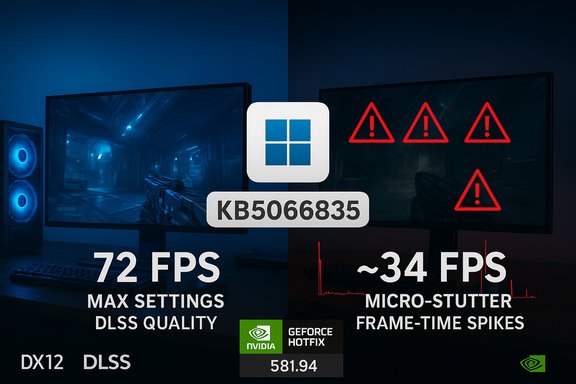
Several independent test runs and editorial comparisons recorded the clearest, most reproducible example in Assassin’s Creed: Shadows on a very high‑end test rig (an AMD Ryzen 7 9800X3D paired with an NVIDIA GeForce RTX 5090, tested at 4K with the max preset and DLSS Quality). One scene dropped from roughly 72 FPS pre‑patch to ~34 FPS after KB5066835 was applied; installing NVIDIA’s hotfix driver recovered frame rates to the pre‑update range (reported as 71 FPS in the same scene after the hotfix). Those measurements were widely circulated and served as the canary illustrating the problem’s severity.Interpreting the numbers (clarifying the math)
There’s been confusion in some headlines about the phrasing “206% improvement.” That wording conflates two different metrics. Concretely:- Pre‑patch: ~34 FPS
- Post‑hotfix: ~71 FPS
- Absolute increase: 37 FPS
- Percent increase (how much faster it runs): (37 / 34) × 100 ≈ 109% increase
- Relative ratio (how big the later FPS is compared to the earlier): 71 ÷ 34 ≈ 2.09, meaning the post‑hotfix FPS is about 209% of the pre‑hotfix FPS.
Scope and variability
The regression’s footprint proved heterogeneous. Some rigs and titles showed no change; others saw transient hitches and worse frame‑pacing rather than a simple average‑FPS drop. In the most extreme cases, users reported large frame‑rate collapses, micro‑stutter and, rarely, black screens or crashes. The heterogeneity — varying by game engine, renderer path (DX11/DX12/Vulkan), overlays, anti‑cheat drivers and driver baseline — made universal reproduction difficult and likely explains NVIDIA’s conservative wording and choice to deliver a hotfix rather than a broad statement.Why an OS patch can cripple game performance
The PC graphics stack is timing‑sensitive
Modern PC gaming runs across tightly coupled layers: the game engine, runtime APIs (DirectX/Vulkan), middleware and overlays, anti‑cheat modules, the GPU driver (WDDM), and the Windows kernel and scheduler. A change in kernel behavior, I/O timing, interrupt handling, or scheduler heuristics can alter sub‑millisecond timing relationships that govern frame submission and present calls. When a maintenance rollup touches those low‑level pieces, corner-case interactions with drivers and game engines can surface as severe performance regressions.KB5066835’s broad touchpoints
KB5066835 included fixes and changes across multiple subsystems and subsequently required emergency follow‑ups for non‑gaming regressions (WinRE USB failures, localhost/HTTP.sys issues), indicating that the update affected low‑level components in ways that had visible, real‑world side effects. The working hypothesis circulating in vendor and community triage is that one or more timing/synchronization changes at the OS layer altered driver behavior or API interaction paths in specific workloads — particularly those that use high present rates, complex draw calls, and modern upscaling stacks (e.g., DLSS).Why vendors shipped a driver fix
NVIDIA’s hotfix is a pragmatic choice: address the symptom in the driver layer so users can get back to expected performance without rolling back critical security updates in the OS. Hotfix drivers are a known operational tool in GPU vendors’ toolkits: they allow targeted, rapid code changes with abbreviated QA to restore functionality while broader diagnosis and longer validation continue. NVIDIA explicitly described 581.94 as a hotfix built on Game Ready Driver 581.80, distributed via its hotfix support channel rather than the regular WHQL Game Ready stream.NVIDIA’s hotfix: what it is — and what it isn’t
- What it is: A targeted mitigation released on an accelerated cadence (GeForce Hotfix Display Driver 581.94) that restores gaming performance for many affected configurations by altering driver behavior to work around the OS‑level change. NVIDIA published the hotfix on November 19, 2025, and framed it as an abbreviated‑QA release to be folded into a later full driver.
- What it isn’t: A WHQL‑certified, exhaustively tested Game Ready driver. Hotfixes reduce QA time to accelerate delivery, which lowers lead time but can increase risk of unforeseen side effects in unusual configurations. NVIDIA’s release notes purposely avoid enumerating fixed titles or GPU models, reflecting the heterogeneous symptom set.
Practical guidance for gamers and admins
Immediate steps to verify impact on your system
- Record baseline telemetry: run a consistent in‑game benchmark or FRAPS‑style run targeting the scene where you feel the slowdowns, capture average FPS, 1% lows and frametime graphs.
- Confirm Windows build: verify if your system installed KB5066835 (common OS build changes after the October cumulative were reported). If you’re on the affected build family, the correlation is plausible.
- Test a clean driver update path: if you observe regression, download NVIDIA’s hotfix 581.94 via the vendor’s hotfix channel and perform a clean install (use “Perform a clean installation” in NVIDIA setup or use DDU for a fully clean workflow). Re‑benchmark and compare.
If you’re an IT admin or manage many PCs
- Stage and pilot updates: KB rollouts can interact unpredictably across fleets; validate cumulative updates in lab environments that reflect production workloads.
- Use Known Issue Rollback (KIR) where appropriate and available for enterprise-managed systems to avoid exposing mission‑critical machines to problematic updates while fixes are developed.
- Document regression telemetry: capture frametime traces, driver versions and OS build numbers so vendors can triage effectively.
Risks and caveats
- Hotfix drivers carry an abbreviated QA profile; they fix immediate pain points but can introduce other edge regressions on unusual stacks. For users who are not experiencing the issue, waiting for the next WHQL Game Ready release that folds the hotfix fixes into a fully tested driver is a prudent choice.
- Rolling back the OS update removes fixes and security hardenings; wholesale rollback is not recommended unless you must restore urgent stability — and even then, it should be a controlled, temporary measure with mitigation plans.
Analysis: what this episode reveals about the Windows‑PC ecosystem
Strengths exposed
- Vendor agility: GPU vendors can and will cut hotfixes fast when a high‑impact regression emerges, demonstrating operational responsiveness to user pain. NVIDIA’s hotfix is a concrete example of vendor support meant to limit disruption.
- Community and editorial value: Rapid reporting from testing outlets and enthusiast telemetry remains a valuable guardrail; complex regressions that escape automated tests often surface first in real‑world scenarios and benefit from independent benching and video comparisons.
Weaknesses and risks
- Update stealth and user impact: The fact that KB5066835 installed broadly and silently — and that the performance regressions manifested for many users without explicit Microsoft notice — amplifies frustration and undermines confidence in automatic servicing for latency‑sensitive workloads like gaming. Several commentators concluded that Microsoft should coordinate more tightly with major GPU vendors before shipping changes that affect the driver‑OS boundary.
- Complexity of modern stacks: The incident shows how fragile millisecond timing relationships are between OS and driver code. Patches intended for security or non‑graphics areas can still alter driver interaction points and produce outsized UX regressions.
- Operational burden on vendors: GPU and game vendors are placed in the difficult position of diagnosing regressions that may originate in the OS, the driver, or the game engine — a costly triage process that consumes engineering time and press coverage cycles.
Broader implications and what to watch next
- Microsoft must provide clearer public communication when a servicing rollup touches low‑level subsystems and offer accelerated coordination channels for major ISVs and driver vendors; better pre‑release validation and cross‑vendor regression testing would reduce the likelihood of dramatic regressions reaching broad audiences. The Known Issue Rollback and emergency updates are valuable tools, but they are reactive.
- NVIDIA’s hotfix strategy is effective in the short term, but long‑term confidence requires the fixes to be folded into a WHQL Game Ready release after full validation; watch for the subsequent official driver that absorbs 581.94’s changes.
- The incident may accelerate community interest in alternative gaming platforms (notably Linux) for some enthusiasts and testers who want greater control over update timing and stack predictability — a reaction echoed by some commentators in the wake of this regression. That does not mean a wholesale migration is imminent, but it does spotlight why some users prefer greater update staging control.
Conclusion
The KB5066835 episode is a striking reminder that modern PC gaming depends on finely tuned interactions between OS and driver at millisecond granularity. When a broadly distributed Windows update shifts those interactions — intentionally or not — the result can be dramatic, measurable, and immediately felt by end users. NVIDIA’s out‑of‑cycle GeForce Hotfix Display Driver 581.94 offered a fast, practical mitigation that, in independent tests, restored performance in the worst‑case scenarios; however, hotfixes are a tactical remedy and not a substitute for better cross‑vendor validation and clearer communication around servicing updates. Gamers and administrators who saw regressions should validate their systems with reproducible benchmarks and consider NVIDIA’s hotfix if affected, while users who are not impacted should weigh the costs and benefits of an abbreviated‑QA driver versus waiting for the consolidated WHQL release.The technical takeaway is simple and sobering: small OS‑level changes can create outsized consequences in timing‑sensitive workloads. The operational takeaway is equally clear: improved pre‑release coordination, staged rollouts, and objective telemetry are essential to prevent the next episode from repeating itself.
Source: GamingBolt Windows 11’s KB5066835 Patch Has Impacted Gaming Performance Without Nvidia’s Hotfix
