

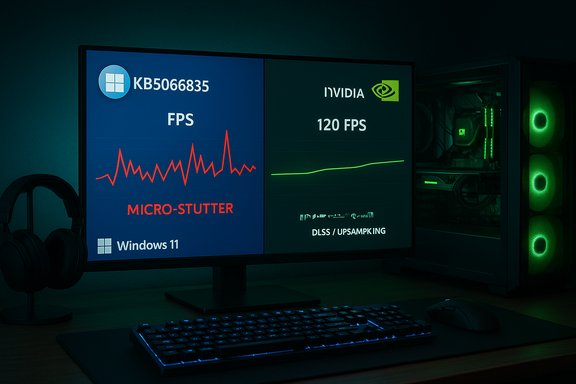
Microsoft’s October cumulative for Windows 11 (catalogued as KB5066835) coincided with a wave of reports that modern games—most notably Ubisoft’s Assassin’s Creed: Shadows—suffered dramatic FPS collapses and micro‑stuttering on some machines, and NVIDIA pushed a targeted out‑of‑cycle hotfix (GeForce Hotfix Display Driver 581.94) on November 19, 2025 to mitigate the symptom while the underlying OS/driver interaction continues to be investigated.
The October 14, 2025 Windows 11 cumulative update (KB5066835) was a routine security-and-quality rollup for several Windows 11 servicing branches, updating consumer builds to numbers such as 26100.6899 (24H2) and 26200.6899 (25H2). Microsoft’s published KB notes list many fixes and small feature changes, but the rollout was also followed by a number of independent, high‑visibility regressions across unrelated subsystems (for example, issues in the Windows Recovery Environment and problems affecting localhost/loopback networking). Within days and weeks of wider deployment, gamers and benchmarking outlets began reporting a scattered but consequential problem: on some systems that had installed KB5066835, certain titles showed significantly lower GPU performance, worse 1% lows, and increased micro‑stutter. The phenomenon was heterogeneous—some machines were untouched while others showed large regressions—pointing to an interaction between the update and particular driver/API/firmware combinations rather than a single game defect.
What we can say with reasonable confidence:
For platform maintainers and game studios, the lesson is twofold:
Short, practical checklist for immediate use:
Source: TechPowerUp October Windows 11 Update Tanked Assassin's Creed Shadows Performance
 Background
The October 14, 2025 Windows 11 cumulative update (KB5066835) was a routine security-and-quality rollup for several Windows 11 servicing branches, updating consumer builds to numbers such as 26100.6899 (24H2) and 26200.6899 (25H2). Microsoft’s published KB notes list many fixes and small feature changes, but the rollout was also followed by a number of independent, high‑visibility regressions across unrelated subsystems (for example, issues in the Windows Recovery Environment and problems affecting localhost/loopback networking). Within days and weeks of wider deployment, gamers and benchmarking outlets began reporting a scattered but consequential problem: on some systems that had installed KB5066835, certain titles showed significantly lower GPU performance, worse 1% lows, and increased micro‑stutter. The phenomenon was heterogeneous—some machines were untouched while others showed large regressions—pointing to an interaction between the update and particular driver/API/firmware combinations rather than a single game defect. What happened to Assassin’s Creed: Shadows (the headline case)
Assassin’s Creed: Shadows became the most visible example of the regression because it is a modern, GPU‑heavy title that stresses the graphics stack (DLSS/upscalers, heavy draw calls, frequent present calls). Multiple community posts and hands‑on tests showed identical benchmark scenes delivering dramatically fewer frames per second after KB5066835 was applied on certain rigs. In some public cases—particularly on very high‑end test systems with Ryzen 7 9800X3D CPUs and GeForce RTX 50‑series GPUs—benchmarked scene FPS in Shadows reportedly fell by roughly 33%–50% in worst‑case test points. Several outlets and independent test benches reproduced similar deltas. Key characteristics that made Shadows an effective canary:- It exercises many micro‑timing sensitive parts of the graphics pipeline (engine present cadence, upscaling handoffs, GPU/driver queues).
- It’s widely played and benchmarked, accelerating community detection of anomalies.
- Its high baseline demands make performance deltas obvious to testers.
How NVIDIA responded (what 581.94 is and what it does)
On November 19, 2025 NVIDIA published GeForce Hotfix Display Driver version 581.94, explicitly stating in its short support note that the hotfix “addresses: Lower performance may be observed in some games after updating to Windows 11 October 2025 KB5066835.” The company made clear this was a hotfix—built on the previously released Game Ready Driver 581.80—intended as a rapid mitigation and distributed via the NVIDIA Customer Care / Hotfix support channel rather than as a full WHQL Game Ready release. Practical points about 581.94:- It is a narrowly scoped, rapid-response hotfix (abbreviated QA compared with normal Game Ready drivers).
- The release notes are intentionally concise and do not list affected SKUs or games; the wording confines the change to a mitigation for reduced performance observed after KB5066835.
- NVIDIA recommended installing 581.94 if a user experienced degraded gaming performance after the Windows update; otherwise, users could wait for the fix to be folded into the next official driver.
Timeline (short, verifiable chronology)
- October 14, 2025 — Microsoft releases cumulative Windows 11 update KB5066835 (builds such as 26100.6899 and 26200.6899).
- Mid‑October → November 2025 — Community reports and forum telemetry point to odd regressions, including localized network issues, WinRE USB problems, and scattered game performance drops.
- November 19, 2025 — NVIDIA publishes GeForce Hotfix Driver 581.94 as an emergency, targeted mitigation for lower performance observed after KB5066835.
- Late November 2025 — Independent testers and multiple outlets publish before/after comparisons showing large recoveries in affected scenes after installing 581.94, while Microsoft and vendors continue triage and longer‑term fixes.
Technical analysis — what likely went wrong (and what we know vs. what remains speculative)
Modern PC gaming is a choreography of tiny, millisecond‑level interactions across the game engine, runtime (DirectX/Vulkan), graphics drivers, OS scheduler, and firmware (BIOS/resizable BAR settings). A change in the OS servicing stack can alter scheduler timing, interrupt routing, or other low‑level behavior; any of these changes can reduce GPU utilization or disturb present timing and frame pacing in timing‑sensitive workloads.What we can say with reasonable confidence:
- The regression is correlated with the October KB5066835 servicing wave and the observed symptom set (reduced average FPS, worse 1% lows, micro‑stutter) is consistent with a timing or interaction regression at the OS/driver boundary.
- NVIDIA’s targeted hotfix and its short release note strongly indicate the vendor recognized the problem as an interaction with the Windows update rather than a standalone graphics driver bug introduced by NVIDIA. A hotfix built on the Game Ready baseline is a classic vendor approach to revert or adjust a small set of behaviors to restore performance quickly.
- The effect’s heterogeneity—some setups unaffected, some showing catastrophic slowdowns—matches a timing‑sensitivity hypothesis: differences in CPU, firmware, enabled motherboard features (Resizable BAR/ReBAR), background overlays, anti‑cheat drivers, or even Windows configuration can flip a system from OK to impacted.
- The precise kernel API or scheduler change in KB5066835 that triggered the issue has not been publicly detailed by Microsoft, and no single smoking‑gun line of code has been disclosed. Investigations are in progress between OS and GPU vendor engineers. Until a formal root‑cause writeup appears, any claim tying the regression to a specific kernel subcomponent (e.g., frame timing change in DWM, present path changes, or a hardened syscall) should be treated as hypothesis rather than established fact.
- Some community anecdotes have cited specific BIOS toggles (for example, disabling Resizable BAR) as mitigating the issue for certain setups. Those recommendations work in some reported cases but are not universal and are configuration dependent; they are practical workarounds rather than explanations of root cause.
Evidence — what the numbers actually show (caveats)
Independent outlets and benchers provided before/after comparisons that show dramatic per‑scene recoveries after installing NVIDIA’s hotfix:- Bench tests on a high‑end rig (Ryzen 7 9800X3D + RTX 5090) displayed an identical Shadows scene falling from ~72 FPS to ~34 FPS after KB5066835 in one published comparison—then recovering substantially after 581.94. Multiple community posts posted percentage improvements as high as ~50% in affected scenes.
- The most dramatic numbers are frequently single‑configuration snapshots shared on social platforms. They are valid for those exact systems and scenes, but they are not a statistical population measurement.
- Outcomes vary by GPU model, resolution, in‑game settings (DLSS/other upscalers), background software, firmware settings (Resizable BAR), anti‑cheat middleware, and the exact Windows build installed. Some systems saw no change, which complicates broad claims.
Risks, trade‑offs, and long‑term implications
This incident highlights several systemic risks and trade‑offs for PC users, OEMs, and platform vendors.- Patchworthiness vs. Stability: Cumulative updates are essential for security, but coupling large, broad servicing updates with deep kernel changes increases the chance of unforeseen interactions with third‑party drivers. The trade‑off between shipping fixes quickly and fully exercising every stack permutation is real and hard.
- Vendor hotfix reliance: GPU vendors can and will ship hotfix drivers to restore performance quickly, but hotfixes are not a long‑term substitute for OS‑level remediation. Hotfixes use reduced QA and are typically folded into the next full driver release; they can occasionally have side effects of their own.
- Fragmentation and user experience: Because effects vary by configuration, many users will never see an issue while a subset will see severe regressions. That makes public troubleshooting noisy and increases pressure on support channels, forums, and social media to triage individual cases.
- Opaque root cause: Without an official, detailed post‑mortem from Microsoft (or a joint Microsoft/NVIDIA technical writeup), users and admins lack a definitive explanation, which slows long‑term mitigation and trust restoration. Until then, mitigation (drivers, BIOS toggles, temporary rollbacks) is the practical option.
Actionable guidance for affected users and administrators
If your gaming performance took a hit after mid‑October and you want to restore smooth play quickly, follow this prioritized checklist:- Confirm the Windows build: check whether KB5066835 (builds like 26100.6899 / 26200.6899) or a later rollup is installed. If not installed, your problem is probably unrelated to this specific regression.
- If you have an NVIDIA GPU and you experienced degraded performance: download and install GeForce Hotfix Driver 581.94 from NVIDIA’s Customer Care / Hotfix page and test the affected titles. This hotfix is the vendor’s recommended rapid mitigation.
- If you prefer to avoid hotfixes: wait for the next WHQL Game Ready driver where the fix will be integrated after broader QA. This is the conservative approach for systems that cannot risk driver instability.
- Short‑term BIOS/firmware workarounds reported by the community: toggling features like Resizable BAR (ReBAR) off in the motherboard BIOS has helped some users in anecdotal reports, but this is configuration dependent and not a universal fix. Apply with caution and document settings before changes.
- For enterprise or managed fleets where security policy forbids rolling back cumulative updates: consider targeted driver deployments to affected machines via your normal driver management tooling, and coordinate with vendors for supported fixes.
Why this matters for the Windows ecosystem and gaming at large
This episode underlines a structural reality of modern PC gaming: raw hardware performance is necessary but not sufficient to guarantee a consistent user experience. The software stack—OS servicing, device drivers, firmware, game engines and anti‑cheat middleware—must all play together. A change in one layer can cascade through the stack with visible end‑user consequences.For platform maintainers and game studios, the lesson is twofold:
- Invest in broader integration testing across diverse partner stacks, especially for servicing updates that touch low‑level subsystems.
- Improve transparency in communications when regressions cross vendor boundaries; concise, jointly authored guidance helps system administrators and gamers choose mitigations without undue risk.
Conclusion
The October Windows 11 cumulative update KB5066835 produced a surprising and visible regression in some gaming workloads, with Assassin’s Creed: Shadows serving as the clearest public example. NVIDIA’s GeForce Hotfix Driver 581.94—released November 19, 2025—was a fast, targeted mitigation that in many reported cases restored performance toward pre‑update levels. However, the incident is a reminder that complex interactions between OS servicing, drivers, firmware, and high‑frequency workloads like modern games can produce outsized user‑facing consequences. The hotfix is a pragmatic stopgap; a transparent, technical post‑mortem from the involved vendors would be the final step in restoring confidence and preventing recurrence. Until then, affected users should apply the vendor‑recommended driver mitigation or wait for the fix to be folded into an official Game Ready driver, while administrators should apply targeted rollouts where security policy permits.Short, practical checklist for immediate use:
- Check Windows build (KB5066835 / 26100.6899 or 26200.6899).
- If affected and using NVIDIA, try GeForce Hotfix Driver 581.94 (manual download).
- If risk‑averse, wait for the fix in the next WHQL Game Ready driver.
- If experimenting, document BIOS/firmware settings before toggling Resizable BAR or other options as a temporary mitigation.
Source: TechPowerUp October Windows 11 Update Tanked Assassin's Creed Shadows Performance
