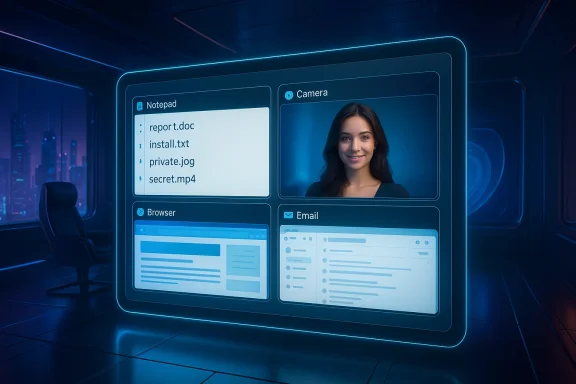
A high-profile streamer was temporarily removed from both Twitch and Kick after a short live moment exposed explicit file names inside a Notepad window — an incident the streamer blamed on a quirk of Windows 11. The episode has quickly become a cautionary case study at the intersection of OS features, content-moderation rules, and streamer workflows: a highly requested Windows 11 capability designed for accessibility and multi‑tasking is now being scrutinized for the unanticipated ways it can surface private or dangerous content on live broadcasts.
The multi‑app camera feature in Windows 11 is a worthwhile, accessibility‑minded improvement, and it should remain in the product. But the incident demonstrates the need for co‑designed safeguards: OS makers should provide explicit broadcast‑safe defaults and easy one‑click isolation for live sessions; platforms should tune moderation and appeals to account for technical context; and creators must harden workflows and adopt pre‑stream hygiene. Only with all three working together will we reduce the number of avoidable bans, protect audiences, and preserve the practical benefits of the very features the community asked Microsoft to build.
Source: Neowin Twitch and Kick streamer banned thanks to a highly requested Windows 11 exclusive feature
 Background
What happened, in brief
On January 22, a prominent streamer showed several Notepad tabs during a live session; the visible filenames suggested explicit and illegal material. The streamer said the files were not intentionally opened, claimed they had been auto‑downloaded, and then attempted to delete them on camera. Shortly thereafter the streamer was banned on Twitch and Kick while moderators and parts of the community debated whether the deletion had been incomplete due to a Windows 11 behavior. Media outlets captured the recordings, community reaction, and the streamer's own defenses.Why this story landed in the Windows conversation
The episode turned into a larger platform-vs-product narrative because the streamer attributed the problem to how Windows 11 handled the file (or the Notepad session) — and because Windows 11 has recently added an array of camera and app-sharing features that change how creators stream and manage multiple video apps simultaneously. That OS-level change matters to streamers: the new camera and application-sharing behaviors alter workflows and increase the surface area for accidental exposures, overlays, or cross‑app leakage of private content. Reporting on the camera change has been consistent across technology outlets and Insider tracking: Windows 11 now offers a Multi‑app Camera option to allow a single webcam to feed several applications at once, a capability explicitly designed with accessibility use cases in mind.Overview of the Windows 11 feature at the center: Multi‑app Camera
What the feature does
- Multi‑app Camera allows a webcam to be accessed by multiple applications at once, removing the previous single‑app lock that produced “Close other apps” messages when the camera was already in use.
- The setting appears under Settings > Bluetooth & devices > Camera > Advanced camera settings, and — when enabled — centralizes certain camera parameters so they can be controlled from Windows settings rather than from each app. The stated, primary design intent is accessibility: to let a sign-language interpreter or captioning tool receive the same live feed as the primary broadcast.
How it changes streaming workflows
For streamers, the feature removes the need for virtual camera drivers or complex OBS routing to push one camera into multiple destinations. Content creators can now:- Use the same physical webcam in OBS while also being present in a video meeting app.
- Run a sign-language interpreter app and broadcast app simultaneously from the same feed.
- Simplify multi‑stream setups where two or more capture applications need concurrent access to the camera.
The incident: timelines, claims, and what’s verifiable
The public timeline
- During a live broadcast the streamer briefly displayed Notepad with several tab names that suggested explicit content.
- Viewers clipped and circulated the moment; the streamer publicly stated the files were auto‑downloaded and that they had deleted the files on camera.
- The streamer attributed the residual on‑screen text to a Windows 11 behavior — saying that even after deletion the file “still stays there.”
- Platform enforcement followed: both Twitch and Kick enacted bans or suspensions while community discussion unfolded.
What is confirmed and what remains speculative
- Confirmed: the livestream clip circulated widely; the streamer deleted the files on camera and was banned on at least one platform. The public clip, reactions, and bans are documented.
- Unverified / speculative: that Windows 11 “keeps deleted files visible forever” in the general sense. Independent attempts to replicate an identical, reproducible Notepad behavior tied to deletion have not been broadly documented; community testers reported mixed results and Microsoft support documentation indicates Notepad stores tab state in local app data but provides mechanisms to clear it. In short: the claim that Windows 11 itself caused the ban is plausible as a narrative, but the technical causation is not conclusively proven in public reporting.
The technical anatomy: Notepad, tab state, caching, and deletion
Why files can appear after deletion
Notepad (the Store‑distributed app in modern Windows builds) retains tab state for sessions: a local file under the Notepad package folder stores which tabs were open and their paths. If a tab referenced a file that was deleted afterward, Notepad may still attempt to rehydrate that tab based on the saved state until the app is reset or the state file is cleared. Microsoft documentation and community Q&A note the TabState location and recommend resetting the Notepad app to purge cached entries. That behavior explains how a zero‑second UI snapshot of a Notepad tab could persist visually after file deletion, without needing a mysterious “undelete” bug in the filesystem.Other plausible mechanisms
- Storage Sense or automatic cleanup may move or purge files from Downloads and other folders in ways the user doesn’t expect; automated cleanup plus cached UI state can produce surprising results.
- Browser auto‑downloads and malware can deposit files into common folders; a user opening a folder quickly during a stream can display filenames they did not consciously create. The combination of auto‑download behavior, Notepad tab state, and a multi‑app camera/streaming pipeline can make a private transient artifact visible on a live feed.
Policy and platform context: why this can trigger bans
Twitch/Kick enforcement priorities
Streaming platforms enforce community standards that treat exposure of illicit or sexual content severely. Twitch in particular has strict rules about broadcasting illicit material or displaying content that violates its sexual content and child safety policies. Beyond content policies, Twitch has historically taken action when a streamer broadcasts content that could be seen as normalizing or enabling illegal activity. Platforms also enforce rules about displaying other platform activity and about third‑party overlays depending on context. When moderators or automated systems see the brief view that looks like illegal material, they often take rapid action.Automated moderation and the ‘false positive’ problem
Large platforms increasingly rely on automated detection to triage and escalate content. These systems prioritize speed and recall, which can create false positives on ambiguous streams — a brief, out‑of‑context screenshot of a filename may trigger a rule intended for explicit content. The result is fast enforcement with little explanation to the streamer and long, often opaque, appeals processes. For creators, the risk of a single strike — or a cross‑platform suspension — is existential. File or UI artifacts that are in one place on a machine but visible to a feed because of multi‑app camera sharing are the exact kind of edge case that automated classifiers historically mislabel.Why a Windows feature can become a lightning rod
Accessibility-firstt design meets broadcaster needs
Microsoft explicitly pitched Multi‑app Camera toward accessibility scenarios — letting interpreters and assistive apps subscribe to the same live feed as the primary app. That’s a legitimate, positive goal, and it reduces complexity for creators who previously used virtual camera drivers and routing hacks. However, features built to lower friction for legitimate use also lower the barrier for accidental cross‑pollination between app windows, overlays, and streams.The unintended surface area
- Sharing the camera across apps reduces the friction for simultaneous app usage, but also increases the chance a background window or overlay will be captured in one of the apps.
- Simplified workflows make it easier to run multiple streaming/meeting apps and to multi‑stream — but that same convenience raises compliance questions about showing other platforms’ chat or content (a known violation vector for some platforms).
What this means for streamers and creators — practical mitigation
Short checklist (immediate actions)
- Test privately. Always run new setups in an unlisted/private session to verify what overlays, windows, and cached UI state are visible on each capture source.
- Reset Notepad or clear TabState if sensitive files were opened; the Notepad app’s advanced options include a Reset function to clear stored state. Microsoft’s community guidance documents the TabState location and reset method; resetting is the fastest way to remove cached tabs that reference deleted files.
- Disable Multi‑app Camera when not needed. If you don’t require the camera feed in multiple apps, turn the option off in Settings > Bluetooth & devices > Camera > Advanced camera settings. That reduces one vector of accidental capture.
- Use a dedicated, secondary capture device for multi‑platform broadcasting where possible (a second PC or an external hardware capture) so accidental UI state on your streaming machine is never visible to the broadcast.
- Harden browser and downloads. Disable automatic downloads, run with a hardened profile for streaming, and confirm your Downloads folder contents before going live.
Longer‑term operational controls
- Implement a pre‑stream checklist that closes personal apps, clears recent files or app caches, and verifies the OBS scene collection contains only intended sources.
- Consider using virtual machine or containerized capture workflows for public streams to isolate user session state from the broadcast capture surface.
- Insist that moderators or co‑hosts have an independent monitoring feed they can quickly cut the stream on if sensitive content appears.
Critical analysis: strengths, weaknesses, and systemic risks
Notable strengths of the Windows change
- Accessibility gains. Allowing multiple apps to use one camera helps assistive workflows (e.g., sign-language interpreters) and is a welcome platform‑level capability.
- Simplified production. For creators, removing the need for virtual cameras and complex driver workarounds reduces setup complexity and lowers friction for smaller creators.
Real risks and tradeoffs
- Accidental exposure risk increases. Lowering the technical barrier to multi‑app camera use can make accidental exposure of private UI elements more likely, especially without clear UI safeguards or defaults optimized for live broadcasters.
- Opaque enforcement collisions. Platforms’ rapid, automated moderation — while designed to protect audiences — can produce outsized penalties for transient, ambiguous incidents. This interaction penalizes creators for edge cases that are often more product‑oriented than intent‑based. Community reporting about broader moderation misclassifications (for example, OS‑how‑to content being flagged by automated systems) illustrates how brittle enforcement can be when content is technical or context‑dependent.
- Attribution confusion. When a creator attributes a violation to an OS feature, platforms and audiences may conflate product choices with user intent; browsers, OS settings, and app caching behavior become de facto actors in moderation narratives.
Platform responses are the weak link
The case shows that even responsible, accessibility‑driven OS changes require clearer guidance for creators and stronger safeguards from platforms. Without either, the response is often to ban first and explain (or restore) later — which imposes real reputational and financial costs on creators. Reporting across multiple incidents demonstrates that automated moderation frequently lacks the domain expertise to correctly parse technical content or transient UI states.Recommendations: how product teams and platforms should respond
For Microsoft (product teams)
- Add a Streamer Mode toggle to camera settings that:
- Disables Notepad/other app UI capture of sensitive file names while active.
- Displays an on‑screen indicator when multiple apps are capturing the camera.
- Provides a one‑click “safe start” for broadcast sessions that clears app caches and recent‑file lists.
- Improve Notepad session handling so that reopened tabs referencing missing files prompt an explicit “Reopen removed file?” confirmation rather than silently re‑showing cached paths. The Notepad reset approach is useful, but a built‑in prompt would reduce surprises for users unaware of TabState persistence.
For streaming platforms (Twitch, Kick, YouTube, et al.
- Create a technical content review lane for appeals that involve OS behavior, app UI, or developer tools; human reviewers with modest technical literacy can quickly distinguish malicious intent from accidental exposure.
- Publish clearer, example‑based guidance on what “displaying other platform activity” means in practice and how multi‑app camera setups are treated under the rules.
- Provide fast, transparent appeal paths for creators who can demonstrate accidental exposure (system logs, VODs, or co‑host attestations) to reduce economic and reputational harms.
For creators and community tools
- Build community checklists and small utilities that automatically clear Notepad and other app caches before going live.
- Encourage use of physical privacy covers and hardware capture separation for any channel carrying high‑risk or regulated content.
Conclusion
The episode that began with a single Notepad screenshot and a pair of bans is more than a streamer PR problem: it exposes a recurring structural issue in the modern creator economy. Platforms enforce content safety with blunt instruments at scale; operating systems add features to reduce friction and increase accessibility; creators operate at the intersection of both. When those three actors — product vendors, platforms, and creators — do not share a clear, operational language for risk and intent, real people and livelihoods are harmed.The multi‑app camera feature in Windows 11 is a worthwhile, accessibility‑minded improvement, and it should remain in the product. But the incident demonstrates the need for co‑designed safeguards: OS makers should provide explicit broadcast‑safe defaults and easy one‑click isolation for live sessions; platforms should tune moderation and appeals to account for technical context; and creators must harden workflows and adopt pre‑stream hygiene. Only with all three working together will we reduce the number of avoidable bans, protect audiences, and preserve the practical benefits of the very features the community asked Microsoft to build.
Source: Neowin Twitch and Kick streamer banned thanks to a highly requested Windows 11 exclusive feature
Last edited: