

Steam's October 2025 Hardware & Software Survey shows a clear — and consequential — reshaping of the PC gaming landscape: Windows 11 is now the majority OS among Steam users, but a substantial minority remain on Windows 10 while Linux has crossed the 3% mark on Steam for the first time, driven in large part by SteamOS and handheld adoption.
The Steam Hardware & Software Survey is Valve’s monthly voluntary snapshot of the software and hardware running on participating Steam clients. It’s not a global census of every desktop PC, but it reliably captures trends within the active PC gaming population — the segment that matters most to game developers, GPU vendors, and peripheral makers. The October 2025 snapshot is consequential precisely because it lands after Microsoft’s announced end-of-support date for Windows 10 and amid vendor decisions about driver lifecycles. Microsoft’s lifecycle schedule set October 14, 2025 as the end of support for Windows 10 consumer editions; after that date, routine feature and security updates stop unless a system enrolls in an Extended Security Updates (ESU) program. That calendar acted as an external deadline for many users and businesses and is a key driver behind the shifts seen in Steam’s data. At the same time, GPU vendor support policies have softened some of the immediate pressure to abandon Windows 10. NVIDIA publicly extended Game Ready Driver support for Windows 10 on modern RTX GPUs through October 2026, offering a short-term buffer for gamers who either can’t or won’t upgrade their hardware right away. That vendor-level extension matters for gamers who rely on day‑zero optimizations for new titles.
Windows gaming is adapting into a more pluralistic environment: a dominant Windows 11 majority, a meaningful Windows 10 minority with temporary vendor and ESU lifelines, and a growing Linux segment shaped by Valve’s handheld success and improved compatibility tooling. Each choice has trade‑offs — cost, compatibility, security, and convenience — and the best path depends on individual priorities. The October 2025 survey doesn’t close the book; it redraws the margins and sets the questions developers and gamers must answer next.
Source: PC Guide Nearly a third of Steam users are still using Windows 10, and Linux usage hits new milestone
 Background
The Steam Hardware & Software Survey is Valve’s monthly voluntary snapshot of the software and hardware running on participating Steam clients. It’s not a global census of every desktop PC, but it reliably captures trends within the active PC gaming population — the segment that matters most to game developers, GPU vendors, and peripheral makers. The October 2025 snapshot is consequential precisely because it lands after Microsoft’s announced end-of-support date for Windows 10 and amid vendor decisions about driver lifecycles. Microsoft’s lifecycle schedule set October 14, 2025 as the end of support for Windows 10 consumer editions; after that date, routine feature and security updates stop unless a system enrolls in an Extended Security Updates (ESU) program. That calendar acted as an external deadline for many users and businesses and is a key driver behind the shifts seen in Steam’s data. At the same time, GPU vendor support policies have softened some of the immediate pressure to abandon Windows 10. NVIDIA publicly extended Game Ready Driver support for Windows 10 on modern RTX GPUs through October 2026, offering a short-term buffer for gamers who either can’t or won’t upgrade their hardware right away. That vendor-level extension matters for gamers who rely on day‑zero optimizations for new titles. What the October 2025 Steam survey actually reports
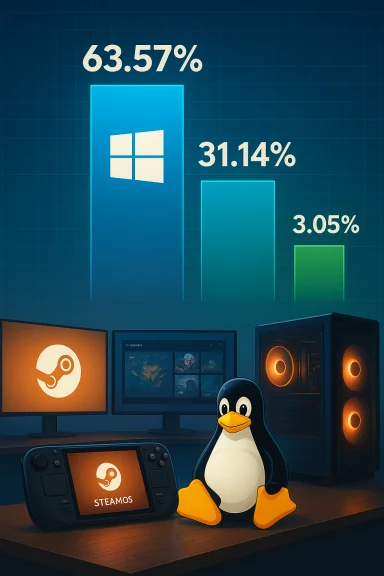
The most load-bearing numbers from Valve’s October 2025 Steam Hardware & Software Survey are precise and worth repeating because they directly inform publisher, driver, and OS planning:- Windows 11 (64-bit): 63.57% of Steam users.
- Windows 10 (64-bit): 31.14% of Steam users — just under a third remain on the older OS.
- Linux: 3.05% of Steam users — the Linux share has finally cleared the 3% threshold on Steam.
Linux and SteamOS: distribution breakdown and Steam Deck influence
Linux’s 3.05% figure hides an important detail: a substantial portion of that Linux share is driven by Valve’s own handheld platform and its SteamOS variants. Within Steam’s Linux user base, SteamOS (SteamOS Holo) accounted for around 27% of Linux installs in the October snapshot — a clear sign the Steam Deck and SteamOS ecosystem continue to move meaningful gaming traffic onto Linux kernels. Other gaming-focused distributions listed in the survey — including Arch, Linux Mint, Bazzite, and CachyOS — also make visible gains on Steam. The Steam Deck’s influence is material: Valve’s handheld has introduced millions of gamers to a Linux-first, Proton-enabled play experience, lowering friction for Linux gaming and increasing confidence that a non-Windows gaming setup can be practical for many players. Gaming-focused distros and community-driven compatibility improvements (Proton/Wine) amplify that trend.Why nearly a third of Steam users still run Windows 10
The persistence of Windows 10 on millions of Steam clients is not mysterious when you map the incentives and constraints facing users.- Hardware gatekeeping: Windows 11’s baseline requirements — TPM 2.0, UEFI Secure Boot, and certain CPU generations — disqualify many still-capable older PCs from a frictionless upgrade, pushing owners toward either hardware replacement or alternative paths. Workarounds to bypass checks exist but carry compatibility and update risks.
- Extended Security Updates (ESU): Microsoft offered a consumer ESU program as a bridge through October 13, 2026, enabling eligible Windows 10 devices to receive security patches for a limited period. That makes staying on Windows 10 a defensible short-term option for some users — especially those on a tight upgrade budget. However, ESU is a temporary patch, not a long-term solution, and in some cases requires Microsoft account enrollment and administrative steps that not all users welcome.
- Driver continuity and vendor support: Hardware vendors — most notably NVIDIA — deliberately softened the cliff by extending driver support for Windows 10 on modern RTX GPUs through October 2026. That commitment reduces one major immediate cost for gamers who might otherwise feel forced to buy new hardware simply to keep receiving day‑0 optimizations.
- Perceived stability and familiarity: For many gamers, Windows 10 is a known quantity: installed games and tools, working anti‑cheat support for multiplayer titles, and a large share of developer testing historically targeted the OS. That inertia is powerful.
Why Linux is making measurable gains on Steam
Linux’s ascent on Steam is the product of several converging technical and market forces:- Proton and compatibility improvements: Valve’s Proton (a packaging of Wine and related patches) has materially improved Windows game compatibility on Linux, reducing the friction for many titles to run acceptably. Proton’s steady progress has made Linux a far more realistic gaming target than it was five years ago.
- Valve’s hardware and store-level focus: The Steam Deck introduced a large cohort of users to a Linux-first gaming environment. Valve’s work on SteamOS, driver engineering, and a compatibility-rating system for the store has lowered the risk for consumers exploring Linux as a daily driver for gaming. That hardware-to-software feedback loop is a direct accelerator for Linux share on Steam.
- Distribution evolution and migration tooling: A new generation of user-focused Linux distributions (Zorin OS, Bazzite, CachyOS, and others) have shipping features and migration helpers that reduce the psychological barrier for Windows users. Some distros are explicitly optimized for gaming or for a Steam Deck‑like experience on x86 handhelds.
- A timely calendar and campaigns: The Windows 10 end-of-support deadline created a decision point that prompted curiosity and experimentation. Community and vendor campaigns — from KDE’s migration efforts to press coverage of distros positioning themselves as replacements — converted curiosity into real installs and live testing. Multiple public trackers (StatCounter and others) corroborate modest but measurable Linux desktop growth in 2025, though the exact percentages vary by methodology and region.
Strengths and opportunities created by the current mix
- Windows 11 majority on Steam accelerates platform-level feature adoption. With Windows 11 now the majority OS on the platform, features tied to the newer OS — such as optimizations that assume modern driver models or storage APIs — are more likely to be prioritized in developer testing pipelines. That can unlock better performance and feature parity for gamers on modern hardware.
- Vendor grace periods reduce immediate upgrade costs. NVIDIA’s driver extension and similar vendor choices give consumers breathing room to plan upgrades, reducing wasteful hardware churn in the short term. This is a practical benefit for gamers on a budget.
- Linux and SteamOS growth broadens choice. For users who cannot upgrade to Windows 11 or who prefer greater control over updates and privacy, the Linux path has become more viable — especially for single‑player and many indie titles. The existence of alternate, well-supported ecosystems (SteamOS included) reduces Microsoft-only lock-in pressure.
Risks, interoperability headwinds and red flags
- Security exposure for laggards: Running Windows 10 without ESU enrollment after October 2025 means missing routine security updates, which increases exposure to newly discovered vulnerabilities. The practical impact varies, but the risk profile for online gaming (multiplayer clients, voice apps, overlay services) is non-trivial. Users remaining on unsupported software should accept that risk or plan migration.
- Anti-cheat and multiplayer compatibility remain friction points for Linux. While Proton has reduced the compatibility gap, anti-cheat systems (Easy Anti‑Cheat, BattlEye, other vendor implementations) remain a primary blocker for many competitive multiplayer titles. Developer policies and middleware adoption will determine how quickly Linux can reach parity in competitive gaming. Prolonged divergence could lock some games to Windows-only servers or feature sets, complicating cross‑platform play.
- Fragmentation costs for developers and publishers. A split where the majority runs Windows 11, a sizeable minority stays on Windows 10, and an expanding — but still small — Linux cohort exists forces publishers to pick their testing matrices carefully. Testing against three OS families (Win11, Win10, Linux) raises QA costs and hardens decisions about which versions are supported for new releases and patches.
- Unverified conversion claims and download vs. install gaps. Several Linux distros reported massive download spikes tied to Windows 10’s support end, but downloads are a noisy proxy for active installs. Without telemetry that separates ISO downloads from completed, daily‑use migrations, conversion rates remain uncertain. Treat download metrics as intent signals, not confirmed deployments.
What this means for different types of gamers
- Competitive multiplayer players: Staying on Windows (either 10 with ESU or Windows 11) is the least disruptive path; anti‑cheat and publisher certification make Windows the safest route for guaranteed compatibility. If you play competitive titles, validate publisher Linux support before migrating.
- Single‑player and indie gamers: This group has the most flexibility. Many single‑player and indie titles run well via Proton or native Linux builds, making SteamOS or desktop Linux a viable, lower-cost alternative. The Steam Deck’s success shows a robust single‑player ecosystem is already feasible on Linux.
- Budget-conscious or older‑hardware users: For machines that fail Windows 11 checks, Linux can extend usable life and reduce total cost of ownership. However, expect a migration curve: some Windows apps may need replacements or workarounds. Distros that focus on Windows‑familiar layouts and compatibility helpers reduce friction.
- Developers and publishers: The data pushes an operational question: which environment to test and certify? With Windows 11 dominant on Steam, vendors will rationally prioritize the newer platform — but the still‑large Windows 10 installed base argues for a measured, transitional support window. Balanced testing strategies and clear end-of-support timelines in release notes will be required.
Practical next steps: a checklist for Steam users
- Check your PC compatibility now. Open Settings → Windows Update on Windows 10 and use Microsoft’s tools to verify Windows 11 eligibility. If your machine supports Windows 11, plan and verify drivers and peripherals before upgrading.
- Decide on a migration path if you’re on Windows 10. Options: upgrade to Windows 11, enroll in consumer ESU as a short-term bridge, buy a new Windows 11 PC, or trial a Linux distro (live USB or VM).
- Back up your games and save data. Use Steam’s cloud saves where available and export local saves before any major OS change. Test restores on a VM if you can.
- Try Linux in a low-risk way. Boot a live USB of a mainstream distro (Ubuntu, Mint, Zorin) or try SteamOS on a spare device to assess Proton compatibility for your library. Community compatibility databases (ProtonDB) are valuable but anecdotal; test your critical titles.
- If you rely on specific multiplayer titles, verify anti‑cheat support. Check publisher and anti‑cheat vendor communications for Proton/SteamOS compatibility before committing.
Final analysis — what to watch next
The October 2025 Steam survey is a milestone: within gaming, Windows 11 is now the de facto majority, but the terrain is far from uniform. The survival of a sizable Windows 10 cohort, combined with measurable Linux growth, creates a transitional era where developers, vendors, and users must make explicit choices about support, upgrades, and risk tolerance.- Short-term: expect continued vendor grace (driver extensions) and stable uptake patterns where budget constraints and hardware compatibility determine individual decisions. NVIDIA’s support extension through October 2026 softens immediate pressure for many RTX owners.
- Medium-term (12–24 months): publishers will increasingly align new-game test matrices with Windows 11 assumptions, particularly as DirectStorage-like optimizations and newer driver models mature and as the Windows 10 installed base continues to thin on Steam. This will raise the costs of continuing broad Windows 10 certification over time.
- Long-term: Linux’s modest but steady growth — amplified by Valve’s ecosystem work and improving compatibility layers — establishes a credible alternative ecosystem for many gamers. The critical path to broader Linux parity remains anti‑cheat adoption and publisher commitment to native or Proton‑friendly channels.
Windows gaming is adapting into a more pluralistic environment: a dominant Windows 11 majority, a meaningful Windows 10 minority with temporary vendor and ESU lifelines, and a growing Linux segment shaped by Valve’s handheld success and improved compatibility tooling. Each choice has trade‑offs — cost, compatibility, security, and convenience — and the best path depends on individual priorities. The October 2025 survey doesn’t close the book; it redraws the margins and sets the questions developers and gamers must answer next.
Source: PC Guide Nearly a third of Steam users are still using Windows 10, and Linux usage hits new milestone
