

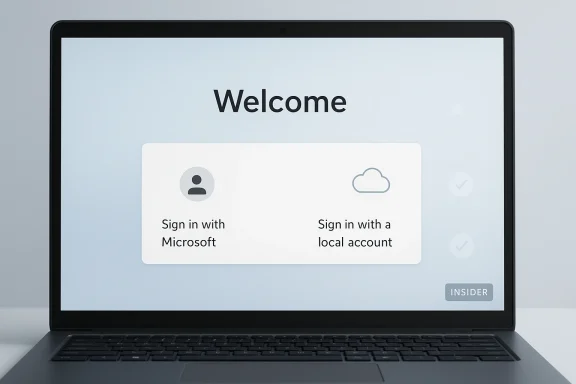
Microsoft’s Windows 11 setup flow may finally be heading toward a quieter, less coercive future. After years of nudging consumers toward a Microsoft account at first boot, new signals suggest the company is at least reconsidering whether the out-of-box experience should keep forcing that choice. The timing matters: Microsoft has already begun rolling out a broader effort to make Windows 11 setup faster and less cluttered, while inside the company some influential engineers are reportedly pushing for an MSA-free path. If that internal pressure turns into product direction, it could reshape one of the most controversial parts of Windows onboarding.
The Windows 11 setup experience has long been one of the most debated parts of the platform. For consumer editions, Microsoft has steadily tightened the path toward a Microsoft account sign-in, and the company has increasingly framed that requirement as part of a more connected, more secure, and more service-rich Windows ecosystem. At the same time, many power users, IT admins, and privacy-conscious consumers have treated that same requirement as friction, especially when they simply want a local PC account and nothing more.
That tension is not new. Microsoft has spent more than a decade trying to shift Windows from a standalone operating system into a cloud-linked identity layer that pulls in OneDrive, Microsoft Store, Windows Backup, Copilot services, and cross-device sync. In practical terms, the account requirement is not just about sign-in; it is about enrollment into an ecosystem. For Microsoft, that creates retention and service usage. For users, it can feel like a gate they must pass through before they can use the machine they just bought.
What makes the current moment noteworthy is that Microsoft itself appears to be reconsidering at least part of the script. The company has already acknowledged a broader effort to make Windows setup “quieter” and more streamlined, with fewer pages and reboots, and it has been actively shipping OOBE updates through Windows Insider and servicing channels. Microsoft’s own support documentation shows that these out-of-box experience updates are not cosmetic; they are part of a continuing effort to reshape first-run behavior. In other words, the setup flow is already a living product surface, not a fixed ceremony.
The reason the account discussion is getting fresh attention is that it now appears to be happening on two tracks at once. One track is public: Microsoft is simplifying onboarding, reducing setup clutter, and still making sure users finish OOBE connected and ready for cloud services. The second track is internal: according to the reporting that surfaced this week, some senior Microsoft engineers, including Scott Hanselman, are pushing for a friendlier login experience that would not force an MSA on everyone. The fact that this push is being described as coming from inside the company is important, because Windows product direction often changes only when the internal incentives shift.
The result has been friction. Many consumers do not object to Microsoft services in principle; they object to being forced into them before they have even reached the desktop. That distinction matters. A setup flow that offers a Microsoft account as a value-add feels different from one that effectively treats it as the only acceptable consumer choice. Microsoft has leaned toward the latter on fresh consumer installs, even as bypass methods have remained available through unsupported scripts, domain-join paths, or other workarounds.
There is also a support angle. The more steps and prompts Microsoft inserts, the more likely users are to get confused, abandon setup, or create unintended configurations. That is why the company’s own framing of a “quieter” setup experience is so revealing: Microsoft is implicitly admitting that the current onboarding funnel has grown too noisy.
Microsoft’s recent updates make that clear. Its support pages and Insider posts show continued changes to OOBE, and some recent builds have even focused on removing old local-account bypass mechanisms because Microsoft believes those shortcuts can leave devices incompletely configured. The company is not merely adding prompts; it is also removing escape hatches.
That said, quieter does not necessarily mean less tied to Microsoft’s ecosystem. A streamlined experience can still end with the same account gate, only with fewer distractions on the way there. Microsoft’s own recent setup changes in Windows Insider builds show that it continues to value a completed internet-connected setup with Microsoft account linkage, even while it trims unnecessary steps.
Still, there are reasons to think the internal debate is real. When a Microsoft executive publicly says, in response to user frustration, “Working on it,” that tends to indicate more than casual sympathy. It suggests the issue is active enough to warrant engineering attention. In a company of Microsoft’s size, that is not nothing.
That is precisely why any change to this flow has broad consequences. A local-account-friendly setup would not merely alter one login screen; it would change the default starting position of the entire Windows ecosystem. That could reduce cloud adoption at the margins, but it could also restore trust among users who have grown wary of account-first design.
Hanselman’s role gives the remark added weight. He is not a random observer; he is one of the company’s better-known technical leaders, and his opinions tend to reflect broader product instincts within Microsoft. When someone in that position publicly sympathizes with user complaints, it often signals that the internal debate is more open than official messaging suggests.
That is why internal advocacy is significant. A senior figure with credibility can translate user pain into product priority. If enough influential people agree that local-account friction is costing more goodwill than it returns in service engagement, the policy can move. Microsoft has changed direction before when platform sentiment shifted.
Even so, it is notable that the complaint was not met with a defense of the current design. That silence, or quasi-agreement, is often more revealing than any formal statement. It suggests the company knows the current experience has become difficult to justify on user-experience grounds. That is not the same as saying Microsoft will reverse course tomorrow. It does mean the conversation is real.
In March and April 2025 Insider builds, Microsoft also previewed a more streamlined UI and later expanded OOBE updates through servicing. By late 2025 and early 2026, additional OOBE updates continued to appear for newer branches, including 25H2 and 26H1. That pattern shows a sustained investment in first-run experience, not a one-off polish pass.
That matters because it lowers the threshold for change. If Microsoft decides to alter account handling, it no longer needs to wait for a major version overhaul. It can test the behavior in preview, adjust based on telemetry and feedback, and then ship it through normal Windows update mechanisms.
Microsoft already makes room for organizational identity through Entra, domain join, and school or work provisioning. The friction is concentrated mostly on consumer setup, where users are told—explicitly or implicitly—that a Microsoft account is the normal path. That is why a change here would be politically and commercially important. It would give consumers more control without undermining the enterprise management model.
That means Microsoft could loosen consumer setup without upsetting the enterprise as much as it would upset its cloud product teams. If anything, enterprise buyers may appreciate a clearer separation between personal and managed onboarding. A local-account option for home users would not inherently weaken business readiness.
There is also a privacy dimension. Even users who already use Microsoft services may not want their Windows machine tied to a cloud identity during first boot. They may prefer to decide later whether to enable sync, backup, or store access. The ability to defer that choice would make Windows feel more respectful, even if the eventual outcome were unchanged. Respect is a product feature when it is visible enough.
If Microsoft makes Windows easier to use without an MSA, it could blunt one of the common complaints that pushes users toward competing ecosystems. Linux distributions have long marketed themselves as local-first and user-controlled. Macs have a very different identity model, but Apple’s onboarding has historically felt less confrontational in tone. Microsoft has often been accused of taking the opposite approach, and that perception can matter as much as the actual policy.
There is also a developer and enthusiast angle. Power users often shape community opinion, create tutorials, and influence buying decisions. When they complain loudly about setup restrictions, the impact spills into forums, YouTube, and review culture. Microsoft may view a local-account option as a small concession, but for enthusiast trust it could be a meaningful reset.
So the real question is not whether Microsoft wants account-based onboarding. It clearly does. The question is whether mandatory onboarding is now producing enough backlash that a softer, optional model would generate better long-term returns. That is the kind of platform calculation Microsoft has to make when user trust and ecosystem growth collide.
If Microsoft were to restore a first-class local option, it would need to ensure the rest of OOBE still functions correctly. That means language selection, keyboard layout, privacy prompts, device naming, update checks, and optional service enrollment all have to work without assuming a cloud identity from the start. The setup flow would need to become more modular, not less.
But that does not mean a properly designed local flow is impossible. It means the company would need to create a supported branch of the experience rather than leaving users to scripts and unsupported tricks. A formal choice is always better engineering than a hidden workaround. In this case, supportability and user freedom are not opposites; they are actually aligned.
That staged approach is probably the most realistic outcome. Microsoft would keep the cloud benefits available, but move them to a post-desktop decision point. That would make setup less adversarial while still allowing the company to monetize and integrate its services later in the lifecycle. In other words, the account could become a recommendation instead of a requirement.
The timing is worth watching closely because Microsoft has been rolling OOBE updates through Insider and servicing channels at a steady pace. That creates a natural runway for behavioral change. If a local-account option is coming, it could appear first in preview builds, then in a later servicing update, and only afterward become broadly visible on consumer hardware.
That would be a meaningful shift for a platform that has spent years pushing the opposite direction. And if Microsoft does it carefully, it could end up being one of those rare changes that feels both overdue and surprisingly strategic.
Source: Windows Latest Microsoft could drop the forced Microsoft account sign-in during Windows 11 setup
 Overview
The Windows 11 setup experience has long been one of the most debated parts of the platform. For consumer editions, Microsoft has steadily tightened the path toward a Microsoft account sign-in, and the company has increasingly framed that requirement as part of a more connected, more secure, and more service-rich Windows ecosystem. At the same time, many power users, IT admins, and privacy-conscious consumers have treated that same requirement as friction, especially when they simply want a local PC account and nothing more.That tension is not new. Microsoft has spent more than a decade trying to shift Windows from a standalone operating system into a cloud-linked identity layer that pulls in OneDrive, Microsoft Store, Windows Backup, Copilot services, and cross-device sync. In practical terms, the account requirement is not just about sign-in; it is about enrollment into an ecosystem. For Microsoft, that creates retention and service usage. For users, it can feel like a gate they must pass through before they can use the machine they just bought.
What makes the current moment noteworthy is that Microsoft itself appears to be reconsidering at least part of the script. The company has already acknowledged a broader effort to make Windows setup “quieter” and more streamlined, with fewer pages and reboots, and it has been actively shipping OOBE updates through Windows Insider and servicing channels. Microsoft’s own support documentation shows that these out-of-box experience updates are not cosmetic; they are part of a continuing effort to reshape first-run behavior. In other words, the setup flow is already a living product surface, not a fixed ceremony.
The reason the account discussion is getting fresh attention is that it now appears to be happening on two tracks at once. One track is public: Microsoft is simplifying onboarding, reducing setup clutter, and still making sure users finish OOBE connected and ready for cloud services. The second track is internal: according to the reporting that surfaced this week, some senior Microsoft engineers, including Scott Hanselman, are pushing for a friendlier login experience that would not force an MSA on everyone. The fact that this push is being described as coming from inside the company is important, because Windows product direction often changes only when the internal incentives shift.
Why Windows 11 Setup Became a Flashpoint
Windows setup is where first impressions are made, and Microsoft has increasingly treated it as a strategic funnel rather than a neutral installer. If a user signs in with a Microsoft account during OOBE, Microsoft gains a direct link between the device and its cloud services, and the user gets access to sync, backup, app distribution, and account recovery features. That model makes sense from a platform perspective, but it also means the setup screen is now a battleground for identity policy.The result has been friction. Many consumers do not object to Microsoft services in principle; they object to being forced into them before they have even reached the desktop. That distinction matters. A setup flow that offers a Microsoft account as a value-add feels different from one that effectively treats it as the only acceptable consumer choice. Microsoft has leaned toward the latter on fresh consumer installs, even as bypass methods have remained available through unsupported scripts, domain-join paths, or other workarounds.
The strategic cost of coercion
The more Microsoft tightens the flow, the more it risks signaling distrust of the user. That perception is especially damaging on a platform that still markets itself as flexible, open, and enterprise-friendly. Windows has always relied on a broad user base that includes gamers, home builders, schools, and companies, so any setup requirement that feels heavy-handed can have an outsized reputational cost.There is also a support angle. The more steps and prompts Microsoft inserts, the more likely users are to get confused, abandon setup, or create unintended configurations. That is why the company’s own framing of a “quieter” setup experience is so revealing: Microsoft is implicitly admitting that the current onboarding funnel has grown too noisy.
- The current OOBE is not just long; it is strategic.
- Microsoft wants users inside its identity ecosystem earlier.
- User frustration has grown because the setup path feels increasingly prescriptive.
- Simplifying the flow could reduce abandonment and support issues.
What changed between Windows 10 and Windows 11
Windows 10 still carried remnants of the older Windows philosophy, where local accounts remained an obvious if not always primary path. Windows 11 has shifted more aggressively toward cloud identity, and each update has tightened the screws a bit further. That evolution reflects a broader industry pattern: operating systems are no longer just local platforms, but identity gateways for broader service portfolios.Microsoft’s recent updates make that clear. Its support pages and Insider posts show continued changes to OOBE, and some recent builds have even focused on removing old local-account bypass mechanisms because Microsoft believes those shortcuts can leave devices incompletely configured. The company is not merely adding prompts; it is also removing escape hatches.
Microsoft’s New Setup Philosophy
Microsoft’s latest public messaging around Windows setup is telling. The company says it wants the experience to be “quieter” and “more streamlined,” with fewer pages and reboots so users can get started faster. That is classic product language for reducing friction, but in this context it also signals a willingness to revisit how much prompting is too much prompting. The setup flow is being repositioned as a utility rather than a marketing stage.That said, quieter does not necessarily mean less tied to Microsoft’s ecosystem. A streamlined experience can still end with the same account gate, only with fewer distractions on the way there. Microsoft’s own recent setup changes in Windows Insider builds show that it continues to value a completed internet-connected setup with Microsoft account linkage, even while it trims unnecessary steps.
Fewer clicks, or a different goal entirely?
The distinction between “fewer clicks” and “less coercion” is critical. Users often assume a simplified setup implies a more open one, but Microsoft may simply be optimizing the same business outcome with a cleaner interface. That would still be an improvement in usability, but not necessarily a victory for local-account advocates.Still, there are reasons to think the internal debate is real. When a Microsoft executive publicly says, in response to user frustration, “Working on it,” that tends to indicate more than casual sympathy. It suggests the issue is active enough to warrant engineering attention. In a company of Microsoft’s size, that is not nothing.
- Microsoft is clearly trying to reduce OOBE clutter.
- The company has not, publicly, promised a full return to local-first setup.
- A simplified flow could still preserve account enforcement.
- Internal pushback may be the strongest sign that policy is not settled.
Why OOBE matters more than most users realize
OOBE is not just a pre-desktop formality. It is the stage where Microsoft can establish defaults, sync preferences, connect services, and steer the device into a managed state. Once that foundation is set, downstream features such as Windows Backup, OneDrive integration, Microsoft Store identity, and Copilot-linked experiences can operate more smoothly. OOBE is effectively the platform’s launch handshake.That is precisely why any change to this flow has broad consequences. A local-account-friendly setup would not merely alter one login screen; it would change the default starting position of the entire Windows ecosystem. That could reduce cloud adoption at the margins, but it could also restore trust among users who have grown wary of account-first design.
Scott Hanselman and the Internal Push
The most interesting part of the latest discussion is not the user complaint itself, but the response. Scott Hanselman, who has been at Microsoft for two decades and currently serves as Vice President, Member of Technical Staff, reportedly replied to criticism of the Microsoft-account requirement with a blunt statement: “Ya, I hate that. Working on it.” That one line matters because it shows the issue is not being defended universally inside Redmond.Hanselman’s role gives the remark added weight. He is not a random observer; he is one of the company’s better-known technical leaders, and his opinions tend to reflect broader product instincts within Microsoft. When someone in that position publicly sympathizes with user complaints, it often signals that the internal debate is more open than official messaging suggests.
Why leadership alignment matters
For a change like this to become real, engineering sympathy is necessary but not sufficient. Product, security, identity, marketing, and support all have to align, and those groups may have different incentives. Identity teams prefer account consistency. Security teams want fewer incomplete setups. Consumer teams want fewer complaints. Enterprise teams want predictable onboarding. Those goals do not always point in the same direction.That is why internal advocacy is significant. A senior figure with credibility can translate user pain into product priority. If enough influential people agree that local-account friction is costing more goodwill than it returns in service engagement, the policy can move. Microsoft has changed direction before when platform sentiment shifted.
- Senior engineers can influence product policy.
- User complaints often become change requests only when leadership hears them.
- Identity strategy is usually driven by multiple teams, not one owner.
- Public remarks from Microsoft veterans can foreshadow policy shifts.
The limits of one comment
At the same time, one quote should not be overread. “Working on it” can mean many things: a bug fix, a broader usability tweak, or a policy review that never becomes public-facing. In a large company, internal momentum does not always survive the approvals process. The safest reading is that the issue is being discussed, not that the switch has already been flipped.Even so, it is notable that the complaint was not met with a defense of the current design. That silence, or quasi-agreement, is often more revealing than any formal statement. It suggests the company knows the current experience has become difficult to justify on user-experience grounds. That is not the same as saying Microsoft will reverse course tomorrow. It does mean the conversation is real.
What Microsoft Has Already Confirmed
Microsoft’s official setup changes already show that the company is willing to reshape the onboarding path. In March 2025, Microsoft published an OOBE update for Windows 11 version 24H2 and Windows Server 2025. The document makes clear that these updates apply specifically to the setup process, which underscores how actively Microsoft is iterating on first boot behavior.In March and April 2025 Insider builds, Microsoft also previewed a more streamlined UI and later expanded OOBE updates through servicing. By late 2025 and early 2026, additional OOBE updates continued to appear for newer branches, including 25H2 and 26H1. That pattern shows a sustained investment in first-run experience, not a one-off polish pass.
The setup experience is becoming a platform of its own
This is where the story moves beyond account policy. Microsoft is building a more dynamic setup pipeline that can be updated independently of major feature releases. That means the company can change OOBE behavior quickly, test variations in Insider channels, and roll them into servicing updates when ready. In practical terms, setup has become a mini-product inside Windows.That matters because it lowers the threshold for change. If Microsoft decides to alter account handling, it no longer needs to wait for a major version overhaul. It can test the behavior in preview, adjust based on telemetry and feedback, and then ship it through normal Windows update mechanisms.
- OOBE is now updated through dedicated servicing.
- Microsoft can trial setup behavior in Insider builds.
- The company has already committed to a less noisy onboarding process.
- Policy changes could land faster than users expect.
What the public messaging suggests
Microsoft’s current messaging still emphasizes connectivity and the Microsoft account as part of the experience. Support documentation for PC-to-PC transfer, for example, explicitly assumes that the new PC will be signed in with a Microsoft account during setup. Other Microsoft services, such as password syncing and passkey support, also continue to be framed around MSA identity. That implies the account ecosystem remains strategically important, even if setup friction may be reduced.Consumer vs Enterprise: Different Stakes, Different Expectations
The consumer and enterprise versions of this debate are often conflated, but they are not the same problem. In enterprise, identity is about management, policy enforcement, device compliance, and fleet control. In consumer Windows, identity is about convenience, retention, and service integration. Both depend on Microsoft accounts or adjacent identity systems, but the rationale differs sharply.Microsoft already makes room for organizational identity through Entra, domain join, and school or work provisioning. The friction is concentrated mostly on consumer setup, where users are told—explicitly or implicitly—that a Microsoft account is the normal path. That is why a change here would be politically and commercially important. It would give consumers more control without undermining the enterprise management model.
Why enterprises may not care as much
IT departments generally care less about whether a fresh Windows device asks for MSA at home. Their concern is whether the device can be provisioned cleanly, enrolled correctly, and managed consistently. In many enterprise environments, a Microsoft consumer account is not even part of the workflow. Domain-join and Entra-based onboarding are already the expected path.That means Microsoft could loosen consumer setup without upsetting the enterprise as much as it would upset its cloud product teams. If anything, enterprise buyers may appreciate a clearer separation between personal and managed onboarding. A local-account option for home users would not inherently weaken business readiness.
- Enterprise onboarding already has alternative identity paths.
- Consumer setup is where the friction is most visible.
- A local-account option would likely have limited enterprise downside.
- The political cost would be higher than the technical cost.
Why consumers are more sensitive
Consumers notice coercion quickly because they feel it directly. If you buy a laptop and cannot get through setup without creating or entering an online account, the machine feels less like yours in that moment. That emotional reaction can shape brand perception far more than any feature checklist.There is also a privacy dimension. Even users who already use Microsoft services may not want their Windows machine tied to a cloud identity during first boot. They may prefer to decide later whether to enable sync, backup, or store access. The ability to defer that choice would make Windows feel more respectful, even if the eventual outcome were unchanged. Respect is a product feature when it is visible enough.
The Market Implications for Windows Competitors
Any relaxation of Microsoft account enforcement would have implications beyond Windows itself. On the surface, it may look like Microsoft is simply being nicer to users. Underneath, it is also a response to the broader market reality that people now compare operating systems more directly on ease of setup, privacy posture, and service lock-in.If Microsoft makes Windows easier to use without an MSA, it could blunt one of the common complaints that pushes users toward competing ecosystems. Linux distributions have long marketed themselves as local-first and user-controlled. Macs have a very different identity model, but Apple’s onboarding has historically felt less confrontational in tone. Microsoft has often been accused of taking the opposite approach, and that perception can matter as much as the actual policy.
Competitive positioning and trust
This is not just about leaving Windows for another OS. It is about how users rank Windows against alternatives. A setup experience that gives the impression of choice tends to build trust. A setup experience that feels like an upsell funnel can do the opposite. If Microsoft wants Windows to remain the default choice for mainstream PCs, it cannot afford to alienate the people who build and evangelize those PCs.There is also a developer and enthusiast angle. Power users often shape community opinion, create tutorials, and influence buying decisions. When they complain loudly about setup restrictions, the impact spills into forums, YouTube, and review culture. Microsoft may view a local-account option as a small concession, but for enthusiast trust it could be a meaningful reset.
- Easier setup can improve platform goodwill.
- Enthusiast sentiment often spreads beyond enthusiast circles.
- Reducing coercion could help Windows compare better against alternatives.
- Trust is part of Windows’ competitive moat.
The ecosystem trade-off Microsoft must weigh
Of course, Microsoft will not give up ecosystem leverage lightly. MSA sign-in supports cross-device continuity, backup, and service activation. It also helps Microsoft surface products like OneDrive, Office, and Copilot at exactly the moment users are most receptive: when they are still configuring the PC. That is valuable real estate.So the real question is not whether Microsoft wants account-based onboarding. It clearly does. The question is whether mandatory onboarding is now producing enough backlash that a softer, optional model would generate better long-term returns. That is the kind of platform calculation Microsoft has to make when user trust and ecosystem growth collide.
The Technical Side of an MSA-Free Setup
From a purely technical standpoint, allowing a local account during Windows 11 setup is not a hard engineering problem. Microsoft has supported local accounts in one form or another for years, and many of the current bypasses already prove the underlying capability still exists. The challenge is not feasibility; it is product policy and the surrounding dependency chain.If Microsoft were to restore a first-class local option, it would need to ensure the rest of OOBE still functions correctly. That means language selection, keyboard layout, privacy prompts, device naming, update checks, and optional service enrollment all have to work without assuming a cloud identity from the start. The setup flow would need to become more modular, not less.
Avoiding an incomplete or broken experience
One reason Microsoft has resisted easy bypasses is that it argues those mechanisms can skip critical setup screens. In a supportable product, that concern is legitimate. If users bypass too much of OOBE, they can end up with devices that are not fully configured, especially if certain security, update, or service screens never appear. Microsoft has recently framed some local-account removal work in precisely those terms.But that does not mean a properly designed local flow is impossible. It means the company would need to create a supported branch of the experience rather than leaving users to scripts and unsupported tricks. A formal choice is always better engineering than a hidden workaround. In this case, supportability and user freedom are not opposites; they are actually aligned.
- A local-account option is technically achievable.
- The harder part is preserving a complete setup sequence.
- Microsoft wants to avoid unsupported bypasses.
- A supported local path would be cleaner than the current workarounds.
What would likely stay the same
Even if Microsoft relaxes account enforcement, it is unlikely to abandon post-setup prompts for services entirely. Users could still be encouraged to sign into OneDrive, back up settings, or enable Microsoft Store features later from Settings. That would let the company preserve its ecosystem pitch without forcing it upfront.That staged approach is probably the most realistic outcome. Microsoft would keep the cloud benefits available, but move them to a post-desktop decision point. That would make setup less adversarial while still allowing the company to monetize and integrate its services later in the lifecycle. In other words, the account could become a recommendation instead of a requirement.
Strengths and Opportunities
Microsoft has a real opportunity to turn a long-standing criticism into a trust-building moment. If it softens the Microsoft-account requirement, the company could reduce setup friction without materially weakening Windows’ core value proposition. The opportunity is not just about appeasing enthusiasts; it is about making the first contact with Windows feel calmer, faster, and more respectful.- Better first impressions for new PCs and clean installs.
- Less setup friction for consumers who do not want cloud sign-in at boot.
- Improved goodwill among enthusiasts, reviewers, and power users.
- Cleaner supportability if Microsoft replaces bypasses with an official option.
- Stronger differentiation by making Windows feel less coercive.
- More flexible onboarding for mixed households and shared PCs.
- Potentially lower abandonment during device setup and recovery.
Risks and Concerns
The biggest risk is that Microsoft could make the setup experience marginally easier while still leaving users with the same sense of being nudged toward services. If the change is only cosmetic, the company may not earn much trust and may even invite more criticism for half-measures. There is also the chance that reducing account enforcement could complicate support, telemetry, backup, and service activation strategies.- Weaker cloud attachment if users skip Microsoft account onboarding.
- More fragmented support if local and cloud paths diverge too much.
- Potential security concerns if Microsoft fears incomplete setup states.
- Inconsistent messaging if official docs still assume MSA-first behavior.
- Enterprise confusion if consumer and managed paths are not clearly separated.
- Brand risk if Microsoft appears to backtrack after years of tightening the flow.
- Implementation complexity if the new setup branch is not well maintained.
Looking Ahead
The most likely near-term outcome is not a dramatic reversal, but a gradual easing. Microsoft is already moving toward a cleaner OOBE, and the internal discussion around local-account access suggests the company knows the old approach is increasingly hard to defend. If the change comes, it will probably arrive as a supported option inside a reworked setup flow rather than as a public renunciation of Microsoft accounts.The timing is worth watching closely because Microsoft has been rolling OOBE updates through Insider and servicing channels at a steady pace. That creates a natural runway for behavioral change. If a local-account option is coming, it could appear first in preview builds, then in a later servicing update, and only afterward become broadly visible on consumer hardware.
What to watch for
- A visible local-account choice returning in Insider OOBE builds.
- A Microsoft blog post that explicitly mentions account flexibility.
- Changes to support documents that stop assuming MSA sign-in at first boot.
- Any shift in how Microsoft describes “quieter” setup in future updates.
- Further public comments from senior engineers or Windows leadership.
That would be a meaningful shift for a platform that has spent years pushing the opposite direction. And if Microsoft does it carefully, it could end up being one of those rare changes that feels both overdue and surprisingly strategic.
Source: Windows Latest Microsoft could drop the forced Microsoft account sign-in during Windows 11 setup
