

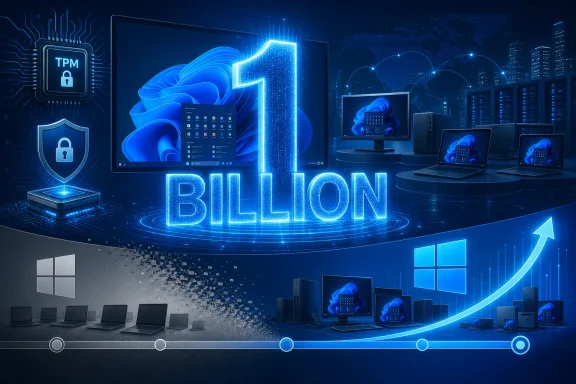
Microsoft says Windows 11 has passed one billion users worldwide in just over four years, reaching the milestone faster than Windows 10 did after its 2015 launch and cementing the newer operating system as the default Windows platform after Windows 10 support ended on October 14, 2025. That headline, reported by Eastleigh Voice and echoed by PCWorld, Windows Central, TechSpot, and TechRadar, is not just a victory lap for Redmond. It is the clearest signal yet that Windows 11’s adoption curve was less a referendum on user affection than on hardware turnover, security deadlines, and Microsoft’s unusually firm control over the PC upgrade path.
Windows 11 did not arrive in 2021 like Windows 10 did in 2015. Windows 10 was marketed as the fix for Windows 8, a free upgrade with a populist pitch and a promise that Windows had finally settled into a service model. Windows 11, by contrast, arrived as a narrower gate: newer CPUs, TPM 2.0, Secure Boot, and a design language that felt more like a managed reset than a mass invitation.
That made its billion-user milestone easy to misread. If Windows 10’s rise was powered by relief, Windows 11’s rise has been powered by inevitability. Microsoft did not need every Windows 10 user to love centered taskbar icons, rounded windows, or the redesigned Settings app; it needed OEMs, enterprises, and security teams to converge on the same answer when the old platform expired.
The October 14, 2025 end of support date for Windows 10 did more than mark a lifecycle boundary. Microsoft’s own lifecycle documentation made clear that Windows 10 devices would continue to run, but would no longer receive the normal stream of quality updates, feature updates, security updates, or technical support unless enrolled in Extended Security Updates. That transformed Windows 11 from an optional modernization project into the default answer for any organization that did not want to pay to stand still.
This is why the “faster than Windows 10” comparison matters, but not in the simple way Microsoft would prefer. Windows 11’s climb was faster because the PC market changed around it. The operating system rode the replacement cycle of pandemic-era laptops, the return of enterprise refresh planning, the security baseline demanded by modern Windows management, and the fact that most new consumer PCs now arrive with Windows 11 already installed.
For enthusiasts, that sounded like a corporate security slide deck stapled to a consumer upgrade. For enterprise IT, it was more complicated. A hard floor can be painful, but it can also simplify policy: if the estate is Windows 11-capable, it meets a known security baseline; if it is not, it belongs in an exception bucket, an ESU plan, a virtual desktop strategy, or the recycling stream.
The result is that Windows 11 adoption accelerated not only because people clicked “upgrade,” but because old PCs aged out. Every laptop sold at retail, every procurement bundle purchased by a school district, every fleet refresh by a financial services firm, and every small business desktop replacement quietly moved the denominator. Users may experience an operating system migration as a setup screen; Microsoft experiences it as years of OEM channel gravity.
That also explains why the mood around Windows 11 has often seemed disconnected from the numbers. A billion users does not mean a billion endorsements. It means a billion active seats in an ecosystem where the operating system is still the default companion to mainstream PC hardware.
By late 2025, Windows 10 was not dead, but it had been administratively downgraded. Microsoft’s lifecycle guidance said customers contacting support after the deadline would be directed toward Windows 11 if compatible, or toward a new Windows 11 PC if not. Extended Security Updates existed as a pressure valve, not a future.
That distinction matters. ESU is useful for businesses that need time, labs with specialized equipment, regulated environments with certification delays, and consumers unwilling or unable to replace a machine immediately. But ESU is not a second life for Windows 10. It is a paid runway for leaving it.
The billion-user announcement therefore lands less like a surprise and more like the end of a long migration memo. Microsoft spent years telling administrators the date was coming, OEMs spent years shipping Windows 11 by default, and users spent years replacing hardware. When the counter finally crossed one billion, the market had already done most of the work.
That residual base is not trivial. Windows has always contained long tails: Windows XP in point-of-sale systems, Windows 7 in labs, Windows 10 on unsupported laptops that still boot quickly and run familiar software. The PC ecosystem is too large, too varied, and too economically uneven for Microsoft to flip a single switch and declare the old world gone.
This is where the one-billion figure becomes politically useful for Microsoft. It allows the company to argue that Windows 11 is no longer a hesitant successor but the mainstream platform. That helps with developers, OEMs, chipmakers, and enterprise planners who need confidence that optimizing for Windows 11 is not premature.
It also gives Microsoft cover for sharper product decisions. If Windows 11 is now the billion-user platform, Microsoft can more confidently prioritize it for security changes, AI integrations, management tooling, Store behavior, driver models, and user-interface experiments. The complaint “most people are still on Windows 10” becomes harder to sustain when Microsoft can point to a billion Windows 11 users.
For IT departments, Windows 11’s adoption story is partly about auditability. A supported OS with a current security baseline is easier to defend in boardroom language than an aging platform protected by exceptions. Cyber insurance questionnaires, compliance reviews, endpoint detection tooling, and zero-trust architecture all reward consistency.
That does not mean every security argument automatically justifies every hardware cutoff. Plenty of users reasonably objected that capable PCs were stranded for reasons that felt arbitrary or underexplained. The environmental critique was also obvious: if software policy shortens the perceived life of hardware, the cost is measured not only in procurement budgets but in e-waste.
Still, Microsoft understood where the leverage was. Consumers might grumble about requirements; enterprises had to manage risk. Once Windows 10 left normal support, staying behind became a documented exception rather than a preference.
The practical enterprise question was not whether Windows 11 was exciting. It was whether the organization could continue defending Windows 10 after October 14, 2025 without paying for ESU, accepting risk, or explaining exceptions. In many environments, the answer was no.
This is why the faster-than-Windows-10 framing should be treated carefully. Windows 10 arrived as a rescue mission after Windows 8 and spread rapidly because Microsoft made it free and aggressively promoted upgrades. Windows 11 spread through a different mechanism: a narrower compatibility gate, a fixed end date for the predecessor, and a PC market where new hardware increasingly shipped with Windows 11 as the ordinary state of things.
For sysadmins, the real lesson is familiar. Microsoft’s desktop strategy is no longer just about operating system features. It is about lifecycle pressure, identity integration, cloud management, security baselines, and hardware certification all moving in concert.
That matters because consumer sentiment around Windows 11 has been mixed. Complaints about interface changes, default app behavior, ads and recommendations, Microsoft account nudges, and Copilot-era integration have been persistent. TechRadar’s coverage of the billion-user announcement captured the tension well: Windows 11 can be widely used and still widely criticized.
Microsoft can live with that tension. Windows is not a social network that depends on daily delight in the same way, nor is it an app that can be casually abandoned. It is the working surface of a huge share of the world’s PCs, tied to games, peripherals, enterprise software, productivity suites, school requirements, and decades of user habit.
That inertia cuts both ways. It helps Microsoft migrate users when the default path is controlled. It also raises the stakes when Microsoft uses Windows as a delivery vehicle for services, advertising surfaces, AI features, and cloud-account prompts that many users did not explicitly ask for.
This does not mean every Windows 11 user has an AI PC, or that every AI feature has landed smoothly. Microsoft has already learned that security and privacy concerns can derail even technically ambitious features when the company appears to outrun user trust. But a billion-user Windows 11 base gives Redmond a much larger target for phased deployment, A/B testing, hardware segmentation, and developer messaging.
The phrase “Windows 11 as the foundation” is corporate boilerplate until the installed base is large enough to make it true. Now it is true in a practical sense. ISVs, hardware makers, IT consultants, and administrators can assume Windows 11 is the center of gravity rather than the early adopter branch.
The unresolved question is whether Microsoft treats that position as a responsibility or as permission. A billion users is a mandate to stabilize, refine, and respect workflows. It is not a blank check to turn the desktop into a promotional surface.
That creates a security gap Microsoft cannot fully close through messaging. The company can say unsupported Windows 10 machines should move to Windows 11 or be replaced, and from a lifecycle standpoint that is coherent. But from a household budget standpoint, “buy a new PC” is not always a small recommendation.
The same is true for small organizations. A large enterprise can amortize refresh planning and negotiate procurement. A local business with ten aging desktops may see the Windows 10 deadline as another forced cost arriving alongside insurance, rent, and software subscriptions.
Microsoft’s challenge now is to avoid sounding triumphant while part of the ecosystem is still digesting the bill. The billion-user number is impressive, but it was achieved partly by making the old path less viable. That may be good platform governance; it is not the same thing as universal consent.
That boring middle is Microsoft’s power base. Windows does not need to be glamorous to be indispensable. In fact, its value often lies in being the thing everyone assumes will be there.
The milestone also reminds competitors of Windows’ resilience. macOS has prestige, ChromeOS has education and simplicity, Linux has servers, developers, and enthusiasts, but Windows has the mainstream PC channel at global scale. When that channel turns over, Microsoft gets another generation of default installs.
The danger for Microsoft is complacency. The company has won the migration, but it has not settled the argument over what users want from a desktop operating system in 2026. Stability, performance, privacy, local control, and fewer interruptions remain just as important as AI hooks and cloud services.
 Microsoft Wins the Upgrade War It Designed
Windows 11 did not arrive in 2021 like Windows 10 did in 2015. Windows 10 was marketed as the fix for Windows 8, a free upgrade with a populist pitch and a promise that Windows had finally settled into a service model. Windows 11, by contrast, arrived as a narrower gate: newer CPUs, TPM 2.0, Secure Boot, and a design language that felt more like a managed reset than a mass invitation.That made its billion-user milestone easy to misread. If Windows 10’s rise was powered by relief, Windows 11’s rise has been powered by inevitability. Microsoft did not need every Windows 10 user to love centered taskbar icons, rounded windows, or the redesigned Settings app; it needed OEMs, enterprises, and security teams to converge on the same answer when the old platform expired.
The October 14, 2025 end of support date for Windows 10 did more than mark a lifecycle boundary. Microsoft’s own lifecycle documentation made clear that Windows 10 devices would continue to run, but would no longer receive the normal stream of quality updates, feature updates, security updates, or technical support unless enrolled in Extended Security Updates. That transformed Windows 11 from an optional modernization project into the default answer for any organization that did not want to pay to stand still.
This is why the “faster than Windows 10” comparison matters, but not in the simple way Microsoft would prefer. Windows 11’s climb was faster because the PC market changed around it. The operating system rode the replacement cycle of pandemic-era laptops, the return of enterprise refresh planning, the security baseline demanded by modern Windows management, and the fact that most new consumer PCs now arrive with Windows 11 already installed.
The Hardware Floor Became the Adoption Engine
The strict hardware requirements that made Windows 11 controversial at launch eventually became part of its adoption machine. TPM 2.0 and supported processors excluded a large installed base of otherwise functional PCs, and that exclusion angered users who saw no obvious reason why a fast-enough machine should be treated as obsolete. Microsoft’s argument was that the new baseline enabled stronger protections by default, particularly around identity, firmware, virtualization-based security, and platform integrity.For enthusiasts, that sounded like a corporate security slide deck stapled to a consumer upgrade. For enterprise IT, it was more complicated. A hard floor can be painful, but it can also simplify policy: if the estate is Windows 11-capable, it meets a known security baseline; if it is not, it belongs in an exception bucket, an ESU plan, a virtual desktop strategy, or the recycling stream.
The result is that Windows 11 adoption accelerated not only because people clicked “upgrade,” but because old PCs aged out. Every laptop sold at retail, every procurement bundle purchased by a school district, every fleet refresh by a financial services firm, and every small business desktop replacement quietly moved the denominator. Users may experience an operating system migration as a setup screen; Microsoft experiences it as years of OEM channel gravity.
That also explains why the mood around Windows 11 has often seemed disconnected from the numbers. A billion users does not mean a billion endorsements. It means a billion active seats in an ecosystem where the operating system is still the default companion to mainstream PC hardware.
Windows 10’s Long Goodbye Was the Real Launch Campaign
Microsoft officially released Windows 11 in October 2021, but the more decisive campaign began when the company reaffirmed that Windows 10 would not continue indefinitely. Microsoft had once encouraged the impression that Windows 10 was the “last version of Windows,” at least in the popular imagination. The arrival of Windows 11 ended that story, and the 2025 support deadline gave it teeth.By late 2025, Windows 10 was not dead, but it had been administratively downgraded. Microsoft’s lifecycle guidance said customers contacting support after the deadline would be directed toward Windows 11 if compatible, or toward a new Windows 11 PC if not. Extended Security Updates existed as a pressure valve, not a future.
That distinction matters. ESU is useful for businesses that need time, labs with specialized equipment, regulated environments with certification delays, and consumers unwilling or unable to replace a machine immediately. But ESU is not a second life for Windows 10. It is a paid runway for leaving it.
The billion-user announcement therefore lands less like a surprise and more like the end of a long migration memo. Microsoft spent years telling administrators the date was coming, OEMs spent years shipping Windows 11 by default, and users spent years replacing hardware. When the counter finally crossed one billion, the market had already done most of the work.
The Billion-User Number Hides a Messier PC Reality
The milestone is real enough to matter, but it should not be mistaken for a clean victory over fragmentation. Windows 10 remains present in homes, small businesses, industrial environments, and older corporate estates. Some of those machines are enrolled in security extension programs. Others are simply still running because users do not follow lifecycle policy pages and because a working PC is easy to ignore until something breaks.That residual base is not trivial. Windows has always contained long tails: Windows XP in point-of-sale systems, Windows 7 in labs, Windows 10 on unsupported laptops that still boot quickly and run familiar software. The PC ecosystem is too large, too varied, and too economically uneven for Microsoft to flip a single switch and declare the old world gone.
This is where the one-billion figure becomes politically useful for Microsoft. It allows the company to argue that Windows 11 is no longer a hesitant successor but the mainstream platform. That helps with developers, OEMs, chipmakers, and enterprise planners who need confidence that optimizing for Windows 11 is not premature.
It also gives Microsoft cover for sharper product decisions. If Windows 11 is now the billion-user platform, Microsoft can more confidently prioritize it for security changes, AI integrations, management tooling, Store behavior, driver models, and user-interface experiments. The complaint “most people are still on Windows 10” becomes harder to sustain when Microsoft can point to a billion Windows 11 users.
Security Became the Language Everyone Could Agree On
Windows 11’s strongest argument was never the Start menu. It was security. Microsoft framed the operating system around hardware-rooted trust, modern authentication, virtualization-based protections, and defenses against credential theft and firmware-level attacks. Those are not features that make a normal user’s day more delightful, but they are features that map neatly onto the risks administrators are paid to reduce.For IT departments, Windows 11’s adoption story is partly about auditability. A supported OS with a current security baseline is easier to defend in boardroom language than an aging platform protected by exceptions. Cyber insurance questionnaires, compliance reviews, endpoint detection tooling, and zero-trust architecture all reward consistency.
That does not mean every security argument automatically justifies every hardware cutoff. Plenty of users reasonably objected that capable PCs were stranded for reasons that felt arbitrary or underexplained. The environmental critique was also obvious: if software policy shortens the perceived life of hardware, the cost is measured not only in procurement budgets but in e-waste.
Still, Microsoft understood where the leverage was. Consumers might grumble about requirements; enterprises had to manage risk. Once Windows 10 left normal support, staying behind became a documented exception rather than a preference.
Enterprises Did Not Fall in Love; They Finished the Spreadsheet
The corporate Windows migration cycle rarely resembles consumer enthusiasm. It is a spreadsheet of device eligibility, application compatibility, security policy, budget timing, help-desk training, and vendor dependencies. Windows 11’s billion-user milestone suggests that enough of those spreadsheets finally resolved in the same direction.The practical enterprise question was not whether Windows 11 was exciting. It was whether the organization could continue defending Windows 10 after October 14, 2025 without paying for ESU, accepting risk, or explaining exceptions. In many environments, the answer was no.
This is why the faster-than-Windows-10 framing should be treated carefully. Windows 10 arrived as a rescue mission after Windows 8 and spread rapidly because Microsoft made it free and aggressively promoted upgrades. Windows 11 spread through a different mechanism: a narrower compatibility gate, a fixed end date for the predecessor, and a PC market where new hardware increasingly shipped with Windows 11 as the ordinary state of things.
For sysadmins, the real lesson is familiar. Microsoft’s desktop strategy is no longer just about operating system features. It is about lifecycle pressure, identity integration, cloud management, security baselines, and hardware certification all moving in concert.
Consumers Were Pulled Along by the PC Aisle
For home users, the migration was quieter. Many did not choose Windows 11 as much as receive it. A laptop bought in 2026 is overwhelmingly likely to be a Windows 11 laptop, and a family replacing an aging Windows 10 machine is unlikely to downgrade or reinstall unless someone in the house is unusually technical.That matters because consumer sentiment around Windows 11 has been mixed. Complaints about interface changes, default app behavior, ads and recommendations, Microsoft account nudges, and Copilot-era integration have been persistent. TechRadar’s coverage of the billion-user announcement captured the tension well: Windows 11 can be widely used and still widely criticized.
Microsoft can live with that tension. Windows is not a social network that depends on daily delight in the same way, nor is it an app that can be casually abandoned. It is the working surface of a huge share of the world’s PCs, tied to games, peripherals, enterprise software, productivity suites, school requirements, and decades of user habit.
That inertia cuts both ways. It helps Microsoft migrate users when the default path is controlled. It also raises the stakes when Microsoft uses Windows as a delivery vehicle for services, advertising surfaces, AI features, and cloud-account prompts that many users did not explicitly ask for.
The AI PC Era Needed Windows 11 to Clear the Runway
The timing of the billion-user milestone is especially useful for Microsoft because Windows 11 is now the staging ground for its AI PC strategy. Copilot, Recall-style local indexing concepts, neural processing unit requirements, and tighter integration between Windows, Microsoft 365, Edge, and cloud identity all need a modern platform story. Windows 10 was never going to be that story.This does not mean every Windows 11 user has an AI PC, or that every AI feature has landed smoothly. Microsoft has already learned that security and privacy concerns can derail even technically ambitious features when the company appears to outrun user trust. But a billion-user Windows 11 base gives Redmond a much larger target for phased deployment, A/B testing, hardware segmentation, and developer messaging.
The phrase “Windows 11 as the foundation” is corporate boilerplate until the installed base is large enough to make it true. Now it is true in a practical sense. ISVs, hardware makers, IT consultants, and administrators can assume Windows 11 is the center of gravity rather than the early adopter branch.
The unresolved question is whether Microsoft treats that position as a responsibility or as permission. A billion users is a mandate to stabilize, refine, and respect workflows. It is not a blank check to turn the desktop into a promotional surface.
The Compatibility Fight Is Not Over
Windows 11’s adoption milestone does not erase the users left on the wrong side of the requirements line. Many Windows 10 PCs are excluded from the official upgrade path despite being usable for everyday computing. Some owners will bypass the checks; some will install Linux; some will pay for extra updates; many will do nothing until hardware failure forces a decision.That creates a security gap Microsoft cannot fully close through messaging. The company can say unsupported Windows 10 machines should move to Windows 11 or be replaced, and from a lifecycle standpoint that is coherent. But from a household budget standpoint, “buy a new PC” is not always a small recommendation.
The same is true for small organizations. A large enterprise can amortize refresh planning and negotiate procurement. A local business with ten aging desktops may see the Windows 10 deadline as another forced cost arriving alongside insurance, rent, and software subscriptions.
Microsoft’s challenge now is to avoid sounding triumphant while part of the ecosystem is still digesting the bill. The billion-user number is impressive, but it was achieved partly by making the old path less viable. That may be good platform governance; it is not the same thing as universal consent.
Windows Still Owns the Boring, Important Middle
The broader significance of one billion Windows 11 users is that Windows remains extraordinarily relevant in the supposedly post-PC era. Smartphones own attention, cloud apps own many workflows, and browsers have eaten large parts of the software stack. Yet the Windows PC remains the place where many people manage files, write documents, join meetings, play games, administer systems, run line-of-business software, and connect strange old peripherals that still matter.That boring middle is Microsoft’s power base. Windows does not need to be glamorous to be indispensable. In fact, its value often lies in being the thing everyone assumes will be there.
The milestone also reminds competitors of Windows’ resilience. macOS has prestige, ChromeOS has education and simplicity, Linux has servers, developers, and enthusiasts, but Windows has the mainstream PC channel at global scale. When that channel turns over, Microsoft gets another generation of default installs.
The danger for Microsoft is complacency. The company has won the migration, but it has not settled the argument over what users want from a desktop operating system in 2026. Stability, performance, privacy, local control, and fewer interruptions remain just as important as AI hooks and cloud services.
The Numbers Say Windows 11 Has Arrived; The Experience Still Has to Earn It
The concrete lesson for WindowsForum readers is that the Windows 11 debate has moved from “if” to “how well.” The installed base is now too large to treat the OS as a tentative successor, and the Windows 10 support deadline has changed the risk calculation for anyone still delaying migration.- Windows 11 has crossed the one-billion-user mark, according to Microsoft, and multiple technology outlets report that it reached that point faster than Windows 10.
- Windows 10’s normal support ended on October 14, 2025, making Windows 11 the default supported destination for most users and organizations.
- New PC sales have done much of the adoption work because Windows 11 is now the standard preinstalled Windows experience on modern hardware.
- The stricter hardware requirements that frustrated early adopters became a security and manageability baseline for enterprise deployment.
- Extended Security Updates can buy time for Windows 10 holdouts, but they do not change Microsoft’s long-term platform direction.
- Microsoft’s next challenge is not adoption, but trust: users will judge Windows 11 by stability, performance, privacy, and whether AI-era integrations respect the desktop.
References
- Primary source: The Eastleigh Voice
Published: 2026-07-07T10:20:14.953186
Loading…
eastleighvoice.co.ke - Related coverage: windowscentral.com
Windows 11 version 26H2 is packed with surprising upgrades, and these 7 features might change how you use your PC | Windows Central
The Windows 11 2026 Update isn't about a major redesign. It's about giving users more control, better customization, and smarter everyday features.www.windowscentral.com - Official source: support.microsoft.com
Windows 10 support has ended on October 14, 2025 | Microsoft Support
Windows 10 support ends on October 14, 2025. Upgrade to Windows 11 now to ensure continued security and feature updates. Learn more about the transition.support.microsoft.com - Official source: learn.microsoft.com
Windows 10 reaching end of support - Microsoft Lifecycle | Microsoft Learn
Announcing Windows 10 reaching end of support.learn.microsoft.com - Official source: techcommunity.microsoft.com
Windows 10's extended support ends in eight months | Microsoft Community Hub
Windows 10’s extended support ends in eight months, but users are still rejecting Windows 11, at least in Germany.Windows 10 support officially ended on... techcommunity.microsoft.com
- Related coverage: pcworld.com
Loading…
www.pcworld.com
- Related coverage: techspot.com
Loading…
www.techspot.com - Related coverage: techradar.com
Loading…
www.techradar.com - Related coverage: isc.upenn.edu
- Related coverage: tomsguide.com
Windows 10 End of Life: Microsoft releases final update — everything you need to know | Tom's Guide
So long, Windows 10www.tomsguide.com - Related coverage: tomshardware.com
Windows 10 support ends today — here's who's affected and what you need to do | Tom's Hardware
Update if you can, upgrade if you can't, or at least get the extended support license.www.tomshardware.com - Related coverage: as.com
Cómo seguir usando Windows 10 después del fin del soporte en octubre de 2025: así funciona el programa ESU de Microsoft - Meristation
Microsoft continuará ofreciendo una alternativa para los usuarios de Windows 10 tras el cese del soporte oficial. Así funciona el programa ESU de W10.as.com - Related coverage: atomicdata.com
- Related coverage: transparity.com
Loading…
www.transparity.com