

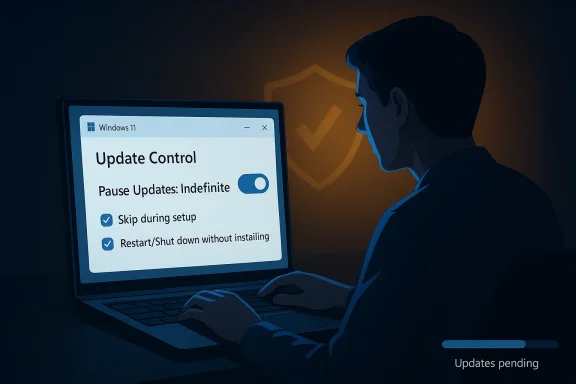
Microsoft is reportedly preparing a significant shift in Windows 11 update behavior, one that would give users far more control over when, and even whether, updates install. The headline change is simple but consequential: instead of being forced into a fixed pause window, users would be able to keep updates paused indefinitely, alongside new options to skip update prompts during setup and restart or shut down without immediately installing pending patches. If implemented as described, it would mark one of the most user-friendly changes to Windows servicing in years, but it also raises familiar security concerns. The tension is obvious: fewer interruptions for people, more responsibility for them to stay protected.
Windows updates have long been one of the most contentious parts of the Microsoft experience. For many users, they represent security, stability, and a safer ecosystem; for others, they mean surprise restarts, interrupted work, and the occasional bad patch at the worst possible time. Microsoft has spent years trying to balance those competing realities, especially as Windows moved from a mostly user-controlled desktop platform to an always-connected service model.
In the Windows 10 era, Microsoft leaned hard into mandatory updating. Users could defer updates for limited periods, but the operating system would eventually insist on installation. That approach was meant to reduce fragmentation and keep the install base protected, but it also created a sense that Windows belonged less to the person using it and more to the servicing policy governing it. The company did introduce active hours, scheduled restarts, and later more granular controls, yet the core model remained largely enforcement-driven.
Windows 11 has continued that pattern, but Microsoft has also been trying to soften the experience. The company has repeatedly emphasized fewer restarts, smaller update payloads, and more reliable installation behavior. At the enterprise level, tools such as Intune, Windows Autopatch, and update rings already give administrators substantial control, including deferrals, pauses, deadlines, and expedited security updates. What has been missing for consumers is a comparable sense of real choice.
That is why the reported change matters. According to the description circulating this week, Microsoft is not merely extending a pause window a bit further. It is redesigning the consumer update experience so that users can delay updates as needed, skip forced installation during setup, and restart or shut down without being bounced back into the update process first. That is a meaningful philosophical shift, not just a settings tweak.
The timing also fits Microsoft’s broader push to improve Windows 11’s reputation. The company has been talking up reliability, performance, and reduced friction across the platform. If updates become less intrusive while still remaining available, Microsoft can argue that it is delivering both a more civilized user experience and a more modern servicing model. That said, every easing of enforcement creates the risk that some users will simply stop updating altogether.
The reported update also includes two other consumer-friendly changes. Users would be able to skip updates during device setup to get to the desktop faster, and they would reportedly be able to restart or shut down without first installing a pending update. Those are not radical ideas in the abstract, but they would significantly reduce the feeling that Windows is dictating the user’s schedule. In practice, they could make first boot and end-of-day shutdown far less annoying.
There is also a trust component here. When users believe an OS is less likely to ambush them, they are more likely to keep it current. Paradoxically, more flexibility can sometimes lead to better compliance because people do not feel cornered. The challenge is making sure that flexibility does not simply become avoidance.
For consumers, the benefit is straightforward: less disruption. For enterprise users, the impact is less dramatic because IT departments already have sophisticated update management through Microsoft’s management stack. But even in managed environments, user-facing restarts and lockouts can still generate complaints, so a less aggressive default behavior could still be welcome.
That makes the reported consumer change especially notable. It narrows the gap between personal and managed Windows devices in one of the most irritating parts of the platform. But it also raises the question of whether Microsoft is moving too far toward user discretion at the expense of platform hygiene.
Security professionals have seen this movie before. Given the option, many people postpone updates until they are forced to act. That is not because users are careless by nature; it is because updates are often inconvenient, ambiguous in benefit, or timed badly. The problem is that vulnerability windows do not care about convenience.
That creates a familiar policy dilemma. If Microsoft offers a freedom most people will use responsibly, it may improve goodwill. If enough people abuse or ignore that freedom, it could become a security liability. In other words, the feature may be technically user-facing but operationally ecosystem-wide.
K2 also seems designed to emphasize productivity and less friction. The idea that users can get to the desktop faster, avoid unnecessary reboots, and experience fewer update prompts fits that pattern neatly. Microsoft is clearly trying to make Windows feel less like an administrator-managed appliance and more like a modern personal computing platform again.
It also gives Microsoft a chance to signal to critics that the company has heard the complaints. Windows updates have long been a punching bag in enthusiast communities, and changes like this are the kind that can reshape that conversation if they work well. If they do not, the branding will not save them.
The consumer side has lagged behind that vision. Home users have had basic controls, but not the same level of trust or autonomy that enterprise administrators enjoy. By potentially allowing indefinite pausing, Microsoft may be trying to make the consumer experience feel less punitive while still preserving the same underlying servicing machinery.
But there is another interpretation too. Microsoft may be recognizing that on modern PCs, forced update behavior is no longer the best way to ensure security adoption. If users resent the process, they may delay workarounds, disable restarts, or develop distrust toward Windows Update itself. A more permissive model may ultimately be more durable.
Windows 10 was the turning point. Microsoft made updating much more aggressive and centralized, arguing that the platform needed consistent patching to stay secure and stable. Home users could still delay, but not forever. The company’s logic was defensible, yet the user experience was often aggravating enough that updates became symbolic of broader Windows frustration.
In that sense, the reported change is less about surrender and more about optimization. Microsoft may be concluding that a well-informed user base can tolerate more autonomy than it used to. That is a big assumption, but it is also one that fits the current direction of the Windows ecosystem.
Setup is the simplest win. Getting to the desktop faster during first boot removes a small but irritating obstacle, especially for new PCs and fresh installs. Shutdown and restart flexibility matter even more because they hit users at the moment when Windows has historically been most insistent.
The question is whether the interface will make the consequences obvious enough. A feature that is too easy to enable and too easy to forget could backfire. Microsoft will need to communicate the trade-off clearly, or else many users will confuse pause with protection.
Apple, for example, has a different update culture but often enjoys a reputation for smoother user experience. Google’s ChromeOS, by contrast, hides much of the update complexity from users entirely. Microsoft’s challenge is more difficult because Windows must satisfy consumers, enthusiasts, businesses, and OEMs at the same time. That makes any update policy change a compromise by definition.
At the same time, the move could increase expectations for the next wave of improvement. Once Microsoft gives users more control over updates, they may expect similar progress in driver handling, feature rollout transparency, and restart management. That is the burden of successful product reform: every solved annoyance reveals the next one.
The broader opportunity is philosophical. Microsoft can demonstrate that it trusts users more than it used to, and that trust can pay dividends when paired with better update engineering. A platform feels more modern when it respects timing as well as security.
There is also a support risk. When devices fall behind, the result is not just a security concern but a future compatibility problem. Users who pause too long may discover that they have traded short-term convenience for long-term maintenance trouble.
It will also matter how broadly the change is deployed. If this lands first for consumer PCs and later expands into other Windows 11 channels, Microsoft will have room to adjust based on telemetry and user behavior. If it arrives too permissively, it could produce a wave of neglected systems that eventually force the company back toward stricter defaults.
Microsoft’s challenge is to make update control feel like empowerment rather than avoidance. That distinction will decide whether this becomes a celebrated quality-of-life improvement or just another permissive setting that looks better in a blog post than it performs in the real world.
Source: gHacks Microsoft Plans to Let Windows 11 Users Pause Updates Indefinitely - gHacks Tech News
 Background
Windows updates have long been one of the most contentious parts of the Microsoft experience. For many users, they represent security, stability, and a safer ecosystem; for others, they mean surprise restarts, interrupted work, and the occasional bad patch at the worst possible time. Microsoft has spent years trying to balance those competing realities, especially as Windows moved from a mostly user-controlled desktop platform to an always-connected service model.In the Windows 10 era, Microsoft leaned hard into mandatory updating. Users could defer updates for limited periods, but the operating system would eventually insist on installation. That approach was meant to reduce fragmentation and keep the install base protected, but it also created a sense that Windows belonged less to the person using it and more to the servicing policy governing it. The company did introduce active hours, scheduled restarts, and later more granular controls, yet the core model remained largely enforcement-driven.
Windows 11 has continued that pattern, but Microsoft has also been trying to soften the experience. The company has repeatedly emphasized fewer restarts, smaller update payloads, and more reliable installation behavior. At the enterprise level, tools such as Intune, Windows Autopatch, and update rings already give administrators substantial control, including deferrals, pauses, deadlines, and expedited security updates. What has been missing for consumers is a comparable sense of real choice.
That is why the reported change matters. According to the description circulating this week, Microsoft is not merely extending a pause window a bit further. It is redesigning the consumer update experience so that users can delay updates as needed, skip forced installation during setup, and restart or shut down without being bounced back into the update process first. That is a meaningful philosophical shift, not just a settings tweak.
The timing also fits Microsoft’s broader push to improve Windows 11’s reputation. The company has been talking up reliability, performance, and reduced friction across the platform. If updates become less intrusive while still remaining available, Microsoft can argue that it is delivering both a more civilized user experience and a more modern servicing model. That said, every easing of enforcement creates the risk that some users will simply stop updating altogether.
What Microsoft Is Reportedly Changing
The most attention-grabbing claim is the ability to pause updates indefinitely. In current Windows 11 support documentation, pausing updates is allowed, but only up to a limit; once that pause time is reached, the system expects the latest updates to be installed. Microsoft’s own guidance makes that constraint explicit today, which is why the rumored change feels so different from the status quo.The reported update also includes two other consumer-friendly changes. Users would be able to skip updates during device setup to get to the desktop faster, and they would reportedly be able to restart or shut down without first installing a pending update. Those are not radical ideas in the abstract, but they would significantly reduce the feeling that Windows is dictating the user’s schedule. In practice, they could make first boot and end-of-day shutdown far less annoying.
The practical effect on daily use
If these changes land as described, the biggest improvement may be psychological rather than technical. Windows users often do not object to updates themselves; they object to the timing. Giving them a cleaner exit path from setup, better control over restart timing, and a genuine pause option could reduce a lot of friction without removing updates from the system entirely.There is also a trust component here. When users believe an OS is less likely to ambush them, they are more likely to keep it current. Paradoxically, more flexibility can sometimes lead to better compliance because people do not feel cornered. The challenge is making sure that flexibility does not simply become avoidance.
- Fewer surprise interruptions during initial setup
- More control over reboots and shutdowns
- Less pressure to install at a bad moment
- A more user-centered update experience
- Potentially lower frustration for home and small-business users
Why This Matters for Windows 11
Windows has always been a platform where user perception and technical policy collide. For years, Microsoft has had to defend updates as both necessary and inconvenient, and the company has often accepted a small amount of resentment in exchange for broad security gains. Windows 11’s rumored change suggests Microsoft may now believe the old enforcement-heavy model is doing more harm than good.For consumers, the benefit is straightforward: less disruption. For enterprise users, the impact is less dramatic because IT departments already have sophisticated update management through Microsoft’s management stack. But even in managed environments, user-facing restarts and lockouts can still generate complaints, so a less aggressive default behavior could still be welcome.
Consumer versus enterprise reality
Consumers have generally had fewer escape hatches than organizations. Microsoft’s enterprise update policies already include pause options, deadlines, and the ability to control restart behavior in significant detail. Documentation for Intune and update compliance makes clear that admins can control timing, force deadlines, and even expedite quality updates when necessary.That makes the reported consumer change especially notable. It narrows the gap between personal and managed Windows devices in one of the most irritating parts of the platform. But it also raises the question of whether Microsoft is moving too far toward user discretion at the expense of platform hygiene.
- Consumers gain the most visible freedom
- Enterprises already have most of these controls today
- Small businesses may benefit from fewer forced restarts
- Microsoft could reduce update-related support complaints
- Security teams will worry about delayed patch adoption
The Security Trade-Off
Any story about update freedom has a shadow side. The more control users get over pausing or delaying updates, the greater the chance that some devices will simply remain unpatched for too long. Microsoft knows this, which is why its current support guidance still emphasizes automatic installation after pause limits expire. Removing that ceiling would change the risk calculus substantially.Security professionals have seen this movie before. Given the option, many people postpone updates until they are forced to act. That is not because users are careless by nature; it is because updates are often inconvenient, ambiguous in benefit, or timed badly. The problem is that vulnerability windows do not care about convenience.
What indefinite pausing could mean in practice
An indefinite pause feature would likely be used in very different ways by different audiences. Power users might treat it as a convenient emergency brake, pausing only when a bad driver, a compatibility issue, or a travel period makes updates undesirable. Casual users, on the other hand, might pause once and forget the setting entirely.That creates a familiar policy dilemma. If Microsoft offers a freedom most people will use responsibly, it may improve goodwill. If enough people abuse or ignore that freedom, it could become a security liability. In other words, the feature may be technically user-facing but operationally ecosystem-wide.
- Increased risk of delayed security patching
- More exposure to known vulnerabilities
- Greater chance of inconsistent device health
- Possible support burden for less technical users
- Higher importance of notifications and education
The Windows K2 Connection
The reported changes are part of a broader Windows K2 update rollout, which positions this not as a one-off concession but as a wider platform initiative. That matters because major Windows experience changes usually arrive in clusters: update policy, restart behavior, setup flow, and performance tuning often move together when Microsoft is trying to reshape the product narrative. A single update control rarely changes in isolation.K2 also seems designed to emphasize productivity and less friction. The idea that users can get to the desktop faster, avoid unnecessary reboots, and experience fewer update prompts fits that pattern neatly. Microsoft is clearly trying to make Windows feel less like an administrator-managed appliance and more like a modern personal computing platform again.
Why branding matters here
Naming an initiative like K2 gives Microsoft room to frame these changes as part of a coherent strategy rather than a patchwork of tweaks. That matters in consumer tech, where perception often drives adoption more than the underlying mechanics. A better update experience can become part of a larger story about Windows 11 maturity.It also gives Microsoft a chance to signal to critics that the company has heard the complaints. Windows updates have long been a punching bag in enthusiast communities, and changes like this are the kind that can reshape that conversation if they work well. If they do not, the branding will not save them.
- Positions update reform as part of a larger strategy
- Helps Microsoft narrate Windows 11 as more user-friendly
- Signals responsiveness to long-running complaints
- Could improve the perception of Windows reliability
- Raises expectations for broader servicing improvements
How This Fits Microsoft’s Update Strategy
Microsoft has been steadily pushing Windows servicing toward a more cloud-managed, policy-driven future. That is obvious in enterprise tools like Intune and Autopatch, which let admins set restart behavior, update timing, and compliance deadlines with increasing precision. Those tools show what Microsoft thinks the future should look like: updates are not optional, but they should be predictable and governed by clear policy.The consumer side has lagged behind that vision. Home users have had basic controls, but not the same level of trust or autonomy that enterprise administrators enjoy. By potentially allowing indefinite pausing, Microsoft may be trying to make the consumer experience feel less punitive while still preserving the same underlying servicing machinery.
From enforcement to persuasion
The strategic shift here is subtle. Instead of forcing compliance through time limits, Microsoft appears to be trying to earn compliance through better design. That is a classic platform maturity move, and it often happens when a product has enough market dominance to loosen controls without fearing fragmentation.But there is another interpretation too. Microsoft may be recognizing that on modern PCs, forced update behavior is no longer the best way to ensure security adoption. If users resent the process, they may delay workarounds, disable restarts, or develop distrust toward Windows Update itself. A more permissive model may ultimately be more durable.
- Better alignment between consumer and enterprise servicing philosophies
- Less resentment around mandatory restarts
- More emphasis on update quality and reliability
- Potentially stronger long-term trust in Windows Update
- A sign that Microsoft is optimizing for experience, not coercion
Historical Context: How We Got Here
To understand why this report is so notable, it helps to remember how Windows updates evolved. In earlier eras, users often chose when to install patches, but that flexibility came at the cost of wildly inconsistent security posture. Microsoft’s move toward mandatory or semi-mandatory updating was partly an effort to protect users from themselves, and partly an attempt to reduce support chaos caused by fragmented patch states.Windows 10 was the turning point. Microsoft made updating much more aggressive and centralized, arguing that the platform needed consistent patching to stay secure and stable. Home users could still delay, but not forever. The company’s logic was defensible, yet the user experience was often aggravating enough that updates became symbolic of broader Windows frustration.
Why this feels different in 2026
The difference now is maturity. Windows is no longer fighting the same kind of fragmentation it once was, and Microsoft has better tools for staged rollout, quality gating, and telemetry-driven delivery. The company also has more confidence in cloud management, which means it can afford to give consumers a bit more breathing room without losing total control.In that sense, the reported change is less about surrender and more about optimization. Microsoft may be concluding that a well-informed user base can tolerate more autonomy than it used to. That is a big assumption, but it is also one that fits the current direction of the Windows ecosystem.
- Earlier Windows versions favored manual control
- Windows 10 pushed hard toward enforced updating
- Windows 11 has been refining the model rather than reversing it
- Cloud telemetry makes staged rollout safer than before
- Microsoft may now trust its servicing pipeline more
What Users Will Actually Notice
Most users will not care about the architectural theory behind Windows servicing. They will care about what happens when they are in the middle of something important. The practical effect of these changes, if they arrive as described, will be visible in three places: setup, shutdown, and restart handling.Setup is the simplest win. Getting to the desktop faster during first boot removes a small but irritating obstacle, especially for new PCs and fresh installs. Shutdown and restart flexibility matter even more because they hit users at the moment when Windows has historically been most insistent.
The everyday experience
For a home user, this could mean fewer late-night prompts and fewer “finish updating” interruptions. For a laptop user on the move, it could mean being able to close a lid or power down without worrying that the machine will force an install at the wrong time. For IT-literate users, it means more fine-grained control over when they accept risk.The question is whether the interface will make the consequences obvious enough. A feature that is too easy to enable and too easy to forget could backfire. Microsoft will need to communicate the trade-off clearly, or else many users will confuse pause with protection.
- Faster first-use setup flow
- Less pressure during shutdown
- More flexible restart behavior
- Better experience for mobile users
- Greater need for clear security messaging
Competitive Implications
Microsoft does not operate in a vacuum. Every improvement to Windows is implicitly compared with macOS, ChromeOS, and even mobile operating systems, all of which have their own approaches to updates and user control. If Windows becomes less disruptive, it can narrow one of the long-standing usability complaints that competitors have been able to exploit.Apple, for example, has a different update culture but often enjoys a reputation for smoother user experience. Google’s ChromeOS, by contrast, hides much of the update complexity from users entirely. Microsoft’s challenge is more difficult because Windows must satisfy consumers, enthusiasts, businesses, and OEMs at the same time. That makes any update policy change a compromise by definition.
The market message
If Microsoft can make updates less intrusive without sacrificing security outcomes, that would strengthen Windows 11’s case as a modern operating system. It would also reduce one of the easiest talking points critics use against Windows in favor of rival platforms. In a market where user frustration often matters as much as feature counts, that is not trivial.At the same time, the move could increase expectations for the next wave of improvement. Once Microsoft gives users more control over updates, they may expect similar progress in driver handling, feature rollout transparency, and restart management. That is the burden of successful product reform: every solved annoyance reveals the next one.
- Makes Windows look more polished versus rivals
- Reduces a common pain point in platform comparisons
- Could improve satisfaction among power users
- Raises the bar for future servicing improvements
- Creates pressure for more transparent update controls
Strengths and Opportunities
The biggest opportunity here is obvious: Microsoft can reduce resentment around updates while preserving the security value of regular patching. If the company executes well, this could become one of those small policy changes that quietly improves user sentiment across millions of PCs. It may also reduce the support burden associated with restarts, half-finished installs, and frustrated users trying to work around Windows Update.The broader opportunity is philosophical. Microsoft can demonstrate that it trusts users more than it used to, and that trust can pay dividends when paired with better update engineering. A platform feels more modern when it respects timing as well as security.
- Improved user goodwill
- Fewer forced interruptions
- Better first-run experience
- Stronger trust in Windows Update
- More alignment with modern productivity workflows
- Potential reduction in update-related complaints
- A cleaner Windows 11 reputation
Risks and Concerns
The risk is that the people most likely to use indefinite pause are also the least likely to manage the consequences responsibly. Security updates work only when they are actually installed, and even a good patching model can be undermined by user inertia. Microsoft will need to decide whether it can rely on better messaging alone or whether it will need additional guardrails.There is also a support risk. When devices fall behind, the result is not just a security concern but a future compatibility problem. Users who pause too long may discover that they have traded short-term convenience for long-term maintenance trouble.
- Greater exposure to unpatched vulnerabilities
- Users may forget paused updates entirely
- Support cases could increase over time
- Compatibility drift could become a problem
- Misleading sense of safety if pause is misunderstood
- Potential for inconsistent fleet hygiene in small businesses
- Risk that the feature encourages avoidance rather than timing control
Looking Ahead
If Microsoft follows through, the key question will not be whether users like the change. They almost certainly will. The real question is whether the company can preserve Windows’ security posture while making updates feel optional in practice. That will depend on how well Microsoft combines policy flexibility, clearer messaging, and more reliable update quality.It will also matter how broadly the change is deployed. If this lands first for consumer PCs and later expands into other Windows 11 channels, Microsoft will have room to adjust based on telemetry and user behavior. If it arrives too permissively, it could produce a wave of neglected systems that eventually force the company back toward stricter defaults.
What to watch
- Whether Microsoft officially confirms the feature for Windows 11 consumer editions
- Whether the pause limit is truly removed or merely extended further
- How the Windows Update interface explains the security trade-off
- Whether enterprise policies remain unchanged
- Whether restart and shutdown behavior becomes consistently less intrusive
- Whether Microsoft pairs the change with stronger update reliability messaging
- Whether telemetry shows users actually keeping devices current
Microsoft’s challenge is to make update control feel like empowerment rather than avoidance. That distinction will decide whether this becomes a celebrated quality-of-life improvement or just another permissive setting that looks better in a blog post than it performs in the real world.
Source: gHacks Microsoft Plans to Let Windows 11 Users Pause Updates Indefinitely - gHacks Tech News
Last edited:
