

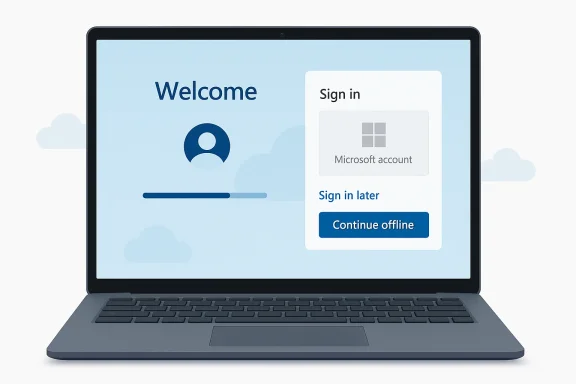
Microsoft’s Windows 11 setup flow may be heading toward one of its most requested changes: the end of a mandatory Microsoft account sign-in during first-run installation. If that happens, it would mark a notable reversal in a setup experience that has become increasingly opinionated over the last few years, especially for consumers buying Home edition PCs. It would also reflect a growing tension inside Microsoft between cloud-first convenience and the long-standing appeal of a simple local account. The result could be a more flexible Windows onboarding experience — but also a more complicated story for Microsoft’s broader ecosystem strategy.
Windows 11’s Out-of-Box Experience, or OOBE, has been a flash point since the operating system launched. For many users, the frustration was not Windows itself, but the feeling that setup had become less about getting to the desktop and more about being routed into Microsoft’s cloud services. Over time, the account prompt became one of the most visible signs that Windows was shifting from a purely device-centric platform to a service-connected one.
That shift did not happen overnight. Microsoft has spent years encouraging users toward account-based sign-in because it helps tie together OneDrive, Microsoft Store apps, Windows Backup, sync settings, parental controls, and security features. The account also creates a more cohesive onboarding path for the company, which is why Microsoft still says it recommends a Microsoft account rather than a local account. But the recommendation has often been experienced by consumers as a default, and in some cases as a hard requirement.
The stricter setup posture has been especially controversial in Windows 11 Home, where users have frequently reported that they cannot proceed without either internet access or a Microsoft account. Microsoft has also been progressively tightening workarounds that previously let users create local accounts during setup. In October 2025, Microsoft said it was removing “known mechanisms” for creating a local account in OOBE because those methods could skip setup screens and leave the device incompletely configured.
At the same time, Microsoft’s own support and servicing materials show that OOBE remains a live engineering surface rather than a static installer. Microsoft has issued repeated OOBE updates for Windows 11 22H2, 23H2, 24H2, and 25H2, showing that the setup flow is still being actively modified. That matters because it means any reported change to account requirements would not be a trivial UI tweak; it would be part of a larger pattern of evolving first-run logic across Windows editions and channels.
The clearest thing to say right now is that this is still a reported shift, not an officially documented product policy. Microsoft has not, at least in its public support materials, announced a universal rollback of Microsoft account requirements for Windows 11 consumer setup. In fact, official Microsoft messaging in recent months has pointed in the opposite direction, emphasizing the removal of bypass mechanisms and the use of account sign-in during OOBE.
Still, the idea is credible for one simple reason: the pressure has been building. Windows enthusiasts, enterprise admins, privacy-minded consumers, and even some OEM and support voices have long argued that account forcing adds friction without always improving the core operating system experience. A reversal would not be out of character for Microsoft if internal telemetry, support burden, or competitive pressure suggested that the current model is too hostile to a segment of users.
A loosened setup flow would therefore be more than an administrative convenience. It would be a symbolic reset around user choice, particularly for people who install Windows on secondary machines, offline systems, test benches, lab devices, or family PCs where a Microsoft account is simply not the preferred option.
The tension became sharper with Windows 11. Microsoft increasingly framed the account as part of a better, more secure, more connected experience. Its support pages stress cloud sync and cross-device services, and they explicitly recommend Microsoft accounts over local accounts. Meanwhile, the OOBE experience in consumer editions made it progressively harder to choose the older path.
Then came the workaround wars. Community-discovered methods such as
That is why a possible policy change would be so interesting. Microsoft has spent time tightening the screws, so any softening would imply either a strategic rethink or a segmented approach that distinguishes between consumer, enterprise, and offline installation scenarios. In other words, the story is not just whether the account prompt changes, but why Microsoft may have decided the current balance is no longer optimal.
For casual users, the screen can feel like a simple login step. For enthusiasts, it is a declaration of design philosophy. That is why even minor changes in OOBE trigger outsized reactions across the Windows community.
There is also a trust component. Some users do not want their first interaction with a new PC to require an online identity tied to Microsoft services. That concern can be about privacy, data minimization, or simply avoiding account dependency. A local account offers a more self-contained setup, and Microsoft’s own documentation acknowledges that local accounts are device-specific and do not require internet connectivity to sign in.
Another reason for pushback is predictability. The more Microsoft changes the rules around setup, the harder it becomes for users to know what will happen on the next machine or the next Windows release. That unpredictability fuels the perception that setup is being designed around Microsoft’s goals, not the user’s. In platform terms, that perception is dangerous because it can create long-term resistance even among otherwise loyal customers.
The challenge is that good strategy can still produce bad first impressions. In Windows, setup is one of the few moments where Microsoft has total control over the user journey, and over-controlling that moment can backfire.
Enterprise environments are a different story. In managed fleets, Microsoft account requirements are often less important than device enrollment, identity federation, and policy control. Enterprise administrators already rely on Entra ID, Intune, Autopilot, and hybrid deployment models rather than consumer account flows. Microsoft’s own OOBE servicing updates continue to reference managed scenarios, which shows that the company’s first-run logic is already differentiated by deployment type.
That distinction matters because a consumer-friendly relaxation does not have to weaken enterprise management. In fact, Microsoft could make the setup flow more permissive for retail installs while keeping enterprise and education workflows tightly integrated with identity systems. That would preserve Microsoft’s control where it matters most commercially while reducing backlash in the consumer segment. Such a split would be strategically elegant if implemented cleanly.
There is also a support angle. Enterprise admins often prefer deterministic setup paths. A more flexible consumer OOBE would need to avoid reintroducing ambiguous behavior that complicates support calls or OEM provisioning. Microsoft’s challenge, then, is to loosen consumer friction without creating a new class of partially configured systems that behave inconsistently across editions.
That is why any change would likely be framed not as a universal abandonment of accounts, but as a better separation of use cases. That distinction is everything.
This could also help Microsoft counter one of the easiest criticisms levied against Windows 11: that it asks for too much before offering too little. If a user can reach the desktop faster, the setup experience becomes less memorable for the wrong reasons. That may not sound dramatic, but the first hour with a new PC is when users decide whether the platform feels welcoming or obstructive.
Competitively, the bigger issue is not whether Microsoft loses some account sign-ins. It is whether it wins back goodwill from users who have learned to resent setup. In consumer computing, goodwill is hard to measure but easy to lose. A smoother install path may not create headline-grabbing growth, but it can reduce the negative emotional friction that shapes brand perception.
A better-designed compromise would let the user choose when to connect to those services rather than forcing the decision at the doorway.
But the most telling official document may be the Windows Insider blog post from October 2025. Microsoft said it was removing local-only commands from the setup process because they could cause users to exit OOBE with a device that was not fully configured. That language indicates a very specific concern: not just account preference, but setup integrity and post-install reliability.
If Microsoft is now reconsidering the mandatory account model, the reasons may be practical rather than ideological. The company may have found that the current approach creates enough support friction, forum backlash, and workaround hunting to outweigh some of the ecosystem gains. Or Microsoft may be planning a more nuanced setup option that remains account-forward by default but no longer makes the local path feel like a secret.
In this case, the most interesting possibility is not a dramatic retreat, but a recalibration of how much pressure is appropriate at the first boot screen.
The company could use this moment to present the change as a user-choice improvement rather than a policy retreat. That would let Microsoft keep emphasizing its cloud ecosystem while acknowledging that not every PC needs to be born into an online identity. A well-designed compromise would also help OEMs, support teams, and power users by reducing setup ambiguity.
There is also the possibility that loosening the requirement could reintroduce partially configured systems, especially if Microsoft removes too many guardrails at once. The company’s October 2025 reasoning for tightening OOBE was that users were skipping critical screens and ending up with devices that were not fully set up. If Microsoft moves in the opposite direction, it will need to prove that convenience does not come at the expense of readiness.
The most plausible outcome is a compromise that preserves Microsoft’s account-centric vision while restoring some degree of user choice. That would be the least disruptive way to answer longstanding complaints without abandoning the broader ecosystem strategy behind Windows 11. If Microsoft gets it right, the change could quietly become one of those usability improvements that users notice mostly by not noticing them.
Source: Analytics Insight Report: Microsoft May Drop Mandatory Login During Windows 11 Setup
 Background
Windows 11’s Out-of-Box Experience, or OOBE, has been a flash point since the operating system launched. For many users, the frustration was not Windows itself, but the feeling that setup had become less about getting to the desktop and more about being routed into Microsoft’s cloud services. Over time, the account prompt became one of the most visible signs that Windows was shifting from a purely device-centric platform to a service-connected one.That shift did not happen overnight. Microsoft has spent years encouraging users toward account-based sign-in because it helps tie together OneDrive, Microsoft Store apps, Windows Backup, sync settings, parental controls, and security features. The account also creates a more cohesive onboarding path for the company, which is why Microsoft still says it recommends a Microsoft account rather than a local account. But the recommendation has often been experienced by consumers as a default, and in some cases as a hard requirement.
The stricter setup posture has been especially controversial in Windows 11 Home, where users have frequently reported that they cannot proceed without either internet access or a Microsoft account. Microsoft has also been progressively tightening workarounds that previously let users create local accounts during setup. In October 2025, Microsoft said it was removing “known mechanisms” for creating a local account in OOBE because those methods could skip setup screens and leave the device incompletely configured.
At the same time, Microsoft’s own support and servicing materials show that OOBE remains a live engineering surface rather than a static installer. Microsoft has issued repeated OOBE updates for Windows 11 22H2, 23H2, 24H2, and 25H2, showing that the setup flow is still being actively modified. That matters because it means any reported change to account requirements would not be a trivial UI tweak; it would be part of a larger pattern of evolving first-run logic across Windows editions and channels.
What Is Changing
The report at issue suggests Microsoft may be considering dropping the mandatory login requirement during Windows 11 setup. If accurate, that would mean users could reach the desktop without being forced through Microsoft account authentication in the initial OOBE flow. For many readers, that sounds like a return to common sense. For Microsoft, however, it would be a significant policy decision with technical, commercial, and support implications.The clearest thing to say right now is that this is still a reported shift, not an officially documented product policy. Microsoft has not, at least in its public support materials, announced a universal rollback of Microsoft account requirements for Windows 11 consumer setup. In fact, official Microsoft messaging in recent months has pointed in the opposite direction, emphasizing the removal of bypass mechanisms and the use of account sign-in during OOBE.
Still, the idea is credible for one simple reason: the pressure has been building. Windows enthusiasts, enterprise admins, privacy-minded consumers, and even some OEM and support voices have long argued that account forcing adds friction without always improving the core operating system experience. A reversal would not be out of character for Microsoft if internal telemetry, support burden, or competitive pressure suggested that the current model is too hostile to a segment of users.
Why This Matters
A mandatory account prompt does more than ask for credentials. It shapes the entire first impression of Windows 11. If users feel trapped before they even see the desktop, that can create resentment that outlasts setup by months or years.A loosened setup flow would therefore be more than an administrative convenience. It would be a symbolic reset around user choice, particularly for people who install Windows on secondary machines, offline systems, test benches, lab devices, or family PCs where a Microsoft account is simply not the preferred option.
- It could reduce setup friction for privacy-conscious users.
- It could make Windows feel more neutral again at first launch.
- It could lower the need for unofficial bypasses and registry tricks.
- It could improve acceptance among power users who dislike forced cloud onboarding.
Historical Context
Windows has never been purely cloud-based, and local accounts have deep roots in the platform’s identity. For decades, users expected that a Windows installation would ask for a username, maybe a password, and then hand over control. Microsoft began nudging users toward online identity as a broader ecosystem strategy, but the transition was gradual and often uneven across editions. That history still matters because many users judge Windows 11 against that earlier expectation of ownership and autonomy.The tension became sharper with Windows 11. Microsoft increasingly framed the account as part of a better, more secure, more connected experience. Its support pages stress cloud sync and cross-device services, and they explicitly recommend Microsoft accounts over local accounts. Meanwhile, the OOBE experience in consumer editions made it progressively harder to choose the older path.
Then came the workaround wars. Community-discovered methods such as
oobe\bypassnro, start ms-cxh:localonly, and similar tricks became widely discussed as ways to escape the account screen. Microsoft responded by removing or disabling some of those escape hatches in later builds. By October 2025, the official Windows Insider blog was explicitly describing a cleanup of “local-only commands” in OOBE.That is why a possible policy change would be so interesting. Microsoft has spent time tightening the screws, so any softening would imply either a strategic rethink or a segmented approach that distinguishes between consumer, enterprise, and offline installation scenarios. In other words, the story is not just whether the account prompt changes, but why Microsoft may have decided the current balance is no longer optimal.
The OOBE Battlefield
OOBE has become a small but highly visible battleground in Windows culture. It is where users form their first emotional impression of the platform, and where Microsoft’s platform ambitions are most directly exposed.For casual users, the screen can feel like a simple login step. For enthusiasts, it is a declaration of design philosophy. That is why even minor changes in OOBE trigger outsized reactions across the Windows community.
- OOBE is now a policy surface, not just an installer.
- Bypasses became a sign of user demand, not merely user mischief.
- Microsoft’s tighter controls reflected ecosystem strategy.
- Any reversal would signal a meaningful shift in priorities.
Why Users Push Back
The main complaint is not philosophical purity; it is friction. Users want to install a PC, name it, and get to work. For someone setting up a new laptop late at night, on a shared machine, or on a test system without internet access, forced sign-in can feel like an unnecessary obstacle. The fact that Microsoft has repeatedly been forced to explain local-account limitations suggests the issue is not confined to a small enthusiast niche.There is also a trust component. Some users do not want their first interaction with a new PC to require an online identity tied to Microsoft services. That concern can be about privacy, data minimization, or simply avoiding account dependency. A local account offers a more self-contained setup, and Microsoft’s own documentation acknowledges that local accounts are device-specific and do not require internet connectivity to sign in.
Another reason for pushback is predictability. The more Microsoft changes the rules around setup, the harder it becomes for users to know what will happen on the next machine or the next Windows release. That unpredictability fuels the perception that setup is being designed around Microsoft’s goals, not the user’s. In platform terms, that perception is dangerous because it can create long-term resistance even among otherwise loyal customers.
Consumer Friction vs Platform Strategy
Microsoft’s logic is understandable. If a user signs in early, the company can enable sync, cloud backup, and identity-based services from day one. But the consumer experience often measures value in a different currency: speed, clarity, and control.The challenge is that good strategy can still produce bad first impressions. In Windows, setup is one of the few moments where Microsoft has total control over the user journey, and over-controlling that moment can backfire.
- Consumers value quick access to the desktop.
- Microsoft values account-driven service attachment.
- The two goals are not always compatible.
- Setup friction can create reputational damage disproportionate to the feature itself.
Enterprise vs Consumer Impact
If Microsoft loosens the Microsoft account requirement, the immediate consumer benefit is obvious. Home users and enthusiasts would gain a simpler path to a clean Windows install, especially on machines that are not meant to be tied to a personal cloud identity. That could be especially welcome on family PCs, offline devices, and systems used for troubleshooting, imaging, or testing.Enterprise environments are a different story. In managed fleets, Microsoft account requirements are often less important than device enrollment, identity federation, and policy control. Enterprise administrators already rely on Entra ID, Intune, Autopilot, and hybrid deployment models rather than consumer account flows. Microsoft’s own OOBE servicing updates continue to reference managed scenarios, which shows that the company’s first-run logic is already differentiated by deployment type.
That distinction matters because a consumer-friendly relaxation does not have to weaken enterprise management. In fact, Microsoft could make the setup flow more permissive for retail installs while keeping enterprise and education workflows tightly integrated with identity systems. That would preserve Microsoft’s control where it matters most commercially while reducing backlash in the consumer segment. Such a split would be strategically elegant if implemented cleanly.
There is also a support angle. Enterprise admins often prefer deterministic setup paths. A more flexible consumer OOBE would need to avoid reintroducing ambiguous behavior that complicates support calls or OEM provisioning. Microsoft’s challenge, then, is to loosen consumer friction without creating a new class of partially configured systems that behave inconsistently across editions.
Different Expectations, Different Risk Profiles
The consumer market is sensitive to irritation and perception. Enterprise buyers are sensitive to control, consistency, and deployment repeatability. Microsoft cannot satisfy both with one blunt rule.That is why any change would likely be framed not as a universal abandonment of accounts, but as a better separation of use cases. That distinction is everything.
- Consumers want convenience and choice.
- Enterprises want compliance and repeatability.
- OEMs want predictable first-boot behavior.
- Microsoft wants cloud attachment without alienating power users.
Competitive Implications
A less restrictive Windows 11 setup could improve Microsoft’s standing with enthusiasts and IT pros who compare Windows to more flexible operating systems. On a practical level, it would make Windows feel less patronizing at first launch, which matters in a market where user sentiment can influence buying decisions, reviews, and recommendations. In a symbolic sense, it would make Windows seem more open again, even if the rest of the ecosystem remains heavily account-driven.This could also help Microsoft counter one of the easiest criticisms levied against Windows 11: that it asks for too much before offering too little. If a user can reach the desktop faster, the setup experience becomes less memorable for the wrong reasons. That may not sound dramatic, but the first hour with a new PC is when users decide whether the platform feels welcoming or obstructive.
Competitively, the bigger issue is not whether Microsoft loses some account sign-ins. It is whether it wins back goodwill from users who have learned to resent setup. In consumer computing, goodwill is hard to measure but easy to lose. A smoother install path may not create headline-grabbing growth, but it can reduce the negative emotional friction that shapes brand perception.
Ecosystem Trade-Offs
Microsoft’s ecosystem benefits from account sign-in because it increases the odds that users will adopt OneDrive, Store apps, and backup features. But pushing too hard can make the ecosystem feel coercive instead of helpful.A better-designed compromise would let the user choose when to connect to those services rather than forcing the decision at the doorway.
- Early sign-in increases service uptake.
- Forced sign-in can depress goodwill.
- Flexible onboarding may trade short-term attachment for long-term satisfaction.
- The best platform strategy often feels invisible, not mandatory.
What the Official Record Suggests
It is important to separate rumor from the official record. Microsoft’s public documentation still recommends Microsoft accounts, and its support materials continue to describe local accounts as valid but less integrated alternatives. The company also keeps updating OOBE, showing that the setup experience remains under active development rather than frozen in its current form.But the most telling official document may be the Windows Insider blog post from October 2025. Microsoft said it was removing local-only commands from the setup process because they could cause users to exit OOBE with a device that was not fully configured. That language indicates a very specific concern: not just account preference, but setup integrity and post-install reliability.
If Microsoft is now reconsidering the mandatory account model, the reasons may be practical rather than ideological. The company may have found that the current approach creates enough support friction, forum backlash, and workaround hunting to outweigh some of the ecosystem gains. Or Microsoft may be planning a more nuanced setup option that remains account-forward by default but no longer makes the local path feel like a secret.
Reading Between the Lines
When a vendor repeatedly patches around bypasses, it is usually protecting a strategic goal. When that same vendor later loosens a policy, it usually means the cost of enforcement has changed.In this case, the most interesting possibility is not a dramatic retreat, but a recalibration of how much pressure is appropriate at the first boot screen.
- Official docs still favor Microsoft accounts.
- OOBE remains actively serviced.
- Microsoft has previously narrowed bypass options.
- A future adjustment could be a compromise, not a capitulation.
Strengths and Opportunities
A more flexible Windows 11 setup could produce real benefits for users and for Microsoft alike. The biggest opportunity is simple: less frustration at the moment when the operating system should be making a good impression. It could also reduce the need for unofficial workarounds, which are messy for support and awkward for Microsoft’s public image.The company could use this moment to present the change as a user-choice improvement rather than a policy retreat. That would let Microsoft keep emphasizing its cloud ecosystem while acknowledging that not every PC needs to be born into an online identity. A well-designed compromise would also help OEMs, support teams, and power users by reducing setup ambiguity.
- Faster path to the desktop.
- Better first impression for new buyers.
- Less reliance on unofficial bypass tricks.
- Stronger user trust around setup choices.
- Cleaner separation between consumer and enterprise onboarding.
- Potentially lower support burden around failed setup attempts.
- A more human Windows setup experience.
Risks and Concerns
The biggest risk is that Microsoft could weaken one of the mechanisms that drives account adoption, and with it the usage of adjacent services such as OneDrive and Microsoft Store. Another concern is that a partially relaxed system might be implemented inconsistently, leaving some users confused about which editions or device types still require sign-in. If the messaging is sloppy, the company could end up with more confusion than it solves.There is also the possibility that loosening the requirement could reintroduce partially configured systems, especially if Microsoft removes too many guardrails at once. The company’s October 2025 reasoning for tightening OOBE was that users were skipping critical screens and ending up with devices that were not fully set up. If Microsoft moves in the opposite direction, it will need to prove that convenience does not come at the expense of readiness.
- Reduced Microsoft account adoption.
- Confusing rules across editions or builds.
- Potential regression in setup completeness.
- More inconsistent support experiences.
- Risk of mixed messaging between marketing and engineering.
- Possible disappointment if the change is narrower than users expect.
- Continued tension between user freedom and ecosystem lock-in.
Looking Ahead
The next phase will likely be defined by documentation, Insider build behavior, and the fine print of OOBE updates rather than by a single splashy announcement. If Microsoft is truly changing course, the first evidence will probably show up in preview builds, support docs, or a revised setup path that distinguishes more clearly between consumer and managed installations. The company has already shown that it is willing to modify OOBE frequently, so this would fit the pattern of iterative adjustment rather than a one-time reset.The most plausible outcome is a compromise that preserves Microsoft’s account-centric vision while restoring some degree of user choice. That would be the least disruptive way to answer longstanding complaints without abandoning the broader ecosystem strategy behind Windows 11. If Microsoft gets it right, the change could quietly become one of those usability improvements that users notice mostly by not noticing them.
What to Watch
- Insider build notes describing OOBE changes.
- Updates to Microsoft support pages about local vs Microsoft accounts.
- Whether Home and Pro editions are treated differently.
- Whether offline install paths become easier again.
- Signs that Microsoft is prioritizing setup completion over account enforcement.
Source: Analytics Insight Report: Microsoft May Drop Mandatory Login During Windows 11 Setup
Last edited:
