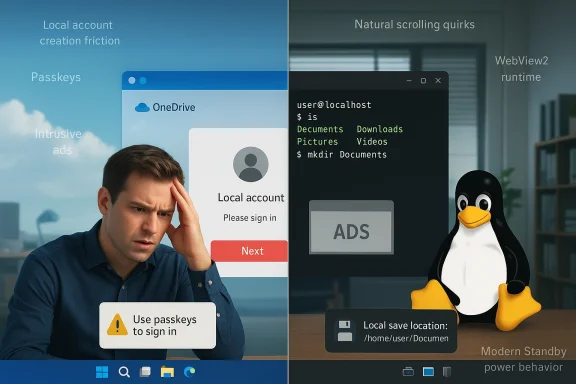
Microsoft’s claim that Windows 11 now reaches “over 1 billion monthly active devices” landed like a victory lap — and immediately reopened a broader debate about the state of the operating system. The milestone, flagged in Microsoft’s Windows Experience Blog, coincided with intense and public user frustration: buggy updates that required emergency out‑of‑band fixes, complaints about intrusive AI features under the Copilot banner, repeated irritation at OneDrive’s folder‑backup defaults, and a persistent sense that regular consumers are being treated as second‑class users compared with enterprise customers.
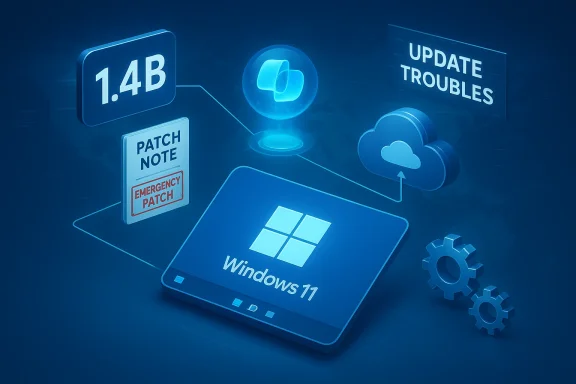
Windows’ user base is massive and complex, stretching from consumer laptops and gaming rigs to large corporate fleets. Microsoft’s June blog post framed Windows’ position in the market and acknowledged the transition away from Windows 10, noting the platform’s scale and the company’s push toward AI‑enhanced experiences on Copilot+ PCs. That post originally used the phrasing “over a billion monthly active devices” and was later corrected to “over 1.4 billion monthly active devices,” a revision that sparked confusion and skepticism in the press and among users. The revision itself illustrates how sensitive simple numeric claims have become in the context of product trust and corporate communication.
Pavan Davuluri, Microsoft’s corporate vice president for Windows + Devices, has been a visible face of that effort, discussing both the company’s enthusiasm for on‑device AI and how the Windows team is listening to feedback. But the tension between strategic objectives (AI integration, new silicon partnerships, Copilot branding) and day‑to‑day user experience (reliability, control, transparency) is visible in forum threads, support logs, and press coverage.
Those OOB packages were significant for two reasons. First, they confirmed a breakdown in standard rollout and validation processes: emergency updates are the exception, not the norm. Second, the fixes themselves sometimes introduced new issues or revealed related regressions, underscoring the challenge of patching a massively heterogeneous PC ecosystem where interactions among drivers, OEM firmware, third‑party apps, and cloud sync services (OneDrive, Dropbox) can produce unexpected results.
The March 2025 update that inadvertently uninstalled or unpinned the Copilot app from affected devices shows how quickly a seemingly small regression becomes a PR issue. Microsoft acknowledged the bug and issued fixes, but the incident crystallized a broader frustration: AI features are being added quickly, sometimes without clear opt‑in design, and when bugs appear they feel emblematic of a lack of polish.
But that focus can leave consumer product flows under‑resourced for the particular problems that individual users face: guided support for reversing KFM, rapid help for corrupted user profiles, or clear remediation for update regressions that block productivity. The consequence is visible in community forums where frustrated consumers report feeling ignored while enterprise channels receive prioritized attention.
This is a classic business tradeoff: prioritize the more lucrative enterprise segment and accept some consumer friction — or allocate more engineering and support effort to the retail market at the risk of slower enterprise innovation. Microsoft’s strategy so far has leaned into enterprise and AI platform playbooks; the question is whether the company will rebalance after sustained user pushback.
But that ambition collides with a practical reality: Windows runs on millions of non‑flagship systems with diverse drivers, legacy workflows, and users who value predictability over bleeding‑edge features. When that collision results in high‑visibility failures, it erodes trust much faster than new features create value.
In short, scale amplifies mistakes. The larger the install base, the more important conservative defaults, clear consent, and robust testing become.
Microsoft has the engineering depth and market position to fix these problems; it’s a matter of prioritization and execution. The company’s public statements — and leaders such as Pavan Davuluri — acknowledge user feedback. The next several release cycles will tell whether that acknowledgement translates into measurable improvements in stability, consent, and consumer satisfaction.
Source: filmogaz.com Windows 11 Reaches 1 Billion Users Amid Widespread Dissatisfaction
 Background and overview
Windows’ user base is massive and complex, stretching from consumer laptops and gaming rigs to large corporate fleets. Microsoft’s June blog post framed Windows’ position in the market and acknowledged the transition away from Windows 10, noting the platform’s scale and the company’s push toward AI‑enhanced experiences on Copilot+ PCs. That post originally used the phrasing “over a billion monthly active devices” and was later corrected to “over 1.4 billion monthly active devices,” a revision that sparked confusion and skepticism in the press and among users. The revision itself illustrates how sensitive simple numeric claims have become in the context of product trust and corporate communication. Pavan Davuluri, Microsoft’s corporate vice president for Windows + Devices, has been a visible face of that effort, discussing both the company’s enthusiasm for on‑device AI and how the Windows team is listening to feedback. But the tension between strategic objectives (AI integration, new silicon partnerships, Copilot branding) and day‑to‑day user experience (reliability, control, transparency) is visible in forum threads, support logs, and press coverage.
Why the “1 billion” headline matters — and why it stung
The headline number matters because it’s shorthand for trust. Saying “1 billion monthly active devices” signals scale, stability, and broad reach. Yet when a number is ambiguous or updated after publication, it invites questions about the underlying methodology and whether attention is being paid to fundamentals like device telemetry, update reliability, and consumer satisfaction.- Microsoft’s official post is the authoritative baseline for the number and how it’s described; the quick correction back to “over 1.4 billion” suggests either a drafting mistake or a last‑minute editorial change that was then reversed.
- Whether the base is 1.0 billion or 1.4 billion, the core reality remains: Windows runs on an enormous global install base. The more important question for most users, however, is what the platform feels like to use every day — and that’s where the negative feedback has centered.
The update crisis: quality and timing under scrutiny
January 2026 Patch Tuesday: a case study in regression risk
The strongest and most immediate evidence of user pain this month came from the January 2026 Patch Tuesday rollout. Multiple cumulative updates — released as part of the normal security cadence — led to a cascade of regressions: some PCs failed to shut down or hibernate, Remote Desktop sign‑ins broke for certain configurations, and a subset of systems experienced boot failures indicating a serious "unmountable" volume condition. Microsoft issued emergency out‑of‑band (OOB) patches twice within weeks to mitigate the fallout.Those OOB packages were significant for two reasons. First, they confirmed a breakdown in standard rollout and validation processes: emergency updates are the exception, not the norm. Second, the fixes themselves sometimes introduced new issues or revealed related regressions, underscoring the challenge of patching a massively heterogeneous PC ecosystem where interactions among drivers, OEM firmware, third‑party apps, and cloud sync services (OneDrive, Dropbox) can produce unexpected results.
What this means for users and admins
For end users, the practical impact was lost productivity and anxiety: interrupted work, failing backup flows, and a need to troubleshoot with limited visibility into the failure modes. For IT admins and power users, the incident amplified familiar tradeoffs: automatic updates improve baseline security but increase the risk of broad regressions if the validation matrix isn’t exhaustive. The public nature of these failures damaged trust and gave critics ammunition to say that Windows has become less stable as Microsoft moves aggressively into AI and feature expansion.AI feature overload, Copilot missteps, and the perception of pushiness
Copilot’s double life: feature and lightning rod
Microsoft has rolled out Copilot as both a platform and a brand: built‑in assistant experiences in the OS, add‑ons for Office, and a marketing tie‑in for Copilot+ PCs. Users’ reactions have been mixed. Some welcome the productivity gains; many others say the integration feels rushed, intrusive, or poorly explained.The March 2025 update that inadvertently uninstalled or unpinned the Copilot app from affected devices shows how quickly a seemingly small regression becomes a PR issue. Microsoft acknowledged the bug and issued fixes, but the incident crystallized a broader frustration: AI features are being added quickly, sometimes without clear opt‑in design, and when bugs appear they feel emblematic of a lack of polish.
Agents, access, and consent: the next battleground
Microsoft’s longer‑term AI roadmap — including agent frameworks that can access user files to provide contextual help — raises legitimate privacy and consent questions. The company has publicly said it intends to make these experiences opt‑in and to enforce user consent and containment, but community skepticism remains. The concern is not only technical (how are credentials protected?) but also UX‑driven: how and when will Windows ask for permission, and will those defaults respect long‑term user expectations about local control and privacy?OneDrive and Known Folder Move: convenience or coercion?
One of the most persistent consumer complaints is about OneDrive’s Known Folder Move (KFM) — the feature that redirects Desktop, Documents, and Pictures to OneDrive for cloud backup. The intention is sound: protect users’ files against device loss. The experience, however, has been described by many users as “pushy” or even deceptive when folder redirection occurs during out‑of‑box setup or after a prompt is dismissed.- Community reporting and forums document instances where users signed in with a Microsoft account during setup and later discovered their folders redirected into OneDrive, sometimes with little obvious explicit confirmation. Microsoft has since improved the undo flow (giving users a way to automatically move files back to local folders), but the core complaint — cloud‑first defaults that can surprise users — remains.
- The practical harms are tangible: users on free OneDrive plans (5 GB) can quickly hit storage limits, causing sync errors and user confusion; automation and scripts that depend on local file paths can break; and users storing sensitive data may inadvertently place it in cloud storage tied to the wrong account or tenant.
Upselling, bloat, and the consumer experience
Microsoft’s push to cross‑sell services — Microsoft 365 subscriptions, extra OneDrive storage, Copilot tiers — is visible across setup flows, Widgets, Settings prompts, and occasional taskbar suggestions. The result is a growing chorus of users who feel the OS is trying to monetize day‑to‑day interactions in a way that compromises a frictionless experience.- Longstanding tech coverage and user guides note ads and promotional prompts appearing in Settings, Widgets, and other UIs; magazine and tech sites have documented places where Microsoft suggests subscriptions or features that require payment. Disabling these prompts requires hunting through nested settings for people who prefer a leaner desktop.
- The problem is not unique to Microsoft — platform vendors monetize attention in various ways — but the combination of forced sign‑ins, OneDrive nudges, and repeated upsell prompts makes the consumer flow feel more cluttered than it did in previous releases. That perception matters for brand loyalty.
Consumer support versus enterprise focus
There’s a growing narrative that Microsoft’s resources and innovations are increasingly oriented toward enterprise scenarios: Windows for Business, Windows 365, Copilot for Enterprise, and deep partnerships with OEMs and silicon vendors for Copilot+ devices. Those investments are strategic: enterprise customers pay higher per‑seat revenue, push large-scale deployments, and shape standards.But that focus can leave consumer product flows under‑resourced for the particular problems that individual users face: guided support for reversing KFM, rapid help for corrupted user profiles, or clear remediation for update regressions that block productivity. The consequence is visible in community forums where frustrated consumers report feeling ignored while enterprise channels receive prioritized attention.
This is a classic business tradeoff: prioritize the more lucrative enterprise segment and accept some consumer friction — or allocate more engineering and support effort to the retail market at the risk of slower enterprise innovation. Microsoft’s strategy so far has leaned into enterprise and AI platform playbooks; the question is whether the company will rebalance after sustained user pushback.
What Microsoft needs to fix — a prioritized checklist
If Microsoft wants to convert scale into sustained goodwill, five things require urgent attention:- Redouble update testing and staged rollouts. OOB patches should be rare; when they’re required, communications must be explicit about affected builds and recovery options.
- Make cloud and AI features explicitly opt‑in. Default settings should default to local control; offer clear, understandable prompts during OOBE rather than small print nudges.
- Reduce visible upsell clutter for consumers. Create a clear “consumer mode” preference that minimizes promotional content across Settings, Widgets, and search suggestions.
- Improve consumer support channels and transparency. Faster, clearer advisories and recovery instructions for consumer incidents would reduce confusion and restore trust.
- Publish measurement methodology for headline metrics. If Microsoft quotes monthly active devices, explain the metric and update cadence. That would preempt the “1 billion vs. 1.4 billion” storms.
Practical advice for Windows users today
If you’re a Windows user worried about these issues, here are concrete steps to reduce risk and reclaim control:- Defer non‑security updates for a short window (7–14 days) when feasible, especially if you rely on your PC for critical tasks. This reduces exposure to early regressions.
- Before installing major updates, create a full system image or ensure you have current backups. Tools like Windows’ built‑in backup, third‑party cloning utilities, or cloud backups are all valid choices.
- Check OneDrive settings immediately after setup: verify whether Known Folder Move (Folder Backup) is enabled and whether your account quota fits your storage needs; opt out or move files locally if you prefer.
- Use a local account during OOBE if you want to avoid Microsoft account nudges; Pro users can also leverage Group Policy to enforce tight defaults. For non‑Pro users, review settings under Accounts and Windows Backup to minimize telemetry and account sync.
- If Copilot or new AI features feel intrusive, use the app uninstall or disable options where available and check privacy controls for agent access to files. Microsoft has stated many AI experiences will require consent, but validate the settings yourself.
The strategic tension: platform growth vs. product polish
Microsoft’s ambition — to bake AI into the operating system, partner with silicon vendors for Copilot+ devices, and expand subscription revenues — is coherent. The company is betting that on‑device AI plus cloud services will define the next generation of PC value.But that ambition collides with a practical reality: Windows runs on millions of non‑flagship systems with diverse drivers, legacy workflows, and users who value predictability over bleeding‑edge features. When that collision results in high‑visibility failures, it erodes trust much faster than new features create value.
In short, scale amplifies mistakes. The larger the install base, the more important conservative defaults, clear consent, and robust testing become.
Verdict: milestone overshadowed by UX debt
The “1 billion” headline — whether accurately worded or not — is impressive in scale, but it cannot paper over the day‑to‑day user experience that many customers report. The operating system’s future depends less on milestone counts and more on whether Microsoft can restore faith in update reliability, give users clear control over cloud and AI features, and trim the visible upsell clutter that makes the desktop feel commercialized.Microsoft has the engineering depth and market position to fix these problems; it’s a matter of prioritization and execution. The company’s public statements — and leaders such as Pavan Davuluri — acknowledge user feedback. The next several release cycles will tell whether that acknowledgement translates into measurable improvements in stability, consent, and consumer satisfaction.
Conclusion
Windows 11’s scale is undeniable; the platform’s reach remains vast and strategically central to Microsoft. But scale without trust is brittle. Recent update failures, repeated friction around OneDrive and account defaults, and the perception of aggressive AI and subscription upsells have combined to create a consumer experience that feels noisy and sometimes unreliable. Addressing that UX debt will not only preserve the platform’s user base — it will determine whether Windows’ next chapter is one of sustained growth or gradual erosion of consumer goodwill. The company’s choices in the months ahead will matter more than any single headline number.Source: filmogaz.com Windows 11 Reaches 1 Billion Users Amid Widespread Dissatisfaction