

Windows 11 has just recorded another milestone among PC gamers, but the headline hides a stubborn and consequential reality: while Valve’s November Steam Hardware & Software Survey shows Windows 11 now running on roughly two-thirds of Steam clients, a substantial minority — nearly one-third of gamers — remain on Windows 10, with serious security and ecosystem implications for Microsoft, PC makers, developers and the players themselves.
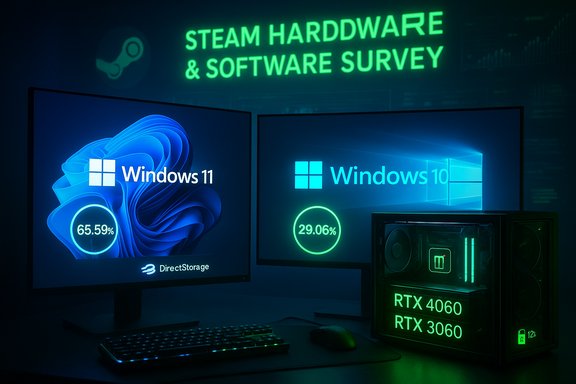
Valve’s monthly Steam Hardware & Software Survey is one of the most reliable windows into the PC-gaming cohort: a voluntary, gamer-focused panel that tracks operating systems, GPUs, memory, storage and other platform details. The November 2025 snapshot reports Windows 11 (64‑bit) at 65.59%, a month‑over‑month rise of 2.02 percentage points, with Windows 10 (64‑bit) still at 29.06%. That leaves a nontrivial tail of Windows 10 holdouts and legacy systems among an audience that matters disproportionately to game developers, anti‑cheat vendors and driver makers. Those percent points matter because Steam’s user base is huge: independent trackers put Steam at roughly 132 million monthly active users, magnifying even small shifts into large absolute numbers and real product‑planning consequences for publishers. At the same time, OEM commentary and industry estimates paint a broader — and more complicated — picture: Dell’s CFO and senior executives have suggested a large installed base still sits on Windows 10, splitting roughly into machines that could be upgraded but haven’t and older machines that can’t meet Windows 11’s hardware baseline. That framing implies the migration to Windows 11 remains incomplete and economically meaningful for PC makers.
Game developers and anti‑cheat vendors must plan for a bifurcated landscape for the foreseeable future — optimize for the modern stack while maintaining practical fallbacks. For end users, the practical advice is straightforward: if your machine is eligible, plan and test an upgrade; if it isn’t, make a concrete security plan that includes ESU options or a refresh timetable. And for Microsoft, the adoption challenge is as much about persuasion as it is about technical capability — improving clarity, reducing friction and addressing legitimate user concerns about privacy, control and stability will be essential to closing the gap between Steam’s gamer sample and the wider PC installed base.
Source: Windows Central https://www.windowscentral.com/micr...should-be-embarrassed-by-windows-10-holdouts/
 Background / Overview
Valve’s monthly Steam Hardware & Software Survey is one of the most reliable windows into the PC-gaming cohort: a voluntary, gamer-focused panel that tracks operating systems, GPUs, memory, storage and other platform details. The November 2025 snapshot reports Windows 11 (64‑bit) at 65.59%, a month‑over‑month rise of 2.02 percentage points, with Windows 10 (64‑bit) still at 29.06%. That leaves a nontrivial tail of Windows 10 holdouts and legacy systems among an audience that matters disproportionately to game developers, anti‑cheat vendors and driver makers. Those percent points matter because Steam’s user base is huge: independent trackers put Steam at roughly 132 million monthly active users, magnifying even small shifts into large absolute numbers and real product‑planning consequences for publishers. At the same time, OEM commentary and industry estimates paint a broader — and more complicated — picture: Dell’s CFO and senior executives have suggested a large installed base still sits on Windows 10, splitting roughly into machines that could be upgraded but haven’t and older machines that can’t meet Windows 11’s hardware baseline. That framing implies the migration to Windows 11 remains incomplete and economically meaningful for PC makers. What Valve’s Survey Actually Shows
The raw numbers (what Valve reports)
- Windows 11 (64‑bit): 65.59% (+2.02% MoM).
- Windows 10 (64‑bit): 29.06% (-2.08% MoM).
- Windows (all versions combined): 94.79% of Steam users.
- Linux: 3.20%; macOS: 2.02%.
What these numbers mean in practice
Because the Steam survey is gamer‑centric and voluntary, it overrepresents early adopters and mid‑to‑high‑end rigs. Gamers buy new hardware more often, install bleeding‑edge GPUs and prefer systems that meet Windows 11’s requirements — TPM 2.0, Secure Boot and a supported CPU family. That’s one reason Windows 11’s share on Steam is higher than in general desktop telemetry: gamers are simply more upgrade‑prone. However, the fact that nearly 30% of Steam users remain on Windows 10 after Microsoft’s end‑of‑support horizon is nontrivial for developers who must still test and support older APIs and behaviors.Why so many holdouts? Economics, hardware gates and behavioral inertia
1) Hardware requirements and compatibility
Windows 11 intentionally raised the minimum platform floor. The TPM 2.0 / Secure Boot / CPU generation checks improved baseline security but excluded many otherwise functional machines. For consumers running a serviceable PC, the choice is often: tinker with firmware, buy new hardware, or skip the upgrade. That friction is real and widespread. Dell has publicly estimated a split in the installed base between machines that can be upgraded but haven’t and machines that can’t — a narrative that underlines why the migration curve is not a simple cliff. OEM commentary must be treated as directional rather than a precise audit, but it aligns with independent telemetry showing sizable Windows 10 footprints outside the gaming cohort.2) Cost and timing
Replacing a main PC or buying components is an expensive decision. Many households and small firms are in a refresh cycle driven by discrete needs (battery, performance, storage), not by an OS deadline. Microsoft’s Extended Security Updates (ESU) program for Windows 10 — including consumer accommodations for a limited extension — reduced near‑term urgency, giving users more time to plan or defer purchases. Microsoft’s official lifecycle pages confirm Windows 10’s end of support on October 14, 2025, and describe ESU and transition pathways for devices that cannot be upgraded. That official end‑date is a hard inflection point, but the real world rarely follows clean, instantaneous upgrades.3) Perceived value and feature calculus
Some users evaluate Windows 11’s tradeoffs differently. While Microsoft and many reviewers point to gaming benefits (DirectStorage, Auto HDR, scheduler improvements), not every user sees a measurable day‑to‑day gain. In some scenarios — especially with older drivers or marginal hardware — Windows 10 still feels “good enough,” and for multiplayer communities the stability of a tested environment often beats cosmetic new features.What this means for Microsoft and PC makers
Strengths for Microsoft
- Windows remains dominant in gaming. Valve’s data show nearly 95% of Steam users run Windows of some version, keeping Microsoft at the center of PC game development and distribution decisions. That dominance is valuable for Microsoft’s ecosystem strategy: Xbox PC integration, Microsoft Store, QoS partnerships with GPU vendors, and Copilot integration all play more naturally atop a widely‑installed platform.
- Windows 11 adoption is accelerating among a key, influential segment. Gamers are early adopters whose behavior often cues driver makers and publishers about which APIs and platforms to prioritize. A majority here matters.
Risks and structural problems
- Security exposure from legacy installs. A persistent Windows 10 base after EoS creates a long‑tail security risk both for individuals and networks. Unsupported OS versions do not receive routine security updates, which increases exposure. Microsoft’s documentation about Windows 10’s EoS is explicit: after October 14, 2025, Windows 10 no longer receives standard security updates unless enrolled in a supported ESU program. That creates a time‑limited support trench and a transitional burden for enterprises and households.
- Fragmentation cost for developers and anti‑cheat vendors. With a multi‑OS installed base still relevant to gaming, developers must continue to maintain backward compatibility and test anti‑cheat systems across varied firmware and driver stacks. That increases QA costs and complicates deployment schedules.
- Perception and PR friction over Microsoft’s direction. Aggressive AI positioning and certain UI/advertising behaviors in Windows 11 have provoked user pushback. Microsoft’s AI leadership publicly expressed surprise at the lukewarm reaction to Windows AI features — a notable quote from Microsoft AI CEO Mustafa Suleyman drew attention when he said he found it “mindblowing” that people were unimpressed with AI advances — a comment that crystallized growing discomfort among some users who see AI‑first moves as tone‑deaf to reliability and privacy concerns. The comment and subsequent coverage show an attitude gap between product messaging and user sentiment.
The hardware axis: why GPUs, RAM and storage matter to the migration
Steam’s hardware snapshot shows a midrange‑heavy gaming install base: 32 GB RAM is common, and RTX 4060 / RTX 3060 variants remain highly reported. That profile favors Windows 11 for a few reasons:- DirectStorage benefits manifest most clearly with NVMe‑backed systems and newer GPUs.
- Midrange discrete GPUs paired with adequate RAM make the feature set and performance advantages of Windows 11 more apparent.
- Gamers with this hardware are already the users most likely to upgrade to Windows 11 or buy new systems with it preinstalled.
The messaging problem: agentic OS, AI pushes, and user sentiment
Microsoft’s vision for Windows as an “agentic OS” — an environment where AI agents proactively complete tasks — is a strategic bet that could transform user workflows. But it’s also politically and culturally sensitive inside the Windows user community.- Microsoft’s aggressive AI push has generated a backlash about priority and timing: many users want a stable, lean OS rather than features perceived as invasive or poorly explained.
- Statements from senior AI figures, and a social media exchange noting that critics being “unimpressed” is “mindblowing,” have brought tone‑and‑values scrutiny to Microsoft’s approach. Commentators interpreted the reaction as a disconnection between Microsoft’s internal enthusiasm and real user experience concerns.
What developers and publishers should plan for now
Short, actionable guidance for game studios, anti‑cheat vendors and middleware providers:- Continue to test across Windows 11 and Windows 10 for the next 12–18 months; expect nontrivial Windows 10 shares in many markets.
- Prioritize features where the incremental engineering and QA cost is justified: security‑sensitive subsystems (anti‑cheat, payment flows) should be validated on both OSes and across UEFI/TMP permutations.
- Consider feature gating: roll out modern capabilities (DirectStorage optimization, ray tracing presets) behind optional toggles so users on older hardware aren’t penalized.
- Track Valve’s deprecation plans (for example, moves like ending 32‑bit Windows client updates) and vendor driver roadmaps to align support windows and minimize surprise breakages.
Policy and security considerations for end users and enterprises
- Individuals: If you remain on Windows 10, register for formal ESU if available for your device or plan a migration path. Without security updates, risks increase over time. Microsoft’s guidance and lifecycle pages outline upgrade options and ESU specifics.
- SMBs and enterprises: Audit installed bases now. The nominal end of support does not magically remove operational software, but it does change compliance risk for regulated sectors. Evaluate whether the device fleet is eligible for Windows 11 upgrades or if hardware refreshes are necessary and budget accordingly.
- Public sector and critical infrastructure: The long tail of legacy OS installations presents systemic risk; plan staged migrations and compensating controls if a wholesale upgrade is infeasible in the immediate term.
Where the numbers are solid — and where to be cautious
- The Steam survey is a trusted, consistent indicator for the gaming population, and Valve’s raw percentages are authoritative for its panel. Use Valve’s data when the audience in question is gamers.
- Microsoft’s official lifecycle statements and KB pages are definitive on support timelines; the Windows 10 EoS date is public and binding.
- OEM statements (for example Dell’s comments about a large Windows 10 installed base and the split between upgradeable and non‑upgradeable machines) are directional and commercially motivated; treat their headline numbers as useful market signals rather than audited, device‑level censuses. The 500M/500M framing is informative but not independently verified to the level of a device inventory audit. Flag this as an OEM estimate rather than a definitive census.
- Third‑party audience and traffic aggregators (DemandSage and similar sites) provide valuable context for Steam’s absolute scale — the ~132 million monthly active user figure is a commonly reported estimate across market trackers, but it is not a primary Valve disclosure in the same way Steam’s survey is. Treat it as a widely cited industry estimate.
The near-term outlook: what to expect in the next 6–12 months
- Expect gradual but persistent Windows 11 growth on Steam as new hardware sales continue and gamers cycle out older rigs. Steam’s monthly trends will likely show incremental gains rather than dramatic spikes.
- Watch for regional variation: some geographies with newer hardware fleets will pivot to Windows 11 faster; others with older installed hardware or more constrained upgrade economics will lag.
- Microsoft will continue to nudge, and occasionally pressure, users to migrate — but the path will be bumpy if messaging and enforcement appear heavy‑handed. Free or low‑friction upgrade pathways, better telemetry tools for users to assess compatibility, and less intrusive marketing could speed adoption.
- Security and compliance pressures will grow as third‑party vendors and online services shift their focus to supported platforms; that will create real deadlines for enterprises even where consumer action is slower.
Conclusion
Valve’s November Steam survey makes two clear claims that matter to anyone who builds, sells or plays PC games: Windows 11 is now the majority OS among Steam users, and a substantial Windows 10 minority remains. The combination is strategically significant. For Microsoft and PC OEMs, the data are encouraging but incomplete: gamers have adopted Windows 11 faster than the broader market, but migration remains uneven, driven by hardware compatibility, cost and user sentiment.Game developers and anti‑cheat vendors must plan for a bifurcated landscape for the foreseeable future — optimize for the modern stack while maintaining practical fallbacks. For end users, the practical advice is straightforward: if your machine is eligible, plan and test an upgrade; if it isn’t, make a concrete security plan that includes ESU options or a refresh timetable. And for Microsoft, the adoption challenge is as much about persuasion as it is about technical capability — improving clarity, reducing friction and addressing legitimate user concerns about privacy, control and stability will be essential to closing the gap between Steam’s gamer sample and the wider PC installed base.
Source: Windows Central https://www.windowscentral.com/micr...should-be-embarrassed-by-windows-10-holdouts/
