

Microsoft’s effort to make Windows 11 less intrusive is no longer just a vague promise. In recent preview builds, Microsoft has been testing a redesigned update pause experience that appears to let users choose an arbitrary resume date, instead of being locked into a fixed five-week window. That sounds small on paper, but it touches one of Windows 11’s most persistent pain points: the feeling that the operating system decides when your PC should stop being your PC. If the feature ships broadly, it could mark a meaningful shift in how Microsoft balances security, autonomy, and the everyday annoyance of forced restarts.
Windows update policy has always lived in tension between two goals that often pull in opposite directions: keeping systems secure and letting users stay in control. Microsoft’s modern servicing model, which treats Windows like an always-evolving platform, has made security patches faster and more consistent, but it has also created frustration when updates arrive at the worst possible time. The company has spent years trying to soften that blow with active hours, restart scheduling, deferrals, and pause options. Even so, many users still describe the experience as too aggressive and, at times, surprisingly inflexible.
The current Windows 11 pause model remains limited. Microsoft’s support documentation says users can pause updates temporarily, and once the pause limit is reached they must install the latest updates before pausing again. That is the official policy today, and it reflects the long-standing belief that updates should not be postponed indefinitely on consumer devices. The practical result is that Windows 11 users have historically had to work within a maximum pause window rather than defining their own end date.
That context makes the latest Insider testing notable. In Windows preview builds released in late March and early April 2026, Microsoft has been emphasizing a broader overhaul of Windows Update itself: fewer automatic restarts, clearer timing, a more predictable cadence, and the ability to pause updates for longer when needed. Microsoft also said it is moving devices to a single monthly reboot, which is a strong signal that the company is trying to reduce the number of disruptive update moments rather than simply hide them behind better UI.
The timing is also important. Microsoft is still navigating the aftershocks of Windows 10’s end of support on October 14, 2025, while pushing Windows 11 as the safer, modern default. That means Windows Update has become more than a housekeeping tool; it is part of Microsoft’s trust pitch. If Windows 11 is going to convince reluctant holdouts and enterprise admins that it is worth the move, it needs to feel less like a system that interrupts work and more like one that respects it.
There is also a broader change in tone. Microsoft executives have publicly talked about making Windows a “calmer” and more user-friendly platform, and the update revamp fits that message. The important caveat is that Microsoft has not yet guaranteed the exact shape of the final feature. Preview behavior can change, and the calendar-based pause UI spotted in testing may still evolve before general release. That uncertainty matters, because the difference between “indefinitely pauseable” and “more flexible but still bounded” is huge for both users and security teams.
The preview screenshots and reporting suggest Microsoft may ultimately allow users to pause far beyond the current five-week cap. Windows Latest reports that Microsoft plans to let users pause updates “for as long as you want,” while independent verification from other outlets has reinforced that reading. Still, the only thing that can be said with certainty today is that Microsoft is testing a more open-ended pause mechanism, not that it has formally committed to unlimited pausing in final release. That distinction matters.
That could be a big deal for casual users who do not live in the update settings menu. It also helps Microsoft address the perception that Windows 11 is always asking for one more restart. If the company wants users to think of Windows as polished rather than pushy, the small details of the update UI matter a great deal.
There is also a commercial angle. Microsoft wants Windows 11 to be the default modern platform, particularly as Windows 10 moves out of support and more devices face upgrade decisions. A less disruptive update model makes it easier for Microsoft to argue that Windows 11 is not only more secure, but also more pleasant to live with. That is especially valuable in enterprise environments where user complaints often become IT support tickets.
The more flexible the setting becomes, the less users need to treat update control as a workaround. Historically, people have postponed updates by sleeping a PC, going offline, or disabling services in ways that are far more brittle than using the actual built-in control. A clearer pause system could reduce the incentive for those less safe habits, which is a win for Microsoft and for users.
The feature could also help in environments where users are local admins on their own devices or where BYOD policies make strict control difficult. In those cases, giving people a sane way to pick a resume date might be better than letting them invent insecure methods to delay updates. A managed escape hatch is often better than an unmanaged one.
There is also the issue of cumulative exposure. Patching delays are rarely harmless when chained over months. A machine that misses one security update may miss several, and the gap can grow just when attackers are most likely to target known vulnerabilities. Security debt compounds quietly.
At the same time, Microsoft cannot simply copy a consumer-friendly checkbox from another platform and call it done. Windows has a much larger compatibility burden, a more diverse hardware base, and a broader mix of home, business, and educational use cases. The update system must work across that complexity, which is why even a seemingly simple calendar control can require careful engineering and policy design.
That evolution is consistent with the company’s recent public messaging. Microsoft has increasingly talked about predictability, reduced disruption, and a smoother update journey. Rather than defending interruptions as unavoidable, the company now seems to be acknowledging that user frustration is a product issue, not just a technical one. That is a healthy shift.
That framing matters because it suggests Microsoft is learning from its own history. Windows has often been strongest when it gives users and administrators room to adapt the system to their needs. When it becomes too prescriptive, resentment builds. When it becomes too permissive, security suffers. The art is in finding the narrow path between those outcomes.
Microsoft is clearly trying to reframe Windows 11 as a platform that works with users instead of against them. If it can pull that off without sacrificing the security discipline that modern Windows needs, the result will be a more credible, more civilized, and ultimately more durable operating system. The hard part is not creating a pause button; it is proving that restraint and safety can coexist in the same Windows experience.
Source: OC3D Microsoft may end forced Windows updates with new pause feature - OC3D
 Background
Windows update policy has always lived in tension between two goals that often pull in opposite directions: keeping systems secure and letting users stay in control. Microsoft’s modern servicing model, which treats Windows like an always-evolving platform, has made security patches faster and more consistent, but it has also created frustration when updates arrive at the worst possible time. The company has spent years trying to soften that blow with active hours, restart scheduling, deferrals, and pause options. Even so, many users still describe the experience as too aggressive and, at times, surprisingly inflexible.The current Windows 11 pause model remains limited. Microsoft’s support documentation says users can pause updates temporarily, and once the pause limit is reached they must install the latest updates before pausing again. That is the official policy today, and it reflects the long-standing belief that updates should not be postponed indefinitely on consumer devices. The practical result is that Windows 11 users have historically had to work within a maximum pause window rather than defining their own end date.
That context makes the latest Insider testing notable. In Windows preview builds released in late March and early April 2026, Microsoft has been emphasizing a broader overhaul of Windows Update itself: fewer automatic restarts, clearer timing, a more predictable cadence, and the ability to pause updates for longer when needed. Microsoft also said it is moving devices to a single monthly reboot, which is a strong signal that the company is trying to reduce the number of disruptive update moments rather than simply hide them behind better UI.
The timing is also important. Microsoft is still navigating the aftershocks of Windows 10’s end of support on October 14, 2025, while pushing Windows 11 as the safer, modern default. That means Windows Update has become more than a housekeeping tool; it is part of Microsoft’s trust pitch. If Windows 11 is going to convince reluctant holdouts and enterprise admins that it is worth the move, it needs to feel less like a system that interrupts work and more like one that respects it.
There is also a broader change in tone. Microsoft executives have publicly talked about making Windows a “calmer” and more user-friendly platform, and the update revamp fits that message. The important caveat is that Microsoft has not yet guaranteed the exact shape of the final feature. Preview behavior can change, and the calendar-based pause UI spotted in testing may still evolve before general release. That uncertainty matters, because the difference between “indefinitely pauseable” and “more flexible but still bounded” is huge for both users and security teams.
What Microsoft Is Testing
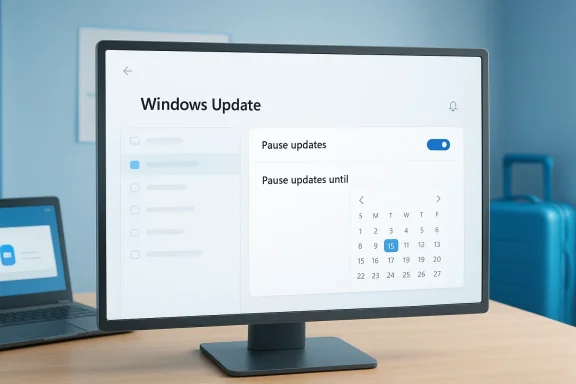
The new pause control appears to replace the old quick-choice model with a calendar-based picker. Rather than choosing a simple interval like one week or two weeks, testers can reportedly select a specific date on which updates should resume. In practical terms, that creates a more flexible interface and gives the user much finer control over when a paused system should rejoin the update stream.Why the calendar matters
A calendar picker is not just a visual refresh. It changes the mental model from how long can I delay this? to when do I want this to happen? That is a subtle but meaningful shift, because date-based control aligns better with real life. People plan around vacations, product launches, travel, exams, demos, and fiscal deadlines, not arbitrary seven-day blocks. The new interface therefore feels more natural, even if the underlying enforcement rules stay the same.The preview screenshots and reporting suggest Microsoft may ultimately allow users to pause far beyond the current five-week cap. Windows Latest reports that Microsoft plans to let users pause updates “for as long as you want,” while independent verification from other outlets has reinforced that reading. Still, the only thing that can be said with certainty today is that Microsoft is testing a more open-ended pause mechanism, not that it has formally committed to unlimited pausing in final release. That distinction matters.
- The feature is currently visible in preview builds, not mainstream release.
- The UI appears to use a calendar instead of a fixed duration menu.
- The final implementation could still add limits or safeguards.
- The change is part of a wider Windows Update redesign.
- Microsoft has framed the shift as better user control, not as an abandonment of security.
The user-experience angle
Microsoft has spent years polishing the mechanics of Windows Update, but mechanics are not the same as experience. A user may technically be able to pause updates, schedule a restart, or set active hours, yet still feel ambushed when the system insists on doing things on its own timetable. The calendar-based pause option appears designed to reduce that friction by making the control path more obvious and less annoying.That could be a big deal for casual users who do not live in the update settings menu. It also helps Microsoft address the perception that Windows 11 is always asking for one more restart. If the company wants users to think of Windows as polished rather than pushy, the small details of the update UI matter a great deal.
Why Microsoft Is Changing Course
The obvious question is why Microsoft would relax control over something as security-sensitive as operating system updates. The answer appears to be that the company is trying to reduce resistance to Windows Update by offering more flexibility, not less security. Microsoft’s own Windows quality messaging in March 2026 stressed faster, more predictable updates, fewer interruptions, and a single monthly reboot model. In other words, the company seems to be betting that better control can improve compliance rather than weaken it.A trust problem as much as a technical problem
Windows update frustration is not just about uptime; it is about trust. People and organizations resist systems that feel unpredictable, even when those systems are doing something objectively beneficial. By giving users more authority over timing, Microsoft may be trying to repair that trust and lower the emotional cost of staying current.There is also a commercial angle. Microsoft wants Windows 11 to be the default modern platform, particularly as Windows 10 moves out of support and more devices face upgrade decisions. A less disruptive update model makes it easier for Microsoft to argue that Windows 11 is not only more secure, but also more pleasant to live with. That is especially valuable in enterprise environments where user complaints often become IT support tickets.
- Less disruption can reduce help desk noise.
- Predictable reboots can improve user satisfaction.
- Flexible pauses can improve acceptance of required updates.
- Better timing can make updates less politically contentious inside organizations.
- A calmer Windows can support Microsoft’s broader platform story.
Consumer Impact
For consumers, the headline benefit is easy to understand: fewer unwanted interruptions and less fear of an update kicking off at the wrong moment. A flexible pause date would let people avoid updates during travel, exams, family events, or periods when they simply cannot afford an unexpected reboot. That is especially useful for home users who do not manage PCs like an IT department but still want basic control.Everyday scenarios where this matters
A better pause feature is most valuable in ordinary, high-friction moments. Someone might want to keep a laptop unchanged during a two-week business trip, or avoid any configuration changes before a software demo. Another user may simply want to wait until the weekend, not because they reject updates, but because they do not want the machine to reboot in the middle of a deadline.The more flexible the setting becomes, the less users need to treat update control as a workaround. Historically, people have postponed updates by sleeping a PC, going offline, or disabling services in ways that are far more brittle than using the actual built-in control. A clearer pause system could reduce the incentive for those less safe habits, which is a win for Microsoft and for users.
- Home users gain a clearer way to plan around major events.
- Travelers can avoid update surprises on the road.
- Gamers can minimize interruption during long play sessions.
- Students can keep a PC stable during exams and deadlines.
- Non-technical users get a simpler control that is easier to understand.
Enterprise and IT Administration
For enterprise customers, the situation is more nuanced. IT departments already have more tools than home users, including centralized management through Windows Update for Business, Group Policy, Microsoft Intune, and Configuration Manager. That means many organizations can already orchestrate update timing in a controlled way. But a better end-user pause experience could still matter a lot in mixed fleets and decentralized environments.Why admins should care
In a corporate setting, the value of this change may be indirect but real. Fewer angry users mean fewer support tickets, and fewer surprise restarts can mean less friction during deployment windows. Even if IT retains ultimate control, a less hostile update interface can reduce the number of people trying to evade policy through odd workarounds.The feature could also help in environments where users are local admins on their own devices or where BYOD policies make strict control difficult. In those cases, giving people a sane way to pick a resume date might be better than letting them invent insecure methods to delay updates. A managed escape hatch is often better than an unmanaged one.
- Centralized tools still matter for compliance and governance.
- User-facing pause controls can reduce resistance to mandatory updates.
- BYOD environments may benefit from a more understandable interface.
- Help desk teams may see fewer restart complaints.
- Admins will still need policy enforcement for regulated industries.
Security Tradeoffs
This is where the debate gets serious. Windows updates are not just feature deliveries; they are a primary defense mechanism against active threats. The more freedom users have to defer patches, the larger the window for exploitation if they choose poorly or ignore reminders. Microsoft knows this, and that is why its support pages still emphasize that updates are important and that pausing is temporary in the current model.The core risk
If Microsoft moves from a bounded pause to a highly flexible one, it will need to rely more heavily on user judgment. That may be acceptable for enthusiasts and cautious professionals, but it is less reassuring when scaled across millions of consumer devices. The danger is not just that people will delay one patch; it is that they will establish a habit of postponement, then forget to catch up until a problem has already appeared.There is also the issue of cumulative exposure. Patching delays are rarely harmless when chained over months. A machine that misses one security update may miss several, and the gap can grow just when attackers are most likely to target known vulnerabilities. Security debt compounds quietly.
- Longer pauses can increase vulnerability to publicly known exploits.
- Users may forget to re-enable updates after the initial need passes.
- Malware writers often target systems that lag behind patch cycles.
- Organizations may need stronger reporting to detect overdue devices.
- Microsoft may need to add warnings or deadlines even in a flexible model.
Competitive Implications
This update policy shift also has competitive implications beyond Microsoft’s own ecosystem. Apple has long emphasized that it can manage software delivery and reboot behavior in a more controlled, opinionated way, while some Linux distributions offer a high degree of transparency and user choice. Microsoft’s challenge is to keep Windows powerful enough for enterprise, flexible enough for enthusiasts, and friendly enough for mainstream users who do not want to think about servicing at all.Windows as a platform experience
Windows has always sold itself as the operating system that can serve everyone, but that promise is only believable if the platform feels adaptable. The more Microsoft can reduce update friction without surrendering security, the easier it becomes to argue that Windows 11 is the best compromise between control and convenience. That matters in a market where frustration can drive power users toward alternative workflows, including managed macOS fleets or Linux-based systems for specific workloads.At the same time, Microsoft cannot simply copy a consumer-friendly checkbox from another platform and call it done. Windows has a much larger compatibility burden, a more diverse hardware base, and a broader mix of home, business, and educational use cases. The update system must work across that complexity, which is why even a seemingly simple calendar control can require careful engineering and policy design.
- Better control can improve Windows’ reputation with enthusiasts.
- Less disruptive updates can help compete for enterprise trust.
- A calmer update flow may reduce comparisons with more rigid platforms.
- Compatibility complexity makes Windows harder to modernize than many rivals.
- Microsoft’s brand benefit comes from convenience without appearing reckless.
Historical Pattern of Windows Update Friction
To understand why this feature matters, it helps to remember how long update frustration has been part of the Windows story. Windows 10 introduced a more aggressive servicing model in the name of security and consistency, but that also made update interruptions more visible to ordinary users. Microsoft later added more control and transparency, including pause windows and active hours, yet the public perception of “forced updates” never fully went away.The evolution of control
In earlier iterations, Microsoft offered pause periods with hard limits. Those controls were useful, but they still implied that the system, not the user, owned the final timing. The new calendar-based design suggests Microsoft is trying to make the interface feel more like a scheduling tool and less like a countdown timer.That evolution is consistent with the company’s recent public messaging. Microsoft has increasingly talked about predictability, reduced disruption, and a smoother update journey. Rather than defending interruptions as unavoidable, the company now seems to be acknowledging that user frustration is a product issue, not just a technical one. That is a healthy shift.
- Windows update control has gradually improved over time.
- The old model emphasized compliance and cadence.
- The new model emphasizes timing and predictability.
- Microsoft is now treating interruption as a design flaw to reduce.
- The user experience has become a strategic priority, not just a support issue.
How This Fits Microsoft’s 2026 Windows Strategy
This pause feature is part of a much larger 2026 push to make Windows feel more deliberate. Microsoft’s own language in March 2026 emphasized quality, reliability, fewer interruptions, and more direct control over updates. That is not random phrasing; it is a signal that the company is rethinking the emotional tone of Windows, not merely its release cadence.The bigger redesign
Microsoft has also been previewing other user-facing changes that reduce friction. These include less intrusive restart behavior, more predictable release phases, and UI updates that better align Windows with its current design language. The update pause change should be read as part of that same effort: make the OS feel less like a machine that interrupts you, and more like a tool that cooperates with your schedule.That framing matters because it suggests Microsoft is learning from its own history. Windows has often been strongest when it gives users and administrators room to adapt the system to their needs. When it becomes too prescriptive, resentment builds. When it becomes too permissive, security suffers. The art is in finding the narrow path between those outcomes.
- The company is leaning into predictability over surprise.
- Windows Update is being repositioned as a managed experience.
- Microsoft wants fewer user-visible disruptions.
- Feature previews suggest a more humane default posture.
- The update pause redesign is consistent with that direction.
Strengths and Opportunities
Microsoft’s update rethink has several real strengths, especially if the final implementation keeps both flexibility and guardrails. The biggest opportunity is to make Windows 11 feel more respectful without turning it into an unmanaged platform. That balance could improve user sentiment, reduce support friction, and make the operating system feel genuinely modern.- More user control over when updates resume.
- Better calendar-based planning for travel, work, and deadlines.
- Lower restart anxiety for everyday consumers.
- Reduced support noise for IT teams.
- Improved goodwill toward Windows 11 as a platform.
- Stronger alignment with Microsoft’s “calmer” Windows messaging.
- Fewer workarounds that users might otherwise employ to dodge updates.
Risks and Concerns
The most obvious concern is that a more flexible pause feature could become a security liability if users exploit it too casually. Microsoft can talk all it wants about control, but if too many systems remain unpatched for too long, the real-world outcome will be worse security and more headaches for support teams. That tension is inherent in the design.- Delayed patching could leave devices exposed longer.
- Users may forget to resume updates after the need passes.
- Security teams may lose visibility if pause choices are too open-ended.
- Policy drift could create inconsistencies across consumer and enterprise devices.
- Preview behavior may change, leaving early reporting overstated.
- Communication must be clear or users will misread the feature’s limits.
- Too much freedom could encourage bad habits in less technical households.
Looking Ahead
The next few Insider flights will tell us whether Microsoft is serious about indefinite or near-indefinite pause control, or whether it is simply refining the current experience into a more flexible form. The distinction is important, because a date picker alone does not tell us whether Microsoft will allow truly open-ended postponement or keep some hidden policy ceiling in place. For now, the safest reading is that Microsoft is testing a more user-directed approach and has not yet locked the final rules.What to watch
The main thing to watch is whether Microsoft adds guardrails such as overdue update warnings, policy overlays, or system prompts that reassert control after a long pause. It will also be worth seeing whether the feature lands in consumer builds first, or whether Microsoft keeps it constrained to specific channels and device types. The rollout path will reveal a lot about how much freedom Microsoft is really comfortable giving.- Whether the pause date can extend beyond the current five-week window.
- Whether Microsoft adds stronger warnings before long delays.
- Whether enterprise policies can override the user-facing control.
- Whether the feature reaches Release Preview before broad rollout.
- Whether Microsoft keeps the calendar UI or further redesigns it.
Microsoft is clearly trying to reframe Windows 11 as a platform that works with users instead of against them. If it can pull that off without sacrificing the security discipline that modern Windows needs, the result will be a more credible, more civilized, and ultimately more durable operating system. The hard part is not creating a pause button; it is proving that restraint and safety can coexist in the same Windows experience.
Source: OC3D Microsoft may end forced Windows updates with new pause feature - OC3D
Last edited:
