

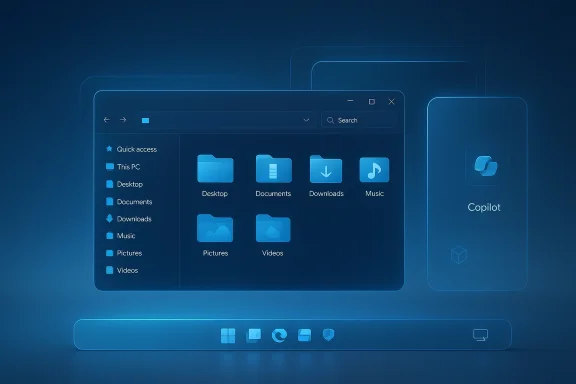
Microsoft’s 2026 Windows 11 roadmap looks less like a fireworks show and more like a public apology tour. After years of hearing that the taskbar was too rigid, File Explorer too sluggish, updates too disruptive, and Copilot too omnipresent, the company is finally moving to address the everyday friction points that shape how people actually use Windows. The result is an update cycle that feels unusually grounded: less hype, more repair, and a clearer attempt to restore trust with users who have been asking for basic polish rather than another wave of novelty.
Background — full context
Windows 11 launched with a familiar paradox: a visually refined desktop that often felt less flexible than the Windows versions it replaced. Microsoft modernized the interface, tightened visual language, and pushed a more curated experience, but in doing so it also removed or constrained habits that power users depended on. Chief among the complaints was the taskbar, which lost the freedom to move to the top or sides of the display. That change frustrated anyone with vertical monitors, multi-display workspaces, or long-established muscle memory. The lack of native repositioning has remained one of the most durable Windows 11 grievances, and even Microsoft support conversations through 2025 continued to confirm that the taskbar remained locked to the bottom in normal releases. (learn.microsoft.com)At the same time, Microsoft has been steadily broadening Copilot’s footprint across Windows and its bundled apps, often in ways that made the assistant feel more imposed than requested. In 2025 and 2026 Insider flights, Windows showed a growing pattern of integrating Copilot into File Explorer, taskbar surfaces, and the core app ecosystem, including suggestions and actions that appeared on hover or in preview workflows. Microsoft’s own Insider posts show this direction clearly, with File Explorer Home gaining on-hover actions and “Ask Copilot” prompts in 2025, followed by more Copilot-linked UI around the taskbar and file surfaces later on. (blogs.windows.com)
That expansion created a familiar tension: AI features are useful when they reduce effort, but intrusive when they interrupt basic tasks. Microsoft appears to have noticed the backlash. The 2026 update posture described in Insider materials shifts from “Copilot everywhere” to a more selective approach, with less visible AI in apps such as Snipping Tool, Photos, Widgets, and Notepad, and more emphasis on features that users can ignore if they do not need them. The move is less a retreat from AI than a recalibration of where it belongs in the Windows experience. (blogs.windows.com)
The same pattern applies to Windows Update. The company has long pushed automation as a virtue, but for many users—especially those working in live environments, on battery, or over constrained connections—forced restarts and update timing remain a recurring source of irritation. Microsoft has begun layering in more control, including clearer progress feedback, better restart behavior, and more options around pausing or skipping updates in certain workflows. The goal is not to eliminate updating, but to make it feel less adversarial. (support.microsoft.com)
Against that backdrop, the 2026 update cycle stands out for its tone. Instead of promising a new era of computing, Microsoft is attempting to make Windows 11 feel less in the way. It is a modest-sounding objective, but in operating systems, reduced friction often matters more than headline features.
The taskbar finally gets real flexibility
The taskbar has become a symbolic issue because it is a tiny feature with an outsized effect on daily workflow. Microsoft’s reported 2026 changes would restore one of the most-requested customization options: the ability to move the taskbar away from the bottom edge of the screen. If the rollout proceeds as described, users will be able to place it at the top, left, right, or bottom, aligning Windows 11 more closely with the spatial flexibility that long-time users remember from earlier versions of Windows. Microsoft’s support materials and community responses through late 2025 and early 2026 make clear how much demand persisted for this change, especially for multi-monitor and vertical-display setups. (learn.microsoft.com)Why taskbar placement matters
For casual users, taskbar placement may sound cosmetic. For serious desktop users, it is a workflow decision.- Vertical monitors benefit from a side-docked taskbar that preserves horizontal space.
- Ultra-wide displays often work better with a bottom bar, but some users prefer top placement to keep eye movement predictable.
- Multi-monitor rigs benefit from symmetry when the taskbar lives where the mouse naturally lands.
- Remote desktop operators often favor a vertical taskbar because it reduces cursor travel in dense interfaces.
- Accessibility-minded users sometimes prefer a position that better matches their gaze or motor habits.
The historical context
Windows allowed deep taskbar flexibility for years, and many people built habits around that freedom. Windows 11’s design shift removed that choice, and even if most users adapted, the lack of control remained a persistent irritant. The bigger issue was not merely location but consistency: when an OS removes a simple option without a clearly better replacement, it signals that user preference has been subordinated to design purity. Restoring the option would be a rare case of Microsoft admitting that a “modern” interface should still respect legacy workflows.What the change would mean in practice
If the taskbar repositioning arrives broadly, the practical gains are straightforward:- Less cursor travel for side-oriented workflows.
- Better use of screen real estate on narrow or tall monitors.
- Improved ergonomics for users who keep their primary app regions centered.
- More natural desktop layouts for power users who manage dozens of windows.
- A stronger sense of ownership over the desktop environment.
Copilot gets less intrusive
The other notable correction in Microsoft’s 2026 plan is the reduction of Copilot’s surface area across Windows apps. In recent Insider builds, Windows has not merely added AI capabilities; it has embedded prompts and actions into app shells, hover states, and taskbar-adjacent surfaces. That strategy may have been intended to normalize AI, but it also made Copilot feel like a UI layer imposed on top of daily work. The new direction suggests Microsoft now wants Copilot to be discoverable without constantly announcing itself. (blogs.windows.com)Why users pushed back
The pushback is easy to understand. People do not object to AI in principle; they object to AI that occupies attention without earning it.- Snipping Tool is often used for capture-and-send tasks where speed matters.
- Photos is expected to be a clean viewing and editing utility, not a command center.
- Notepad has traditionally represented minimalism and speed.
- Widgets serve as glanceable information surfaces, which are easily cluttered.
- File Explorer works best when it disappears into the background.
A more intentional AI model
The phrase Microsoft appears to be converging on is more intentional. That matters. A useful desktop assistant should behave like a tool that appears when needed and stays quiet otherwise. The difference between assistance and intrusion often comes down to timing, placement, and trust. If the 2026 Windows 11 updates reduce visible Copilot interference while preserving opt-in workflows, Microsoft may finally be learning that desktop AI must justify its footprint rather than inherit one.Likely effects for daily users
A smaller Copilot footprint could have several positive effects:- Fewer accidental clicks in tools people use constantly.
- Cleaner app interfaces with less visual noise.
- Reduced cognitive load during repetitive work.
- Lower frustration for users who simply want a simple utility.
- More room for users to choose AI on their own terms.
File Explorer gets the polish it has needed for years
File Explorer remains one of the most politically important apps in Windows because nearly every user depends on it, and nearly every user notices when it misbehaves. Microsoft’s 2026 changes emphasize faster launch times, smoother navigation, lower UI flicker, and better reliability in common operations. That may not sound dramatic, but when an operating system’s default file manager feels sluggish, the whole platform feels older than it should. Microsoft’s recent KB and Insider notes already show ongoing work in File Explorer reliability, preview handling, archive actions, and response time. (support.microsoft.com)Why File Explorer is so sensitive
File Explorer touches almost everything:- launching downloads
- moving screenshots
- renaming documents
- opening archives
- browsing network locations
- previewing files
- managing folders
- accessing removable media
The kinds of improvements that matter most
The most valuable improvements in File Explorer are rarely glamorous.- Faster startup reduces the feeling that the OS is loading through molasses.
- Less UI flicker makes the interface feel stable and modern.
- More reliable navigation cuts down on accidental backtracking.
- Improved file transfers reduce error-prone routine tasks.
- Better indexing and search make it easier to recover files quickly.
- More consistent right-click and command behavior lowers frustration.
Why this feels like a course correction
Windows 11 has often been criticized for polishing the paint while leaving old friction untouched. File Explorer is the opposite case: it is not a cosmetic issue, but a core utility that shapes perception of the whole system. If Microsoft can make Explorer feel quicker and less temperamental, users will experience the OS as more responsive even if the underlying changes are modest.Windows Update becomes less coercive
Update behavior is one of the clearest examples of how an operating system can either respect or resist its users. Microsoft’s 2026 changes reportedly give users more control over when updates happen, including options to pause updates more flexibly, avoid some forced restart behavior, and skip updates during setup scenarios. This is a direct response to a complaint that has followed Windows for years: that updates arrive at inconvenient moments and too often act like instructions rather than options. Microsoft’s recent preview updates also show progress in update reliability and device targeting, suggesting that the company is trying to make patch delivery less disruptive while preserving security goals. (support.microsoft.com)The user pain point
Most people do not oppose security updates. They oppose surprise.- Interrupted work is the biggest irritation.
- Restart prompts at the wrong time feel disrespectful.
- Opaque progress makes users uncertain how long they must wait.
- Setup-time defaults often create a sense of being nudged into the company’s preferred rhythm.
What more control should look like
A better update experience is one where users can:- postpone updates without hunting through menus
- understand what an update is doing
- restart on their own schedule
- avoid forced disruption during active work
- see clearer status indicators
- trust that pauses really mean pauses
The balancing act Microsoft faces
Microsoft cannot simply let users ignore security maintenance forever. That would undermine the reliability of the ecosystem. But it can be more transparent and less coercive. The best version of update control is not “never update”; it is “update on my terms when possible, and tell me plainly when not.”Memory and system overhead come under scrutiny
One of the more interesting promises in the 2026 Windows 11 work is memory optimization. That phrase is easy to underplay, but it matters because Windows has spent years accumulating background services, UI layers, cloud hooks, and feature surfaces that collectively consume resources users would rather devote to apps. Reducing baseline RAM usage would not necessarily make the operating system feel radically different in a single task, but it could improve multitasking, reduce stutter on lower-memory systems, and create headroom for browsers, creative apps, and gaming. (support.microsoft.com)Why RAM usage is a visible issue
Users feel memory overhead in practical ways:- slower app switching
- more aggressive paging on 8 GB systems
- browser tabs reloading more often
- background activity competing with foreground tasks
- reduced responsiveness during file-heavy workflows
Where optimization can help most
Microsoft’s strategy appears to be twofold:- Trim waste in background behavior
- Move UI components toward more efficient native frameworks
Why this matters beyond benchmarks
Benchmark numbers are useful, but real-world value shows up in moments like these:- opening a large folder while several apps are active
- switching between editing and browsing
- resuming from sleep with many windows open
- using Windows on a thin-and-light laptop
- relying on integrated graphics and shared memory
Reliability work: the unglamorous but essential layer
Microsoft’s 2026 focus is not just on visible features. The company is also talking about stability improvements across hardware and device interaction, including drivers, Bluetooth behavior, USB reliability, and resume-from-sleep performance. These issues rarely generate splashy headlines, but they are precisely the kind of failures that shape whether people describe a PC as dependable or annoying. Recent Windows 11 preview notes already show the company working on display wake behavior, device reliability, and other infrastructure-level fixes. (support.microsoft.com)Why reliability still matters so much
A modern PC can feel broken for reasons that have nothing to do with raw performance.- Bluetooth headphones disconnecting ruin meetings.
- USB accessories failing after sleep create unnecessary support incidents.
- Drivers misbehaving cause users to blame Windows, not the peripheral.
- Wake-from-sleep delays make the machine feel old.
- Input lag and UI glitches undermine confidence.
What Microsoft can realistically fix
Microsoft cannot control every third-party driver or accessory. But it can improve:- core power-state handling
- default device interaction logic
- compatibility testing
- OS-level timing and resume behavior
- better error handling around common hardware events
Why this work often goes unnoticed
If Microsoft succeeds, users will not always see a banner announcing it. They will simply stop noticing failures. That is the best possible outcome for reliability work: invisibility.What this says about Microsoft’s broader Windows strategy
The 2026 update direction suggests a notable strategic shift. For much of the past few years, Microsoft treated Windows as a platform that could be improved by layering in new capabilities—AI, cloud services, cross-device features, and modernized UI treatments. Those ideas still matter, but they do not solve the complaints users voice most often. This new cycle implies that Microsoft understands something important: trust in a desktop OS is built on small repeated acts of respect. Let users move the taskbar. Do not shove Copilot into every workflow. Make File Explorer faster. Give people control over updates. Reduce memory drag. That is not flashy, but it is meaningful. (support.microsoft.com)The design lesson
There is a broader lesson here for any platform vendor: the user notices the interface most when the interface gets in the way.- Flexibility beats rigid elegance.
- Quiet tools beat attention-seeking features.
- Predictability beats cleverness.
- Speed beats visual novelty.
- Control beats automation imposed without consent.
The business lesson
Microsoft’s challenge is not just technical. It is reputational. Windows is still the default desktop OS for millions of people, but the company has to keep earning that default status. Each user annoyance that goes unfixed nudges some customers toward skepticism, workarounds, or alternative tools. Even if those alternatives are limited, the mere existence of dissatisfaction shapes the brand.Strengths and Opportunities
Microsoft’s 2026 Windows 11 update plan has several obvious strengths.- It targets real complaints, not just feature wish lists.
- It acknowledges user fatigue with forced AI placement.
- It restores lost flexibility that many users never wanted removed.
- It improves core apps that shape daily satisfaction.
- It treats performance as a usability issue, not just a technical metric.
- It gives the platform a chance to feel calmer and more mature.
- It may reduce support burden by making common behaviors more predictable.
- It could improve goodwill among power users and IT administrators.
- It aligns Microsoft with feedback it has already been hearing for years.
- It makes the desktop feel more human-scaled again.
Risks and Concerns
The plan is promising, but there are still real risks.- Taskbar repositioning may arrive with limitations that blunt the win.
- Copilot reductions may be partial, leaving users with a mixed message.
- Performance gains may be incremental, not transformative.
- File Explorer fixes may improve one path while leaving others slow.
- Update control may still be constrained by security policy.
- Memory optimization could be hard to perceive on higher-end systems.
- Insider features do not always survive unchanged into broad release.
- Complex hardware diversity may keep reliability issues alive.
- Too many parallel improvements can create regression risk.
- Users may remain skeptical until the changes are in stable builds.
What to Watch Next
The next few months will tell us whether Microsoft’s promises are landing in a meaningful way or merely previewing a future that keeps moving.- Watch whether taskbar repositioning appears in Insider builds exactly as described.
- Watch whether top, left, and right placement are all supported or whether only some positions arrive first.
- Watch how broadly Copilot surfaces are reduced across bundled apps.
- Watch whether File Explorer launch and navigation feel measurably faster in practice.
- Watch for update control that works consistently rather than symbolically.
- Watch for memory use improvements in lower-RAM systems.
- Watch whether Microsoft continues to move UI elements toward native frameworks.
- Watch whether Bluetooth and USB reliability improve across diverse devices.
- Watch how often Microsoft uses the phrase quality rather than innovation.
- Watch user feedback, because the loudest signal will be whether people finally feel heard.
The most interesting thing about Microsoft’s 2026 Windows 11 update push is that it sounds almost old-fashioned. The company is not trying to reinvent the desktop so much as make it behave like a trustworthy desktop again. That is a subtle but important shift. If Microsoft follows through, Windows 11 may become less of a showcase for what the company wants to add and more of a platform that quietly respects how people already work. For a great many users, that would be the best update of all.
Source: Tbreak Media Windows 11 2026 update: taskbar fixes, less Copilot | tbreak
Last edited:
