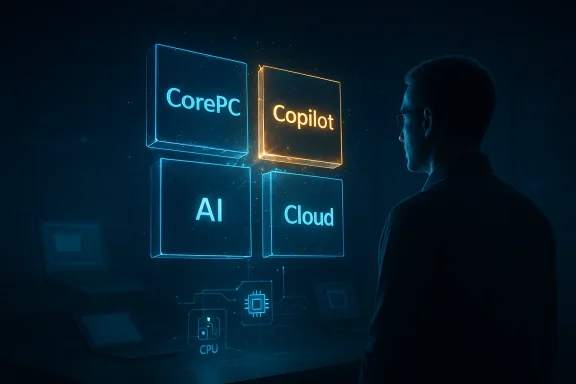
Microsoft’s next-generation Windows is the subject of growing rumor and industry attention: multiple reports claim an AI-first successor to Windows 11 — frequently called Windows 12 in leaks — could arrive in 2026 with a modular CorePC-style architecture, tighter hardware floors centered on Neural Processing Units (NPUs), and Copilot promoted from a helper app to a system-level control plane. These claims combine legitimate roadmap signals (new platform work such as the Germanium base and Copilot+ PC initiatives) with unverified leaks and aggressive speculation; readers and IT teams should treat the story as plausible, but far from settled.
Microsoft’s public Windows roadmap remains officially quiet on any product called “Windows 12.” Still, the company’s recent platform work — shipped and previewed over the last two years under names like Germanium and through Copilot+ PC hardware branding — has changed the technical and commercial context for what a next-generation Windows could be. Those changes include a push toward on-device AI, new hardware capabilities (NPUs), and experiments with more modular, update-friendly OS architectures. At the same time, several reputable outlets and insiders have cautioned that the leap from “platform experiments” to a marketed new OS with a version number is neither automatic nor guaranteed.
This article synthesizes the strongest public signals, contrasts them with pushback from sources close to Microsoft’s roadmap, and analyzes practical consequences for consumers, enterprises, and OEMs. Where claims are unverified or speculative, we flag them explicitly and indicate the best evidence available.
Importantly, the most dramatic claims — a branded Windows 12 launching in 2026, mandatory NPU floors to use basic OS features, or a subscription-only consumer OS — are not confirmed. Reputable reporting with Microsoft roadmap contacts suggests the company’s nearer-term focus remains stabilizing Windows 11 and addressing customer feedback rather than mass-marketing a brand-new OS in 2026. Organizations should plan for the hardware and OS trends (NPUs, Copilot features, modular updates), but avoid knee-jerk migrations or procurement decisions based solely on leaks.
But a decisive, production-quality shift — one that forces enterprises and consumers to upgrade or subscribe to access essential OS functionality — has not been announced, and credible sources say Microsoft’s immediate roadmap still centers on hardening and refining Windows 11. Treat the “Windows 12 in 2026” story as an important signal worth preparing for, not as an imminent mandate. Plan for AI-capable hardware where it makes sense, demand clear migration and privacy guarantees from vendors, and watch Microsoft’s official channels for definitive announcements before committing large migration budgets.
Source: Research Snipers New AI system Windows 12 could come as early as 2026 – Research Snipers
 Background / Overview
Microsoft’s public Windows roadmap remains officially quiet on any product called “Windows 12.” Still, the company’s recent platform work — shipped and previewed over the last two years under names like Germanium and through Copilot+ PC hardware branding — has changed the technical and commercial context for what a next-generation Windows could be. Those changes include a push toward on-device AI, new hardware capabilities (NPUs), and experiments with more modular, update-friendly OS architectures. At the same time, several reputable outlets and insiders have cautioned that the leap from “platform experiments” to a marketed new OS with a version number is neither automatic nor guaranteed.This article synthesizes the strongest public signals, contrasts them with pushback from sources close to Microsoft’s roadmap, and analyzes practical consequences for consumers, enterprises, and OEMs. Where claims are unverified or speculative, we flag them explicitly and indicate the best evidence available.
What the leaks are saying — and what’s already public
Hudson Valley Next, Germanium and CorePC: the naming tangle
- The rumored internal codename appearing in multiple leaks is Hudson Valley Next, and several reporting threads tie that work to a lower-level platform layer dubbed Germanium. These names have appeared in roadmap chatter and in leak summaries across the blogosphere.
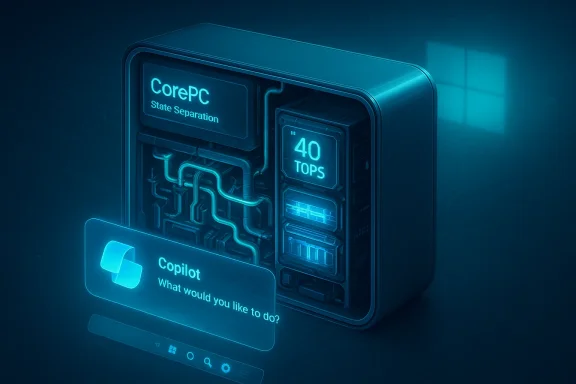
- Separately, the CorePC concept — a modularized version of Windows that isolates system state from user state and allows read-only system partitions with separate update channels — keeps resurfacing in coverage of Microsoft’s ambitions to make Windows more secure and easier to update. CorePC (or “Core PC”) is the descendant of earlier efforts such as Windows Core OS and the shelved Windows 10X experiments; it represents an architectural approach rather than a ship-ready product.
AI-first: Copilot elevated from app to backbone
A central rumor thread says Microsoft intends to move Copilot from an optional assistant toward a system-level control instance that can perform context-aware tasks across the OS. The implication: Copilot becomes the orchestration layer for search, file handling, window-level assistance, and agent-style automation rather than just a chat window. Several outlets reporting on internal plans and product demos suggest this ambition is genuine, but the scope of what Copilot will do — and whether those features will be universally available — remains heavily debated.Hardware gating: NPUs and the 40 TOPS figure
One of the most consequential claims is that advanced AI system features will be gated by dedicated on-device AI silicon — Neural Processing Units (NPUs) — measured in TOPS (Trillions of Operations Per Second). Microsoft’s Copilot+ PC branding already established a practical baseline: devices qualifying for Copilot+ must ship with NPUs rated at roughly 40+ TOPS, paired with higher RAM and NVMe storage minimums. That Copilot+ bar is real and documented in coverage of Microsoft’s Copilot+ PC program; the leap some leaks make is to say Windows 12 will require or assume that floor for the full experience. That remains a strong industry hypothesis but not an official requirement for a future OS version yet.Visual and interaction changes: floating taskbar, glass and search-first UX
Leaked UI concepts and reporting point to a cleaner, more search- and AI-centric desktop metaphor: reports mention a floating taskbar, increased translucency and glass surfaces, and a tighter focus on contextual prompts and system-level suggestions. These UI speculations echo designer concepts and early internal mockups rather than ship-ready designs. Expect proof-of-concept screenshots and concept art to continue circulating; treat them as indicative of direction, not final UI.Monetization and subscriptions — rumor versus skepticism
Coverage has floated the idea that advanced AI and cloud services in the OS could be monetized (for example, a Windows 365–style subscription offering feature tiers). Industry observers warn that Microsoft already monetizes Copilot and Microsoft 365 in multiple ways, and bundling AI features behind subscriptions would be commercially attractive — but not without backlash. Importantly, reputable sources with contacts close to Microsoft’s roadmap have pushed back on claims that Microsoft plans to ship a subscription-only or subscription-locked Windows 12 in 2026, suggesting the subscription rumor is overblown or conflating enterprise cloud offerings with consumer OS licensing.Verifiable anchors: timeline and support signals
- Microsoft’s Extended Security Updates (ESU) for Windows 10 provide a hard calendar anchor: consumer ESU options continue security servicing for Windows 10 through October 13–14, 2026, depending on documentation. That end-of-support window creates a plausible market timing argument for introducing a successor during 2026 if Microsoft wanted to align migrations. However, timing an OS release to coincide with an ESU cutoff is an argument of convenience, not proof.
- Copilot+ PC specifications and the NPU baseline (40+ TOPS) are public product and press facts about the Copilot+ branding and OEM requirements; Microsoft and OEM materials, and in-depth reporting from outlets such as PCWorld, document the 40 TOPS marketing/performance floor for Copilot+ devices. That number legitimately shapes hardware planning for OEMs and enterprises.
- Microsoft’s public-facing roadmap and communications have not announced a product called Windows 12; reporters with contacts inside Microsoft have stated the company’s 2026 roadmap is primarily focused on stabilizing and refining Windows 11 rather than launching a branded Windows 12 in 2026. This is a crucial counter-signal that tempers the rumor narrative.
Technical analysis: what CorePC and “state separation” would actually buy you
The promise
- Faster, safer updates. A partitioned OS with a read-only system partition and separate user/data partitions could enable non-blocking background updates and near-instant rollback, similar to modern mobile OSes. That reduces update failure blast radius and simplifies recovery scenarios.
- Improved security posture. Read-only system areas and stronger isolation between system and user spaces reduce attack surface for file-tampering and some classes of ransomware or persistent kernel compromise.
- Smaller, more composable images. OEMs and Microsoft could deliver tailored Windows variants for different device classes (thin clients, convertible tablets, gaming desktops) from a single modular core, making maintenance easier and enabling lighter single-purpose SKUs.
The reality checks
- Driver and Win32 compatibility. Windows’ enormous ecosystem of legacy Win32 apps and kernel drivers is the real Achilles’ heel for any CorePC-like shift. Partitioning and lock-down must preserve well-tested compatibility layers; otherwise enterprise line-of-business apps and third‑party drivers will break. Microsoft has decades of enterprise inertia on its side — but migrating complex OEM and bespoke drivers is non-trivial.
- Migration complexity. Enterprises would need tools and long testing cycles to migrate to a new partitioned model, and many may choose to delay migration until year two or three after a new release.
- Surface area for subtle bugs. Read-only system partitions and state separation change failure modes. Update agents, image factory tooling, and recovery services will all need precise redesign and extensive field testing.
The hardware floor, NPUs, and the economics of forced refresh
Why NPUs matter
On-device AI scales best when inference is offloaded to specialized silicon: NPUs are far more power-efficient and faster per watt than general-purpose CPUs, and they free the GPU for graphics and the CPU for foreground tasks. For features that demand low-latency multimodal AI — for example, real-time transcription, local image editing, and privacy-preserving local models — NPUs are a natural fit. The 40 TOPS metric is a concrete industry marker because Microsoft’s Copilot+ branding uses it as the baseline for enhanced local experiences.The downside: customer cost and fragmentation
- Upgrade pressure for consumers. If Microsoft’s future flagship features assume 40 TOPS NPUs or similar floors, a large installed base of PCs (especially older laptops and custom desktops) will not get the “full” experience. That creates an implicit hardware refresh cycle for consumers who want AI-first capabilities.
- Fragmented feature sets. Expect a world where some AI experiences run locally on Copilot+ machines while other devices use cloud fallbacks. That’s functionally manageable but can confuse users and complicate enterprise procurement: which features are essential, and what hardware do they demand?
- OEM and supply-chain constraints. OEMs must balance price, battery life, and marketing claims; integrating high-TOPS NPUs raises BOM cost and may force segment repositioning (premium AI laptops vs. mainstream models).
UX and UI: practical consequences for everyday users
Design leaks and concept art promise a more “AI-aware” UI — adaptive suggestions, a search-first shell, and contextual Copilot interventions. Those advances could streamline repetitive tasks (organizing documents, summarizing meetings, automating email triage), but they come with unavoidable trade-offs:- Control vs. helpfulness. Users will demand granular controls to limit when and where Copilot acts; giving Copilot agent-level privileges without opt-outs would generate intense privacy and usability backlash.
- Opt-in defaults matter. The historical lesson: when feature defaults push telemetry or cloud services, users and regulators react. Microsoft will need to be explicit and user-friendly about controls for data collection and on-device versus cloud processing.
- Accessibility and discoverability. A search-first experience that surfaces AI hints can help novices, but power users and admins must be able to disable or tune suggestions to avoid workflow interruptions.
Security and privacy: the trade-offs of local AI
- Local inference improves privacy for many use cases: sensitive notes, documents, and personal media are less likely to leave the device if processed on-device.
- Conversely, local agents enlarge the local attack surface. An agent with broad file-access permissions becomes a high-value target; hardened OS partitions and robust attestation (Pluton, TPM2.0, secure boot) will be critical.
- Regulatory exposure. As European and US regulators press for algorithmic transparency and data minimization controls, Microsoft’s approach to on-device models, telemetry, and cloud fallbacks will face scrutiny. Clear choices, logging, and enterprise policy controls will be essential.
Gaming, DirectStorage and enterprise impact
- Games may benefit from local AI for upscaling, asset streaming hints, and streaming optimization, but gamers will weigh NPU requirements against GPU performance. DirectStorage optimization and tighter Xbox integration could reduce load times and enable higher-fidelity streaming assets, but the benefits will vary by title and studio support.
- Enterprises face policy and deployment questions. IT will demand group policies, image tooling, and driver compatibility statements before broad upgrades. A forced hardware floor or radical core change without solid enterprise migration tooling would slow corporate adoption.
Credibility check: what’s likely, what’s unproven, and what’s been contradicted
- Likely / Well-supported:
- Microsoft is investing in on-device AI and Copilot features. Copilot+ PC hardware branding and a 40+ TOPS NPU baseline for enhanced local experiences are real product signals.
- Microsoft’s platform work has included Germanium and iterative changes to Windows 11 that move toward modularity and better AI plumbing. These are visible through Windows Insider releases and OEM developer materials.
- Windows 10’s consumer Extended Security Updates program runs through October 2026, creating a natural migration window for many users.
- Unproven / Speculative:
- That Microsoft will brand and ship a product called Windows 12 in 2026, and pigeonhole full AI functionality behind mandatory NPUs and subscription tiers, remains speculative. Credible reporters with roadmap contacts argue there is no plan to ship Windows 12 in 2026 and that Microsoft’s immediate focus is refining Windows 11. Treat the 2026 release date as rumor unless Microsoft announces a schedule.
- UI elements like a floating taskbar and the exact subscription mechanics for advanced AI features are leaked concepts rather than confirmed design decisions; they can — and often do — change during productization.
Practical guidance: what consumers, IT admins, and OEMs should do now
For consumers
- Audit your hardware: if you plan to buy a new PC and want the smoothest AI experience, prefer devices that adhere to Copilot+ or OEM AI branding and list NPU TOPS in specs. Expect premium pricing for these SKUs.
- Don’t rush to upgrade your primary work machine solely to chase rumored AI features; Windows 11 will continue to receive major updates, and many AI features will be available as cloud or software fallbacks.
- Keep backups and be cautious about opt-in defaults: read privacy prompts carefully when Copilot features appear, and use per-feature disable controls to preserve workflow and privacy.
For IT leaders and admins
- Begin inventory and compatibility planning now: document line-of-business apps and custom drivers, and build a test matrix for any CorePC-like changes that could isolate system components.
- Engage with OEMs for lifecycle and driver support commitments. If NPUs and AI features become mission-critical, procurement guidelines must include validation of both hardware TOPS and driver firmware update paths.
- Push for clear Microsoft guidance before scheduling mass migrations — expect a multi-year transition window if Microsoft ever ships a major architectural change.
For OEMs and ISVs
- Validate NPU and SDK support across your driver and security stacks. Compatibility with hardware attestation, secure boot, and Pluton will be differentiators.
- Work with Microsoft Insider channels and early-access programs to understand partitioning and update semantics; migration tool parity will be a competitive advantage.
Final assessment: opportunity and risk in equal measure
Microsoft’s push toward local AI, Copilot integration, and platform modularity is a credible long-term direction. The technical benefits — faster updates, improved security boundaries, and on-device privacy-preserving AI — are real and valuable. The practical risks are equally real: user confusion from heterogeneous feature availability, higher hardware costs, compatibility churn for legacy software, and political/regulatory backlash if subscription or telemetry mechanisms are poorly designed.Importantly, the most dramatic claims — a branded Windows 12 launching in 2026, mandatory NPU floors to use basic OS features, or a subscription-only consumer OS — are not confirmed. Reputable reporting with Microsoft roadmap contacts suggests the company’s nearer-term focus remains stabilizing Windows 11 and addressing customer feedback rather than mass-marketing a brand-new OS in 2026. Organizations should plan for the hardware and OS trends (NPUs, Copilot features, modular updates), but avoid knee-jerk migrations or procurement decisions based solely on leaks.
Conclusion
The current narrative about a potential “Windows 12” is a mix of genuine platform signals and speculative leapfrogging. Microsoft has clearly pushed the industry toward AI-aware hardware and has experimented with modular architectures and Copilot‑centric experiences. Those moves make an eventual major OS re-think plausible.But a decisive, production-quality shift — one that forces enterprises and consumers to upgrade or subscribe to access essential OS functionality — has not been announced, and credible sources say Microsoft’s immediate roadmap still centers on hardening and refining Windows 11. Treat the “Windows 12 in 2026” story as an important signal worth preparing for, not as an imminent mandate. Plan for AI-capable hardware where it makes sense, demand clear migration and privacy guarantees from vendors, and watch Microsoft’s official channels for definitive announcements before committing large migration budgets.
Source: Research Snipers New AI system Windows 12 could come as early as 2026 – Research Snipers