

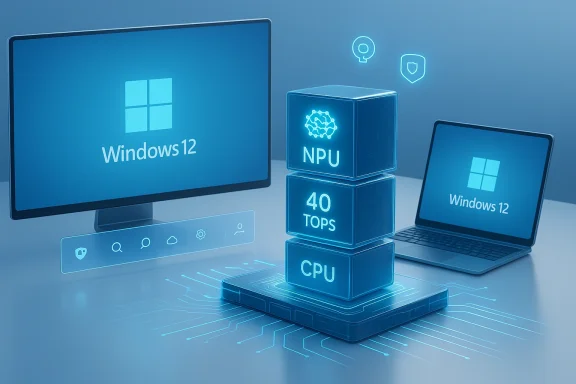
Microsoft’s next desktop gamble is shaping up as equal parts technical overhaul and product bet: leaked reporting and community breadcrumbs now point to a radically modular “CorePC” architecture, a redesigned interface with a floating taskbar and top-mounted search, and Windows baked around on‑device AI — a Copilot+ experience that may be gated by NPUs delivering roughly 40 TOPS of inferencing performance. The result, if these rumors are accurate, could be a cleaner, more configurable Windows — but also a hardware and upgrade storm that will force users, IT teams, and OEMs to make hard choices about compatibility, privacy, and support. erview
Microsoft’s post‑Windows‑10 roadmap has always been more evolutionary than revolutionary, but the latest leak cycle has pushed a much bolder thesis: a next‑generation client — commonly called “Windows 12” or discussed under internal tags like Hudson Valley Next and CorePC — designed from the ground up as a modular, AI‑first platform. That narrative blends design mockups, Microsoft and partner messaging around “Copilot+ PCs,” and multiple community leaks that together sketch a coherent blueprint: modular OS components, tighter Copilot integration as a system service, and an emphasis on on‑device neural acceleration.
At the same time, this story is not crosoft announcement. Parts of the picture have been seeded in presentations and Copilot+ documentation, while others appear in secondary reporting and community reconstructions. Readers should treat specific release timing, final hardware requirements, and exact UI choices as provisional until Microsoft publishes formal documentation. Where possible, this article cross‑references official guidance, independent hardware reporting, and the community leaks that kicked off the conversation.
A modular OS dovetails with a hybrid compute model: CorePC reportedly enables the OS to balance workloads between local resources and cloud services according to policy, device capability, and privacy constraints. This can reduce latency for AI tasks run on local NPUs while allowing heavier or more up‑to‑date models to run in the cloud — a pragmatic approach that recognizes the limits of on‑device silicon without surrendering the benefits of local inference.
However, hybrid models complicate software lifecycle, commercial licensing, and telemetry surfaces. Expect Microsoft to lean on Copilot services (and Copilot+ branding) to monetize this hybrid stack while steering users toward the experience‑complete configurations.
This is far more than cosmetic. The design signals a few important priorities:
This requirement already exists as a marketing and certification line for Copilot+ PCs and has been confirmed in vendor conversations and press reports. Independent hardware reporting and vendor roadmaps show a fast‑moving TOPS arms race: Intel’s earlier Arrow Lake NPUs were in the ~13 TOPS range on desktop, while Intel’s upcoming NPU generations and Qualcomm’s designs aim far higher; equally, AMD’s recent Ryzen AI announcements indicate desktop NPUs approaching or exceeding the Copilot+ threshold in newer APUs. Put plainly: a 40 TOPS bar could be an effective device class marker — but it also risks leaving older machines behind.
Still, TOPS alone doesn’t guarantee user experience: software optimization, compiler toolchains, model quantization, and thermal headroom matter. Microsoft and partners must provide strong platform‑level optimizations and clear fallbacks so that lower‑end devices can still deliver a useful, if degraded, Copilot experience via cloud fallback.
But game compatibility and driver ecosystems are fragile. Any OS redesign needs to preserve DirectX behavior and driver models, or developers will face regressions. Microsoft must carefully shepherd the gaming stack so that modularity is a win for performance and not a source of fragmentation.
But this is not a risk‑free pivot. The balance between pushing on‑device AI forward and maintaining backwards compatibility, privacy guarantees, and enterprise stability will define whether this becomes a successful transition or simply another contentious upgrade cycle. For now, the sensible stance for users and administrators is to watch vendor certifications closely, pilot judiciously, and avoid rushed migrations until Microsoft publishes final specifications. The next year will show whether Windows evolves into a modular, AI‑infused platform that respects continuity — or whether the industry must wrestle with a more fractured Windows landscape.
Source: PC Gamer Windows 12 could be out later this year as the latest rumours predict Microsoft is planning a radical 'modular' OS and a new interface with a 'floating' taskbar
Microsoft’s post‑Windows‑10 roadmap has always been more evolutionary than revolutionary, but the latest leak cycle has pushed a much bolder thesis: a next‑generation client — commonly called “Windows 12” or discussed under internal tags like Hudson Valley Next and CorePC — designed from the ground up as a modular, AI‑first platform. That narrative blends design mockups, Microsoft and partner messaging around “Copilot+ PCs,” and multiple community leaks that together sketch a coherent blueprint: modular OS components, tighter Copilot integration as a system service, and an emphasis on on‑device neural acceleration.
At the same time, this story is not crosoft announcement. Parts of the picture have been seeded in presentations and Copilot+ documentation, while others appear in secondary reporting and community reconstructions. Readers should treat specific release timing, final hardware requirements, and exact UI choices as provisional until Microsoft publishes formal documentation. Where possible, this article cross‑references official guidance, independent hardware reporting, and the community leaks that kicked off the conversation.
 What “CorePC” and a modular Windows really mean
A componentized OS for targeted builds
The core technical claim in the leaks is that Microsoft is moving toward an architecture variously described as CorePC: a platform that allows different “builds” or configurations of Windows tailored for desktops, tablets, gaming rigs (including Xbox integration), and constrained devices. The promise is sensible: smaller, more maintainable components that can be updated independently, reduced system bloat for specific form factors, and clearer upgrade/rollback paths for critical subsystems.- Benefits:
- Faster, targeted updates to key subsystems (security, UI, AI services)
- Smaller base images for thin clients and embedded devices
- Easier customization for OEMs and vertical deployments
- Trade‑offs:
- Increased complexity in testing and QA across many OS permutations
- Potential fragmentation of features across different SKU families
- Greater surface area for support edge cases and driver compatibility issues
A modular OS dovetails with a hybrid compute model: CorePC reportedly enables the OS to balance workloads between local resources and cloud services according to policy, device capability, and privacy constraints. This can reduce latency for AI tasks run on local NPUs while allowing heavier or more up‑to‑date models to run in the cloud — a pragmatic approach that recognizes the limits of on‑device silicon without surrendering the benefits of local inference.
However, hybrid models complicate software lifecycle, commercial licensing, and telemetry surfaces. Expect Microsoft to lean on Copilot services (and Copilot+ branding) to monetize this hybrid stack while steering users toward the experience‑complete configurations.
The new inkbar, top search, and touch parity
The floating taskbar and desktop redesign
One of the most visible and widely discussed changes in the leaks is the floating taskbar: a taskbar that detaches from the screen edge, gains rounded corners, and sits over a translucent “glass” surface — visually echoing macOS’s dock in some respects. The system tray and clock are reported to move to the top‑right, while a Copilot‑powered search bar sits centrally on the top of the screen. Prototype screenshots and earlier Ignite presentations have walked the community through similar visuals, and third‑party mods have already tried to reproduce that aesthetic for Windows 11.This is far more than cosmetic. The design signals a few important priorities:
- Touch and hybrid input parity: floating chrome and larger, more reachable UI elements are friendlier to touch and hybrid devices.
- Focused search and AI entry point: elevating the search box (physically) also elevates Copilot as a primary interaction model.
- Cleaner desktop composition: a floating taskbar can reduce edge collisions on ultrawide displays and visually de‑clutter desktops.
Touch, high‑DPI, and display scaling
Community commentary repeatedly demands better high‑DPI support and DPI scaling that doesn’t break legacy apps — an issue Microsoft has wrestled with since the Longhorn days. The modular UI effort reportedly includes improved touch behaviors, smoother scaling across mixed DPI displays, and more robust per‑display scaling policies. If Coore granular UI modules, Windows could finally close long‑standing gaps in high‑DPI handling — but only if Microsoft forces a consistent per‑app DPI story and provides migration guidance for enterprise apps.AI as a system service: Copilot+, semantic search, and the 40 TOPS question
From optional feature to OS primitive
The leaks and Microsoft’s own Copilot+ messaging suggest a philosophical shift: Copilot is no longer a peripheral add‑on; it’s now a system‑level service deeply integrated with search, notifications, and user workflows. That includes semantic search (find files by description, not filename), richer recall/history features, and Copilot agents embedded in apps and the shell. Microsoft’s Copilot+ documentation explicitly describes a class of PCs that deliver “40+ TOPS” NPU performance to enable on‑device features, and their marketing pages explain the battery and latency advantages of on‑device inference.The 40 TOPS NPU gate: what it is and why it matters
A repeated technical detail is the 40 TOPS (trillions of operations per second) threshold Microsoft uses to describe Copilot+‑ready hardware. The practical implication is that significant Copilot features will run locally on an NPU with roughly that capability, delivering low latency, offline capabilities, and a measure of privacy because inference does not need to leave the device.This requirement already exists as a marketing and certification line for Copilot+ PCs and has been confirmed in vendor conversations and press reports. Independent hardware reporting and vendor roadmaps show a fast‑moving TOPS arms race: Intel’s earlier Arrow Lake NPUs were in the ~13 TOPS range on desktop, while Intel’s upcoming NPU generations and Qualcomm’s designs aim far higher; equally, AMD’s recent Ryzen AI announcements indicate desktop NPUs approaching or exceeding the Copilot+ threshold in newer APUs. Put plainly: a 40 TOPS bar could be an effective device class marker — but it also risks leaving older machines behind.
- Confirmed/official: Microsoft explicitly references 40+ TOPS in Copilot+ guidance and marketing.
- Independent corroboration: reporting from hardware outlets and Intel confirms that manufacturers are treating 40 TOPS as a meaningful performance target for next‑gen AI PCs.
Why 40 TOPS isn’t just marketing spin
On a technical level, TOPS is a coarse measure — it depends on precision format (INT8, INT4), model architecture, and memory bandwidth. But from a product perspective, a conservatively high TOPS bar ensures a smooth on‑device experience for complex multi‑modal models, real‑time translation, and continuous semantic indexing without overtaxing CPU/GPU or draining battery.Still, TOPS alone doesn’t guarantee user experience: software optimization, compiler toolchains, model quantization, and thermal headroom matter. Microsoft and partners must provide strong platform‑level optimizations and clear fallbacks so that lower‑end devices can still deliver a useful, if degraded, Copilot experience via cloud fallback.
Hardware reality: who can run the full experience?
The current and emerging NPU landscape
At the start of this rumor cycle, many desktop CPUs lacked NPUs capable of hitting 40 TOPS: early Intel Arrow Lake parts were reported around 13 TOPS, and AMD’s desktop chips had fewer AI accelerators. That dynamic made a 40 TOPS gate appear punitive. But the silicon roadmap moved quickly: both Intel and AMD announced newer NPU architectures that close the gap, and Qualcomm and specialized AI silicon makers are in the mix as well. Recent announcements and leaked slides suggest the desktop ecosystem will include Copilot+‑capable systems from multiple vendors in the coming year.- OEMs and silicon vendors have a clear incentive to hit the 40 TOPS mark if Microsoft ties premium features to that threshold.
- Microsoft’s Copilot+ certification already lists partner devices and shows an ecosystem shaping up around qualified NPUs.
What a hardware gate would mean in practice
If Microsoft were to require a 40 TOPS NPU for full Windows 12 functionality, consequences would include:- A forced upgrade cycle for many laptops and desktops that lack modern NPUs.
- Stronger OEM bundling of Copilot+ features with selected hardware SKUs (and possibly licensing).
- Potential for tiered Windows experiences — full Copilot+ on NPU‑rich machines, reduced or cloud‑dependent features on others.
- Enterprise headaches over migration, support, and procurement cycles.
Gaming, Xbox, and OEM/enterprise consequences
Gaming and Xbox integration
The leaks anticipate tighter Xbox integration and modular builds that could better deliver gaming-optimized Windows variants. On paper, a modular OS can allow a gaming profile to prioritize latency, GPU scheduling, and kernel paths beneficial to games, or to integrate Xbox services and streaming more deeply.But game compatibility and driver ecosystems are fragile. Any OS redesign needs to preserve DirectX behavior and driver models, or developers will face regressions. Microsoft must carefully shepherd the gaming stack so that modularity is a win for performance and not a source of fragmentation.
OEMs, enterprise and update management
CorePC modularity can empower OEMs to ship thinner images and deliver branded experiences — and it can also yield complexity in update orchestration. For enterprises, the central questions will be:- How will Microsoft support multi‑SKU environments?
- Will Long‑Term Servicing Channel (LTSC) or similar models persist for regulated customers?
- How will imaging, MDM, and driver certification adapt to modular components?
Privacy, security, and regulatory angles
On‑dade‑offs
On‑device inference improves latency and can reduce data departure, improving privacy posture. However, how models are managed, which telemetry is collected, and what hooks Copilot opens into the system are legitimate privacy concerns. Microsoft’s model for Copilot+ centers on on‑device models plus hybrid cloud capabilities; users and admins must be able to control where sensitive data is processed. Documentation so far is promising on opt‑ins and management controls, but specificosoft.com]Security implications of modular components
Modularity can reduce attack surface — if components are well sandboxed and updated independently — but it can also create more trust boundaries and more upgrade vectors. A successful modular OS must maintain robust signing, secure boot, and attestation flows for all interchangeable modules, and Microsoft will need to make those mechanisms transparent and auditable to enterprise security teams.Regulatory and competition scrutiny
A Windows that links premium AI features to certified hardware could attract regulatory attention, especially in markets sensitive to platform gatekeeping or competitive bundling. Microsoft will need careful messaging and fair partner engagement to avoid accusations of anti‑competitive bundling of OS features with select OEM hardware. Previous shifts in Windows distribution and bundling have drawn antitrust scrutiny; the AI era will be no different.Practical guidance: what users, IT teams and OEMs should do now
For individual users and enthusiasts
- If you’re happy with Windows 11, don’t panic: Microsoft historically supports prior versions and often provides migration paths. Expect tiered features rather than an immediate hard cutoff.
- If you want a full Copilot+ experience, prioritize devices marketed as Copilot+ PCs or machines with NPUs approaching the 40 TOPS range (Qualcomm, upcoming Intel/AMD APUs).
- Try third‑party mods and skins cautiously — they reproduce leaked UI elements but may break updates and security assumptions.
For IT and procurement teams
- Audit device fleet NPU capability and driver update policies.
- Plan pilot programs for Copilot features where value is clear (semantic search, knowledge recall).
- Maintain a conservative update cadence; treat modular UI elements as optional until stability is proven.
- Watch Microsoft’s commercial terms for Copilot and Copilot+ — licensing and feature gates will affect TCO.
For OEMs and partners
- Continue investing in NPU performance and power‑efficient designs. The market signal is strong: devices that hit Copilot+ criteria will carry premium positioning.
- Work closely with Microsoft on image management for modular builds and certification to reduce integration costs.
- Provide clear partitioning of firmware and driver updates to reduce support friction when customers mix hardware and software components.
Strengths, risks, and the bottom line
Notable strengths
- Modularity can finally make Windows lighter, faster to update, and more adaptable to device classes.
- On‑device AI promises responsive, private features (semantic search, live translation, recall) that could materially improve productivity.
- New UI gestures toward a cleaner, touch‑friendly Windows that better serves hybrid devices.
Key risks and unknowns
- Hardware gating could accelerate e‑waste and force costly upgrades for users and enterprises if a 40 TOPS requirement is appliedtation risk**: modular versions and tiered features may increase the support burden for developers and IT operations.
- Privacy and telemetry: system‑level Copilot integration needs clear, manageable controls to avoid data leakage and to satisfy regulators.
- Compatibility: gaming, device drivers, and legacy enterprise apps must be preserved, or user trust will fray.
Conclusion — a pivot with caveats
The leaks and reporting on a modular, AI‑native Windows show an ambitious Microsoft — one willing to rethink the OS’s internal architecture and the user interface while doubling down on Copilot as a platform service. If Microsoft executes CorePC modularity well and backs Copilot+ with transparent opt‑ins, fallbacks, and enterprise controls, the result could be a meaningful usability and capability leap.But this is not a risk‑free pivot. The balance between pushing on‑device AI forward and maintaining backwards compatibility, privacy guarantees, and enterprise stability will define whether this becomes a successful transition or simply another contentious upgrade cycle. For now, the sensible stance for users and administrators is to watch vendor certifications closely, pilot judiciously, and avoid rushed migrations until Microsoft publishes final specifications. The next year will show whether Windows evolves into a modular, AI‑infused platform that respects continuity — or whether the industry must wrestle with a more fractured Windows landscape.
Source: PC Gamer Windows 12 could be out later this year as the latest rumours predict Microsoft is planning a radical 'modular' OS and a new interface with a 'floating' taskbar
