

Windows 12 is less a product today than a Rorschach test: an imprint of industry hopes, analyst checklists, and user anxieties projected onto whatever Redmond might do next. The latest public signals — Microsoft’s huge capital expenditure on AI infrastructure, the company’s stated focus on refreshing and hardening Windows 11 rather than shipping a numbered successor, and an attendant swirl of leaks and punditry — have produced a frantic, often contradictory conversation. What began as reasonable curiosity about “what’s next” for the PC has blurred into a larger debate about priorities: should Microsoft push a new operating system that rethinks fundamentals, or should it stop chasing novelty and simply make Windows that works, faster and with less fuss? The answer matters because it shapes purchasing choices, enterprise upgrade plans, hardware roadmaps, and investor expectations alike. rview
Microsoft’s public posture over the past two years has been unmistakable: invest heavily in AI and fold those capabilities into Windows where they make sense, while iterating on Windows 11 through annual feature releases rather than rushing to a Windows 12 launch. That strategy is visible in product messaging (the “Copilot+ PC” story), in platform releases such as Windows 11 24H2 and 25H2, and in the company’s public statements that 2025 would be a year of Windows 11 refresh rather than a big-numbered sequel. Independent reporting from mainstream outlets and multiple industry trackers shows Microsoft actively prioritizing Windows 11 feature updates and Copilot integration over a sudden, monolithic OS replacement.
At the same time, Microsoft’s transition toward an AI-first company is capital intensive. The biggest hyperscalers have shifted their balance sheets to accommodate vast data‑center expansion, specialized silicon, and cloud services that run large language models and other compute‑heavy workloads. Recent investor conversations and analyst surveys capture genuine unease that capex for AI is compressing free cash flow and changing how Wall Street thinks about these companies. That macroeconomic reality shapes how Microsoft can approach multi‑year projects like a full OS rearchitecture — it’s not just engineering risk, it’s funding and timing risk too.
The combination of hype, technical ambition, and capital intensity is the root of the current mess: journalists, vendors, and commenters project features and deadlines; investors worry about capital discipline; and users — especially enterprise IT teams — ask the practical question the Digital Journal op‑ed posed plainly: “Does a spreadsheet need a brass band?” That pithy complaint captures a central tension. New capabilities are seductive, but every layer of complexity that Microsoft adds increases the friction for the people who run, secure, and rely on PCs day-to-day.
The op‑ed’s central claims are straightforward and merit-by‑merit:
I paraphrase the op‑ed here because the argument is important and representative of a broader sentiment circulating in user communities and forums. Community threads amplify many of these same points: skepticism about hardware requirements, annoyance at forced defaults and bundled apps, and a constant refrain that “make it work” matters more than headline features.
Windows‑specific community reporting has also flagged a nuance: for IoT Enterprise editions (a different SKU class), Microsoft relaxed certain hardware constraints — for example, TPM and UEFI requirements are treated differently in that edition — underscoring that Microsoft is willing to decouple OS packaging and hardware gates when it serves a market segment. That’s a useful precedent for anyone hoping Microsoft might deliver a “pick‑what-you-need” Windows for general users someday.
At the same time, forums also reflect divergent views: some users eagerly anticipate AI features and modular rethinks; others want no part of a Copilot‑infused desktop. Microsoft’s challenge is to bridge that divide without alienating either side.
Short of a full rearchitecture, Microsoft can achieve a lot by making Windows 11 updates more surgical and less theatrical, by offering genuinely lightweight editions for constrained devices, and by codifying the privacy and resource costs of AI features. The company’s enormous AI capex and its strategic pivot are real and will continue to dominate headlines; the test will be whether those investments translate into practical, measurable improvements on the things that matter to users: reliability, performance, battery life, serviceability, and predictable upgrade paths.
Watch for these early signs that Microsoft is listening: clear, machine‑readable compatibility contracts for ISVs; an official modular feature packaging roadmap; transparent performance benchmarks for Copilot/AI features on real hardware; and enterprise‑grade privacy controls that make AI safe to deploy at scale. If Microsoft delivers those elements, the conversation about Windows 12 will shift from speculative doom‑scrolling to concrete migration planning. Until then, skepticism — and a demand for usable, focused software — remains a healthy posture for users, administrators, and investors alike.
Source: Digital Journal Op-Ed: Windows 12 – Speculation, pessimism, and when do users get a say?
Microsoft’s public posture over the past two years has been unmistakable: invest heavily in AI and fold those capabilities into Windows where they make sense, while iterating on Windows 11 through annual feature releases rather than rushing to a Windows 12 launch. That strategy is visible in product messaging (the “Copilot+ PC” story), in platform releases such as Windows 11 24H2 and 25H2, and in the company’s public statements that 2025 would be a year of Windows 11 refresh rather than a big-numbered sequel. Independent reporting from mainstream outlets and multiple industry trackers shows Microsoft actively prioritizing Windows 11 feature updates and Copilot integration over a sudden, monolithic OS replacement.
At the same time, Microsoft’s transition toward an AI-first company is capital intensive. The biggest hyperscalers have shifted their balance sheets to accommodate vast data‑center expansion, specialized silicon, and cloud services that run large language models and other compute‑heavy workloads. Recent investor conversations and analyst surveys capture genuine unease that capex for AI is compressing free cash flow and changing how Wall Street thinks about these companies. That macroeconomic reality shapes how Microsoft can approach multi‑year projects like a full OS rearchitecture — it’s not just engineering risk, it’s funding and timing risk too.
The combination of hype, technical ambition, and capital intensity is the root of the current mess: journalists, vendors, and commenters project features and deadlines; investors worry about capital discipline; and users — especially enterprise IT teams — ask the practical question the Digital Journal op‑ed posed plainly: “Does a spreadsheet need a brass band?” That pithy complaint captures a central tension. New capabilities are seductive, but every layer of complexity that Microsoft adds increases the friction for the people who run, secure, and rely on PCs day-to-day.
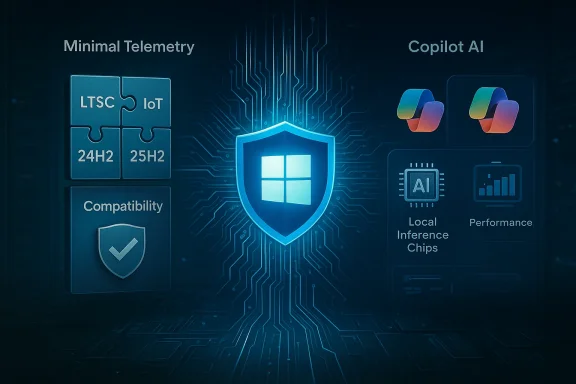 What the Digital Journal op‑ed argued — a fair summary
The op‑ed’s central claims are straightforward and merit-by‑merit:- Windows 12 is more rumor than reality at present; most public reporting is panoramic speculation rather than concrete feature lists.
- Tech media coverage tends to be top‑down and product‑centric, prioritizing architecture and buzzwords over the practical tasks users need to accomplish.
- AI has exacerbated that tendency; “AI-first” narratives often overshadow whether an OS actually meets users’ core needs.
- There’s hope for a simplified “Windows Lite” or LTSC‑style offering, but the author is skeptical Microsoft will simplify the desktop to the point where users receive only what they need, when they need it.
- Hardware and software must be rationalized together; an AI-capable OS must manage power and resources far more efficiently than before.
- Above all, Windows 12 must not be another reinvention for its own sake — it must work.
I paraphrase the op‑ed here because the argument is important and representative of a broader sentiment circulating in user communities and forums. Community threads amplify many of these same points: skepticism about hardware requirements, annoyance at forced defaults and bundled apps, and a constant refrain that “make it work” matters more than headline features.
The facts we can verify now — and what they mean
Before jumping to conclusions about Windows 12, it’s necessary to check three critical, verifiable touchpoints: Microsoft’s product cadence and messaging; technical details that are already shipping (or have shipped) in Windows 11 and its IoT/LTSC variants; and the financial context that constrains big engineering programs.1) Microsoft’s product focus: Windows 11 refreshes, not an imminent Windows 12 release
Microsoft publicly framed 2025 as a year to refresh Windows 11 and to roll out Copilot-integrated experiences in the Windows ecosystem rather than to ship an immediate Windows 12. Industry reporting confirms that Microsoft pushed major updates (24H2, and subsequently 25H2) and that the company remains committed to annual feature releases instead of a sudden large-numbered jump. Several reputable outlets reported that a Windows 12 release was being pushed back or deprioritized in favor of continuing to enhance Windows 11. That’s an important, confirmable point for IT planners who might otherwise budget for a new OS refresh cycle.2) Windows 11 IoT Enterprise LTSC 2024 and the “Windows Lite” idea are concrete, not just vaporware
There is a specific, supported edition that embodies many of the “lite” arguments: Windows 11 IoT Enterprise LTSC 2024. Microsoft’s documentation and the product announcement show that this LTSC release targets constrained devices, removes consumer‑grade baggage, and deliberately omits some modern apps and experiential telemetry that appear in mainstream editions. In other words, a leaner Windows for controlled deployments already exists. Microsoft’s official Learn pages and deployment docs list the features added and removed in that LTSC release and explain the use cases — kiosk systems, industrial edge devices, and long‑lifecycle hardware. The LTSC line is a real example of Microsoft tailoring Windows for specific, simpler needs.Windows‑specific community reporting has also flagged a nuance: for IoT Enterprise editions (a different SKU class), Microsoft relaxed certain hardware constraints — for example, TPM and UEFI requirements are treated differently in that edition — underscoring that Microsoft is willing to decouple OS packaging and hardware gates when it serves a market segment. That’s a useful precedent for anyone hoping Microsoft might deliver a “pick‑what-you-need” Windows for general users someday.
3) Microsoft and the broader hyperscaler cohort are investing enormous sums in AI infrastructure
This is the financial tail that wags the product dog. Multiple business and financial outlets report very large AI‑related capital commitments across the major cloud and platform providers, with analysts and fund managers increasingly concerned about the trajectory of capex versus cash returns. A Bank of America / fund manager survey and coverage in business outlets captured investor unease: heavy AI infrastructure spending has reduced free cash flow and undercut historical mechanisms (like share buybacks) that have supported tech stock valuations. For Microsoft specifically, the scaling of cloud infrastructure, AI model hosting, and specialized hardware is a clear corporate priority — and that scale changes how leadership must trade off long‑term platform investments like a whole‑OS rearchitecture versus incremental feature work.What the op‑ed got right — strengths of the critique
- Pragmatic user needs are under‑represented in the mainstream narrative. The op‑ed correctly highlights that coverage too often centers on what the OS architects want to build rather than what end users need to accomplish. That blind spot leads to feature bloat and usability regressions that manifest as real productivity costs.
- The author correctly identifies existing, practical alternatives to a monolithic new OS. Microsoft’s LTSC and IoT channels already demonstrate that a trimmed, more deterministic Windows is possible. If Microsoft wanted to deliver a “lite” Windows for mainstream users, — or at least a modular approach that only loads heavier features when hardware and context permit — the technical priors and product templates already exist to make it feasible.
- The financial pressure narrative is real and consequential. The op‑ed’s point that investors are sensitive to AI capex is borne out in the markets and among institutional managers; this reality constrains how quickly Microsoft can fund parallel multi‑year platform overhauls while maintaining other strategic investments. That’s not a rhetorical flourish — it changes product cadence decisions.
What the op‑ed understated or missed — risks and caveats
- Engineering complexity and ecosystem costs are not just Microsoft’s problem. Migrating Windows to a genuinely modular baseline (one that can selectively load Copilot or NPUs, or that adapts to device classes) is a massive engineering undertaking with significant backward‑compatibility risk. Businesses — not just consumers — depend on legacy behaviors, drivers, and application compatibility. Any fast‑tracked modularization risks fragmenting the ecosystem, increasing support costs for ISVs and device makers, and creating new forms of “tech debt” for enterprises.
- AI integration at the OS level brings new resource and privacy trade‑offs. Embedding AI features (local model inference, background context capture for “recall” features, or automatic summarization) consumes CPU/GPU/NPU cycles and potentially introduces increased telemetry and data‑handling surface. These trade‑offs are real — they can be tuned, but they must be designed and governed with enterprise compliance and user privacy in mind. The op‑ed is right to push back against indiscriminate AI fetishism, but it underplays how challenging it is to design AI features that are both lightweight and genuinely helpful across millions of hardware configurations.
- Timing: the market narrative of “Windows 12 tomorrow” is unreliable. Multiple reputable outlets have tracked Microsoft’s cadence and concluded that a full‑blown Windows 12 is unlikely to arrive on the originally rumored schedule; instead, Microsoft will push Windows 11 forward with deeper AI features while presumably planning a longer horizon for a major rearchitecture. That delay may be frustrating to enthusiasts, but it is often a necessary consequence of aligning device ecosystems, developer tooling, and enterprise compatibility cycles.
The middle path: how Microsoft could satisfy both pragmatists and futurists
If Microsoft genuinely wants to reconcile the competing pressures — investor scrutiny, developer compatibility, and the desire to innovate with AI — it should consider committing to three clear principles. Each principle has practical, implementable steps.Principle A — Modularize around compatibility guarantees, not marketing
- Build a clearly documented compatibility layer that guarantees legacy Win32 and driver behaviors for the vast majority of enterprise workloads, with a fast‑path modernization layer for apps that opt in.
- Publish a strict compatibility contract and a robust compatibility test suite for ISVs and hardware vendors.
- Ship a “core” Windows image that is minimal by default, and allow OEMs / admins to stage optional components (UI enhancements, Copilot services, telemetry agents) as installable modules.
Principle B — Make AI features “opt‑in by usefulness,” not “opt‑out by default”
- Default AI features to off for mainstream users and provide simple, transparent options to enable local or cloud AI, with clear cost/performance indicators.
- Provide local lightweight AI primitives (text extraction, summarization) that run efficiently on NPUs when available, and fall back to server-side inference when necessary — and make the runtime costs transparent in Settings and Enterprise management consoles.
- Document privacy and data handling in plain language and provide enterprise controls that allow admins to enforce data residency and telemetry levels.
Principle C — Align enterprise upgrade windows with hardware cycles
- Give enterprises multi‑year upgrade mapping tools that automatically determine device fit for future features.
- Offer extended‑support lanes or hardened LTSC images for devices that cannot or should not be upgraded to AI-first experiences.
- Publish an explicit “capability roadmap” rather than aspirational marketing language; if NPUs or Copilot features will require specific silicon, say so with dates and OEM coordination.
Practical guidance for IT and power users right now
- If you are responsible for a fleet, treat Windows 11 24H2 / 25H2 as the target for broad deployment rather than waiting for Windows 12. Microsoft’s roadmap and product signals indicate continued investment in Windows 11 features through these releases. Plan testing and deployment accordingly.
- For constrained or long‑lifecycle hardware (kiosks, industrial controllers), evaluate Windows 11 IoT Enterprise LTSC 2024 — it exists and is designed for those scenarios. It might spare you from needless feature churn and provide a leaner update model.
- If you are a device buyer: consider Copilot+ hardware only when the feature set and local inference performance match your needs. Don’t buy an NPU laptop on a promise; test the actual Copilot workflows you require and benchmark battery and thermal behavior.
- For individual users who feel overwhelmed by feature changes: use the built‑in update deferment and telemetry controls, and consider an LTSC or Enterprise image on devices where you require absolute stability.
The community voice — why the backlash matters
The frustration captured in user forums and commentary is consistent: hardware requirements, forced defaults, and perceived bloat have alienated a nontrivial portion of Windows’ loyal base. Community threads reflect a simple thesis: users want a stable, predictable computing environment that doesn’t punish older but functional hardware, and they want Microsoft to prioritize reliability over optics. That sentiment appears repeatedly across independent community posts and forum threads, which have tracked the same set of issues — from TPM debates to taskbar changes and concerns about telemetry creep. Those conversations, while noisy, carry signals that matter to real‑world adoption and perception.At the same time, forums also reflect divergent views: some users eagerly anticipate AI features and modular rethinks; others want no part of a Copilot‑infused desktop. Microsoft’s challenge is to bridge that divide without alienating either side.
Conclusion — what Windows 12 should be (and what to watch for)
The op‑ed’s plain demand — “All Windows 12 needs to do is work” — is a simple and defensible yardstick. If Microsoft intends to ship a major new OS, the company must prove that the new system reduces friction for real users, rather than adding another layer of product theater. The path to that proof is obvious in outline: modularize to protect compatibility, make AI features optional and transparent, and align upgrade cycles to enterprise reality.Short of a full rearchitecture, Microsoft can achieve a lot by making Windows 11 updates more surgical and less theatrical, by offering genuinely lightweight editions for constrained devices, and by codifying the privacy and resource costs of AI features. The company’s enormous AI capex and its strategic pivot are real and will continue to dominate headlines; the test will be whether those investments translate into practical, measurable improvements on the things that matter to users: reliability, performance, battery life, serviceability, and predictable upgrade paths.
Watch for these early signs that Microsoft is listening: clear, machine‑readable compatibility contracts for ISVs; an official modular feature packaging roadmap; transparent performance benchmarks for Copilot/AI features on real hardware; and enterprise‑grade privacy controls that make AI safe to deploy at scale. If Microsoft delivers those elements, the conversation about Windows 12 will shift from speculative doom‑scrolling to concrete migration planning. Until then, skepticism — and a demand for usable, focused software — remains a healthy posture for users, administrators, and investors alike.
Source: Digital Journal Op-Ed: Windows 12 – Speculation, pessimism, and when do users get a say?
