

The recent flare-up over a purported “Windows 12” release—framed by a translated roundup that tied an internal codename, a modular architecture called CorePC, and ambitious on‑device AI requirements together into a neat 2026 launch narrative—has become a useful case study in how leaks, re‑used internal names, and rapid republishing can convert dated engineering notes into urgent consumer panic. The claim set was precise and consequential: a product codenamed Hudson Valley Next, built on a new CorePC modular kernel, with Copilot elevated to a system control instance, hardware gating via a ~40 TOPS Neural Processing Unit (NPU), and the suggestion of subscription‑style monetization. Those claims were published, amplified, and then publicly pushed back on by better‑connected reporters and Microsoft’s own public roadmaps; parsing the two sides shows a mix of real engineering signals, historical artifacts, and speculative leaps that lacked independent corroboration. the story formed and why it spread
The translated article that catalyzed the cycle packaged several technical and product assertions into a single forward‑dated narrative. It portrayed a modular rearchitecture—CorePC—as the foundation for a consumer product that would be marketed as Windows 12 (internally labeled “Hudson Valley Next” in the story), and it framed AI and Copilot as the OS’s structural centerpiece. The piece also linked the rumored timing to the practical milestone of Windows 10 end‑of‑support (October 2026), implying that Microsoft might use that window to push customers to a new, gated platform.
That narrative hit all the elements that drive social virality: a clear villain (forced upgrades/subscriptions), stark system requirements (a 40 TOPS NPU), and an alleged official codename. Once republished by a cascade of outlets and social posts, the story was framed as near‑certain and imminent—despite being a translated summary that drew on a mix of recent leaks, older reporting, and speculative synthesis. Multiple community and editorial threads noted how quickly the aggregation chain turned anecisive headlines.
Microsoft’s public channels and documentation back this more cautious and evolutionary account. The company’s February 2026 roadmap and training documentation stress continued investment in Windows 11—including security, feature stabilization, and expanded Copilot integrations in the existing platform—rather than announcing or signaling an imminent, retail Windows 12 launch. Official learning and roadmap materials in February 2026 emphasized Windows 11 as the supported baseline and highlighted Copilot features delivered within the Windows 11 lifecycle. That public posture reinforces the idea that Microsoft’s corporate plan for 2026 was to evolve Windows 11, not replace it wholesale.
Moreover, several outlets that republished the translation appended editor’s notes or corrections after being contacted or after cross‑checks exposed inconsistencies in sourcing. One prominent republisher added a correction and editor’s note acknowledging the translation and sourcing problems; community editors later documented correction and retraction activity tied to the original piece. Those updates narrowed the gap between the original amplified claims and the more skeptical, sourced reporting that followed.
Verification: the 40 TOPS figure appears in the original translated narrative and was widely repeated in aggregated coverage, but it is not corroborated by Microsoft’s public documentation or by reporting from sources with hands‑on track records with Microsoft’s roadmap. Veteran reporting that dug into Microsoft’s plans treated the “40 TOPS” figure as an unverified number and traced the hardware gating concept to broader industry discussions about Copilot+ device tiers and edge inference, not to a binding Microsoft product requirement. In short, the 40 TOPS number circulated as a specific, attention‑grabbing detail, but it lacked independent confirmation and was not reflected in Microsoft’s public messaging.
Practical implication: hardware gating is plausible as an industry pattern—vendors are increasingly shipping devices with NPUs and tiered capabilities—but a hard 40 TOPS minimum as a gating criterion for a flagship OS release is a strong technical claim that requires direct Microsoft confirmation, which does not exist publicly. Treat the 40 TOPS figure as speculative unless Microsoft or a trusted partner publishes exact thresholds.
Verification: CorePC is a real engineering concept with public reporting history; Windows Central and other outlets covered it in 2023 as a forward‑looking platform effort. However, Bowden’s March 2026 follow‑up indicates that CorePC’s status as an active, scheduled consumer shipping base for a new Windows product in 2026 was not supported by his sources; rather, CorePC-like work has been in Microsoft’s engineering backlog and experimental branches. The key difference: CorePC is an architectural aspiration and a set of engineering research threads, not an automatically shipping product on a fixed 2026 timeline.
Practical implication: the existence of CorePC in engineering documents is genuine and important; the leap from “CorePC exists” to “Microsoft will release Windows 12 built on CorePC in 2026” is a separate, evidence‑dependent claim that was not corroborated.
Verification: Microsoft’s product direction for 2025–2026 clearly elevates Copilot experiences across Microsoft 365 and Windows, introducing deeper integrations and agentic features in productivity scenarios. Windows 11 has been getting tighter Copilot integrations in the 2026 roadmap, and Microsoft has public messaging about Copilot’s expanding role. However, “Copilot as OS control plane” in the sense of replacing the primary system UI or usurping core management interfaces is a strong formulation that exceeds public announcements. Microsoft is pushing Copilot deeper, but the claim that Copilot will act as the central OS control plane—effectively the primary system shell—remains aspirational and unverified for a consumer release narrative.
Practical implication: expect continued Copilot expansion and richer system hooks within Windows 11; treat claims of Copilot becoming the sole or dominant control plane as speculative pending direct product announcements.
Verification: Microsoft has experimented with subscription tiers across services (Microsoft 365, Copilot subscriptions in enterprise contexts), and OEM/partner models for “Copilot+ PCs” were discussed publicly. However, there is no public evidence that Microsoft planned to convert the core Windows retail license into a subscription‑only model in 2026. Reporting that pushed back on the leak explicitly stated there was no sign of a consumer subscription‑only OS plan in confirmed roadmaps. Subscription models for premium AI features are plausible, but the radical claim of a subscription‑only OS was not substantiated.
Practical implication: Microsoft is likely to continue hybrid monetization—free OS baseline, paid premium features—rather than an abrupt, subscription‑only retail OS. Enterprises and consumers should watch for tiered Copilot monetization, not an immediate wholesale change in Windows licensing.
The Windows rumor cycle that produced the Hudson Valley/CorePC narrative is a reminder that technical truth and narrative convenience are often at odds: durable engineering work like CorePC can be recycled into startling product claims by translation, aggregation, and aggressive headline incentives. The most defensible position for professionals and consumers is to track primary Microsoft publications, rely on experienced reporting for interpretation, and treat spectacular leak claims as hypotheses to be tested against official announcements—especially when those claims would materially change procurement, security, or licensing decisions.
Source: FilmoGaz Leaks vs. Rebuttals: What Windows 12 Claims Reveal About AI Rumors
The translated article that catalyzed the cycle packaged several technical and product assertions into a single forward‑dated narrative. It portrayed a modular rearchitecture—CorePC—as the foundation for a consumer product that would be marketed as Windows 12 (internally labeled “Hudson Valley Next” in the story), and it framed AI and Copilot as the OS’s structural centerpiece. The piece also linked the rumored timing to the practical milestone of Windows 10 end‑of‑support (October 2026), implying that Microsoft might use that window to push customers to a new, gated platform.
That narrative hit all the elements that drive social virality: a clear villain (forced upgrades/subscriptions), stark system requirements (a 40 TOPS NPU), and an alleged official codename. Once republished by a cascade of outlets and social posts, the story was framed as near‑certain and imminent—despite being a translated summary that drew on a mix of recent leaks, older reporting, and speculative synthesis. Multiple community and editorial threads noted how quickly the aggregation chain turned anecisive headlines.
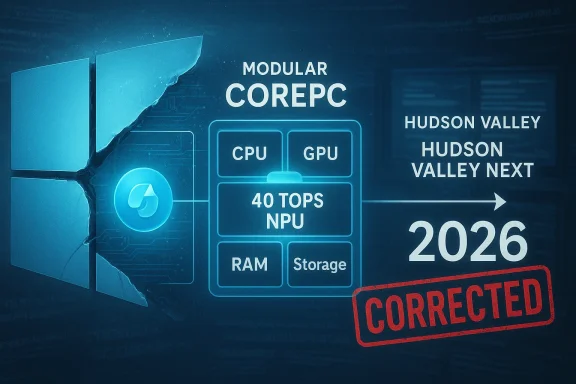 Overview of the leak’s central technical claims
- Hudson Valley Next as a product codename: Presented as the internal name for a consumer successor to Windows 11.
- CorePC architecture: Described as a modular platform to isolate system components, enable granular updates, and scale to different device classes from tablets to high‑performance PCs.
- AI and Copilot at the system level: A thesis that Copilot would change from an app/assistant to a central OS control plane—effectively a primary, persistent interface for system services.
- Hardware gating (40 TOPS NPU): Reported claims that advanced features would require on‑device neural performance tiers, measured at roughly 40 TOPS of inferencing throughput.
- Subscriptial model: Suggestions that premium, AI‑enabled functionality might be monetized via subscriptions rather than one‑time license updates.
The rebuttals: what established reporting and Microsoft activity actually show
Within 48 hours of the viral posts, veteran Windows reporter Zac Bowden of Windows Central investigated the sourcing and pushed back, concluding that the leap to a 2026 Windows‑numbered launch was unsupported by his contacts and that Microsoft’s immediate roadmap emphasized improving and stabilizing Windows 11. Bowden’s reporting traces many of the technical pieces—like CorePC and the “Hudson Valley” phrasing—back to earlier internal efforts or planning conversations from 2023, rather than a shipping plan for a consumer is assessment was blunt: there was no confirmed plan to ship a distinct Windows‑numbered OS to consumers in 2026; the near‑term work was described internally as a repair and iteration cycle on Windows 11.Microsoft’s public channels and documentation back this more cautious and evolutionary account. The company’s February 2026 roadmap and training documentation stress continued investment in Windows 11—including security, feature stabilization, and expanded Copilot integrations in the existing platform—rather than announcing or signaling an imminent, retail Windows 12 launch. Official learning and roadmap materials in February 2026 emphasized Windows 11 as the supported baseline and highlighted Copilot features delivered within the Windows 11 lifecycle. That public posture reinforces the idea that Microsoft’s corporate plan for 2026 was to evolve Windows 11, not replace it wholesale.
Moreover, several outlets that republished the translation appended editor’s notes or corrections after being contacted or after cross‑checks exposed inconsistencies in sourcing. One prominent republisher added a correction and editor’s note acknowledging the translation and sourcing problems; community editors later documented correction and retraction activity tied to the original piece. Those updates narrowed the gap between the original amplified claims and the more skeptical, sourced reporting that followed.
CorePC and Hudson Valley: history, reuse, and why recycled names confuse coverage
CorePC’s lineage
CorePC is not a brand‑new idea invented in 2026. Multiple credible reports track CorePC and related modular Windows platform experiments back to 2023, when Microsoft explored a more componentized OS to speed updates, reduce legacy bloat around Win32, and enable more device‑specific scale. The CorePC concept has been publicly discussed in tech reporting as a future architecture that would let Microsoft isolate major subsystems and update them independently—an idea with lineage to work on the Windows Core OS (WCOS) and the brief Windows 10X initiative. That historical context matters: it means references to CorePC in contemporary leaks may simply be re‑surfacing older project names rather than confirming a newly minted consumer product.Hudson Valley’s reuse
Similarly, the codename “Hudson Valley” has appeared in reporting and internal conversations for several years. Journalists with long ties to Microsoft have documented Hudson Valley as a label applied to planned platform work in 2023 and 2024 rather than an unambiguous wrapper for a 2026 consumer product. When old codenames are republished without timescale context, they can create an illusion of immediacy—an old project name + a modern claim = new release, in the public eye. Zac Bowden’s reporting specifically noted that Hudson Valley’s presence in the leak looked like recycled internal usage rather than fresh confirmation of a new OS.What this reuse tells us about rumor mechanics
Two structural drivers explain how the leak evolved into a media cascade:- Recycled internal terminology and project artifacts are easy to conflate with current plans, especially when those artifacts are fragments (slides, repo traces, or brief emails) that lack clear temporal markers.
- Fast republishing, especially of translations or syndicated summaries, can create closed loops: Site A translates Site B’s old report; Site C cites Site A; social feeds recycle Site C. Without independent sourcing, the chain amplifies fringe probability into apparent certainty.
Technical claims examined one by one
1. The 40 TOPS NPU requirement
Claim: flagship features of the rumored OS would require dedicated on‑device NPUs capable of roughly 40 TOPS.Verification: the 40 TOPS figure appears in the original translated narrative and was widely repeated in aggregated coverage, but it is not corroborated by Microsoft’s public documentation or by reporting from sources with hands‑on track records with Microsoft’s roadmap. Veteran reporting that dug into Microsoft’s plans treated the “40 TOPS” figure as an unverified number and traced the hardware gating concept to broader industry discussions about Copilot+ device tiers and edge inference, not to a binding Microsoft product requirement. In short, the 40 TOPS number circulated as a specific, attention‑grabbing detail, but it lacked independent confirmation and was not reflected in Microsoft’s public messaging.
Practical implication: hardware gating is plausible as an industry pattern—vendors are increasingly shipping devices with NPUs and tiered capabilities—but a hard 40 TOPS minimum as a gating criterion for a flagship OS release is a strong technical claim that requires direct Microsoft confirmation, which does not exist publicly. Treat the 40 TOPS figure as speculative unless Microsoft or a trusted partner publishes exact thresholds.
2. CorePC as the foundation for a consumer Windows 12
Claim: CorePC is the modular rearchitecture that will underpin a ground‑up consumer Windows 12.Verification: CorePC is a real engineering concept with public reporting history; Windows Central and other outlets covered it in 2023 as a forward‑looking platform effort. However, Bowden’s March 2026 follow‑up indicates that CorePC’s status as an active, scheduled consumer shipping base for a new Windows product in 2026 was not supported by his sources; rather, CorePC-like work has been in Microsoft’s engineering backlog and experimental branches. The key difference: CorePC is an architectural aspiration and a set of engineering research threads, not an automatically shipping product on a fixed 2026 timeline.
Practical implication: the existence of CorePC in engineering documents is genuine and important; the leap from “CorePC exists” to “Microsoft will release Windows 12 built on CorePC in 2026” is a separate, evidence‑dependent claim that was not corroborated.
3. Copilot as an OS control plane
Claim: Copilot will elevate into a central, system‑level control instance rather than remaining an assistant app.Verification: Microsoft’s product direction for 2025–2026 clearly elevates Copilot experiences across Microsoft 365 and Windows, introducing deeper integrations and agentic features in productivity scenarios. Windows 11 has been getting tighter Copilot integrations in the 2026 roadmap, and Microsoft has public messaging about Copilot’s expanding role. However, “Copilot as OS control plane” in the sense of replacing the primary system UI or usurping core management interfaces is a strong formulation that exceeds public announcements. Microsoft is pushing Copilot deeper, but the claim that Copilot will act as the central OS control plane—effectively the primary system shell—remains aspirational and unverified for a consumer release narrative.
Practical implication: expect continued Copilot expansion and richer system hooks within Windows 11; treat claims of Copilot becoming the sole or dominant control plane as speculative pending direct product announcements.
4. Subscription‑based OS monetization
Claim: the rumored Windows 12 would shift consumers to subscription tiers for premium AI features or even the OS itself.Verification: Microsoft has experimented with subscription tiers across services (Microsoft 365, Copilot subscriptions in enterprise contexts), and OEM/partner models for “Copilot+ PCs” were discussed publicly. However, there is no public evidence that Microsoft planned to convert the core Windows retail license into a subscription‑only model in 2026. Reporting that pushed back on the leak explicitly stated there was no sign of a consumer subscription‑only OS plan in confirmed roadmaps. Subscription models for premium AI features are plausible, but the radical claim of a subscription‑only OS was not substantiated.
Practical implication: Microsoft is likely to continue hybrid monetization—free OS baseline, paid premium features—rather than an abrupt, subscription‑only retail OS. Enterprises and consumers should watch for tiered Copilot monetization, not an immediate wholesale change in Windows licensing.
Why this dispute matters: industry, enterprise, and consumer risks
For consumers
- Upgrade anxiety: Messaging that implies forced hardware purchases (e.g., mandatory NPUs) can accelerate upgrade cycles and consumer frustration. The viral claim of a 40 TOPS gate created immediate worry about obsolescence for existing PCs. Because that claim lacked independent confirmation, it generated avoidable panic.
- Monetization fear: The suggestion of subscription‑only access generated headlines about new, recurring costs for the OS—an emotionally charged narrative that drives clicks and consumer outrage even when unproven.
For enterprises and IT managers
- Procurement planning uncertainty: Enterprises plan hardware and lifecycle based on supported Windows versions. A plausible consumer‑grade successor timed against Windows 10’s EoL would force large organizations to revisit long‑term refresh plans. But the absence of a confirmed product means instituting such changes now would be premature and costly.
- Compatibility and management: A modular platform plus AI features raises questions about management tooling, update plans, and kernel compatibility. Enterprises should focus on the known variables: continued Windows 11 support, the normal update cadAPI/management changes.
For OEMs and silicon partners
- Supply chain signals: GPU/NPU thresholds cited as requirements would influence OEM design and silicon sourcing. Even speculative thresholds can cause ripple effects in silicon roadmaps and marketing. Since the 40 TOPS figure was unverified, OEMs should treat it as noise until Microsoft announces official hardware minimums.
How to evaluate future leaks reliably: lessons from this cycle
- Prioritize primary sources: official Microsoft posts, Windows Insider announcements, and verified corporate blogs will always be the baseline for shipping commitments. Independent reporting from long‑established reporters with sources inside Redmond (e.g., Windows Central’s track record) is the next best check.
- Treat codenames as agnostic: internal project names (Hudson Valley, CorePC) are often reused or repurposed; they indicate areas of work, not shipping names or exact timelines.
- Verify specific numbers and hard requirements: hardware thresholds (TOPS, cores, etc.) should be treated as unconfirmed until device compatibility pages or Microsoft partner documentation spells them out.
- Watch for when an earlier story gets appended with an editor’s note or retraction, give that weight—some outlets will correct quickly when new information surfaces.
- Consider the incentive landscape: outlets that benefit from rapid republishing, translation syndication, or click optimization will sometimes prioritize speed over deep sourcing; cross‑checking is essential.
What to watch next: concrete milestones that will validate or refute the leak
- Microsoft product announcements and Insider releases: the official Windows events, Windows Insider notes, and Microsoft corporate blogs for the remainder of 2026 will be the authoritative sources on any new product naming or platform rearchitecture. If Microsoft publishes a consumer product called Windows 12 tied to CorePC, it will be announced there first.
- Windows 10 end‑of‑support (October 2026): this external milestone drives planning, but it is not in itself proof of an imminent Windows 12 product. If Microsoft does not announce a consumer Windows successor before that EoL date, the leak’s timing claim will have been contradicted by events.
- Hardware specification releases from OEMs and silicon partners: explicit NPU/AI performance minimums on new SKUs—if published—would support claims about gating. Absent such specifications, hardware gating remains speculative.
- Windows Central and comparable reporting: ongoing investigative follow‑ups from reporters who maintain robust contacts inside Microsoft are likely to be reliable interpretive guides as the roadmap unfolds.
Final assessment: what the evidence supports, and where caution is warranted
- The leak packaged legitimate threads—CorePC research, Copilot expansion, and vendor interest in on‑device NPUs—into a tidy narrative and added specific timing and gating claims that were not independently corroborated. The engineering signals are real; their repackaging into a firm 2026 launch and a mandatory 40 TOPS gate was not supported by available evidence.
- Credible reporting from journalists with sustained Microsoft coverage contradicted the claim of a consumer Windows 12 release in 2026 and placed CorePC and Hudson Valley as older programmatic efforts that were being iterated on, not imminent shipping plans. The public Microsoft posture—training paths and roadmap posts in February 2026—explicitly continued to center Windows 11 as the supported platform receiving AI feature investments.
- Several outlets and community threads documented corrections and retracts after the original translated piece spread, underscoring how aggregation and translation without fresh sourcing can produce misleading certainty. That pattern is a recurring risk for technology coverage in an era of AI‑assisted summarization and fast syndication.
Practical guidance for readers today
- If you manage enterprise fleets, continue to treat Windows 11 as the supported platform and follow Microsoft’s official lifecycle guidance for Windows 10 and Windows 11. Do not accelerate hardware procurement based on unverified leak thresholds.
- If you’re an OEM or silicon partner, maintain close alignment with Microsoft partner channels and treat leaked thresholds as market signals—not commitments—until they appear in partner documentation or public hardware compatibility materials.
- If you’re a consumer considering an upgrade, weigh the functional benefits of new AI‑capable PCs today (battery life, productivity gains, AI acceleration) against the cost; don’t assume your current PC will be forcibly deprecated in 2026 absent explicit Microsoft hardware minimums.
- Finally, treat dramatic, tightly specific claims about shipping dates, gating thresholds, and new licensing models with skepticism until confirmed by at least one primary Microsoft channel or multiple, independently sourced reports.
The Windows rumor cycle that produced the Hudson Valley/CorePC narrative is a reminder that technical truth and narrative convenience are often at odds: durable engineering work like CorePC can be recycled into startling product claims by translation, aggregation, and aggressive headline incentives. The most defensible position for professionals and consumers is to track primary Microsoft publications, rely on experienced reporting for interpretation, and treat spectacular leak claims as hypotheses to be tested against official announcements—especially when those claims would materially change procurement, security, or licensing decisions.
Source: FilmoGaz Leaks vs. Rebuttals: What Windows 12 Claims Reveal About AI Rumors
