Microsoft’s next-generation operating system — widely circulated as “Windows 12” and internally referenced in some reporting as Hudson Valley Next — has emerged from a swirl of leaks, partner briefings, and rebuttals, producing a high‑stakes debate about where the PC platform is headed and what it will require from hardware, software, and users.
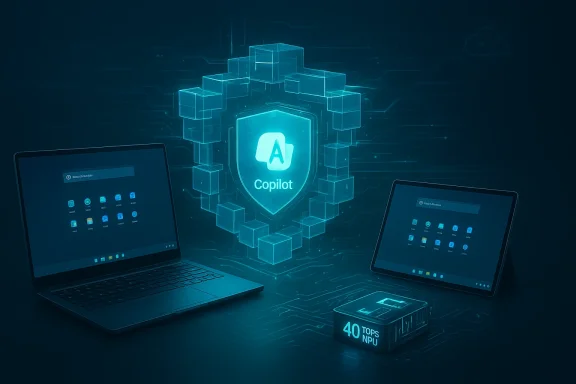
The past week’s media cycle forced two parallel narratives into public view. One major technology outlet summarized multiple traces of reporting and partner signals into a coherent portrait of a new, modular, AI‑first OS scheduled for 2026 under the internal name Hudson Valley Next. That narrative centers on a CorePC modular architecture, deep system‑level integration of Copilot as the OS brain, and a hardware threshold tied to Neural Processing Units (NPU) capable of roughly 40 TOPS (trillions of operations per second) to unlock the full set of AI features.
Almost immediately, long‑time Microsoft watchers and reporters pushed back. Microsoft‑focused reporting that tracks engineering roadmaps argues the CorePC work in question largely traces back to initiatives from 2023 and that engineering priorities for 2026 are primarily about repairing and iterating on Windows 11, not shipping a full‑numbered sequel this year. That rebuttal warns that the more dramatic claims — a universal hardware gate, forced subscription access to basic OS features, or a wholesale UI overhaul — are either recycled engineering experiments or misinterpretations of partner marketing.
Both threads contain verifiable elements worth parsing: Microsoft has already formalized the Copilot+ device tier, which references NPUs rated in TOPS; Intel, Qualcomm, and AMD have introduced silicon emphasizing integrated NPUs; and internal Microsoft engineering projects over the last three years have explored modular platform ideas that would be technically feasible to evolve into a product line. Where the disagreement matters is timing, scope, and Microsoft’s product strategy: a 2026 launch of a disruptive, AI‑dependent OS would be a strategic pivot with material consequences; a continued evolution of Windows 11 focused on quality and usability would be a very different outcome.
That said, TOPS is a coarse metric. It measures raw operation throughput but not model efficiency, memory bandwidth, on‑die integration, or thermal behavior — all crucial to the perceived performance of AI features. Vendors and OEMs optimize across the stack, so a 40 TOPS figure is better interpreted as a pragmatic industry benchmark for delivering advanced local AI services rather than a technical law.
What remains uncertain is the shape and timing of that future. Recent, contrasting coverage demonstrates this uncertainty: parts of the story are anchored in tangible work (CorePC experiments, Copilot+ hardware criteria), while other parts are speculative aggregations of older prototypes, design concepts, and partner marketing. The sensible reading for most readers is to treat the current wave of headlines as an indicator of direction — modular architecture, stronger on‑device AI, and a growing ecosystem of AI PCs — but not as proof that a disruptive, hardware‑locked Windows 12 will ship universally in 2026.
For end users, the immediate practical moves are modest and measured: evaluate device needs against real workloads, track Copilot+ certification and Microsoft’s official guidance, and avoid reactive hardware refreshes based solely on rumors. For enterprises and developers, the wise path is to pilot strategically, prepare for hybrid feature deployments, and insist on clear, auditable privacy and upgrade policies from vendors.
The industry is converging on a new balance between local intelligence, cloud services, and modular platforms. Whether Microsoft chooses a bold rebrand or a careful evolution, the next few product cycles will determine how that balance shapes user experience, developer ecosystems, and the economics of personal computing.
Source: SSBCrack News Windows 12 Expected to Launch in 2026 with Major AI Integration and Modular Architecture - SSBCrack News
 Background
The past week’s media cycle forced two parallel narratives into public view. One major technology outlet summarized multiple traces of reporting and partner signals into a coherent portrait of a new, modular, AI‑first OS scheduled for 2026 under the internal name Hudson Valley Next. That narrative centers on a CorePC modular architecture, deep system‑level integration of Copilot as the OS brain, and a hardware threshold tied to Neural Processing Units (NPU) capable of roughly 40 TOPS (trillions of operations per second) to unlock the full set of AI features.Almost immediately, long‑time Microsoft watchers and reporters pushed back. Microsoft‑focused reporting that tracks engineering roadmaps argues the CorePC work in question largely traces back to initiatives from 2023 and that engineering priorities for 2026 are primarily about repairing and iterating on Windows 11, not shipping a full‑numbered sequel this year. That rebuttal warns that the more dramatic claims — a universal hardware gate, forced subscription access to basic OS features, or a wholesale UI overhaul — are either recycled engineering experiments or misinterpretations of partner marketing.
Both threads contain verifiable elements worth parsing: Microsoft has already formalized the Copilot+ device tier, which references NPUs rated in TOPS; Intel, Qualcomm, and AMD have introduced silicon emphasizing integrated NPUs; and internal Microsoft engineering projects over the last three years have explored modular platform ideas that would be technically feasible to evolve into a product line. Where the disagreement matters is timing, scope, and Microsoft’s product strategy: a 2026 launch of a disruptive, AI‑dependent OS would be a strategic pivot with material consequences; a continued evolution of Windows 11 focused on quality and usability would be a very different outcome.
Overview: What the reports say (and what’s verified)
Core claims circulating in the coverage
- Codename and timing: The leaked timeline points to a 2026 roll‑out of a successor OS with the internal name Hudson Valley Next. This is reported as a potential marketing “Windows 12” moment but not confirmed by Microsoft.
- Modular architecture (CorePC): The operating system would be built on a modular CorePC approach to enable better isolation of system components, faster and more granular updates, and scaled variants for tablets, laptops, and high‑end desktops.
- AI at the center: Rather than a set of optional features, AI and Copilot would be fundamental: context‑aware suggestions, system‑wide content generation, semantic search across files, and on‑device AI services designed to run with low latency.
- Hardware gating (NPU 40 TOPS): Full functionality is reported to require an NPU capable of roughly 40 TOPS, driven by the desire to run complex models locally for privacy and responsiveness.
- UX changes: Visual concepts circulating in leaks show a floating taskbar, a prominent search/Copilot bar, top‑aligned UI elements, and adaptive window management geared to touch and hybrid devices.
- Security and enterprise focus: Deeper system isolation, stronger authentication, and zero‑trust elements are expected to be prominent.
- Monetization and subscription: There are references in leaked fragments to a “subscription status,” suggesting premium AI features might be offered through Windows 365 or a Windows‑adjacent subscription tier while basic licensing would remain one‑time.
Which of these claims are backed by existing, verifiable facts?
- Microsoft has publicly launched the Copilot+ device designation and published guidance around local AI capabilities and hardware characteristics for Copilot‑enabled features; device makers and OEM materials already reference 40+ TOPS as the practical benchmark for advanced on‑device functionality. This is a documented part of the Copilot+ ecosystem.
- Major silicon vendors (notably Intel’s Lunar Lake/Core Ultra series, Qualcomm’s Snapdragon X Elite lineage, and AMD’s Ryzen AI family) are shipping or planning NPUs and marketing TOPS figures as part of the AI PC story. Those hardware pushes are real and measurable.
- Microsoft engineering has indeed explored modular platform designs in past years (projects referenced in public coverage include efforts that evolve Windows Core OS concepts into more componentized approaches). These initiatives are part of a multi‑year modernization effort and appear in multiple engineering and partner briefings.
What remains speculative or disputed?
- A hard release date for a product named Windows 12 in 2026 is not confirmed by Microsoft. Reporting that treats the PCWorld/PC‑WELT translation as a definitive road map was corrected by that publisher; independent Microsoft‑facing reporting from Windows Central and other outlets explicitly disputes a 2026 shipping plan.
- Claims that Microsoft will refuse upgrades or block key functionality on devices lacking a 40 TOPS NPU — i.e., a universal hardware gate for installation — are not substantiated by public Microsoft policy. What is documented is that premium Copilot+ features expect high‑performance NPUs; how Microsoft will assign upgrade paths or limit features across OS versions remains unannounced.
- The most sweeping UI redesigns and subscription rules reported in some summaries appear to conflate leaked UI concepts and partner marketing with finalized product decisions. Those concepts have a long history of surfacing and then not shipping.
Deep dive: The modular CorePC story — technical promise and practical pitfalls
What is CorePC, in plain terms?
CorePC is a modernization concept that seeks to split Windows into smaller, well‑isolated components. The objective is to:- Make updates more granular and safer by reducing interdependencies between subsystems.
- Enable variant builds tailored to device class (tablet, laptop, ARM/Intel, low‑power Chromelike devices).
- Provide stronger security by hardening or read‑only partitioning of core system components.
- Improve recovery and rollback by enabling OS swaps or component reinstalls without touching user data.
Potential strengths
- Faster, safer updates: Granular updates reduce the blast radius of buggy patches and could shorten the time between fixes and feature deployments.
- Device‑appropriate builds: OEMs could ship scaled builds that trim legacy subsystems on low‑power devices, improving battery life and responsiveness.
- Security gains: Better isolation can contain exploits and make integrity verification easier for enterprises.
- Cloud integration: Modular systems can offload non‑critical services to cloud instances or swap in cloud‑accelerated components more cleanly.
Real world constraints and risks
- Compatibility debt: The Windows ecosystem is still heavily dependent on legacy APIs and behaviors. A modular pivot that changes update semantics or OS interfaces risks breaking enterprise app compatibility unless Microsoft delivers robust compatibility layers.
- Upgrade fragmentation: If CorePC deployments are rolled out only on new hardware (as some engineering notes have suggested), the result could be a split ecosystem where legacy Windows and CorePC variants coexist for years — complicating support and developer targeting.
- Testing complexity: Greater modularity increases the number of combinations to test (module versions, driver stacks, OEM customizations), potentially increasing QA burden unless Microsoft commits to a disciplined compatibility certification program.
- Vendor lock expectations: If functionality is gated by NPU or specific silicon, consumers could face pressure to buy new hardware to access features that are nominally part of the OS experience.
AI integration and the 40 TOPS threshold: capability versus gatekeeping
Why 40 TOPS shows up in reporting
Microsoft’s Copilot+ marketing and device certification guidance makes clear that a class of on‑device experiences — fast local inference, complex multimodal features like Recall, and low‑latency content generation — are realistically delivered only when a dedicated NPU crosses a certain performance threshold. Hardware vendors, in turn, tout TOPS numbers because they are an easy headline measure for NPU capability.That said, TOPS is a coarse metric. It measures raw operation throughput but not model efficiency, memory bandwidth, on‑die integration, or thermal behavior — all crucial to the perceived performance of AI features. Vendors and OEMs optimize across the stack, so a 40 TOPS figure is better interpreted as a pragmatic industry benchmark for delivering advanced local AI services rather than a technical law.
What this could mean for users
- Systems branded as AI PCs or Copilot+ devices will likely deliver a noticeably richer on‑device AI experience — faster local inference, better privacy for sensitive tasks, lower latency for live features — compared with machines that lack NPUs or rely on cloud inference.
- Users on older hardware or those with devices lacking NPUs will not necessarily lose general OS function. However, premium AI features may require hardware that meets vendor‑specified thresholds.
- For enterprises, the practical question becomes: how many employees need those premium features, and does the productivity uplift justify hardware refreshes?
Privacy, data flows, and local vs. cloud tradeoffs
One of the arguments for high‑performance NPUs is to keep personal data and model execution local on the device. That reduces the need to send sensitive data to the cloud for inference. But the actual privacy posture depends on Microsoft’s implementation choices:- If features run fully on the device with localized models and clear, auditable data retention policies, privacy improves.
- If devices still fall back to cloud services for higher‑quality models or proprietary features, then local NPUs become a way to reduce but not eliminate cloud exposure — complicating compliance assessments for regulated environments.
UX, gaming, and power: what changes are plausible
User interface and productivity
The visual leaks discussed in reporting — a floating taskbar, a top‑centered search/Copilot bar, and more adaptive window management — are consistent with Microsoft’s multi‑year experimentation around touch, hybrid input, and search‑centric interfaces. Those concepts could improve discoverability for AI features, but the user backlash against intrusive AI elements in recent Windows 11 updates demonstrates there is political and user experience risk in pushing a Copilot‑centric design without clear opt‑out models.Gaming and DirectStorage
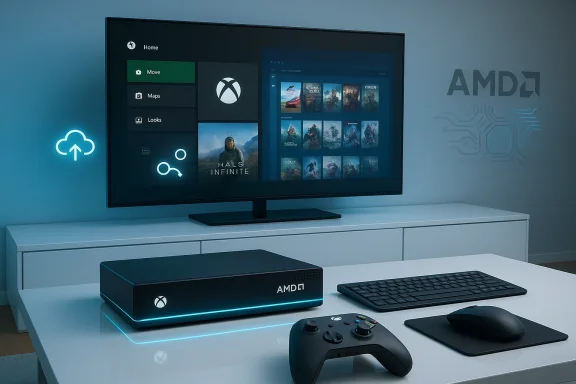
Gaming remains a core platform anchor for Windows. Expectations for improved DirectStorage, lower latency in cloud‑assisted streaming, and AI‑driven performance tuning are aligned with Microsoft’s ecosystem goals (Xbox integration, Game Pass, developer tooling). These improvements are evolutionary and fit existing priorities: better IO pipelines, smarter presets delivered by on‑device analysis, and deeper integration with Xbox services are realistic near‑term outcomes whether or not a full‑numbered OS relaunch ships.Power and memory management
Targeting modern mobile processors and AI workloads means Windows will need tighter power management, smarter memory compression, and scheduler tweaks to make NPUs and heterogeneous compute efficient. Those are practical engineering tasks that Microsoft has already been addressing via Windows updates; they are necessary for a good AI PC experience but not themselves proof of a new OS.Business model implications: subscriptions, licensing, and market strategy
A recurring element in the reporting is the potential for tiered monetization: a core, traditionally licensed OS augmented by premium AI features delivered via subscription (Windows 365 or Copilot+ subscriptions).- This model fits industry trends: compute‑heavy (and infrastructure‑heavy) features are increasingly monetized as services.
- It also raises user concerns: if Microsoft positions advanced AI features behind a subscription while branding them as fundamental OS capabilities, the perception of bait‑and‑switch could erode trust.
- Practically, Microsoft would have multiple levers: limited feature gating, performance tiers, or cloud‑native services that provide premium experiences independent of local NPUs.
Timeline and probability assessment
Based on the reporting and rebuttals available now, multiple realistic scenarios exist:- Evolutionary path (higher probability): Microsoft continues to iterate on Windows 11 via major feature updates in 2026 (26H2, 27H2 cadence), integrates Copilot features more deeply, and incrementally adopts modular architecture elements and NPU‑aware features without forcing a universal platform swap. This matches sources that emphasize fixing Windows 11 and cautious rollout strategies.
- Hybrid release (moderate probability): Microsoft introduces a new SKU or branded edition (e.g., a Windows 365 consumer tier or an “AI edition”) that bundles Copilot‑heavy features with cloud services while shipping a CorePC‑based variant for specific hardware lines. This approach reduces the risk of mass fragmentation while signaling a new product direction.
- Full OS reset (lower probability in 2026): Microsoft ships a numbered successor (Windows 12) with CorePC as the baseline and strict hardware expectations. This is the most disruptive path and is credible only if Microsoft judges Windows 11’s reputation irrecoverable and has coordinated hardware channel readiness — which reporting suggests is less likely for 2026.
Practical guidance for users, IT managers, and developers
Consumers and enthusiasts
- Don’t panic buy hardware solely to “future‑proof” for a rumored OS. If you are a heavy AI‑dependent user (local video processing, advanced on‑device inference), prioritize devices with NPUs from reputable vendors and proven battery/thermal characteristics.
- Watch Microsoft’s Copilot+ certification materials and OEM product specs. Those are the most concrete signals of the on‑device experience.
- Keep your devices updated and evaluate extended security options only if your hardware cannot be migrated to supported platforms.
IT managers and enterprises
- Inventory your installed base and classify users by workload. For many knowledge workers, the productivity uplift from on‑device AI may be measurable. Pilot Copilot+ devices for targeted teams before broad refresh cycles.
- Evaluate privacy and compliance: on‑device AI reduces some cloud exposure, but model telemetry, fallback to cloud services, and subscription controls must be audited.
- Plan procurement cycles around OEM roadmaps and Microsoft’s official deployment guidance rather than press leaks.
Developers and ISVs
- Maintain compatibility with Windows 11 APIs while monitoring CorePC/componentization guidance. If modularity proceeds, Microsoft will likely provide compatibility layers — but prepare to test across variants.
- Consider integrating AI‑aware features that gracefully scale: provide server‑side or cloud fallback for features that rely on NPUs so your app works across a broad install base.
- Leverage DirectStorage and GPU/NPU acceleration where applicable, but prioritize portability and graceful degradation.
Critical analysis: strengths, risks, and Microsoft’s bet
Notable strengths if the modular, AI‑first vision arrives
- A modular core and stronger on‑device AI could markedly reduce latency, improve privacy, and unlock new productivity scenarios that blend the local and cloud models.
- Aligning Windows with silicon trends around NPUs positions the platform for continued relevance in AI workloads and could catalyze a PC hardware cycle that benefits OEMs and developers.
- A disciplined modular architecture could accelerate security patching and cut down on system bloat for low‑end devices.
Major risks and open questions
- User backlash: Recent history shows users are sensitive to perceived intrusive AI and subscription creep. Any heavy‑handed rollout risks further reputational damage.
- Fragmentation: If CorePC and legacy Windows diverge materially, the ecosystem (drivers, enterprise tooling, ISVs) faces years of complexity and testing overhead.
- Hardware gating and equity: Forcing premium features behind hardware requirements could accelerate digital divide concerns. Microsoft must balance technical reality with fair access.
- Monetization optics: Packaging core OS capabilities behind a subscription risks colliding with the longstanding expectation that basic OS functionality is a one‑time purchase.
- Execution complexity: The engineering challenge of delivering modularity, legacy compatibility, local AI, and enterprise security simultaneously is nontrivial. Missteps could worsen user trust rather than restore it.
What to watch next
- Official Microsoft channels: product blogs, Windows Insider releases, and Copilot/Copilot+ documentation will be the authoritative source for policy and timing.
- OEM hardware briefings: device announcements that reference Copilot+ certification, TOPS metrics, and specific capabilities are practical indicators of the hardware ecosystem’s readiness.
- Windows Insider rings: early previews will show whether modular components and UI changes are being tested at scale.
- Enterprise guidance: Microsoft’s commercial licensing documents and Windows update/servicing policy statements will clarify upgrade paths and any subscription mechanics.
- Independent coverage with multiple corroborations: look for reporting that cites named partner briefings, official documentation, or demonstrable artifacts rather than single‑source leak aggregations.
Conclusion
The conversation about “Windows 12” — whether it becomes a formal product later this decade or remains the loose label for a set of modular, AI‑forward experiments — reflects a larger inflection point in personal computing. Hardware vendors are shipping NPUs and touting TOPS metrics; Microsoft has defined Copilot+ device classes and is integrating AI more broadly; and OEMs are eyeing a refresh cycle. Those technical and market forces make deeper AI integration in Windows likely at some point.What remains uncertain is the shape and timing of that future. Recent, contrasting coverage demonstrates this uncertainty: parts of the story are anchored in tangible work (CorePC experiments, Copilot+ hardware criteria), while other parts are speculative aggregations of older prototypes, design concepts, and partner marketing. The sensible reading for most readers is to treat the current wave of headlines as an indicator of direction — modular architecture, stronger on‑device AI, and a growing ecosystem of AI PCs — but not as proof that a disruptive, hardware‑locked Windows 12 will ship universally in 2026.
For end users, the immediate practical moves are modest and measured: evaluate device needs against real workloads, track Copilot+ certification and Microsoft’s official guidance, and avoid reactive hardware refreshes based solely on rumors. For enterprises and developers, the wise path is to pilot strategically, prepare for hybrid feature deployments, and insist on clear, auditable privacy and upgrade policies from vendors.
The industry is converging on a new balance between local intelligence, cloud services, and modular platforms. Whether Microsoft chooses a bold rebrand or a careful evolution, the next few product cycles will determine how that balance shapes user experience, developer ecosystems, and the economics of personal computing.
Source: SSBCrack News Windows 12 Expected to Launch in 2026 with Major AI Integration and Modular Architecture - SSBCrack News