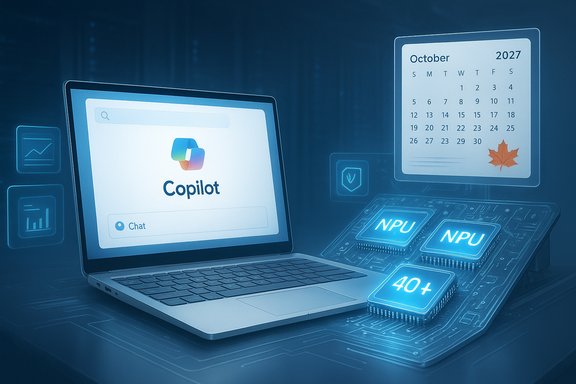
Microsoft’s OS roadmap may be clearer than the rumor mill suggests: several tech analysts and trade press pieces now point to a next major Windows release arriving no later than 2027, with October frequently named as the likeliest month — but the firm evidence shows a mix of confirmed signals, corporate product positioning, and a large dose of informed speculation that Windows users, IT managers, and device makers should treat cautiously.
The recent spike in coverage stems from two converging facts: Microsoft’s public lifecycle dates for recent Windows feature releases, and a deliberate industry push toward AI‑first hardware (notably, devices branded as “Copilot+” with high‑performance NPUs). Microsoft’s lifecycle table for Windows 11 lists version 25H2 as reaching end of support in October 2027, a fixed milestone that naturally invites speculation about what comes next. At the same time, Microsoft and PC OEM partners have defined and shipped a new device tier — Copilot+ PCs — that include Neural Processing Units (NPUs) capable of running local AI workloads at roughly 40+ TOPS (trillions of operations per second). Microsoft’s own developer guidance and consumer product pages make clear that many advanced on‑device experiences are tied to that hardware tier. That commercial thrust toward local AI acceleration is the other concrete fact driving talk of a Windows release that leans heavily on NPUs. What’s less concrete — and what every reader must keep in mind — is the difference between company positioning and product requirements today and an official Microsoft announcement of a standalone “Windows 12.” Analysts and journalists (including a PCMag feature and commentary appearing in other trade outlets) have stitched together timelines, Insider build hints, and the lifecycle calendar to produce plausible release scenarios; Microsoft, however, has not formally announced a Windows 12 product or a release date. Treat the forecasted 2027 timeframe as an informed projection, not a corporate roadmap.
Important verification notes and cautionary flags
Source: Inbox.lv The Year of Windows 12 Release Predicted
 Background / Overview
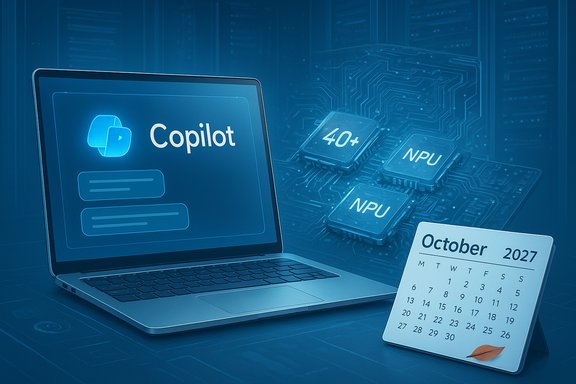
The recent spike in coverage stems from two converging facts: Microsoft’s public lifecycle dates for recent Windows feature releases, and a deliberate industry push toward AI‑first hardware (notably, devices branded as “Copilot+” with high‑performance NPUs). Microsoft’s lifecycle table for Windows 11 lists version 25H2 as reaching end of support in October 2027, a fixed milestone that naturally invites speculation about what comes next. At the same time, Microsoft and PC OEM partners have defined and shipped a new device tier — Copilot+ PCs — that include Neural Processing Units (NPUs) capable of running local AI workloads at roughly 40+ TOPS (trillions of operations per second). Microsoft’s own developer guidance and consumer product pages make clear that many advanced on‑device experiences are tied to that hardware tier. That commercial thrust toward local AI acceleration is the other concrete fact driving talk of a Windows release that leans heavily on NPUs. What’s less concrete — and what every reader must keep in mind — is the difference between company positioning and product requirements today and an official Microsoft announcement of a standalone “Windows 12.” Analysts and journalists (including a PCMag feature and commentary appearing in other trade outlets) have stitched together timelines, Insider build hints, and the lifecycle calendar to produce plausible release scenarios; Microsoft, however, has not formally announced a Windows 12 product or a release date. Treat the forecasted 2027 timeframe as an informed projection, not a corporate roadmap. Why 2027 (and October) keeps coming up
The anchor: Windows 11 25H2 lifecycle
Microsoft’s published lifecycle for Windows 11 versions shows 25H2’s end of support landing in October 2027. Release and end‑of‑support dates for major Windows releases have historically helped shape planning cycles for enterprises and OEMs; when a widely deployed branch is scheduled to retire support, vendors often time major upgrades around that transition to simplify migrations. This is the first concrete, non‑rumor anchor point for any prediction about a “next major Windows.”Seasonal rhythm: fall launches
Microsoft has a long tradition of major Windows announcements and general‑availability windows in the autumn quarter (the October timeframe is repeatedly referenced in industry coverage). Analysts extrapolate that logic: if a major version should follow the retirement of a previous supported branch, and Microsoft favors fall windows, then October becomes the natural conjured date for a next‑gen rollout. That reasoning is straightforward but not definitive.Industry signals and partner leaks
OEMs and silicon partners (Intel, AMD, Qualcomm) have signalled tight coordination around new silicon, AI accelerators, and OEM device programs. Microsoft’s Copilot+ program, and device announcements from major OEMs that follow its hardware checklist, are interpreted by many observers as Microsoft preparing the ecosystem for AI‑centric experiences that could make a significant next‑version milestone meaningful. But those signals describe readiness for AI‑first features — not an incontrovertible promise of a Windows naming change or a hard release date.What the authoritative facts say (technical verification)
- Windows 11 version 25H2: Microsoft lists Version 25H2 of Windows 11 with a documented support window that ends in October 2027 for Home and Pro lifecycle entries. That end‑of‑service date is official and public. This is an indisputable dataset point that underpins many timing projections.
- Copilot+ PCs and NPU requirements: Microsoft’s Copilot+ PC documentation and FAQs explicitly require high‑performance NPUs (the guidance references 40+ TOPS) for many of the enhanced local AI experiences that differentiate Copilot+ devices. Those product pages and developer guidance are official and confirm that Microsoft expects certain advanced on‑device AI features to be tied to NPU‑capable hardware. This is factual and verifiable.
- OEM and press confirmations: Major technology sites and hardware review outlets summarize the Copilot+ program and the rough NPU / memory / storage thresholds that vendors are using to classify devices. These independent reports align with Microsoft’s publicly posted hardware expectations for the Copilot+ device class.
What remains speculative (and why to be cautious)
- Mandatory NPU for the next major Windows version: It is often stated that “Windows 12 will require an NPU,” but Microsoft has not published any OS‑level minimum that makes an NPU a gate for installing the OS itself. What is real is that Copilot+ experiences require a 40+ TOPS NPU; what is speculative is whether Microsoft would block installation or support of the next major OS on devices lacking an NPU. Industry precedent shows Microsoft sometimes gates specific features or experiences to hardware tiers — but mandating a physical NPU to install a core OS would be an unusual and highly disruptive step that Microsoft has not announced. Treat any claim that “Windows 12 will only run on NPU machines” as plausible inference rather than confirmed fact.
- Pricing and licensing model changes (subscriptionization of Pro features): Several analysts have floated the idea that Microsoft may shift more capabilities behind subscription bundles (e.g., tying advanced Copilot credits or enterprise capabilities to Microsoft 365‑style plans). Microsoft already sells subscription services widely; however, there’s no public Microsoft announcement converting perpetual Windows Pro licenses to subscription‑only. Any claim that the next Windows will definitively remove perpetual licenses or make Pro subscription‑only is speculative and unsupported by official statements.
- A hard “Windows 12” product announcement and October 2027 GA date: Many outlets and individual analysts (cited analyses in the trade press) project late‑2025 through 2027 release windows. While October 2027 appears in some forecasts — largely because it aligns with 25H2’s lifecycle horizon — Microsoft has not declared a product name or a public release schedule that pins down those dates. In short, the most load‑bearing calendar facts are Microsoft’s lifecycle pages, and the rest are reasoned extrapolations.
What the rumors say about what Windows 12 would look like
Industry commentary and repeated leaks converge on a few thematic expectations:- Deep AI integration: an expanded, system‑level Copilot that offers proactive, contextual assistance across the OS (file recall, automated edits, image generation, live translation and captioning). These features are clearly being developed today and are already shipping as part of Copilot+ device experiences and Windows 11 updates; the speculation is that Microsoft will broaden and bake them still more tightly into the next major UI/OS milestone.
- Modular codebase / smaller platform core (CorePC/CoreOS threads): there’s repeated talk of a more componentized Windows to make updates lighter, improve security isolation, and allow leaner variants for constrained devices. Microsoft experimented with modular variants (Windows 10X, S Mode) and the concept is technically coherent — but compatibility tradeoffs (legacy Win32 support) make this a tricky pivot.
- Stricter hardware baseline for advanced features: more RAM, SSD requirements, and optional gating of premium AI experiences to Copilot+‑class hardware. Again, the confirmed part is Copilot+ gating; the leap to OS‑level gating is conjectural.
Strengths and compelling rationales for an AI‑centric Windows
- Local AI reduces latency and privacy exposure: running inference on NPUs inside a user’s device lowers round‑trip latency to cloud models and gives Microsoft and OEMs a clear privacy narrative because data can be processed locally when appropriate. For latency‑sensitive features (real‑time caption translation, on‑device image generation), local accelerators are transformational.
- Differentiation for PC OEMs: Copilot+ positioning lets hardware partners build devices that carry a distinct marketing narrative versus commodity PCs, potentially increasing margin and providing a hardware upgrade cycle impetus. The Copilot+ checklist is already influencing product design across multiple OEM lines.
- A platform play for Microsoft’s AI investments: bundling AI experiences with Windows across local and cloud inference creates opportunities to tie Copilot functionality into Microsoft 365, Azure, and services revenue. From a vendor strategy standpoint, that is coherent and powerful.
Real risks and practical pain points
- Upgrade fragmentation and e‑waste: if Microsoft or partners effectively require new silicon to unlock the headline AI features, many otherwise usable PCs would be left behind. Enterprises with heterogeneous fleets will face a costly refresh wave or complex mixed‑environment management overhead. That’s a real operational and sustainability risk.
- Compatibility with legacy Windows applications: a modular or more locked‑down Windows variant could complicate support for Win32 applications. Microsoft has tried store‑centric and containerized approaches before (S Mode, Windows 10X) with mixed results; forcing a major migration or sandboxing approach at scale would be messy and expensive for businesses that rely on long‑tail applications.
- Subscription backlash: moving traditionally perpetual feature sets behind recurring fees risks consumer and enterprise pushback. Microsoft already extracts subscription revenue across its portfolio, but consumer sentiment can be sensitive to perceived monetization of core OS capabilities. Any move that meaningfully raises costs for mainstream users risks reputational and market consequences.
- Privacy and “agentic” AI behavior: deeper, proactive Copilot experiences — e.g., an OS that records or indexes user activity to make it “searchable” — can raise serious privacy, regulatory, and user‑trust questions. Features such as Recall (which indexes on‑device history) are powerful but controversial; wider rollout without robust, user‑centric controls would likely provoke scrutiny.
What IT teams and power users should do now (practical checklist)
- Inventory and classify hardware fleet now — map devices that meet Copilot+‑style thresholds (NPU capability, 16GB memory, 256GB SSD, modern silicon families) and mark candidates for future AI‑optimized deployments.
- Isolate critical legacy workloads — test those apps on current Insider builds and, when possible, trial sandbox/container approaches to determine migration pathways.
- Update lifecycle planning — use Microsoft’s official lifecycle dates (25H2 end‑of‑service) to build a multi‑year replacement, BYOD, and training budget tied to potential OS and feature needs.
- Adopt a phased Copilot pilot — deploy Copilot features on a controlled set of devices to understand operational impacts (privacy, productivity gains, support loads) before wide rollout.
- Negotiate OEM/volume discounts now — if hardware refreshes are likely, start procurement conversations early to avoid late‑cycle price pressure.
Consumer guidance (short, practical)
- Don’t panic‑upgrade: current Windows 11 releases and 24H2 / 25H2 updates continue to receive support; consumers should evaluate on‑device compatibility and needs before buying a new Copilot+ PC specifically for an unreleased OS.
- If you value on‑device generative AI today: consider Copilot+ hardware or devices that already advertise local‑AI features. For many users, immediate productivity gains arrive from software features rather than an OS rebrand.
- Watch for privacy settings and opt‑outs: as AI features that record context and behavior mature, ensure robust privacy controls remain easily accessible and default to conservative settings.
Parsing the evidence: how to read the PCMag / ZDNet narratives
The specific story that kicked off recent headlines — a PCMag roundup and commentary by veteran reviewers that synthesizes leaks and Insider channel hints — is valuable as analysis of evidence, not as a primary announcement. Industry veteran commentary (e.g., PCMag’s analysis) and ZDNet editorial perspectives provide useful synthesis, but they lean on leaked features, partner statements, and Microsoft lifecycle math rather than internal Microsoft press briefings. Use those narratives to understand likely scenarios and to prepare operationally — but verify any consequential decisions against Microsoft’s official lifecycle and product announcements.Editorial assessment: strengths, motivations, and a reality check
Microsoft’s push to pair Windows with local AI hardware makes strategic sense: it counters cloud‑only narratives, creates a hardware upgrade vector, and gives Microsoft a platform to integrate its AI investments with Windows and Microsoft 365 services. From a product strategy point of view, the pieces line up: Copilot+ PCs exist, Microsoft documents the NPU requirements that enable richer on‑device AI, and Microsoft’s lifecycle milestones give a natural timing window for a major version conversation. However, history teaches caution. Breaking compatibility or forcing widespread hardware upgrades risks fragmentation and backlash — both from consumers and enterprises. Microsoft has repeatedly tested locked‑down variants and modular experiments (Windows 10X, S Mode) and retreated when compatibility or adoption costs were too high. If a “Windows 12” or next major milestone is primarily a set of new experiences layered on top of Windows 11 and gated to Copilot+ devices, that’s a low‑risk, realistic path. If it becomes a hard reset that materially excludes broad classes of existing PCs, the political, regulatory, and commercial costs could be steep.What to watch next (signals that would change the picture)
- An official Microsoft announcement naming a “Windows 12” product and publishing clear minimum requirements (beyond the Copilot+ device guidance).
- Microsoft moving from “Copilot+ experiences” to a statement that NPUs are required OS minimums. That would be a watershed moment and likely to accelerate OEM and enterprise planning.
- Clear pricing changes announced for Windows licensing or Pro feature packaging (subscription vs perpetual licensing) that would alter long‑term cost models.
- Insider channel changes: a formal Canary/Dev channel path that explicitly marks a leap in platform version (e.g., platform rebase named in release notes).
Conclusion
The forecast that a next major Windows will appear around the time Windows 11 25H2 support winds down in October 2027 is reasonable as a planning hypothesis — it is anchored in Microsoft’s lifecycle calendar and reinforced by a clear industry shift toward Copilot+ NPUs and local AI experiences. But it is still a projection, not a confirmation. The most reliable facts today are Microsoft’s published lifecycle dates and its Copilot+ hardware requirements; everything else is an extrapolation of those facts combined with partner positioning and media analysis. Organizations should plan around Microsoft’s lifecycle milestones and the growing availability of AI‑capable hardware, prepare for selective refreshes where AI features are mission‑critical, and keep a careful eye on official Microsoft announcements before committing to broad, irreversible migrations.Important verification notes and cautionary flags
- Microsoft’s lifecycle dates (25H2 end of support in October 2027) and Copilot+ NPU guidance (40+ TOPS) are confirmed in Microsoft documentation.
- The notion that Windows 12 will be released in October 2027 is an analyst projection synthesized from those facts and trade reporting; it is plausible but not officially confirmed. Treat October 2027 as a logical forecast, not a guaranteed date.
- Claims that the next major Windows will require NPUs at the OS‑installation level, or that Pro will become subscription‑only, remain speculative until Microsoft publishes definitive requirements or licensing changes. Those items should be treated with caution and validated against Microsoft’s official announcements before organizations change procurement or licensing strategies.
Source: Inbox.lv The Year of Windows 12 Release Predicted