

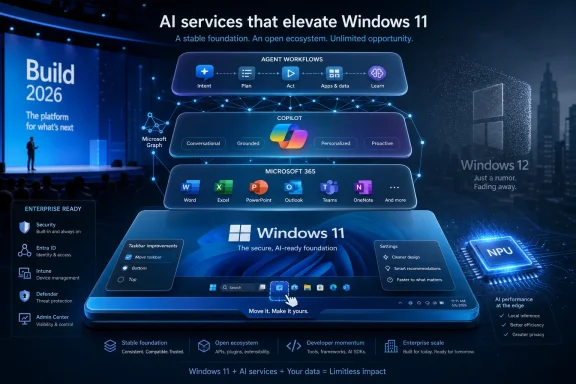
Microsoft has not announced Windows 12 for 2026, and the company’s recent Windows Insider builds, Build 2026 messaging, and enterprise AI disclosures all point instead to Windows 11 remaining the operating-system base for Copilot, agents, and Microsoft 365 services. That is the important part of the current Windows 12 rumor cycle: not merely that one prediction was wrong, but that the old Windows rhythm has stopped being the center of Microsoft’s business. As IBTimes Singapore framed it this week, Microsoft is no longer treating Windows as the launch vehicle for the next era so much as the foundation beneath it. The version number is becoming less interesting than the services Windows keeps within reach.
For most of the PC era, Microsoft taught customers to think in eras. Windows 95 was the consumer internet on a Start button. Windows XP was the home-and-work unification story. Windows 7 was the apology for Vista. Windows 10 was “the last version of Windows,” until Windows 11 became the hardware-security reset that arrived anyway.
That cadence mattered because Windows itself was the product drama. A new version meant a new retail box, a new OEM cycle, a new set of compatibility anxieties, and a new round of consumer judgment. Even when the company moved Windows into a service model, the industry kept expecting Microsoft to return to the pageantry of a major-number launch.
Windows 12 rumors survived because they fit that learned behavior. A more AI-heavy Windows, stricter hardware rules, a new desktop shell, and perhaps a subscription layer all sounded plausible after two years in which Microsoft put Copilot wherever it could find a surface. The rumor was not persuasive because it was well sourced; it was persuasive because it sounded like something Microsoft might do.
But the evidence now points in a different direction. Windows 11 version 26H1 and the expected 26H2 cycle look like continuation releases, not the runway to a renamed OS. Windows Central’s Zac Bowden has reported that Microsoft’s roadmap for 2026 is focused on improving Windows 11, including long-requested usability fixes and a more restrained approach to AI placement. Microsoft’s own Windows Insider blog has continued to describe new builds as Windows 11 builds, not as a transition track to Windows 12.
That distinction matters. A company preparing a major Windows generation usually leaves fingerprints: SDK language, branding shifts, compatibility program changes, version flags, developer guidance, or OEM signaling. Instead, the public trail shows Microsoft polishing Windows 11 while building the next business layer above it.
That fear was not imaginary. Microsoft spent 2024 and 2025 pushing Copilot into Windows with a confidence that often looked indistinguishable from impatience. The assistant appeared in system surfaces, inbox apps, and productivity workflows. Copilot+ PCs introduced a new tier of AI-capable hardware defined around NPUs and local AI workloads. Recall, Click to Do, and AI-enhanced search were presented as the beginning of a new Windows experience.
For users with older PCs, that all looked like the beginning of another compatibility cliff. Windows 11 had already made TPM 2.0, newer CPUs, and secure boot part of the mainstream upgrade conversation. An AI-first Windows 12 with a 40 TOPS NPU requirement sounded like Windows 11’s hardware gatekeeping repeated at higher speed.
That is why Bowden’s pushback landed. Windows Central reported that Microsoft was not preparing Windows 12 for 2026 and was instead concentrating on Windows 11 improvements. In a normal product cycle, “no new version this year” would be a narrow scheduling correction. In this case, it is a strategic tell.
The false rumor described the Microsoft many consumers feared: a company ready to make Windows more expensive, more cloud-dependent, and more AI-saturated. The more interesting reality is that Microsoft appears to have concluded that doing so under a new Windows brand would create more problems than it solves.
The movable taskbar is the perfect symbol. It is not a breakthrough feature, and that is precisely why its absence annoyed people for so long. Windows users did not need Microsoft to explain the future of computing; they needed the operating system to restore a customization option that earlier versions already had.
That kind of work rarely generates keynote applause. It does, however, repair trust. Windows 11’s biggest problem has never been that it lacked futuristic ideas. Its problem has been that too many users felt Microsoft removed familiar affordances, added new friction, and then tried to compensate with features they had not asked for.
The Copilot retreat fits the same pattern. Microsoft has removed or deemphasized some Copilot-branded entry points in apps where the branding felt bolted on. Notepad’s generative features can exist as “Writing Tools” without demanding that every text edit become a Copilot moment. Photos and Snipping Tool do not need a visible AI pitch in every workflow.
That is not Microsoft abandoning AI. It is Microsoft admitting, quietly and pragmatically, that consumer Windows has a tolerance limit. Users may accept AI features that save time, improve accessibility, or perform a specific task. They are much less forgiving when the operating system starts to feel like a showroom for corporate strategy.
That sentiment matters because Windows is not a normal app. Users can uninstall a browser extension, ignore a web service, or switch productivity tools in limited contexts. The operating system is ambient. When unwanted features appear there, they feel less like options and more like conditions imposed on the user.
Microsoft seems to have noticed. Windows and Devices president Pavan Davuluri’s 2026 messaging has emphasized quality, restraint, and putting AI where it has meaningful value. That is a different tone from the earlier Copilot-everywhere phase, when strategic urgency often seemed to outrun product judgment.
The company’s challenge is that AI is both a product and a posture. Microsoft wants investors, developers, and enterprise customers to see it as the platform company best positioned for the agentic era. But ordinary Windows users do not boot their PCs in order to participate in an enterprise AI strategy. They boot them to browse, work, play, edit, manage files, and get out of the way.
That gap explains why a new Windows version would be risky. If Microsoft launched Windows 12 as the AI OS, every complaint about unwanted AI would become part of the upgrade narrative. By keeping the platform as Windows 11 and changing features incrementally, Microsoft lowers the temperature.
The precise accounting around “AI revenue” can be slippery because it spans Azure AI consumption, Copilot subscriptions, model services, and first-party software. But the direction is not slippery at all. Microsoft’s AI growth is primarily an enterprise monetization story, not a consumer Windows monetization story.
That has profound implications for Windows. A consumer might reject Copilot in Photos. An enterprise may pay for Copilot in Word, Teams, Outlook, Excel, SharePoint, and line-of-business workflows because the assistant can be grounded in organizational data through Microsoft Graph. The same brand that irritates a home user can become a budget line for a CIO.
At $30 per user per month before discounts, Microsoft 365 Copilot is not a casual add-on. It is an enterprise productivity bet. Even allowing for negotiated pricing, bundling, and uneven adoption, the revenue opportunity is much more attractive than trying to persuade consumers to buy a new Windows license.
This is why Windows 12 looks less necessary. Microsoft does not need a new OS brand to sell the thing Wall Street cares about. It needs Windows to remain stable, secure, familiar, and deeply connected to Microsoft 365, Entra, Intune, Defender, Azure, and Graph.
That is a major change from the Copilot+ PC launch window, when Windows hardware itself was the star. In 2024, Microsoft needed to explain why NPUs mattered and why a new class of PCs would unlock new experiences. Recall, local models, and Copilot+ exclusives made the PC feel like the next frontier.
By 2026, the conversation had shifted upward in the stack. Microsoft’s Build announcements talked about building and governing agents, securing model behavior, connecting AI to enterprise data, and giving developers controlled execution environments. Windows mattered as a place where these things run, but the main object of desire was no longer a Windows release.
The Microsoft Security Blog’s Build 2026 coverage is instructive here. It discussed securing agents, code, and models across the development lifecycle, including controls for enterprise-ready agents. That is not the language of a desktop operating-system launch. It is the language of a company trying to make AI automation governable enough for regulated organizations.
Windows becomes infrastructure in that model. It supplies identity integration, endpoint controls, local execution, app compatibility, and policy surfaces. But the commercial story happens through services, subscriptions, and management planes layered above the OS.
What has changed is the exclusivity story. Microsoft and its partners increasingly have to account for a market where capable AI acceleration exists in more forms than a specific NPU badge. Discrete GPUs, newer integrated GPUs, and cloud-backed services all complicate a neat Copilot+ dividing line.
Reports from Tom’s Hardware and Windows-focused outlets indicate Microsoft has been testing or expanding Windows AI APIs beyond the original NPU-only framing in some contexts. That is exactly what one would expect as the AI PC market matures. A hard platform cliff may help launch a category, but it becomes limiting once developers want reach and customers want flexibility.
This makes Windows 12 even less attractive as a forcing function. If Microsoft tied a new OS identity too tightly to NPU requirements, it would risk turning AI features into another compatibility grievance. If it launched Windows 12 without a meaningful hardware break, the release would look cosmetic.
Windows 11 lets Microsoft thread the needle. It can offer the best local AI experiences on new hardware while backporting or adapting selected features to broader PC configurations. That is messier than a clean generational reset, but it is better aligned with how Windows actually lives in the world: across hundreds of millions of machines with uneven hardware, update policies, and user tolerance.
Those questions are manageable when the new release is strategically necessary. They are self-inflicted when the real business objective is to expand Microsoft 365 Copilot, Graph-connected agents, and Azure AI consumption. In that context, Windows 12 would be a distraction.
Microsoft also has to live with the memory of Windows 11’s adoption friction. The company raised the security baseline for defensible reasons, but the result was a divided PC installed base and years of confusion around support eligibility. Windows 10’s end-of-support pressure has already created enough upgrade anxiety. Adding Windows 12 speculation on top of that would muddy the message.
There is also a branding problem. Windows 11 is still, for many users, the current Windows they have not fully accepted. Launching Windows 12 before Windows 11 feels finished would confirm the suspicion that Microsoft treats Windows as a perpetual migration exercise rather than a stable computing environment.
That is why the most rational move is the least dramatic one. Keep the brand. Improve the product. Move AI value into places where customers will pay for it. Let Windows become the substrate rather than the spectacle.
Microsoft 365 is stickier. Azure is larger as a strategic growth engine. Security, identity, management, and developer tooling give Microsoft multiple ways to monetize the same customer relationship. AI strengthens those businesses because it gives Microsoft a reason to charge more for workflows customers already use.
Windows’ role is to make that ecosystem feel native. A Windows PC joined to Entra ID, managed by Intune, protected by Defender, connected to OneDrive, and running Teams and Office is not just an endpoint. It is the client face of Microsoft’s commercial cloud.
That is why the consumer annoyance around Copilot has to be managed carefully. Microsoft cannot afford for Windows to become a symbol of forced AI in the same way Internet Explorer once became a symbol of forced bundling. If Windows users start treating every new feature as an intrusion, Microsoft’s broader AI ambitions inherit that distrust.
The better play is to make Windows boring again in the best sense. Stable updates, restored controls, fewer surprise surfaces, clearer settings, better performance, and AI features that earn their place. Boring Windows is not bad for Microsoft. Boring Windows is the launchpad for everything more profitable.
Windows Central’s recent reporting on Project Aion, a reportedly experimental Copilot-centered shell concept built around agentic experiences, shows that Microsoft is still exploring what a more radical AI interface could look like. The important detail is that such work reportedly runs on top of existing platforms rather than necessarily replacing Windows with a traditional major release. That is a very different model from “Windows 12 is coming.”
The future may look less like Windows 12 and more like optional shells, managed enterprise agent environments, cloud PCs, specialized devices, and Copilot experiences that follow the user across endpoints. Microsoft can innovate above Windows without asking everyone to reinstall the world.
That approach has historical irony. Windows became dominant because it abstracted hardware complexity for applications. Now Microsoft wants Microsoft 365, Graph, Copilot, and Azure to abstract operating-system complexity for agents and enterprise workflows. The platform boundary is moving again.
For enthusiasts, that can feel unsatisfying. A new Windows version gives the community something tangible to test, critique, optimize, and argue about. A service-layer transition is harder to see. But it may be more consequential than a new Start menu ever would be.
 Microsoft Has Learned to Stop Needing a Windows Moment
For most of the PC era, Microsoft taught customers to think in eras. Windows 95 was the consumer internet on a Start button. Windows XP was the home-and-work unification story. Windows 7 was the apology for Vista. Windows 10 was “the last version of Windows,” until Windows 11 became the hardware-security reset that arrived anyway.That cadence mattered because Windows itself was the product drama. A new version meant a new retail box, a new OEM cycle, a new set of compatibility anxieties, and a new round of consumer judgment. Even when the company moved Windows into a service model, the industry kept expecting Microsoft to return to the pageantry of a major-number launch.
Windows 12 rumors survived because they fit that learned behavior. A more AI-heavy Windows, stricter hardware rules, a new desktop shell, and perhaps a subscription layer all sounded plausible after two years in which Microsoft put Copilot wherever it could find a surface. The rumor was not persuasive because it was well sourced; it was persuasive because it sounded like something Microsoft might do.
But the evidence now points in a different direction. Windows 11 version 26H1 and the expected 26H2 cycle look like continuation releases, not the runway to a renamed OS. Windows Central’s Zac Bowden has reported that Microsoft’s roadmap for 2026 is focused on improving Windows 11, including long-requested usability fixes and a more restrained approach to AI placement. Microsoft’s own Windows Insider blog has continued to describe new builds as Windows 11 builds, not as a transition track to Windows 12.
That distinction matters. A company preparing a major Windows generation usually leaves fingerprints: SDK language, branding shifts, compatibility program changes, version flags, developer guidance, or OEM signaling. Instead, the public trail shows Microsoft polishing Windows 11 while building the next business layer above it.
The Windows 12 Rumor Was Wrong in a Revealing Way
The now-retracted PCWorld report that helped fuel the latest Windows 12 speculation claimed Microsoft was preparing an AI-first operating system with heavy neural processing requirements and subscription-style AI capabilities. PCWorld later withdrew the story after determining it did not meet its editorial standards. By that point, however, the claim had already done what Windows rumors do best: it gave shape to a fear many users already had.That fear was not imaginary. Microsoft spent 2024 and 2025 pushing Copilot into Windows with a confidence that often looked indistinguishable from impatience. The assistant appeared in system surfaces, inbox apps, and productivity workflows. Copilot+ PCs introduced a new tier of AI-capable hardware defined around NPUs and local AI workloads. Recall, Click to Do, and AI-enhanced search were presented as the beginning of a new Windows experience.
For users with older PCs, that all looked like the beginning of another compatibility cliff. Windows 11 had already made TPM 2.0, newer CPUs, and secure boot part of the mainstream upgrade conversation. An AI-first Windows 12 with a 40 TOPS NPU requirement sounded like Windows 11’s hardware gatekeeping repeated at higher speed.
That is why Bowden’s pushback landed. Windows Central reported that Microsoft was not preparing Windows 12 for 2026 and was instead concentrating on Windows 11 improvements. In a normal product cycle, “no new version this year” would be a narrow scheduling correction. In this case, it is a strategic tell.
The false rumor described the Microsoft many consumers feared: a company ready to make Windows more expensive, more cloud-dependent, and more AI-saturated. The more interesting reality is that Microsoft appears to have concluded that doing so under a new Windows brand would create more problems than it solves.
Windows 11 Is Being Rehabilitated, Not Replaced
If Windows 12 were imminent, Microsoft would have little reason to spend political capital fixing Windows 11’s reputation. Yet that is exactly what the company appears to be doing. Reports from Windows Central and Microsoft’s own preview channels show attention returning to fundamentals: taskbar flexibility, performance, search, update behavior, and a reduction in low-value AI entry points.The movable taskbar is the perfect symbol. It is not a breakthrough feature, and that is precisely why its absence annoyed people for so long. Windows users did not need Microsoft to explain the future of computing; they needed the operating system to restore a customization option that earlier versions already had.
That kind of work rarely generates keynote applause. It does, however, repair trust. Windows 11’s biggest problem has never been that it lacked futuristic ideas. Its problem has been that too many users felt Microsoft removed familiar affordances, added new friction, and then tried to compensate with features they had not asked for.
The Copilot retreat fits the same pattern. Microsoft has removed or deemphasized some Copilot-branded entry points in apps where the branding felt bolted on. Notepad’s generative features can exist as “Writing Tools” without demanding that every text edit become a Copilot moment. Photos and Snipping Tool do not need a visible AI pitch in every workflow.
That is not Microsoft abandoning AI. It is Microsoft admitting, quietly and pragmatically, that consumer Windows has a tolerance limit. Users may accept AI features that save time, improve accessibility, or perform a specific task. They are much less forgiving when the operating system starts to feel like a showroom for corporate strategy.
Consumer Copilot Became a Branding Problem Before It Became a Product Habit
The consumer backlash to Copilot has been unusually blunt. Windows users have mocked the branding, resisted persistent entry points, and treated AI additions as another form of operating-system clutter. The nickname “Microslop,” however crude, captured a real sentiment: that Microsoft was adding things faster than it was making them useful.That sentiment matters because Windows is not a normal app. Users can uninstall a browser extension, ignore a web service, or switch productivity tools in limited contexts. The operating system is ambient. When unwanted features appear there, they feel less like options and more like conditions imposed on the user.
Microsoft seems to have noticed. Windows and Devices president Pavan Davuluri’s 2026 messaging has emphasized quality, restraint, and putting AI where it has meaningful value. That is a different tone from the earlier Copilot-everywhere phase, when strategic urgency often seemed to outrun product judgment.
The company’s challenge is that AI is both a product and a posture. Microsoft wants investors, developers, and enterprise customers to see it as the platform company best positioned for the agentic era. But ordinary Windows users do not boot their PCs in order to participate in an enterprise AI strategy. They boot them to browse, work, play, edit, manage files, and get out of the way.
That gap explains why a new Windows version would be risky. If Microsoft launched Windows 12 as the AI OS, every complaint about unwanted AI would become part of the upgrade narrative. By keeping the platform as Windows 11 and changing features incrementally, Microsoft lowers the temperature.
Enterprise AI Is Where the Money Actually Moves
The consumer story looks messy. The enterprise story looks far more compelling for Microsoft. During its fiscal 2026 reporting, Microsoft said Microsoft 365 Copilot had reached more than 20 million paid commercial seats, and Satya Nadella described Copilot usage as becoming a daily work habit for many customers. TechCrunch highlighted the paid-seat figure after Microsoft’s April earnings call, while broader AI revenue run-rate estimates put Microsoft’s AI business in the tens of billions annually.The precise accounting around “AI revenue” can be slippery because it spans Azure AI consumption, Copilot subscriptions, model services, and first-party software. But the direction is not slippery at all. Microsoft’s AI growth is primarily an enterprise monetization story, not a consumer Windows monetization story.
That has profound implications for Windows. A consumer might reject Copilot in Photos. An enterprise may pay for Copilot in Word, Teams, Outlook, Excel, SharePoint, and line-of-business workflows because the assistant can be grounded in organizational data through Microsoft Graph. The same brand that irritates a home user can become a budget line for a CIO.
At $30 per user per month before discounts, Microsoft 365 Copilot is not a casual add-on. It is an enterprise productivity bet. Even allowing for negotiated pricing, bundling, and uneven adoption, the revenue opportunity is much more attractive than trying to persuade consumers to buy a new Windows license.
This is why Windows 12 looks less necessary. Microsoft does not need a new OS brand to sell the thing Wall Street cares about. It needs Windows to remain stable, secure, familiar, and deeply connected to Microsoft 365, Entra, Intune, Defender, Azure, and Graph.
Build 2026 Put Agents Above the Operating System
Microsoft Build 2026 made the hierarchy clear. The company’s developer messaging centered on agents, AI governance, app generation, model tooling, GitHub Copilot, Microsoft Foundry, and enterprise controls. Windows was present, but not as the protagonist.That is a major change from the Copilot+ PC launch window, when Windows hardware itself was the star. In 2024, Microsoft needed to explain why NPUs mattered and why a new class of PCs would unlock new experiences. Recall, local models, and Copilot+ exclusives made the PC feel like the next frontier.
By 2026, the conversation had shifted upward in the stack. Microsoft’s Build announcements talked about building and governing agents, securing model behavior, connecting AI to enterprise data, and giving developers controlled execution environments. Windows mattered as a place where these things run, but the main object of desire was no longer a Windows release.
The Microsoft Security Blog’s Build 2026 coverage is instructive here. It discussed securing agents, code, and models across the development lifecycle, including controls for enterprise-ready agents. That is not the language of a desktop operating-system launch. It is the language of a company trying to make AI automation governable enough for regulated organizations.
Windows becomes infrastructure in that model. It supplies identity integration, endpoint controls, local execution, app compatibility, and policy surfaces. But the commercial story happens through services, subscriptions, and management planes layered above the OS.
The Copilot+ PC Bet Is Being Softened, Not Abandoned
The absence of Windows 12 does not mean Microsoft is backing away from AI hardware. Copilot+ PCs still represent the company’s preferred direction for local AI, especially for features that benefit from on-device inference, privacy boundaries, low latency, and battery-efficient NPUs. The hardware story remains real.What has changed is the exclusivity story. Microsoft and its partners increasingly have to account for a market where capable AI acceleration exists in more forms than a specific NPU badge. Discrete GPUs, newer integrated GPUs, and cloud-backed services all complicate a neat Copilot+ dividing line.
Reports from Tom’s Hardware and Windows-focused outlets indicate Microsoft has been testing or expanding Windows AI APIs beyond the original NPU-only framing in some contexts. That is exactly what one would expect as the AI PC market matures. A hard platform cliff may help launch a category, but it becomes limiting once developers want reach and customers want flexibility.
This makes Windows 12 even less attractive as a forcing function. If Microsoft tied a new OS identity too tightly to NPU requirements, it would risk turning AI features into another compatibility grievance. If it launched Windows 12 without a meaningful hardware break, the release would look cosmetic.
Windows 11 lets Microsoft thread the needle. It can offer the best local AI experiences on new hardware while backporting or adapting selected features to broader PC configurations. That is messier than a clean generational reset, but it is better aligned with how Windows actually lives in the world: across hundreds of millions of machines with uneven hardware, update policies, and user tolerance.
A New Version Number Would Create Problems Microsoft No Longer Needs
A Windows 12 launch would not merely be a marketing event. It would trigger a long chain of operational consequences. OEMs would need messaging. Enterprises would need evaluation plans. Admins would ask about deployment rings, group policies, application compatibility, driver support, and end-of-life timelines. Consumers would ask whether their PCs qualify.Those questions are manageable when the new release is strategically necessary. They are self-inflicted when the real business objective is to expand Microsoft 365 Copilot, Graph-connected agents, and Azure AI consumption. In that context, Windows 12 would be a distraction.
Microsoft also has to live with the memory of Windows 11’s adoption friction. The company raised the security baseline for defensible reasons, but the result was a divided PC installed base and years of confusion around support eligibility. Windows 10’s end-of-support pressure has already created enough upgrade anxiety. Adding Windows 12 speculation on top of that would muddy the message.
There is also a branding problem. Windows 11 is still, for many users, the current Windows they have not fully accepted. Launching Windows 12 before Windows 11 feels finished would confirm the suspicion that Microsoft treats Windows as a perpetual migration exercise rather than a stable computing environment.
That is why the most rational move is the least dramatic one. Keep the brand. Improve the product. Move AI value into places where customers will pay for it. Let Windows become the substrate rather than the spectacle.
The Old Windows Business Has Been Swallowed by the Microsoft 365 Machine
Windows still matters enormously. It remains the default enterprise desktop, the heart of the PC ecosystem, and one of Microsoft’s most powerful strategic assets. But it is no longer the company’s cleanest growth narrative.Microsoft 365 is stickier. Azure is larger as a strategic growth engine. Security, identity, management, and developer tooling give Microsoft multiple ways to monetize the same customer relationship. AI strengthens those businesses because it gives Microsoft a reason to charge more for workflows customers already use.
Windows’ role is to make that ecosystem feel native. A Windows PC joined to Entra ID, managed by Intune, protected by Defender, connected to OneDrive, and running Teams and Office is not just an endpoint. It is the client face of Microsoft’s commercial cloud.
That is why the consumer annoyance around Copilot has to be managed carefully. Microsoft cannot afford for Windows to become a symbol of forced AI in the same way Internet Explorer once became a symbol of forced bundling. If Windows users start treating every new feature as an intrusion, Microsoft’s broader AI ambitions inherit that distrust.
The better play is to make Windows boring again in the best sense. Stable updates, restored controls, fewer surprise surfaces, clearer settings, better performance, and AI features that earn their place. Boring Windows is not bad for Microsoft. Boring Windows is the launchpad for everything more profitable.
The Future Windows Release May Not Be Called Windows 12
None of this means Microsoft will never change Windows branding again. Product names are not laws of physics. A future hardware transition, security architecture shift, cloud-client strategy, or AI shell could still justify a new label.Windows Central’s recent reporting on Project Aion, a reportedly experimental Copilot-centered shell concept built around agentic experiences, shows that Microsoft is still exploring what a more radical AI interface could look like. The important detail is that such work reportedly runs on top of existing platforms rather than necessarily replacing Windows with a traditional major release. That is a very different model from “Windows 12 is coming.”
The future may look less like Windows 12 and more like optional shells, managed enterprise agent environments, cloud PCs, specialized devices, and Copilot experiences that follow the user across endpoints. Microsoft can innovate above Windows without asking everyone to reinstall the world.
That approach has historical irony. Windows became dominant because it abstracted hardware complexity for applications. Now Microsoft wants Microsoft 365, Graph, Copilot, and Azure to abstract operating-system complexity for agents and enterprise workflows. The platform boundary is moving again.
For enthusiasts, that can feel unsatisfying. A new Windows version gives the community something tangible to test, critique, optimize, and argue about. A service-layer transition is harder to see. But it may be more consequential than a new Start menu ever would be.
The Clues Point to a Quieter, More Profitable Windows Era
The current Windows story is less dramatic than the Windows 12 rumor, but it is more important for anyone who has to use, manage, or support PCs. Microsoft is not stepping back from AI. It is moving AI away from noisy consumer surfaces and toward the enterprise systems where it can be sold, governed, audited, and renewed.- Microsoft has not officially announced Windows 12, and credible Windows roadmap reporting says there is no 2026 Windows 12 launch plan.
- Windows 11 preview builds and Microsoft’s own documentation continue to frame upcoming releases as Windows 11 updates rather than a new OS generation.
- Microsoft is reducing some low-value Copilot entry points while keeping AI features that can be presented as practical tools rather than branding exercises.
- Enterprise Copilot adoption gives Microsoft a stronger financial incentive to improve Windows 11 as a stable platform than to disrupt customers with another major OS migration.
- Build 2026 showed Microsoft’s real priority: agents, governance, Graph-connected workflows, developer tooling, and AI services that sit above Windows.
- The most likely near-term Windows future is incremental Windows 11 evolution, broader AI API support, and tighter Microsoft 365 integration rather than a clean Windows 12 break.
References
- Primary source: International Business Times, Singapore Edition
Published: 2026-07-08T05:47:08.231634
Loading…
www.ibtimes.sg - Related coverage: windowscentral.com
Microsoft Copilot OS revealed in LEAKED video: Lightweight Windows OS exploration features new desktop UI built entirely around Copilot and agentic AI | Windows Central
A leaked video from 2024 has revealed all about Microsoft's internal explorations for a Copilot OS running on a stripped back Windows codebase.www.windowscentral.com - Related coverage: awesomeagents.ai
Microsoft AI Revenue Hits $37B as Copilot Tops 20M Seats | Awesome Agents
Microsoft's Q3 FY2026 earnings show its AI business running at $37 billion annually - up 123 percent - while Copilot enterprise seats hit 20 million, demolishing the low-adoption narrative.awesomeagents.ai - Related coverage: techcrunch.com
Microsoft says it has over 20M paid Copilot users, and they really are using it | TechCrunch
Despite the lingering perception that no one really uses Copilot, Microsoft said on Wednesday that the number of users and engagement is growing.techcrunch.com - Related coverage: pcworld.com
No Windows 12 at Build, but Microsoft has something else up its sleeve | PCWorld
Microsoft's Pavan Davuluri confirmed Windows 12 won't appear at Build 2026, but the new Surface Laptop Ultra with Nvidia N1X might steal the show.www.pcworld.com - Related coverage: theplanettools.ai
Microsoft Copilot: 20M Paid Seats, $37B AI ARR (Q3 FY26) | ThePlanetTools.ai
Microsoft Q3 FY26: 20M paid Copilot seats, $37B AI ARR up 123%, Accenture at 740K seats. Why enterprise AI just crossed from pilot to default deployment.theplanettools.ai
- Related coverage: perplexityaimagazine.com
Microsoft AI Revenue $37 Billion ARR Copilot 20M Seats M365 E7 2026
Microsoft AI Revenue hits $37 billion ARR growing 123% with 20 million Copilot 2026 — the M365 E7 Frontier Suite at $99 changes economics.perplexityaimagazine.com - Official source: learn.microsoft.com
When is windows 12 coming out - Microsoft Q&A
ITS BEEN 5 YEARS SINCE WINDOWS 11 and windows has almst always had a 3 year streak but it been 5 years and still no windows 12. Microsoft is something wronglearn.microsoft.com - Related coverage: windowsforum.com
No Windows 12 in 2026: Microsoft Focuses on Windows 11 Evolution | Windows Forum
The viral claim that Microsoft is preparing a subscription‑only, AI‑first “Windows 12” for 2026 has been emphatically overstated: there is no public...windowsforum.com - Related coverage: digital-chiefs.de
Loading…
www.digital-chiefs.de - Related coverage: techradar.com
Windows 12 at Build 2026: What to expect | TechRadar
What Build 2026 signals about the future of the Windowswww.techradar.com - Official source: blogs.windows.com
Announcing new builds 8 June 2026
[Update 6/11/2026: Release notes have now been published to Windows Insider release notes - Windows Insider Program | Microsoft Learn.]blogs.windows.com - Official source: blogs.microsoft.com
Microsoft Build 2026: Be yourself at work - The Official Microsoft Blog
Platforms shift when developers build. We explore, choose tools, dream, create. This platform shift comes with more information than ever, ready at your fingertips. This shift, it’s about building fast AND THEN: it’s about building, operating, optimizing and observing. Securing your...blogs.microsoft.com - Official source: microsoft.com
Microsoft Build 2026: Securing code, agents, and models across the development lifecycle | Microsoft Security Blog
Discover how Microsoft enables fast, secure AI development with MDASH and new security capabilities.www.microsoft.com - Official source: devblogs.microsoft.com
Build and run agents at scale with Microsoft Foundry at Build 2026 | Microsoft Foundry Blog
Learn how Microsoft Foundry helps developers build, deploy, and operate production-ready agents with Agent Framework, Toolboxes, hosted agents, Microsoft 365 distribution, observability, and agent optimization. devblogs.microsoft.com
- Related coverage: tomshardware.com
Microsoft unveils Project Solara AI, a chip-to-cloud platform built to power a new generation of 'agent-first' enterprise devices — hardware designed to run AI agents instead of traditional apps | Tom's Hardware
Microsoft ditches Windows to build OS on Androidwww.tomshardware.com - Related coverage: tomsguide.com
Biggest Microsoft Build 2026 announcements — agentic AI, RTX Spark Dev Box, GitHub Copilot app, new MAI models, and more | Tom's Guide
All the big news from Microsoft's AI-focused eventwww.tomsguide.com - Official source: adoption.microsoft.com
- Official source: cdn-dynmedia-1.microsoft.com
- Official source: marketing.partner.microsoft.com
Slide 1: Use the Teams AI Library to build your own Copilot Sample high-level architecture
PDF documentmarketing.partner.microsoft.com