

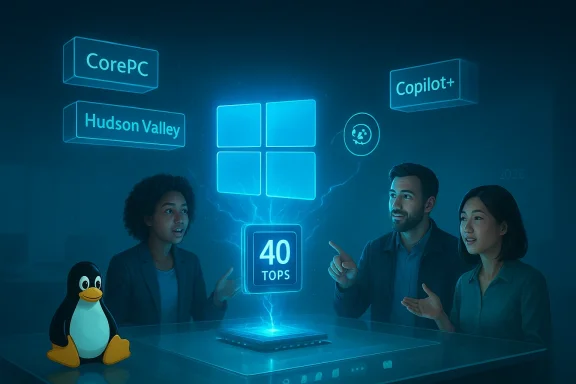
Microsoft’s once‑a‑generation rhythm appears to be collapsing into a blur of rumors, roadmaps and industry counter‑claims: this week’s viral sprint about a supposed “Windows 12” — codenamed Hudson Valley Next and described as a modular, AI‑first OS that gates advanced features behind 40+ TOPS NPUs and optional subscriptions — is part leak, part recycling of older projects, and part reaction to a larger anxiety inside the Windows ecosystem. The story started as a PCWorld roundup of scattered clues, was amplified by mainstream outlets and social media, and was swiftly rebutted by long‑standing Windows reporters who say 2026 is meant to be a year of repair for Windows 11 rather than a launch year for a successor.
Microsoft’s public roadmap for the Windows client has been muddied by two parallel currents for several years: an engineering shift toward on‑device AI acceleration (Copilot, Copilot+ PCs and NPUs) and an internal history of modular OS experiments (Windows Core OS, Windows 10X, CorePC). Those currents have produced credible engineering artifacts — partner guidance on Copilot+ PCs and incremental Windows 11 features in Insider channels — but they have not, so far, produced a confirmed, new, numbered consumer OS release with shipping timelines and formal system requirements. The rumor stream that coalesced this week stitches together those artifacts into a single narrative about a 2026 “Windows 12,” and the result is both plausible and partially unverifiable.
Independent industry reporting — from outlets that follow silicon launches and OEM roadmaps — corroborates both the existence of the Copilot+ definition and the push toward NPUs with TOPS figures in that range. Coverage of new AMD and Intel AI‑focused chips shows vendors racing to deliver NPUs capable of tens of TOPS, and OEM messaging increasingly highlights integrated NPU performance as a selling point. That corroboration indicates Microsoft and hardware partners are converging on on‑device performance goals, even if a full OS release predicated on them is not yet confirmed.
Why Linux? A few dynamics drive that reaction:
Conclusion: treat the “Windows 12” headlines as a mixture of engineering signals and rumor, expect Microsoft to prioritize stability for Windows 11 in the near term, and plan purchases and upgrades around published Copilot+ hardware guidance — not social‑media panic.
Source: TechRadar https://www.techradar.com/computing...eavy-ai-focus-and-the-hate-is-strong-already/
 Background
Microsoft’s public roadmap for the Windows client has been muddied by two parallel currents for several years: an engineering shift toward on‑device AI acceleration (Copilot, Copilot+ PCs and NPUs) and an internal history of modular OS experiments (Windows Core OS, Windows 10X, CorePC). Those currents have produced credible engineering artifacts — partner guidance on Copilot+ PCs and incremental Windows 11 features in Insider channels — but they have not, so far, produced a confirmed, new, numbered consumer OS release with shipping timelines and formal system requirements. The rumor stream that coalesced this week stitches together those artifacts into a single narrative about a 2026 “Windows 12,” and the result is both plausible and partially unverifiable.What the rumors actually claim
The core claims
- A successor to Windows 11 — often called “Windows 12” or “Hudson Valley Next” — will ship broadly in 2026, timed around Windows 10’s extended‑support end.
- The OS will be modular (an evolution of the “CorePC” idea), letting Microsoft ship leaner builds for specific device classes and update core pieces independently.
- AI will be baked in: Copilot moves from being an add‑on to a system‑level orchestrator and agent platform. Some advanced AI features will be exclusive to machines with dedicated NPUs that can deliver around 40 TOPS (trillions of operations per second).
- There will be visual and interaction changes (floating taskbar, glass/transparency tweaks) based on leaked UI mockups.
- Microsoft might adopt a mixed commercial model: keep core Windows licensing but offer subscription tiers (or Windows 365‑style packages) for enhanced AI features, particularly cloud‑backed capabilities.
Verifying the most load‑bearing technical claims
The 40+ TOPS NPU requirement
Microsoft’s Copilot+ PC program does publicly describe a 40+ TOPS NPU threshold as a differentiator for Copilot+ devices — that guidance is present on Microsoft’s documentation and product pages. That 40 TOPS number is used as a marketing and engineering boundary for on‑device experiences like real‑time translation, cocreation and Recall‑style features. In other words: the 40+ TOPS threshold is a real, company‑level criterion for Copilot+ experiences, but it applies to a device tier (Copilot+ PCs) rather than an absolute gating mechanism for all Windows features.Independent industry reporting — from outlets that follow silicon launches and OEM roadmaps — corroborates both the existence of the Copilot+ definition and the push toward NPUs with TOPS figures in that range. Coverage of new AMD and Intel AI‑focused chips shows vendors racing to deliver NPUs capable of tens of TOPS, and OEM messaging increasingly highlights integrated NPU performance as a selling point. That corroboration indicates Microsoft and hardware partners are converging on on‑device performance goals, even if a full OS release predicated on them is not yet confirmed.
CorePC, Hudson Valley and modular Windows
CorePC (and related internal names like Hudson Valley) appear repeatedly in leaks and historical notes about Microsoft’s platform experiments. But the context is important: CorePC traces back to earlier engineering efforts around modularizing Windows (some efforts date to 2023 and were discussed during the Windows 10X / WCOS era). Several experienced Windows reporters say CorePC is an older initiative that has not shipped and that the current engineering plan for 2026 emphasizes Win11 fixes and feature evolution rather than a wholesale CorePC rollout as “Windows 12.” In short: the names and architectural ideas are real; the claim that they’ll produce a wide consumer OS launch in 2026 is, at best, unproven.How credible is the “Windows 12 in 2026” timeline?
Two predictable forces shape the timeline story: the Windows 10 support calendar (October 2026 is the canonical end‑of‑support horizon for older Windows 10 SKUs) and the PR momentum around Copilot+ hardware roadmaps. Those factors create a plausible window for a new OS announcement. But credible industry insiders and Microsoft tracking journalists, who brief regularly with engineering and partner teams, report that 2026 is being treated internally as a repair and consolidation year for Windows 11 — “swarming” on reliability, performance and user‑facing pain points — not as a number‑change launch year. That push to restore trust, especially after high‑profile update regressions, argues against a simultaneous, big‑bang new OS rollout.What Microsoft is actually doing right now (public signals)
- Copilot+ PC program: Microsoft has an explicit Copilot+ classification and public guidance about 40+ TOPS NPUs for advanced on‑device AI experiences. That is a real, shipping story across OEMs and qualifying devices.
- Windows 11 quality/repair focus: multiple outlets report that Microsoft has redirected engineering resources to address performance, reliability and UX regressions in Windows 11 — an internal tactic often described as “swarming.” Those public reports quote senior Windows execs and analyzing journalists; they explain why Microsoft might prioritize stabilization rather than launching a successor this year.
The reaction: why the story blew up on Reddit and why Linux is mentioned so often
The dramatic element in this week’s cycle is not purely technical; it’s emotional. The rumor — interpreted by many as an attempt to lock advanced AI features behind new silicon or paid tiers — triggered a predictable backlash among longtime Windows users and hobbyist communities. Reddit threads and comment streams reacted with anger and resignation: “It’s going to be a good year for Linux,” became shorthand for the sense that Microsoft was pushing people off perfectly functional hardware. Tech commentary outlets quoted multiple such reactions to underscore the intensity of the pushback.Why Linux? A few dynamics drive that reaction:
- Hardware gating feels like planned obsolescence: demanding a device with a 40+ TOPS NPU for full features threatens the installed base of millions of machines.
- Subscription + AI = perceived double‑charge: users already pay for devices and Windows licenses; adding paid AI tiers creates the sense of monetization layered on top of core functionality.
- Trust erosion: repeated update regressions and intrusive prompts in Windows 11 have already frayed goodwill; a new, hardware‑gated OS announcement would be perceived as tone‑deaf.
The risks and practical impacts — a close analysis
For consumers
- Upgrade confusion and expense: gating “full” functionality behind NPU performance means many existing devices could be marketed as “capable” but excluded from prime features unless upgraded. That accelerates refresh cycles for consumers who value AI features.
- Fragmented experience: modular OS builds plus variable Copilot capabilities across NPUs, cloud connectivity and subscription tiers could create a confusing product matrix for buyers.
For enterprises
- Migration and compliance costs: businesses value predictable servicing and long‑term stability. New hardware gating would impose device refresh costs and procurement challenges, especially where line‑of‑business compatibility matters.
- Manageability: modular updates and subscription features complicate patching and licensing. IT teams prefer clear upgrade entitlements and roll‑out windows; ambiguity raises operational risk.
For privacy and data residency
- On‑device vs cloud trade‑offs: Microsoft’s Copilot strategy mixes local neural inference with cloud‑backed models. Subscription tiers that rely on cloud compute create additional privacy, compliance and cost considerations. Organizations with strict residency rules will need explicit controls.
For the industry and environment
- Environmental cost: forcing hardware refreshes to access convenience features increases e‑waste and embodied carbon unless Microsoft and OEMs offer trade‑in, recycling and long support options.
- Market segmentation: an AI hardware arms race between Qualcomm, Intel, AMD and others may lock features to certain silicon vendors or device classes during early transition phases.
Strengths in the rumor’s logic — why it’s plausible
- Microsoft already defines Copilot+ and publicly promotes 40+ TOPS NPUs for advanced experiences, so that number is not a random invention.
- OEMs and silicon vendors (AMD, Intel) are shipping chips and marketing NPUs with tens of TOPS, which would enable the kinds of local AI experiences described. Those platform moves make an AI‑centric Windows both technically feasible and commercially attractive.
Weaknesses and reasons to be skeptical
- Single‑source aggregation: much of the Windows 12 narrative comes from a handful of leaks and recycled project names; credible reporters with deep Microsoft contacts explicitly dispute the time frame. That contrast between aggregation and insider reporting is a major red flag.
- Engineering realism: Microsoft is publicly re‑allocating resources to solve Windows 11 reliability issues — shipping a large new OS in the same year would strain that effort and risk further trust erosion.
What users and IT teams should do now
- Verify hardware capability before buying: if you care about on‑device AI features, look for Copilot+ certification and explicit NPU performance claims (40+ TOPS is Microsoft’s marketing boundary for Copilot+).
- Stage updates conservatively: enterprises should continue established staging, testing and canary processes for Windows 11 updates; assume Microsoft will prioritize reliability fixes in 2026.
- Consider alternatives for aging hardware: if your devices can’t meet future NPU expectations, evaluate extended security options, Linux alternatives for specific workloads, or delayed refresh cycles with a plan for secure maintenance.
- Watch licensing closely: treat claims of subscription gating as unverified until Microsoft publishes clear entitlements, prices and upgrade paths. Don’t assume a paywall until the vendor confirms exact terms.
The bottom line: what actually matters
A few concrete facts are settled and worth remembering. Microsoft’s Copilot+ program and the 40+ TOPS Copilot+ messaging are real and published by Microsoft; hardware makers are shipping NPUs with performance in the tens of TOPS; and the names “CorePC” and “Hudson Valley” have pedigree as internal project terms. But the leap from those fragments to a full, numbered Windows 12 launch in 2026 — with mandatory NPU gating and subscription‑locked AI agents — is not confirmed. Senior Microsoft watchers and reporters say 2026 is more likely to be a year when Microsoft tries to “fix” Windows 11’s trust problem rather than launch a successor. Treat the Windows 12 rumor as a high‑impact headline built from a mix of genuine signals, older project names and speculation, not as an authoritative roadmap.Final assessment and what to watch next
If you want to track this story responsibly, watch for three things from Microsoft and partners:- Official Microsoft messaging about a new product name, shipping dates and exact upgrade entitlements (free vs paid, device eligibility). Until Microsoft publishes clear upgrade policy, treat subscription claims as hypotheses.
- Copilot+ feature rollout lists and hardware certification updates from Microsoft and OEM announcements — these will concretely show which experiences are tied to on‑device NPUs and which still rely on cloud backends.
- Reporting from established Microsoft reporters (those who commonly brief with Microsoft engineering and partners) and independent confirmation from at least two sources before accepting sweeping product claims. The recent back‑and‑forth between PCWorld, TechRadar and Windows Central is a textbook example of how to treat rumor cycles: plausible one moment, debunked or qualified the next.
Conclusion: treat the “Windows 12” headlines as a mixture of engineering signals and rumor, expect Microsoft to prioritize stability for Windows 11 in the near term, and plan purchases and upgrades around published Copilot+ hardware guidance — not social‑media panic.
Source: TechRadar https://www.techradar.com/computing...eavy-ai-focus-and-the-hate-is-strong-already/
