

For the first time since its debut, Windows 7’s grip on the desktop has slipped below 50%, a milestone that reads like a swan song for a once-ubiquitous operating system — but the numbers behind that headline deserve scrutiny. 2017-era web-analytics revisions from NetMarketShare produced a dramatic one-month fall to 43.12%, a drop that TechRadar and contemporaneous outlets tied to a deliberate change in methodology designed to strip out automated (bot) traffic. That update exposed how measurement choices can make an OS look larger — or smaller — than it really is, and it offers a timely reminder: reading market-share tea leaves requires more than one thermometer.
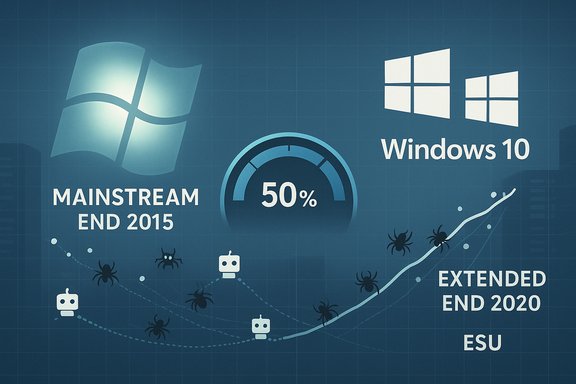
Windows 7 arrived in October 2009 and quickly became the corporate and consumer favorite that Vista never was. Its interface, stability and broad hardware compatibility cemented a long tail of use that survived the release of Windows 10 in 2015. Microsoft’s official lifecycle timeline shows a clear, staged sunsetting process: mainstream support ended on January 13, 2015, and extended support formally ended on January 14, 2020 for mainstream Windows 7 editions — though some embedded and specialized variants received longer update windows under separate schedules. Those lifecycle dates set the security and commercial backdrop for all later migration conversations. NetMarketShare’s late-2017 revision — which pushed Windows 7’s market share below half of active Windows desktops — triggered a flurry of headlines that framed the decline as an accelerating exodus to Windows 10. But a significant part of the story was methodological: NetMarketShare rebuilt its data collection and bot-detection pipeline, then reissued historical numbers with bot-inflation removed. The result was a noticeably smaller Windows 7 footprint than earlier reports had suggested.
NetMarketShare explicitly acknowledged that bots “can cause significant skewing of data,” and described a wholesale rebuild of its collection and aggregation infrastructure to detect and remove suspicious traffic patterns. That revision produced a numerical change large enough to alter the public narrative about Windows 7’s decline. In plain terms: some portion of the earlier Windows 7 share was not human browsing at all.
For IT managers and vigilant home users, the motion is straightforward: inventory your estate, plan migrations around high-risk endpoints first, consider ESU as short-term cover only, and remember that a seemingly small share often represents a large and exploitable group of devices. The market-share drama matters most when it affects operational security — and on that front the advice is timeless: prioritize patches, reduce exposure, and migrate on a plan that balances cost, risk and continuity.
Source: Mashable Windows 7 users are officially dropping like flies
 Background
Windows 7 arrived in October 2009 and quickly became the corporate and consumer favorite that Vista never was. Its interface, stability and broad hardware compatibility cemented a long tail of use that survived the release of Windows 10 in 2015. Microsoft’s official lifecycle timeline shows a clear, staged sunsetting process: mainstream support ended on January 13, 2015, and extended support formally ended on January 14, 2020 for mainstream Windows 7 editions — though some embedded and specialized variants received longer update windows under separate schedules. Those lifecycle dates set the security and commercial backdrop for all later migration conversations. NetMarketShare’s late-2017 revision — which pushed Windows 7’s market share below half of active Windows desktops — triggered a flurry of headlines that framed the decline as an accelerating exodus to Windows 10. But a significant part of the story was methodological: NetMarketShare rebuilt its data collection and bot-detection pipeline, then reissued historical numbers with bot-inflation removed. The result was a noticeably smaller Windows 7 footprint than earlier reports had suggested. What the original story said — and what it actually meant
The core claims running through the original Mashable/TechRadar-style coverage were these:- A single-month NetMarketShare adjustment placed Windows 7 at 43.12%, down about 3.5% year-over-year and showing a recent monthly decline of roughly 2.6%.
- NetMarketShare identified bot traffic as a significant confounder and said its previous methodology had overstated Windows 7’s presence.
- That decline was being interpreted as users upgrading to Windows 10, but the data revision suggested the prior Windows 7 numbers were artificially high.
Why the bot story matters
Bots are ubiquitous across the modern web. Some are benign (search engine crawlers), some are operational (monitoring or distribution services), and others are outright malicious (ad fraud, traffic stuffing, credential harvesting). When a measurement vendor relies on client-side signals from a panel of websites, and that panel sees significant bot traffic, a platform like Windows 7 — historically widespread on older devices and servers — can end up over-represented.NetMarketShare explicitly acknowledged that bots “can cause significant skewing of data,” and described a wholesale rebuild of its collection and aggregation infrastructure to detect and remove suspicious traffic patterns. That revision produced a numerical change large enough to alter the public narrative about Windows 7’s decline. In plain terms: some portion of the earlier Windows 7 share was not human browsing at all.
The measurement problem — two different kinds of “share”
- Pageview-weighted share (what NetMarketShare reports): Measures the fraction of web traffic (pageviews) attributable to devices identifying a specific OS. Vulnerable to bot traffic and behavioral skew (heavy users = heavier weight).
- Installed-base or device census (OEMs, security vendors): Measures how many devices are actually running a given OS at a point in time. Requires device-level telemetry or inventorying and tends to lag web-usage signals.
The lifecycle reality: what Microsoft officially did (and when)
Microsoft’s lifecycle policy for Windows 7 was explicit and staged. Key dates and program elements to remember:- Mainstream support end: January 13, 2015. After that date Windows 7 no longer received new feature development or free mainstream support.
- Extended support end: January 14, 2020. The familiar “end of support” label after which non-ESU users stopped receiving security patches for consumer editions. Microsoft provided paid Extended Security Updates (ESU) for eligible systems for a limited period.
What the numbers did — and did not — imply for users in 2017
Headlines that treated the November 2017 revision as a straight migration story missed nuance. The revised figures told us:- The web-visible footprint of Windows 7 had been overestimated because of bot traffic that preferentially impersonated older systems.
- Windows 10 adoption was, therefore, slightly larger relative to Windows 7 than prior NetMarketShare releases suggested.
- However, the installed base of Windows 7 devices remained substantial for years after support ended, especially in business environments, embedded systems, and regions where hardware refresh cycles run long.
Security consequences: why small percentages can mean big risks
Even with a corrected share, millions of devices remained on Windows 7 well after mainstream updates stopped. The operational risk from continued use of an unsupported OS is systemic:- No routine security updates means new vulnerabilities remain exploitable indefinitely on unpatched machines.
- Attackers focus on exposed, homogeneous targets; large tails of legacy systems are attractive targets for ransomware and supply-chain abuse.
- Organizations that keep unsupported endpoints in production raise questions for insurers and regulators about reasonable cybersecurity hygiene. Security vendors warned repeatedly that attackers would weaponize support cutoffs as attack triggers.
How much did the NetMarketShare revision actually move the needle?
To keep claims concrete: NetMarketShare’s 2017 adjustment moved reported Windows 7 share from the mid- to high-40s down to the low-40s in web-analytics terms, and it raised Windows 10’s share proportionally. The precise snapshot often quoted — 43.12% — came from that revised November dataset. That number was notable precisely because it crossed the psychological 50% threshold and helped frame Windows 7 as “retro” in media narratives. But that single figure is best read as an artifact of NetMarketShare’s improved bot filtering rather than as definitive proof of mass user migration in that single month.Beyond 2017: how the end-of-life conversation evolved
Windows 7’s formal retirement in January 2020 became a live security problem for organizations that deferred migration. Microsoft’s ESU program and later decisions to offer limited paid updates extended lifelines for certain customers through staggered windows (for some embedded variants and enterprise volume-licensed editions). These contractual patching options were always stopgaps: they limited exposure while migrations were planned but did nothing to compel indefinite reliance on an outdated platform. Subsequent years saw similar lifecycle debates for Windows 10, including its own end-of-support planning and consumer ESU options.The Windows 10 parallel
Microsoft set a new, hard end-of-life date for Windows 10: October 14, 2025. The company offered a consumer ESU pathway (including a modest fee for continued security updates), and it made clear the strategic push toward Windows 11 as the modern, secure platform. The Windows 10 retirement illustrated the same dynamics we saw in the Windows 7 era: large installed bases, hardware eligibility differences for upgrades, and a patchwork of enterprise migration timelines. Those realities made migration rates uneven and extended the lifespan of older systems in pockets around the world.Analytical takeaways for IT managers and power users
- Data literacy matters: When reading market-share headlines, distinguish between pageview-weighted metrics and installed-base inventories. The former reflects active web traffic; the latter counts devices. Both are useful but answer different questions.
- Don’t let aggregated percentages lull you: A single-digit percentage of a global installed base still translates into millions of endpoints — more than enough to sustain targeted criminal campaigns. Even a 1% tail on a billion devices is material.
- Paid ESUs are bridges, not solutions: Microsoft’s ESU programs (for Windows 7 historically and for Windows 10 more recently) provide breathing room. They are explicitly priced and time-limited. Treat ESUs as temporary mitigation while you perform an orderly migration.
- Plan migrations holistically: Upgrading an OS is not just a software swap. It requires hardware compatibility checks, driver and application testing, user training, backup validation and rollback plans. For businesses, incremental staged rollouts are still the prudent playbook.
Practical migration and remediation options
- Upgrade to a supported Windows version where possible (Windows 11 for eligible hardware).
- Enroll eligible systems in an ESU program for short-term protection while migration is staged.
- Consider virtualization or containerization for legacy apps that cannot be ported quickly.
- For older hardware that cannot upgrade, evaluate modern Linux distributions or ChromeOS Flex as plausible life-extenders for general-purpose machines.
- Prioritize high-value, high-risk endpoints (domain controllers, financial systems, devices with sensitive data) for early migration.
Strengths and limitations of the reportage and metrics
Strengths:- The NetMarketShare revision was a responsible correction that exposed the scale of bot contamination in web-analytics datasets; improving measurement integrity is inherently valuable.
- Relying on active web measurements provides a timely signal for consumer-facing usage patterns (e.g., which OS versions are surfacing most frequently right now).
- Pageview-weighted data can mislead when not compared to device inventories; headline percentages may over- or understate actual installed base counts.
- Public narratives built on single-provider revisions can cause unnecessary panic or complacency. IT decision-makers should triangulate across OEM telemetry, security-vendor reports, and site analytics.
- The bot problem is persistent and evolving: detection improvements in 2017 won’t be the final word; new evasion techniques continually push the analytical frontier.
Fact-checking and unverifiable claims
- The exact global installed-device count for Windows 7 in any single month is not directly verifiable from web-analytics alone; claims that equate pageview percentages with device counts should be treated cautiously. NetMarketShare’s correction demonstrates how measurement adjustments can materially change the reported share. Where device-level census matters, rely on multiple independent datasets (OEM statements, security vendor telemetry, enterprise inventory) before drawing firm conclusions.
- When specific numerical claims (for example, a precise number of machines still on Windows 7 worldwide) appear in headlines, flag them: they likely represent extrapolations from one dataset rather than a universal device census.
Conclusion: what readers should take away
The NetMarketShare/TechRadar-era headlines that “Windows 7 users are dropping like flies” were not fiction — web-visible Windows 7 traffic dropped — but the most sensational readings misunderstood the mechanics behind the numbers. The fall below 50% reflected a combination of true user migration and, more importantly, a measurement correction that removed bot-inflated traffic. The practical, long-term lesson is unchanged: unsupported operating systems remain a security liability, and accurate measurement of installed bases requires careful triangulation across multiple, methodologically diverse sources.For IT managers and vigilant home users, the motion is straightforward: inventory your estate, plan migrations around high-risk endpoints first, consider ESU as short-term cover only, and remember that a seemingly small share often represents a large and exploitable group of devices. The market-share drama matters most when it affects operational security — and on that front the advice is timeless: prioritize patches, reduce exposure, and migrate on a plan that balances cost, risk and continuity.
Source: Mashable Windows 7 users are officially dropping like flies
