

When a senior Windows executive described the platform as “evolving into an agentic OS,” a wave of user anger, skepticism and wary curiosity swelled across social networks — and that reaction tells us as much about Microsoft’s messaging as it does about the technical direction of Windows itself.
Microsoft’s recent public statements and product previews have made one thing clear: the company is intentionally steering Windows 11 toward deep, system-level AI integration — voice, vision, and automated multi-step actions that can act on behalf of users. That strategy has been framed internally and publicly as a move to make Windows an ambient, agentic platform that connects devices, cloud services and AI to “unlock intelligent productivity and secure work anywhere.”
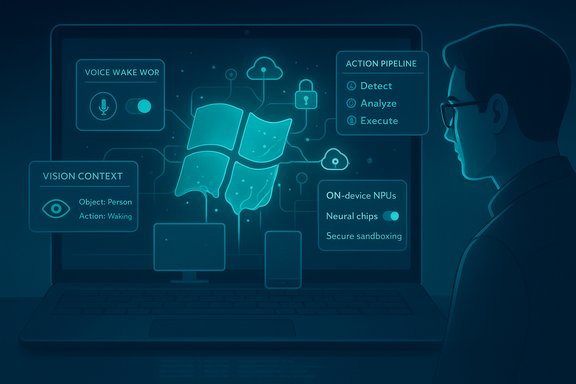
This pivot did not arrive out of nowhere. Over the last year Microsoft has expanded Copilot from a chat-based assistant into a broader set of system features — Copilot Voice (wake-word voice control), Copilot Vision (screen-aware assistance), and Copilot Actions (agentic workflows that can execute multi-step tasks under permission). The company has also introduced a hardware program — Copilot+ PCs — and specified a target performance floor for NPUs used for on-device inference. The 40+ TOPS NPU guidance has been referenced widely in coverage of Microsoft’s Copilot+ messaging.
But describing Windows as “agentic” — an OS that can take initiative, not just respond to user commands — triggered an unusually intense reaction online. The backlash raises two connected questions that businesses and consumers alike are now asking: (1) what does “agentic” actually mean in practice, and (2) should this be the priority when many users still complain about basic Windows usability and reliability?
Why the reaction concentrated on wording:
Caveat: TOPS figures are a useful shorthand, but they are vendor- and workload-dependent. Independent benchmarking will be required to validate on-device performance claims once hardware ships in volume.
But technical potential alone is not enough. The social and political context matters: a patchwork of past UX grievances, trust issues around telemetry and privacy, and the specter of hardware-driven feature gating has produced a volatile environment where a single phrase — “agentic OS” — can inflame a broad audience.
This moment is a test of execution and humility. Microsoft must show that agentic features are optional by default, auditable, and governed in ways that reassure privacy-minded users and enterprise security teams alike. If those technical and governance requirements are met, agentic automation could be a major step forward. If they are not, the push risks hardening user resistance and accelerating friction at the platform level.
Delivering an “agentic Windows” is a marathon, not a marketing sprint. The path forward requires measured rollouts, independent validation, robust admin controls, and above all, user-centric humility: prioritize control, clarity and basic polish before expecting users to trust an assistant that can act on their behalf.
Source: TechRadar https://www.techradar.com/computing...rating-system-is-evolving-into-an-agentic-os/
 Background
Microsoft’s recent public statements and product previews have made one thing clear: the company is intentionally steering Windows 11 toward deep, system-level AI integration — voice, vision, and automated multi-step actions that can act on behalf of users. That strategy has been framed internally and publicly as a move to make Windows an ambient, agentic platform that connects devices, cloud services and AI to “unlock intelligent productivity and secure work anywhere.”This pivot did not arrive out of nowhere. Over the last year Microsoft has expanded Copilot from a chat-based assistant into a broader set of system features — Copilot Voice (wake-word voice control), Copilot Vision (screen-aware assistance), and Copilot Actions (agentic workflows that can execute multi-step tasks under permission). The company has also introduced a hardware program — Copilot+ PCs — and specified a target performance floor for NPUs used for on-device inference. The 40+ TOPS NPU guidance has been referenced widely in coverage of Microsoft’s Copilot+ messaging.
But describing Windows as “agentic” — an OS that can take initiative, not just respond to user commands — triggered an unusually intense reaction online. The backlash raises two connected questions that businesses and consumers alike are now asking: (1) what does “agentic” actually mean in practice, and (2) should this be the priority when many users still complain about basic Windows usability and reliability?
What Pavan Davuluri actually said — and why the wording mattered
Pavan Davuluri, who leads Windows and Devices at Microsoft, posted a message that summarized the company’s long-term vision for the platform: Windows is “evolving into an agentic OS, connecting devices, cloud, and AI to unlock intelligent productivity and secure work anywhere.” That phrase — agentic OS — is the phrase that circulated rapidly and provoked the most visible pushback on social platforms.Why the reaction concentrated on wording:
- “Agentic” implies initiative: It suggests software that acts rather than waits for instruction, a semantic shift that raises questions about autonomy and control.
- Context matters: The post was aimed at Ignite attendees and enterprise customers, but the phrase leaked into broader consumer channels — where many users interpret “agentic” as potential for intrusive automation or unexpected system actions.
- Trust deficit: Years of contentious UI changes, telemetry debates, and upsell behaviors have left a segment of Windows users primed to mistrust any feature that might contest user intent or privacy.
What “agentic OS” would mean technically
Core components Microsoft is building into Windows
Microsoft’s public and technical signals point to a multi-layered architecture that makes agentic features possible:- Multimodal inputs: native support for voice wake words, vision-based context capture (with user permission), and richer natural-language understanding across apps.
- Agent sandboxing and permissions: a controlled workspace model where agentic actions run with explicit authorization and logging; Microsoft has described permission gating and sandboxes in previews.
- Local/Hybrid inference model: small models and wake-word spotters run locally, heavier reasoning falls to the cloud unless the device meets Copilot+ hardware criteria. The company is steering richer on-device experiences to devices with NPUs that meet certain performance metrics.
- Developer primitives and protocols: APIs and platform-level integration (protocols like Model Context Protocol and a Windows AI Foundry in Microsoft messaging) to allow apps and services to interoperate with agentic capabilities.
The Copilot+ hardware tier and the NPU argument
Microsoft’s Copilot+ concept frames a two-tier hardware reality: baseline Copilot features can be offered broadly, but the fastest and most private experiences will run on Copilot+ devices that include robust NPUs. Several outlets and briefings have cited a 40+ TOPS baseline for devices that will deliver the fullest on-device inference. This is a performance guideline — not a universal guarantee — and its practical effect will be to stratify experience by hardware.Caveat: TOPS figures are a useful shorthand, but they are vendor- and workload-dependent. Independent benchmarking will be required to validate on-device performance claims once hardware ships in volume.
Why users rebelled: three overlapping grievances
- Buzzwords instead of basics
- Many long-time Windows users reacted less to the specific AI promise and more to the perception that Microsoft is prioritizing flashy AI features over fixing core pain points: sluggish right-click menus, taskbar limitations (such as the inability to move it freely), inconsistent search responsiveness, and persistent bugs reported in Insider builds. The perception is that the fundamentals of usability have been deprioritized in favor of an AI narrative.
- AI bloat, upsell and monetization concerns
- There’s a growing fear that agentic features will be another surface for upselling Microsoft services or third-party commerce. Users point to prior instances of visible promotions inside Windows and worry that an assistant with initiative could increase the frequency of such nudges. Because Windows is not a subscription product for most consumers, the prospect of persistent in-OS commerce is especially galling.
- Security and privacy fears
- Agentic AI that can “see” your screen or listen for wake words introduces new attack surfaces. Security researchers and privacy advocates have repeatedly flagged similar features (for example, Recall) as contentious: implementation flaws in early builds resulted in storage and access concerns, leading Microsoft to rework and harden those features — but skepticism remains. The combination of always-available multimodal sensors and automated actions raises legitimate questions about data flows, storage, and potential misuse.
What the community actually said (examples and patterns)
Responses spanned from sarcastic memes and parodies of “Clippy 2.0” to measured security critiques and long threads detailing how agentic automation could be exploited. Typical commentary fell into predictable buckets:- “Stop pushing AI — fix the basics” — users demanding attention to everyday regressions in the UI and reliability.
- “Agentic equals autonomy; that scares me” — privacy-minded users worried about what permissions and background access agents will require.
- “If Windows keeps this up, I’ll move to Linux” — a vocal minority reacting by signaling an OS switch; such declarations reflect frustration, though mass migration is unlikely in the short term.
Security, privacy and governance: technical reality vs perception
Real risks to address
- Attack surface growth: wake-word surfaces and vision features create new vectors for accidental or malicious activation (e.g., adversarial audio or visual triggers). Microsoft has proposed on-device spotters and opt-in defaults, but risk remains.
- Data flow ambiguity: hybrid models mean some audio and visual context may be sent to cloud services; retention and telemetry policies must be crystal clear to enterprises and consumers alike.
- Agent action auditability: when an agent performs multi-step actions (send an email, change settings, move files), enterprises need logging, revocation, and forensic trails to mitigate wrongful or erroneous behaviors.
Microsoft’s stated mitigations (and where they fall short)
Microsoft has described a layered approach: local spotters, explicit permission prompts, sandboxed agent workspaces, and enterprise controls for IT policy. These are sensible starting points, but practical adoption will require:- Independent audits and third-party validation of privacy claims.
- Robust default-off modes for consumer devices where agentic features are opt-in and clearly explained during OOBE.
- Enterprise-level policy controls exposed through familiar MDM/GPO telescopes so admins can centrally manage which agents can do what and when.
Enterprise vs consumer realities
For enterprises
Enterprises generally welcome automation but demand governance. The agentic vision maps to clear ROI scenarios: automated ticket triage, contextual document generation, and assistance workflows that reduce repetitive tasks. But CIOs require:- Controlled pilots before broad enablement.
- Audit and DLP integration for any Copilot connectors to corporate mail, SharePoint or ERPs.
- Clear vendor commitments on incident response, data retention and forensic access.
For consumers
Many consumers won’t have Copilot+ hardware and will experience a spectrum of features. For those on older or budget hardware, the agentic future can feel like either vaporware or an unfair carrot dangling beyond their budget — a concern with environmental and equity implications. Communities and activists have raised the specter of accelerated device churn and resultant e-waste.The UX paradox: convenience vs control
Agentic assistants promise to reduce friction — “Summarize my inbox and draft a reply” — but they also raise the question of how much control users are willing to cede. That tension is a historic theme in HCI:- Convenience increases when the assistant reliably carries out tasks.
- Trust collapses when agents make mistakes, surface promotions, or act without transparent undo paths.
Strengths of Microsoft’s approach — why agentic Windows could succeed
- Real productivity gains for certain workflows: multi-step, cross-app automations are genuinely time-saving in many enterprise scenarios; voice and vision features improve accessibility for users with motor or vision impairments.
- Hybrid model is pragmatic: mixing local spotters with cloud reasoning is a realistic compromise between latency, privacy and model capability.
- Platform-level integration: by baking agent capabilities into the OS, Microsoft can reduce friction and make integrations more consistent than siloed third-party assistants. That consistency could be a genuine competitive advantage if executed well.
Key weaknesses and risks Microsoft must address
- Fragmentation by hardware: gating the best experiences to Copilot+ NPUs risks a two-tier Windows experience. This can harm perceptions of fairness and slow mass adoption.
- Perception of monetization: if agent visibility is used to promote Microsoft products or paid features, users will react strongly. Windows is paid software for many, and aggressive in-OS commerce is a volatile move.
- Trust deficit and rollout risks: technical assurances are only half the battle; Microsoft must prove claims through independent audits, transparent telemetry controls and clear opt-in UX during setup.
Practical guidance — what Microsoft should do next
- Prioritize a trust-first rollout: default agentic features to off, require clear opt-in during OOBE, and make permission requests granular and legible.
- Publish independent audits and invite third-party security researchers to validate privacy and storage claims, especially for features that access screen content and audio.
- Provide a lightweight “Classic” or “Lite” experience for devices that don’t need agentic features, reducing pressure for hardware churn and giving users a clear choice. Community concepts for lite variants have proven popular because they promise fewer surprises and less bloat.
- Expose enterprise guardrails upfront: logging policies, DLP connectors, per-agent whitelists, and revocation controls should be administratively enforceable at scale.
Practical guidance — what users and admins should do now
- Audit devices: classify endpoints by Windows 11 eligibility and NPU capability to understand who will receive what features.
- Pilot agentic features cautiously: run small, measurable pilots before enabling Copilot Actions or Recall-like features broadly.
- Review privacy settings at OOBE: for new installs, take care with voice and vision permissions and apply least-privilege defaults.
- Demand transparency: ask vendors and OEMs for explicit data retention, incident response and audit commitments before enabling heavy connector use.
Verdict: a high-stakes pivot that needs humility
Microsoft’s ambition to make Windows “agentic” is neither frivolous nor tiny; it is a structural reimagining of the OS interface and interaction model. The move contains legitimate potential: meaningful accessibility, time-saving automations and a modern multimodal input stack that could reshape productivity.But technical potential alone is not enough. The social and political context matters: a patchwork of past UX grievances, trust issues around telemetry and privacy, and the specter of hardware-driven feature gating has produced a volatile environment where a single phrase — “agentic OS” — can inflame a broad audience.
This moment is a test of execution and humility. Microsoft must show that agentic features are optional by default, auditable, and governed in ways that reassure privacy-minded users and enterprise security teams alike. If those technical and governance requirements are met, agentic automation could be a major step forward. If they are not, the push risks hardening user resistance and accelerating friction at the platform level.
Conclusion
The social media storm following a short executive post is more than noise: it signals a broader unease about an OS that increasingly positions AI at the center of everyday workflows. Microsoft has the engineering scale to attempt this pivot and some clear design thinking behind it, but the company now faces a familiar challenge — converting corporate ambition into trustworthy, reliable, and inclusive experiences.Delivering an “agentic Windows” is a marathon, not a marketing sprint. The path forward requires measured rollouts, independent validation, robust admin controls, and above all, user-centric humility: prioritize control, clarity and basic polish before expecting users to trust an assistant that can act on their behalf.
Source: TechRadar https://www.techradar.com/computing...rating-system-is-evolving-into-an-agentic-os/
