

Microsoft's plan to make Windows “agentic” — where AI agents run on the PC, connect to apps, and take multi‑step actions for users — has moved from roadmap to platform-level engineering, and that pivot is already reshaping developer tooling, hardware requirements, and the user experience debate around Windows 11.
Microsoft announced native support for the Model Context Protocol (MCP) and a refreshed AI stack for Windows at recent developer events, describing an ambition to turn Windows into an agentic OS — a system where small, permissioned AI agents can discover capabilities on the device, access selected files and apps, and perform compound tasks on behalf of users. The company says MCP on Windows provides a standardized, secure framework for agents to connect to native apps and expose specific app functionality to those agents; initial access will be limited to a private developer preview. At the same time Microsoft has rolled out the Windows AI Foundry and expanded Windows ML, aiming to let developers deploy models locally or select them from catalogs to run on Copilot+ and other capable PCs. Microsoft has talked about making features like Copilot Vision (which can be screen‑aware) and on‑device agents central parts of future Windows experiences. The announcements triggered a visible consumer backlash after Windows leadership publicized the vision; social posts and community threads reacted with skepticism and anger over terminology like “agentic OS,” fears of added bloat, hardware gating, and privacy implications. That reaction has already altered the public conversation about Windows’ AI direction.
Yet the PR reaction and community skepticism are not mere noise. They’re a pragmatic reminder that platform changes touch user trust, privacy expectations, and the hard realities of resource constraints on billions of diverse PCs. To succeed Microsoft must do three things well: secure the protocol and registry, give users decisive control and transparency, and avoid fragmenting the ecosystem with poor defaults or hardware lock‑in.
The next months — as MCP previews roll out and developer actions appear in the wild — will determine whether the agentic OS becomes a productivity multiplier or a controversial layer that amplifies existing criticisms of bloat, telemetry, and control. For the Windows ecosystem, this is an inflection point: practical engineering and policy choices made now will echo for years across privacy, security, and how users experience AI on their PCs.
Source: Neowin Microsoft confirms Windows 11 is about to change massively, gets enormous backlash
 Background / Overview
Microsoft announced native support for the Model Context Protocol (MCP) and a refreshed AI stack for Windows at recent developer events, describing an ambition to turn Windows into an agentic OS — a system where small, permissioned AI agents can discover capabilities on the device, access selected files and apps, and perform compound tasks on behalf of users. The company says MCP on Windows provides a standardized, secure framework for agents to connect to native apps and expose specific app functionality to those agents; initial access will be limited to a private developer preview. At the same time Microsoft has rolled out the Windows AI Foundry and expanded Windows ML, aiming to let developers deploy models locally or select them from catalogs to run on Copilot+ and other capable PCs. Microsoft has talked about making features like Copilot Vision (which can be screen‑aware) and on‑device agents central parts of future Windows experiences. The announcements triggered a visible consumer backlash after Windows leadership publicized the vision; social posts and community threads reacted with skepticism and anger over terminology like “agentic OS,” fears of added bloat, hardware gating, and privacy implications. That reaction has already altered the public conversation about Windows’ AI direction.What Microsoft is building: concrete pieces and claims
Model Context Protocol (MCP) on Windows
- What it is: MCP is an open standard that defines how LLMs and agent frameworks discover and use tools, data sources, and services via a client–server model. Microsoft is adding native support for MCP inside Windows so agents can discover MCP servers (capability providers) on a device and call into app‑exposed functionality.
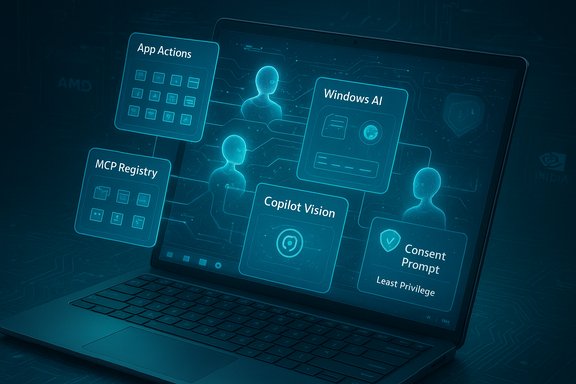
- How Microsoft describes it: Windows apps will be able to expose actions via App Actions APIs; an MCP registry on the device will act as the trusted directory where agents discover local MCP servers and request access. Microsoft is positioning this as a developer‑first, permissioned model. A private developer preview will be available first.
Windows AI Foundry, Windows ML, and Copilot+ PCs
- Windows AI Foundry and Windows ML aim to simplify deployment of on‑device models across CPUs, GPUs and NPUs from AMD, Intel, NVIDIA and Qualcomm. Microsoft promises simplified runtimes and support for model catalogs and local inference.
- Copilot+ PCs and vendor AI accelerators (NPUs) are referenced as a target platform for richer on‑device experiences. Microsoft and hardware partners argue that an on‑device first model improves latency, privacy, and offline capabilities. AMD, among others, has emphasized that Ryzen AI hardware and software are designed to support such workloads.
Vision features: Copilot Vision and agentic interactions
Microsoft has described features such as Copilot Vision (screen awareness), Copilot Voice (speech/multi‑modal input), and Copilot Actions (automated multi‑step workflows), painting a picture of Windows that can “semantically understand you” and act on context when permitted by the user. Microsoft’s public statements frame this as a productivity leap: less manual navigation, more natural language and visual inputs, and agents that “coordinate” services for tasks.Why this is technically plausible — and why Microsoft is pushing it now
- Hardware maturity: Modern SoCs and discrete GPUs now include NPUs, and vendors ship system software (drivers, execution providers) that let Windows ML target NPUs for local inference. Industry momentum (AMD’s Ryzen AI, Intel Core Ultra, NVIDIA NIMs) makes on‑device inference practically feasible at scale.
- Interoperability pressure: MCP emerged as a community standard to solve the N × M integration problem between models and tools. Microsoft embracing MCP reduces per‑integration cost and allows diverse agents and tools to interoperate on the desktop.
- Developer tooling and platform control: By embedding agent primitives into Windows — an MCP registry, App Actions APIs, Windows AI Foundry — Microsoft makes it easier for developers to build agent‑aware experiences that can access the file system, windowing, or WSL in a consistent way. That vertical integration reduces friction for complex apps.
The public reaction: what users and communities are saying
The public response to the “agentic OS” framing has been notably negative in many corners of the Windows community. Common themes from community threads and social posts include:- Preference for performance and polish: Many users say basic Windows problems — taskbar regressions, slowdowns, lingering bugs — deserve attention before a push to agentic features. Comments frequently call for “make Windows faster, not agentic.”
- Fear of bloat and telemetry: Users worry about always‑on services, new background agents “phoning home,” and further monetization nudges embedded in the OS. The language of “bloat incoming” or “more features that are always on and beta” appears repeatedly in threads.
- Privacy and control worries: Screen‑aware features (Copilot Vision) and local agent memory raise red flags about what gets stored, how consent is handled, and how easy it is to audit agent actions. Prior missteps on features like Recall have heightened those anxieties.
- Pushback on hardware gating: Some users resent the impression that the full vision requires Copilot+ hardware (NPUs) and may be unavailable or limited on older PCs — an affordability and right‑to‑upgrade gripe.
Security, privacy and supply‑chain surface area: concrete risks
Microsoft and neutral observers have flagged several risk axes that must be managed carefully for an agentic Windows to be safe:- Prompt injection and tool poisoning: MCP’s design (agents invoking third‑party tools via manifests) opens pathways for malicious tool descriptions, replaced or spoofed MCP servers, or injected prompts that cause agents to leak data or perform unauthorized actions. Independent researchers have warned about these classes of attacks for MCP deployments.
- Token theft and privileged server compromise: If an MCP server is given access to privileged resources (file system, windows, network) and is compromised, an attacker could exfiltrate secrets or open lateral attack paths. Microsoft says it will gate MCP servers via a registry and permissions model, but the devil is in the details and the initial ecosystem will be a learning period.
- Privacy & memory models: Agentic features often benefit from “memory” (structured retrieval, short‑term context retention). If that memory is persisted poorly, or cloud fallbacks are used without clear user control, sensitive data could be retained beyond user expectations. Past features that attempted system‑wide recall created skepticism when exclusion lists and blacklists were imperfect.
- Expansion of telemetry and surface area: Every official MCP server or App Action increases the platform’s attack surface. Even well‑intentioned App Actions may implement network calls or use tokens; oversight and strict least‑privilege policies are essential.
What this means for hardware vendors, developers and enterprises
- Hardware vendors (AMD, Intel, NVIDIA, Qualcomm): Expect tighter collaboration with Microsoft on drivers, execution providers, and NPU tooling. AMD’s push with Ryzen AI and AMD’s software zoo is a direct response to the demand for on‑device inference. Vendors will need to standardize execution providers and interoperability to avoid fragmentation.
- Independent software vendors and app developers: App authors must decide whether to expose App Actions and which capabilities to surface via MCP servers. They’ll need to implement clear manifests, least‑privilege access, and offer transparent consent flows so agents cannot misuse app permissions. Developers also get an opportunity: App Actions and MCP support create new discoverability paths for app features.
- Enterprises: IT teams will demand enterprise controls: whitelisting MCP servers, auditing agent access logs, data residency controls, and policy enforcement (e.g., blocking certain agents from accessing corporate document stores). Enterprises will evaluate the model for its productivity upside against compliance and risk management costs.
Pragmatic concerns for everyday users
- Performance & battery life: On‑device AI workloads can be compute‑intensive. Even with NPUs available, poorly optimized models or always‑on agents could drain battery and reduce responsiveness. The platform’s power management and model scheduling features will be critical.
- Control & discoverability of permissions: Users should be presented with clear, granular prompts when agents want access (files, windows, system services), and policies should make it trivial to revoke or audit those consents. Without this, trust will erode quickly.
- Opt‑out choices: The most frequent early complaint in community threads is that users feel features are being added that they cannot fully control. Microsoft must ensure easy, understandable opt‑outs and “off” switches for agentic components and telemetry.
Strengths of Microsoft’s approach
- Platform integration reduces friction: By providing native primitives (MCP registry, App Actions APIs, Windows AI Foundry), Microsoft lowers the cost for developers to build powerful agentic interactions that can coordinate across apps and services. This is a pragmatic way to bootstrap an agent ecosystem.
- Hardware acceleration & on‑device emphasis: Prioritizing on‑device inference for latency, privacy, and offline use is aligned with current enterprise and consumer expectations for responsive AI features. Vendor cooperation (AMD, Intel) strengthens this stance.
- Early security guardrails in messaging: Microsoft’s public materials emphasize a private preview, registry vetting, and user consent flows — an acknowledgment that this work needs careful rollout and governance. Those guardrails matter.
Key weak points and risks
- Protocol-level attacks are real: MCP increases interoperability but also creates standardized vectors for tool‑level attacks (prompt injection, malicious tool manifests). This is a systemic risk that must be addressed with strict cryptographic vetting, permissions, and runtime isolation.
- Messaging and trust: The phrase “agentic OS” and demos that emphasize the OS “acting” instead of “responding” inflamed user sentiment. People interpret agency as autonomy. Microsoft’s marketing should be precise: agency in this design must be bounded, permissioned and auditable. Failure to communicate that increases pushback.
- Potential for fragmentation: If each vendor or major app exposes different MCP servers or incompatible App Actions, the promise of cross‑agent interoperability weakens. A curated registry is necessary, but curation at scale is hard.
- Bloat and background resource use: The “always‑on” risk is not hypothetical; community threads show users already fearing new background processes and telemetry. Microsoft needs to optimize for idle‑time behavior and make resource costs visible to users.
Checklist: What Microsoft must do well (short-term roadmap)
- Enforce strict MCP manifest signing and registry vetting to prevent impersonation and tool replacement attacks.
- Provide explicit, human‑readable consent dialogs and easy revocation for agent permissions, with a central audit log users and admins can inspect.
- Ship sane defaults: MCP disabled by default, opt‑in for agents, and conservative resource limits for background models.
- Publish transparent security reviews, threat models, and third‑party audits for MCP and App Actions implementations.
- Continue hardware‑agnostic fallbacks — useful features must not be permanently gated behind expensive NPU hardware when reasonable software fallbacks exist.
What to watch next (events and signposts)
- Developer preview availability of MCP on Windows: This will reveal the types of App Actions, how the registry is curated, and what consent flows look like.
- Security audits and public red teams: Independent analysis of MCP servers and agent interactions will either validate Microsoft’s approach or uncover gaps to be patched.
- Enterprise policy tooling: Expect Microsoft to publish Group Policy and Intune controls for MCP and agent governance — watch how granular those controls are.
- Performance and battery telemetry from Copilot+ devices: Real‑world numbers will determine if on‑device agents are practical in laptops and tablets.
Conclusion — measured optimism with clear caveats
Microsoft’s agentic Windows vision maps to genuine engineering advances: standardized protocols (MCP), platform primitives, and hardware acceleration make richer, context‑aware agents technically feasible. The potential productivity gains — faster multi‑step workflows, multi‑modal input, and natural language control across apps — are compelling if implemented thoughtfully.Yet the PR reaction and community skepticism are not mere noise. They’re a pragmatic reminder that platform changes touch user trust, privacy expectations, and the hard realities of resource constraints on billions of diverse PCs. To succeed Microsoft must do three things well: secure the protocol and registry, give users decisive control and transparency, and avoid fragmenting the ecosystem with poor defaults or hardware lock‑in.
The next months — as MCP previews roll out and developer actions appear in the wild — will determine whether the agentic OS becomes a productivity multiplier or a controversial layer that amplifies existing criticisms of bloat, telemetry, and control. For the Windows ecosystem, this is an inflection point: practical engineering and policy choices made now will echo for years across privacy, security, and how users experience AI on their PCs.
Source: Neowin Microsoft confirms Windows 11 is about to change massively, gets enormous backlash
