

Microsoft’s June 2026 Windows story is no longer about whether AI PCs are real, but whether Windows, Arm silicon, native apps, and local agents can finally converge into a platform shift that users and developers can actually feel. NVIDIA’s RTX Spark push, Qualcomm’s second-generation Snapdragon X moment, and Microsoft’s Build 2026 developer reset all point in the same direction. The argument is no longer “Copilot in the taskbar.” It is whether Windows can become a modern client platform again.
That is why this week’s most interesting Windows conversation was not really about Windows 12, NVIDIA N1X, Copilot branding, or WinUI in isolation. It was about Microsoft trying to stitch together several half-finished revolutions — Windows on Arm, local AI, modern Windows development, and agentic computing — before users decide that none of them mattered.
For most of the Windows on Arm era, Qualcomm carried the burden alone. That was both a technical and political problem. Snapdragon X finally made Arm-based Windows laptops credible for mainstream productivity, but the category still felt like a specialist branch of the PC market: great battery life, excellent standby, impressive efficiency, and a persistent asterisk around games, drivers, and certain professional workloads.
NVIDIA changes the emotional temperature of that discussion. RTX Spark, widely associated with the N1X codename, is not entering the market as a polite efficiency chip. It is arriving as a high-end Windows platform built around a 20-core Arm CPU, Blackwell-class RTX graphics, up to 128GB of unified memory, and a pitch that blends local AI, creator workloads, gaming, and developer horsepower.
That combination matters because NVIDIA does not merely sell chips. It sells gravity. CUDA, RTX, DLSS, TensorRT, Studio drivers, Omniverse-adjacent workflows, and deep ties to Adobe, game studios, AI developers, and workstation buyers give NVIDIA a kind of ecosystem leverage that Qualcomm never had in the Windows PC world.
The uncomfortable question is whether RTX Spark is an AI workstation in laptop clothing, a gaming laptop SoC with an AI badge, or the first credible attempt to make Windows on Arm desirable to people who never cared about battery life as the headline feature. The honest answer is that it is probably all three, and Microsoft needs all three to be true.
Anti-cheat systems, kernel-level drivers, launchers, old middleware, and performance-sensitive engines make PC gaming one of the hardest compatibility tests for Windows on Arm. A fast GPU can brute-force some of the penalty, but it cannot magically make every game native, every driver available, or every anti-cheat vendor cooperative.
That is why the NVIDIA angle cuts both ways. On one hand, RTX Spark laptops should be far better gaming candidates than first-generation Snapdragon X machines because the GPU side is not an afterthought. On the other hand, the very presence of NVIDIA raises expectations. A Windows laptop with RTX branding will be judged against x86 gaming laptops, not merely against other Arm PCs.
The crucial test is not whether NVIDIA can show a few impressive demos. It is whether the company can persuade developers and publishers that Windows on Arm is worth targeting as a first-class runtime. If NVIDIA can move game studios, middleware vendors, and engine makers even modestly toward native Arm support, the entire Windows ecosystem benefits. If not, RTX Spark risks becoming a spectacular machine with a compatibility footnote attached to its most marketable feature.
That invisibility created the backlash. People looked at Copilot+ PCs and asked why the NPU mattered. Developers looked at powerful GPUs already sitting in their workstations and wondered why Microsoft’s early local AI APIs were locked so tightly to NPU-first assumptions. Enthusiasts looked at Recall and saw privacy risk before platform potential.
Build 2026 suggests Microsoft understands at least part of the problem. Expanding Windows AI APIs beyond Copilot+ PCs to run across CPUs and GPUs is a quiet but important retreat from a too-narrow definition of the AI PC. It acknowledges that local AI is not one silicon block. It is a scheduling, model, memory, power, privacy, and developer-platform problem.
NVIDIA’s arrival makes that correction unavoidable. A machine with a major RTX GPU and enormous unified memory pool cannot be treated as less AI-capable than a thin-and-light laptop simply because one workload runs on a discrete-class GPU instead of an NPU. Efficiency still matters, especially on battery, but capability matters too. Microsoft’s platform has to recognize both.
That line was defensible in theory. Windows needed a forward-looking client spec, and AI workloads gave Microsoft a reason to insist on more modern hardware. But the branding implied a user-facing transformation that the first wave did not deliver. Too often, Copilot+ meant “good laptop with a few AI demos,” not “new kind of PC.”
Now Microsoft appears to be trapped by its own label. If Windows AI APIs can run on CPUs and GPUs, if NVIDIA’s RTX Spark machines become flagship AI PCs, and if future Snapdragon X2 systems run a different Windows branch or upgrade path, then Copilot+ PC either becomes broader, gets replaced, or turns into a confusing sub-brand.
This is where the Windows 12 speculation becomes more than fan chatter. Microsoft does not need a new version number to ship meaningful changes, but it may need a cleaner story. Windows 11 has accumulated too much baggage: the hardware cutoff controversy, the Start menu debates, the Copilot false starts, Recall anxiety, and the general sense that AI was bolted onto the shell rather than used to rethink the client.
A new Windows brand would not solve those problems. But it could give Microsoft a reset point if the company has a coherent platform shift to attach to it. That is the key condition. Windows 12 as a sticker would be pointless. Windows 12 as the public face of Arm maturity, local AI, agent runtime controls, native app modernization, and a new hardware baseline would at least have an argument.
A hardware-scoped Windows release suggests platform enablement work that Microsoft does not want to push broadly, at least not yet. That could be about Arm-specific optimizations, new silicon support, AI plumbing, power management, drivers, security boundaries, or some combination of all of the above. It does not automatically mean Windows 12 is imminent. But it does imply that not all Windows 11 roads are converging this fall.
The timing is hard to ignore. Snapdragon X2, RTX Spark machines, and Microsoft’s Build-era Windows AI push all appear to be lining up around the same broad window. That does not prove a rebrand, but it does suggest Microsoft is preparing a client-side transition more substantial than a routine annual update.
The risk is that Microsoft lets the naming mystery become the story. Windows users have lived through enough half-communicated platform shifts to know that ambiguity breeds distrust. If 26H1 machines get one path, 26H2 machines get another, and a new Windows-branded AI experience appears on top, Microsoft will need unusually clear messaging to prevent the whole thing from sounding like edition sprawl with a neural-network accent.
The current Copilot experience has not earned the right to be the center of Windows. It has changed forms, moved around the interface, lost and gained capabilities, and often felt less like a native operating-system feature than a web service searching for a role. Microsoft’s ambition is obvious. The product identity has been much less so.
A true super app would need to do more than chat. It would need to coordinate work across documents, apps, files, settings, meetings, code, browser context, and local models while staying inside understandable privacy and permission boundaries. That is a much harder product than a sidebar.
This is where local AI becomes more than a benchmark. Users may tolerate cloud AI for search, drafting, and broad reasoning, but an agent that touches local files, automates apps, or watches workflows feels different. Latency, privacy, offline capability, and trust all improve if more of that work can happen locally. But local execution also demands a mature permission model and visible user control.
Microsoft’s Execution Containers and broader agent-safety work appear aimed at this problem. The company seems to know that agentic Windows cannot be a free-for-all where software assistants rummage through the user’s machine with vague consent. If Windows is going to host agents, it has to become the policy and containment layer for agents. That may be the most consequential operating-system work Microsoft has done in years.
That history is why renewed Build 2026 enthusiasm around WinUI and the Windows App SDK deserves skepticism. Microsoft has announced Windows app futures before. Developers have learned to ask not whether the demo is good, but whether the team, tooling, documentation, migration path, and executive backing will still be there in five years.
The twist in 2026 is that Microsoft may not need to persuade every developer in the old way. If AI coding agents become a normal part of software development, then the framework those agents are trained, guided, and tooled to use gains enormous practical importance. A WinUI agent plugin for GitHub Copilot and Claude Code is not just a developer convenience. It is Microsoft trying to make modern native Windows apps the default output of AI-assisted development.
That is a subtle but profound shift. In the old model, Microsoft had to convince human developers to learn the new stack, migrate old apps, and accept the risk. In the new model, Microsoft can shape the scaffolding, samples, skills, and automated workflows that agents use when a developer says, “Build me a Windows app.”
This does not guarantee success. AI agents can generate bad code at scale as easily as good code, and Windows development remains full of historical traps. But it gives Microsoft a new lever. The company can make modern Windows development easier not only by improving APIs, but by teaching the machines that increasingly write code which APIs to choose.
The new push for native Windows apps is therefore not nostalgia. It is a performance, integration, power, accessibility, and AI story. If Microsoft wants Windows to expose local models, semantic indexes, shell integrations, agent permissions, and hardware acceleration, web wrappers will not be enough for the best experiences.
That does not mean every app should become a handcrafted WinUI showcase. Cross-platform economics are real, and Windows is no longer the only client platform that matters. But Microsoft has to make native development attractive again for the apps where Windows-specific capability matters: terminals, creative tools, developer utilities, enterprise software, AI-enhanced productivity apps, and system-adjacent workflows.
The agent angle sharpens the point. A local AI assistant that can understand and operate inside native app structures is more powerful than one peering through a generic web surface. If Windows is going to host serious agents, the apps those agents work with need richer contracts than pixels and simulated clicks.
That is why WinUI’s fate matters beyond developer fashion. Microsoft is not simply trying to win a framework argument. It is trying to create a native substrate for the next wave of AI-assisted Windows software.
A generational upgrade may make sense for users who need more RAM, heavier local AI work, better GPU performance, or specific developer workloads. But for typical coding, writing, browsing, office work, light local experimentation, and casual games, the first generation is not suddenly obsolete. If anything, Microsoft’s ongoing work to reduce Windows resource usage and improve Arm support should extend the useful life of those machines.
The biggest caveat is memory. A 16GB Arm laptop can remain useful for years, but local models and developer workflows can consume RAM quickly. Users who bought lower configurations may feel pressure sooner than users who chose 32GB or higher. That is not a Snapdragon-specific problem; it is the new baseline reality of AI-era computing.
The broader lesson is that Windows on Arm is becoming a platform, not a one-chip event. Qualcomm proved the mainstream laptop case. NVIDIA is now trying to prove the high-performance and creator case. If both succeed, early Snapdragon X buyers will not be stranded. They will look more like the first wave of a transition that finally found momentum.
For Microsoft 365 subscribers, Copilot is the obvious candidate if Microsoft can make the integration feel indispensable rather than ornamental. For Google-heavy users, Gemini bundled with storage and Google services has a strong practical argument. For developers, writers, researchers, and power users, standalone subscriptions to ChatGPT or Claude may be justified by model quality, tooling, coding ability, or workflow fit.
But the economics are unstable. Today’s best model may be tomorrow’s runner-up. Local AI may absorb routine tasks that once justified a cloud subscription. Enterprise licensing may bundle capabilities that consumers still buy separately. Apple’s choices around Apple Intelligence and third-party models may shift user expectations again.
The deeper point is that AI is starting to resemble both an app and a utility. Sometimes users will pay for a named assistant. Sometimes they will pay for an application that quietly includes AI. Sometimes the AI will be local and effectively bundled into the device. Microsoft’s Windows strategy has to survive all three futures.
The keynote’s Windows emphasis, the prominence of Terminal, the hardware announcements, the local AI stack, the developer tooling, the WinUI push, and the agent containment story collectively made Windows feel like a platform with work to do. That has not always been true in the Azure-dominated era of Microsoft events.
Project Solara, as described in the Build conversation, seems to have landed because it evoked an older Microsoft habit: showing a future of computing rather than merely announcing another enterprise service integration. That kind of vision can be dangerous when it outruns shipping reality, but it is also necessary. Platforms need imagination as well as plumbing.
Windows has spent much of the last decade defending its relevance. It remained commercially enormous, but culturally less central. Build 2026 suggested Microsoft knows the client is becoming strategically important again, not because the PC is returning to its 1990s monopoly role, but because agents, local models, developer workflows, and personal data all need a trusted place to run.
That is why this week’s most interesting Windows conversation was not really about Windows 12, NVIDIA N1X, Copilot branding, or WinUI in isolation. It was about Microsoft trying to stitch together several half-finished revolutions — Windows on Arm, local AI, modern Windows development, and agentic computing — before users decide that none of them mattered.
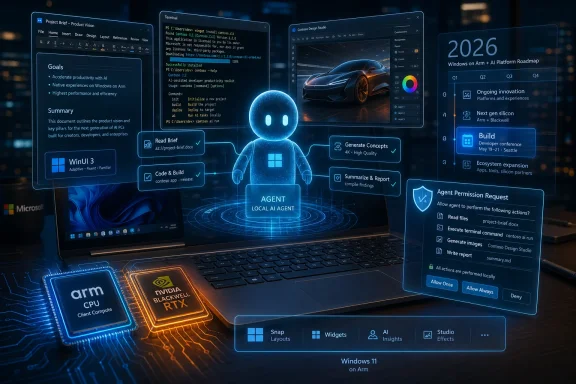 NVIDIA Has Made Windows on Arm Impossible to Ignore
For most of the Windows on Arm era, Qualcomm carried the burden alone. That was both a technical and political problem. Snapdragon X finally made Arm-based Windows laptops credible for mainstream productivity, but the category still felt like a specialist branch of the PC market: great battery life, excellent standby, impressive efficiency, and a persistent asterisk around games, drivers, and certain professional workloads.NVIDIA changes the emotional temperature of that discussion. RTX Spark, widely associated with the N1X codename, is not entering the market as a polite efficiency chip. It is arriving as a high-end Windows platform built around a 20-core Arm CPU, Blackwell-class RTX graphics, up to 128GB of unified memory, and a pitch that blends local AI, creator workloads, gaming, and developer horsepower.
That combination matters because NVIDIA does not merely sell chips. It sells gravity. CUDA, RTX, DLSS, TensorRT, Studio drivers, Omniverse-adjacent workflows, and deep ties to Adobe, game studios, AI developers, and workstation buyers give NVIDIA a kind of ecosystem leverage that Qualcomm never had in the Windows PC world.
The uncomfortable question is whether RTX Spark is an AI workstation in laptop clothing, a gaming laptop SoC with an AI badge, or the first credible attempt to make Windows on Arm desirable to people who never cared about battery life as the headline feature. The honest answer is that it is probably all three, and Microsoft needs all three to be true.
The Gaming Asterisk Still Haunts the Arm Transition
The strongest argument against calling N1X a gaming breakthrough is simple: most Windows games are still written for x86. Emulation has improved dramatically, and Snapdragon X machines have shown that a surprising amount of everyday Windows software can run well enough that users forget a translation layer is involved. Games are less forgiving.Anti-cheat systems, kernel-level drivers, launchers, old middleware, and performance-sensitive engines make PC gaming one of the hardest compatibility tests for Windows on Arm. A fast GPU can brute-force some of the penalty, but it cannot magically make every game native, every driver available, or every anti-cheat vendor cooperative.
That is why the NVIDIA angle cuts both ways. On one hand, RTX Spark laptops should be far better gaming candidates than first-generation Snapdragon X machines because the GPU side is not an afterthought. On the other hand, the very presence of NVIDIA raises expectations. A Windows laptop with RTX branding will be judged against x86 gaming laptops, not merely against other Arm PCs.
The crucial test is not whether NVIDIA can show a few impressive demos. It is whether the company can persuade developers and publishers that Windows on Arm is worth targeting as a first-class runtime. If NVIDIA can move game studios, middleware vendors, and engine makers even modestly toward native Arm support, the entire Windows ecosystem benefits. If not, RTX Spark risks becoming a spectacular machine with a compatibility footnote attached to its most marketable feature.
Microsoft’s AI PC Bet Finally Has Hardware Worth Arguing About
The Copilot+ PC launch suffered from a classic platform problem: Microsoft tried to sell a future before the software made the hardware feel necessary. NPUs were technically important, but to normal users they were invisible. A laptop that saves a watt here, accelerates a background effect there, or enables a handful of isolated AI features does not feel like a new category.That invisibility created the backlash. People looked at Copilot+ PCs and asked why the NPU mattered. Developers looked at powerful GPUs already sitting in their workstations and wondered why Microsoft’s early local AI APIs were locked so tightly to NPU-first assumptions. Enthusiasts looked at Recall and saw privacy risk before platform potential.
Build 2026 suggests Microsoft understands at least part of the problem. Expanding Windows AI APIs beyond Copilot+ PCs to run across CPUs and GPUs is a quiet but important retreat from a too-narrow definition of the AI PC. It acknowledges that local AI is not one silicon block. It is a scheduling, model, memory, power, privacy, and developer-platform problem.
NVIDIA’s arrival makes that correction unavoidable. A machine with a major RTX GPU and enormous unified memory pool cannot be treated as less AI-capable than a thin-and-light laptop simply because one workload runs on a discrete-class GPU instead of an NPU. Efficiency still matters, especially on battery, but capability matters too. Microsoft’s platform has to recognize both.
Copilot+ PC Was a Brand Before It Was a Platform
The original Copilot+ PC specification was unusually aggressive for Windows. It set expectations around 16GB of RAM, 512GB of storage, a 40-plus TOPS NPU, modern security requirements, and Windows Hello enhancements. After years of permissive Windows hardware baselines, Microsoft suddenly drew a line.That line was defensible in theory. Windows needed a forward-looking client spec, and AI workloads gave Microsoft a reason to insist on more modern hardware. But the branding implied a user-facing transformation that the first wave did not deliver. Too often, Copilot+ meant “good laptop with a few AI demos,” not “new kind of PC.”
Now Microsoft appears to be trapped by its own label. If Windows AI APIs can run on CPUs and GPUs, if NVIDIA’s RTX Spark machines become flagship AI PCs, and if future Snapdragon X2 systems run a different Windows branch or upgrade path, then Copilot+ PC either becomes broader, gets replaced, or turns into a confusing sub-brand.
This is where the Windows 12 speculation becomes more than fan chatter. Microsoft does not need a new version number to ship meaningful changes, but it may need a cleaner story. Windows 11 has accumulated too much baggage: the hardware cutoff controversy, the Start menu debates, the Copilot false starts, Recall anxiety, and the general sense that AI was bolted onto the shell rather than used to rethink the client.
A new Windows brand would not solve those problems. But it could give Microsoft a reset point if the company has a coherent platform shift to attach to it. That is the key condition. Windows 12 as a sticker would be pointless. Windows 12 as the public face of Arm maturity, local AI, agent runtime controls, native app modernization, and a new hardware baseline would at least have an argument.
The Strange Case of 26H1 Makes the Calendar Look Suspicious
Windows versioning is usually boring until it suddenly becomes revealing. The reported split between Windows 11 version 26H1 for new Snapdragon X2-class hardware and Windows 11 version 26H2 for the broader installed base is exactly the kind of detail that invites speculation because Microsoft has not fully explained the destination.A hardware-scoped Windows release suggests platform enablement work that Microsoft does not want to push broadly, at least not yet. That could be about Arm-specific optimizations, new silicon support, AI plumbing, power management, drivers, security boundaries, or some combination of all of the above. It does not automatically mean Windows 12 is imminent. But it does imply that not all Windows 11 roads are converging this fall.
The timing is hard to ignore. Snapdragon X2, RTX Spark machines, and Microsoft’s Build-era Windows AI push all appear to be lining up around the same broad window. That does not prove a rebrand, but it does suggest Microsoft is preparing a client-side transition more substantial than a routine annual update.
The risk is that Microsoft lets the naming mystery become the story. Windows users have lived through enough half-communicated platform shifts to know that ambiguity breeds distrust. If 26H1 machines get one path, 26H2 machines get another, and a new Windows-branded AI experience appears on top, Microsoft will need unusually clear messaging to prevent the whole thing from sounding like edition sprawl with a neural-network accent.
The Super App Is Microsoft’s Biggest Unshown Promise
The rumored Copilot “super app” may be the most important piece of the puzzle precisely because it is the least concrete. Microsoft can talk about agents, local models, coding for knowledge work, Scout, Autopilots, and orchestration layers, but users will judge the entire strategy by what sits in front of them.The current Copilot experience has not earned the right to be the center of Windows. It has changed forms, moved around the interface, lost and gained capabilities, and often felt less like a native operating-system feature than a web service searching for a role. Microsoft’s ambition is obvious. The product identity has been much less so.
A true super app would need to do more than chat. It would need to coordinate work across documents, apps, files, settings, meetings, code, browser context, and local models while staying inside understandable privacy and permission boundaries. That is a much harder product than a sidebar.
This is where local AI becomes more than a benchmark. Users may tolerate cloud AI for search, drafting, and broad reasoning, but an agent that touches local files, automates apps, or watches workflows feels different. Latency, privacy, offline capability, and trust all improve if more of that work can happen locally. But local execution also demands a mature permission model and visible user control.
Microsoft’s Execution Containers and broader agent-safety work appear aimed at this problem. The company seems to know that agentic Windows cannot be a free-for-all where software assistants rummage through the user’s machine with vague consent. If Windows is going to host agents, it has to become the policy and containment layer for agents. That may be the most consequential operating-system work Microsoft has done in years.
WinUI’s Comeback Is Really About AI Writing the Next Windows Apps
The Windows developer story has been a long exercise in squandered trust. Win32 endured. WPF survived long after Microsoft’s enthusiasm cooled. UWP arrived with grand ambitions and never became the universal app model its name promised. Project Reunion became the Windows App SDK. WinUI kept being described as the future while many developers sensibly waited for the future to stop moving.That history is why renewed Build 2026 enthusiasm around WinUI and the Windows App SDK deserves skepticism. Microsoft has announced Windows app futures before. Developers have learned to ask not whether the demo is good, but whether the team, tooling, documentation, migration path, and executive backing will still be there in five years.
The twist in 2026 is that Microsoft may not need to persuade every developer in the old way. If AI coding agents become a normal part of software development, then the framework those agents are trained, guided, and tooled to use gains enormous practical importance. A WinUI agent plugin for GitHub Copilot and Claude Code is not just a developer convenience. It is Microsoft trying to make modern native Windows apps the default output of AI-assisted development.
That is a subtle but profound shift. In the old model, Microsoft had to convince human developers to learn the new stack, migrate old apps, and accept the risk. In the new model, Microsoft can shape the scaffolding, samples, skills, and automated workflows that agents use when a developer says, “Build me a Windows app.”
This does not guarantee success. AI agents can generate bad code at scale as easily as good code, and Windows development remains full of historical traps. But it gives Microsoft a new lever. The company can make modern Windows development easier not only by improving APIs, but by teaching the machines that increasingly write code which APIs to choose.
Native Windows Is Back Because Web Wrappers Were Not Enough
For years, Windows users have watched major apps become indistinguishable from browser tabs with custom title bars. Electron and web technologies won because they were cross-platform, fast enough, and economically rational. Native Windows UI often lost because Microsoft’s own app-platform story was too fragmented.The new push for native Windows apps is therefore not nostalgia. It is a performance, integration, power, accessibility, and AI story. If Microsoft wants Windows to expose local models, semantic indexes, shell integrations, agent permissions, and hardware acceleration, web wrappers will not be enough for the best experiences.
That does not mean every app should become a handcrafted WinUI showcase. Cross-platform economics are real, and Windows is no longer the only client platform that matters. But Microsoft has to make native development attractive again for the apps where Windows-specific capability matters: terminals, creative tools, developer utilities, enterprise software, AI-enhanced productivity apps, and system-adjacent workflows.
The agent angle sharpens the point. A local AI assistant that can understand and operate inside native app structures is more powerful than one peering through a generic web surface. If Windows is going to host serious agents, the apps those agents work with need richer contracts than pixels and simulated clicks.
That is why WinUI’s fate matters beyond developer fashion. Microsoft is not simply trying to win a framework argument. It is trying to create a native substrate for the next wave of AI-assisted Windows software.
Snapdragon X Owners Should Not Panic
The arrival of Snapdragon X2 and RTX Spark will inevitably make first-generation Snapdragon X buyers wonder whether they bought too early. For most of them, the answer is no. The original Snapdragon X and X Plus machines remain among the most successful Windows laptops of the last few years because their strengths are durable: battery life, responsiveness, standby reliability, quiet operation, and enough performance for mainstream productivity.A generational upgrade may make sense for users who need more RAM, heavier local AI work, better GPU performance, or specific developer workloads. But for typical coding, writing, browsing, office work, light local experimentation, and casual games, the first generation is not suddenly obsolete. If anything, Microsoft’s ongoing work to reduce Windows resource usage and improve Arm support should extend the useful life of those machines.
The biggest caveat is memory. A 16GB Arm laptop can remain useful for years, but local models and developer workflows can consume RAM quickly. Users who bought lower configurations may feel pressure sooner than users who chose 32GB or higher. That is not a Snapdragon-specific problem; it is the new baseline reality of AI-era computing.
The broader lesson is that Windows on Arm is becoming a platform, not a one-chip event. Qualcomm proved the mainstream laptop case. NVIDIA is now trying to prove the high-performance and creator case. If both succeed, early Snapdragon X buyers will not be stranded. They will look more like the first wave of a transition that finally found momentum.
AI Subscriptions Are Becoming the New Productivity Suite
The user question about choosing one AI subscription may seem separate from Windows hardware, but it belongs in the same conversation. Microsoft, Google, OpenAI, Anthropic, Perplexity, and others are all racing to make AI feel less like a chatbot and more like the front end for work. That creates a familiar consumer dilemma: pay for the best model, the best ecosystem bundle, or the service already attached to tools you use.For Microsoft 365 subscribers, Copilot is the obvious candidate if Microsoft can make the integration feel indispensable rather than ornamental. For Google-heavy users, Gemini bundled with storage and Google services has a strong practical argument. For developers, writers, researchers, and power users, standalone subscriptions to ChatGPT or Claude may be justified by model quality, tooling, coding ability, or workflow fit.
But the economics are unstable. Today’s best model may be tomorrow’s runner-up. Local AI may absorb routine tasks that once justified a cloud subscription. Enterprise licensing may bundle capabilities that consumers still buy separately. Apple’s choices around Apple Intelligence and third-party models may shift user expectations again.
The deeper point is that AI is starting to resemble both an app and a utility. Sometimes users will pay for a named assistant. Sometimes they will pay for an application that quietly includes AI. Sometimes the AI will be local and effectively bundled into the device. Microsoft’s Windows strategy has to survive all three futures.
Build Felt Like Windows Mattered Again
The most striking thing about Build 2026 was not that Microsoft talked about AI. Microsoft always talks about AI now. The surprise was that Windows did not feel like an afterthought in its own company’s developer conference.The keynote’s Windows emphasis, the prominence of Terminal, the hardware announcements, the local AI stack, the developer tooling, the WinUI push, and the agent containment story collectively made Windows feel like a platform with work to do. That has not always been true in the Azure-dominated era of Microsoft events.
Project Solara, as described in the Build conversation, seems to have landed because it evoked an older Microsoft habit: showing a future of computing rather than merely announcing another enterprise service integration. That kind of vision can be dangerous when it outruns shipping reality, but it is also necessary. Platforms need imagination as well as plumbing.
Windows has spent much of the last decade defending its relevance. It remained commercially enormous, but culturally less central. Build 2026 suggested Microsoft knows the client is becoming strategically important again, not because the PC is returning to its 1990s monopoly role, but because agents, local models, developer workflows, and personal data all need a trusted place to run.
The Fall Windows Story Now Has Real Stakes
Microsoft’s next move matters because the pieces are finally on the board, and because the company has a habit of blurring the message just when clarity is most needed. The names may change, but the practical stakes are becoming clear.- Microsoft needs to explain whether Copilot+ PC remains the flagship AI PC brand or becomes a stepping stone toward a broader Windows AI platform.
- NVIDIA’s RTX Spark machines will test whether Windows on Arm can move beyond efficient productivity laptops into creator, developer, workstation, and gaming-adjacent territory.
- Snapdragon X owners should expect continued usefulness, not instant obsolescence, unless their workloads are constrained by memory or GPU performance.
- Windows AI APIs expanding to CPUs and GPUs is a necessary correction that makes the platform more credible to developers with existing high-performance hardware.
- WinUI’s renewed relevance depends less on another framework pitch and more on whether AI coding agents can reliably generate modern native Windows apps.
- A Windows 12 rebrand would only matter if Microsoft uses it to clarify the platform shift rather than decorate another incremental Windows 11 update.
References
- Primary source: thurrott.com
Published: 2026-06-05T15:50:18.468720
Ask Paul: June 5 ⭐ - Thurrott.com
Happy Friday! This was a particularly eventful week, especially for those interested in the future of Windows.www.thurrott.com
