

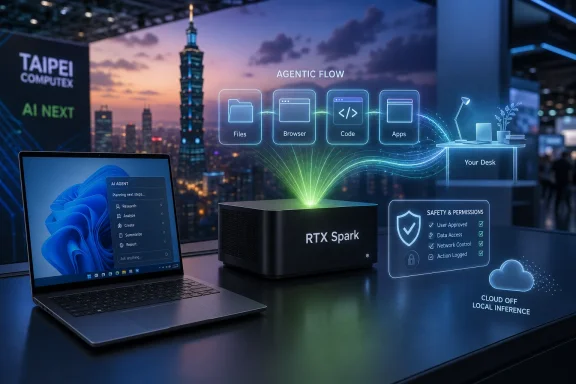
Nvidia and Microsoft used Computex 2026 in Taipei to pitch RTX Spark Windows PCs as a new class of “agentic AI” computer, built around Nvidia’s N1X-style Arm silicon and aimed at running local AI agents on laptops and compact desktops. The claim is deliberately grand: not a faster PC, not a nicer Copilot button, but the first real reinvention of the personal computer in decades. The problem is that the more closely you inspect the pitch, the more familiar it looks. What is new is the silicon and the intensity of the marketing; what remains unresolved is whether Windows users actually need another PC category to do work that still depends heavily on software, trust, cost, and cloud services.
Jensen Huang has never been shy about giving a chip a civilizational job description. At Computex, the Nvidia CEO framed RTX Spark PCs as machines that would let users talk to their computers, ask them to inspect files, research topics, and carry out multi-step work. Microsoft joined the framing, presenting the Windows PC as a place where personal AI agents could move closer to the user, the file system, the GPU, and the desktop.
That is an appealing story because the PC has been waiting for a more convincing AI narrative. The first wave of “AI PCs” was mostly defined by the presence of a neural processing unit, a Copilot key, and a promise that future Windows features would make the hardware matter. It was a category assembled in advance of its killer app, and users noticed.
RTX Spark is meant to fix that by shifting attention from lightweight NPU-assisted features to serious local inference. Instead of merely blurring a webcam background or summarizing a meeting, these machines are being sold as devices that can host larger models, accelerate agent frameworks, process private data locally, and keep developers from renting every experiment from a cloud provider. That is a more substantive proposition than the average AI PC sticker.
But “more substantive” is not the same as “new class of computer.” Workstations have run local models for years. Gaming laptops have carried powerful Nvidia GPUs for years. Developers have already been experimenting with local LLMs on high-end desktops, Macs with unified memory, and cloud-connected notebooks. RTX Spark may improve that experience, but the burden of proof is on Nvidia and Microsoft to show that it changes the everyday contract between user and machine.
In practice, agentic behavior is not created by a GPU alone. It depends on model reliability, permissions, memory, orchestration, identity, auditability, application integration, and a user interface that makes delegation feel safe. A fast chip can make an agent more responsive, more private, and less expensive to run at the margin, but it cannot decide which files the agent should see or whether its actions are appropriate.
That is why analysts are right to be skeptical of the “new PC” label. Nvidia can credibly argue that RTX Spark changes the performance envelope for local AI. Microsoft can credibly argue that Windows is the right environment for agents because so much work already happens there. Neither argument automatically proves that users are about to abandon the app-centric model of computing.
The modern PC is not limited by an inability to execute instructions on the user’s behalf. It is limited by trust. Users do not avoid automation because their laptops lack theoretical TOPS; they avoid it because automation breaks in embarrassing ways, misunderstands context, and creates cleanup work. For IT departments, the nightmare is not that an agent runs too slowly. It is that it runs confidently, invisibly, and across sensitive data.
That matters because AI inference is spreading outward. Cloud inference will remain essential, especially for frontier models and shared enterprise services, but there are clear reasons to run more workloads locally. Latency improves. Sensitive data may not need to leave the machine. Developers can prototype without turning every test into an operating expense. Offline or constrained-network scenarios become more plausible.
RTX Spark is designed to make that edge-computing story sound less like a compromise. Nvidia’s claims around large local models, unified memory, high-end graphics, and Windows-on-Arm integration are meant to position these PCs above the mainstream AI laptop and below the dedicated AI workstation. It is a premium middle tier: personal enough to sit on a desk, powerful enough to matter to developers, creators, engineers, and researchers.
That positioning is much more believable than the idea that every household will soon need an agentic AI PC. The early audience is not the average Word-and-browser user. It is the person who already knows why local model performance matters, already waits on GPU-bound tasks, already pays for cloud compute, or already worries about sending proprietary material into hosted AI services.
The RTX Spark partnership lets Microsoft reframe Windows as the operating environment for personal agents rather than merely the host of a chatbot sidebar. If agents are going to inspect documents, manipulate local files, automate desktop workflows, and coordinate between apps, Windows has a strong claim to relevance. The operating system still owns the messy, local, permission-heavy layer of work that browser-based AI assistants can only partially reach.
But Microsoft’s history also explains the caution. Windows users remember features that arrived before the controls felt mature. Enterprises remember security baselines, compliance reviews, app compatibility testing, and the long tail of group policy. A Windows agent that can “read files” is exciting in a keynote and alarming in a security meeting.
For Microsoft, the win condition is not simply shipping agent experiences on RTX Spark hardware. It is making them governable. Admins will want policy controls, logs, data-boundary assurances, application allow lists, model provenance, and a clean answer to what happens when a local agent interacts with cloud services. Without that, agentic Windows risks becoming another feature that consumers experiment with and enterprises disable.
That confusion did not begin with RTX Spark. The first AI PC wave emphasized NPUs, but many of the most visible AI workloads still ran in the cloud or on GPUs. Users were told that local acceleration mattered, yet the must-have local experiences remained thin. Even when the hardware was genuinely better, the category felt like a promise awaiting software.
RTX Spark changes the hardware side of that equation by leaning into serious GPU acceleration and unified memory, not just low-power AI features. That is meaningful. A machine capable of running larger local models and more demanding creative or development workflows is not the same thing as a laptop whose AI story begins and ends with webcam effects.
Still, Nvidia and Microsoft are trying to rename a continuum. At one end are ordinary laptops with NPUs. At the other are workstations and deskside AI boxes. RTX Spark sits somewhere between them, and its value will depend less on the phrase “agentic AI PC” than on whether the price, thermals, battery life, Windows-on-Arm compatibility, and software stack hold up in real deployments.
Agentic AI challenges that model by promising an intent-driven interface. Instead of opening five apps and performing a task, the user states a goal and the machine carries it out. That is the dream behind the “tool to teammate” language: the PC becomes less like a toolbox and more like a colleague.
But colleagues require management. They misunderstand instructions. They need supervision. They have access limits. They create accountability questions when something goes wrong. The more agentic a PC becomes, the more it starts to resemble a junior employee with root-adjacent access rather than a passive device.
That is why the app-centric model will not disappear quickly. Users may delegate more tasks, but they will still want to inspect, edit, approve, and reverse actions. The most successful agentic PC experiences are likely to be narrow at first: coding assistants, creative pipeline automation, local document analysis, IT troubleshooting, data transformation, and research workflows with clear checkpoints. The general-purpose “do my work” agent remains more slogan than product.
For Windows enthusiasts, the appeal is obvious. A powerful local AI PC is a machine you can tinker with. You can run models, inspect performance, experiment with open-source frameworks, and decide what does or does not leave your device. That is much closer to the spirit of the PC than a locked-down cloud assistant rented by the prompt.
For enterprises, the case is more selective. Some organizations will value on-device processing for regulated data, field work, engineering models, media assets, or low-latency workflows. Others will look at fleet cost, support complexity, model governance, and refresh timing and decide that centralized AI services are easier to control.
The hybrid outcome is the likely one. Some tasks will run locally because they are sensitive, interactive, or GPU-friendly. Some will run in the cloud because they require the largest models, shared enterprise context, or centralized oversight. The PC does not need to become the entire AI platform to matter; it only needs to become a more capable edge of that platform.
Nvidia’s entry could help normalize Arm-based Windows machines, especially if performance is strong enough to make users tolerate the transition. A high-end Nvidia GPU story also changes the emotional texture of Windows on Arm, which has often been sold around efficiency rather than raw workstation-class appeal. If RTX Spark systems can run demanding creative, AI, and gaming workloads convincingly, they could make Arm Windows feel less like a compromise.
But compatibility is not just a benchmark problem. Enterprise Windows estates are full of old plug-ins, custom line-of-business apps, security tools, print drivers, automation scripts, and hardware dependencies. Even if most mainstream software works, the last 5 percent can block deployment at scale.
That is another reason RTX Spark’s first audience is likely to be specialist users rather than broad corporate fleets. Developers, creators, and AI practitioners can tolerate rough edges when the performance upside is large. Procurement departments rolling out thousands of laptops are less romantic. They buy predictability.
A developer workstation that reduces cloud GPU spend may justify itself. A media machine that accelerates local video and generative workflows may justify itself. A regulated organization that needs local document analysis may justify itself. A standard office laptop bought because it might one day host a semi-autonomous agent is a harder sell.
This is where analyst skepticism becomes useful rather than cynical. The claim that there is “not much new here” is not a denial that the hardware is faster or that local AI is important. It is a reminder that the PC industry often repackages incremental shifts as epochal breaks. The revolution is frequently a new bill of materials with better launch adjectives.
Enterprise buyers will also worry about support boundaries. If a local agent misfiles documents, sends a flawed summary, deletes the wrong folder, or acts on stale information, who owns the failure? The user? The IT department? Microsoft? Nvidia? The application vendor? The model provider? Until those lines are clearer, many admins will keep agentic features fenced off from sensitive work.
That would not be a small market, but it is not the same as reinventing the PC for everyone. It is closer to the way early workstations served specialized communities before their capabilities filtered downward. The first RTX Spark buyers may not be asking their PC to manage their inbox autonomously. They may be using it to build the tools that eventually make agentic computing less brittle.
There is also a platform advantage for Nvidia here. Developers already know CUDA. Nvidia’s software ecosystem is a major reason its GPUs dominate AI development. If RTX Spark gives developers a local Windows target with familiar acceleration libraries, it strengthens Nvidia’s gravitational pull at the edge.
Microsoft benefits if those developers build for Windows rather than treating it as an afterthought. The company has spent years courting developers through WSL, Windows Terminal, Visual Studio Code, GitHub, and Azure. Agentic AI on Windows is another attempt to make the desktop relevant to modern development rather than merely compatible with it.
Consumer AI features have already trained users to be skeptical. Many are useful in small doses, but few have changed the reason people buy a PC. The average buyer still cares about price, battery life, display quality, weight, keyboard feel, performance, storage, gaming capability, and whether their apps work. AI is a bonus when it solves a real problem, not a replacement for the fundamentals.
RTX Spark systems may be too expensive and too specialized to carry the mainstream consumer story at first. If they are premium devices, they will compete against gaming laptops, creator laptops, MacBook Pros, and mobile workstations. In that context, agentic AI is one feature among many, and buyers will want receipts.
The consumer version of agentic computing may arrive indirectly. Users may not buy an “agentic AI PC”; they may buy a faster laptop for gaming or creative work and later discover that local AI tools run well on it. That is a less glamorous adoption curve, but it is often how the PC actually changes.
But local agents also expand the blast radius of endpoint compromise. A computer that can inspect more files, infer more context, and take more actions on behalf of the user becomes a more valuable target. Malware that hijacks an agentic workflow could be more dangerous than malware that merely steals files, because the agent may have legitimate access and a plausible reason to act.
Security teams will want to know how these systems isolate agent permissions, record actions, prevent prompt injection, and defend against malicious content embedded in documents or web pages. An agent that reads a poisoned PDF or browses a hostile site could be manipulated unless its tool use is carefully constrained. This is not a theoretical problem; it is a central challenge of giving language models access to tools.
The privacy story, then, is not simply “local good, cloud bad.” Local processing reduces some risks and introduces others. The winning platform will be the one that makes those tradeoffs visible and manageable rather than hiding them behind companion-like branding.
The industry already has AI PCs, Copilot+ PCs, gaming PCs, creator laptops, mobile workstations, mini PCs, cloud PCs, and thin clients. Adding “agentic AI PCs” may help Nvidia distinguish RTX Spark from mainstream NPU laptops, but it may also deepen the confusion. If every device is an AI PC, the label stops informing the buyer.
A more honest taxonomy would separate machines by what they can run locally. Entry-level AI PCs can handle low-power on-device features. Mainstream premium systems can accelerate productivity and media tasks. High-end RTX Spark-style machines can run larger models, agent frameworks, and GPU-heavy workflows. Workstations and deskside AI systems can handle the largest local jobs.
That taxonomy lacks keynote magic, but it has the advantage of being useful. Buyers do not need metaphysics. They need to know whether a machine can run the workload, for how long, at what noise level, with which software, under which management policies, and at what price.
This is a plausible bet. Models are becoming more efficient. Quantization and local inference tooling are improving. Enterprises are increasingly sensitive to AI costs. Developers want more control. Users are wary of sending everything to hosted services. A powerful local AI tier could become an important part of the computing landscape.
But the timing is uncertain. Hardware often arrives before software knows what to do with it. The first generation of AI PCs demonstrated that clearly. RTX Spark may be a stronger foundation, but foundation is the right word. It is infrastructure awaiting mature applications, governance, and habits.
That does not make it unimportant. The PC has often changed by accumulation rather than sudden rupture. USB, Wi-Fi, SSDs, GPUs, webcams, biometric login, virtualization, and high-DPI displays all altered expectations over time. Local AI acceleration could join that list without validating the claim that the PC has been reinvented overnight.
The next year will show whether RTX Spark is the start of a durable Windows AI tier or another premium label in a market already crowded with them. If Nvidia can deliver performance, OEMs can ship credible systems, Microsoft can make the agent layer governable, and developers can produce tools that solve real problems, the PC may indeed become more capable and more personal. But the reinvention will not be declared from a Computex stage; it will happen quietly, one trusted workflow at a time.
 The Reinvention Pitch Arrives Before the Reinvention
Jensen Huang has never been shy about giving a chip a civilizational job description. At Computex, the Nvidia CEO framed RTX Spark PCs as machines that would let users talk to their computers, ask them to inspect files, research topics, and carry out multi-step work. Microsoft joined the framing, presenting the Windows PC as a place where personal AI agents could move closer to the user, the file system, the GPU, and the desktop.That is an appealing story because the PC has been waiting for a more convincing AI narrative. The first wave of “AI PCs” was mostly defined by the presence of a neural processing unit, a Copilot key, and a promise that future Windows features would make the hardware matter. It was a category assembled in advance of its killer app, and users noticed.
RTX Spark is meant to fix that by shifting attention from lightweight NPU-assisted features to serious local inference. Instead of merely blurring a webcam background or summarizing a meeting, these machines are being sold as devices that can host larger models, accelerate agent frameworks, process private data locally, and keep developers from renting every experiment from a cloud provider. That is a more substantive proposition than the average AI PC sticker.
But “more substantive” is not the same as “new class of computer.” Workstations have run local models for years. Gaming laptops have carried powerful Nvidia GPUs for years. Developers have already been experimenting with local LLMs on high-end desktops, Macs with unified memory, and cloud-connected notebooks. RTX Spark may improve that experience, but the burden of proof is on Nvidia and Microsoft to show that it changes the everyday contract between user and machine.
“Agentic” Is a Software Claim Wearing a Hardware Jacket
The most important word in the announcement is also the slipperiest one. Agentic AI describes systems that can pursue goals across steps: gather context, use tools, act on files, call applications, and report back. In a perfect demo, that looks like a computer finally doing what office workers always wished automation would do.In practice, agentic behavior is not created by a GPU alone. It depends on model reliability, permissions, memory, orchestration, identity, auditability, application integration, and a user interface that makes delegation feel safe. A fast chip can make an agent more responsive, more private, and less expensive to run at the margin, but it cannot decide which files the agent should see or whether its actions are appropriate.
That is why analysts are right to be skeptical of the “new PC” label. Nvidia can credibly argue that RTX Spark changes the performance envelope for local AI. Microsoft can credibly argue that Windows is the right environment for agents because so much work already happens there. Neither argument automatically proves that users are about to abandon the app-centric model of computing.
The modern PC is not limited by an inability to execute instructions on the user’s behalf. It is limited by trust. Users do not avoid automation because their laptops lack theoretical TOPS; they avoid it because automation breaks in embarrassing ways, misunderstands context, and creates cleanup work. For IT departments, the nightmare is not that an agent runs too slowly. It is that it runs confidently, invisibly, and across sensitive data.
Nvidia Wants the PC to Become an Edge AI Node
The strategic logic for Nvidia is obvious. The company already dominates the data-center AI market, but the PC remains one of the largest compute markets where Nvidia does not control the central processor. RTX Spark gives Nvidia a story that extends from hyperscale training racks to deskside development boxes to thin-and-light Windows systems.That matters because AI inference is spreading outward. Cloud inference will remain essential, especially for frontier models and shared enterprise services, but there are clear reasons to run more workloads locally. Latency improves. Sensitive data may not need to leave the machine. Developers can prototype without turning every test into an operating expense. Offline or constrained-network scenarios become more plausible.
RTX Spark is designed to make that edge-computing story sound less like a compromise. Nvidia’s claims around large local models, unified memory, high-end graphics, and Windows-on-Arm integration are meant to position these PCs above the mainstream AI laptop and below the dedicated AI workstation. It is a premium middle tier: personal enough to sit on a desk, powerful enough to matter to developers, creators, engineers, and researchers.
That positioning is much more believable than the idea that every household will soon need an agentic AI PC. The early audience is not the average Word-and-browser user. It is the person who already knows why local model performance matters, already waits on GPU-bound tasks, already pays for cloud compute, or already worries about sending proprietary material into hosted AI services.
Microsoft Is Selling Windows as the Agent’s Natural Habitat
Microsoft’s role is more delicate. The company has spent the past several years injecting Copilot into Windows, Microsoft 365, Edge, Teams, GitHub, and Azure. It has also learned that users do not automatically accept AI simply because it appears in the taskbar.The RTX Spark partnership lets Microsoft reframe Windows as the operating environment for personal agents rather than merely the host of a chatbot sidebar. If agents are going to inspect documents, manipulate local files, automate desktop workflows, and coordinate between apps, Windows has a strong claim to relevance. The operating system still owns the messy, local, permission-heavy layer of work that browser-based AI assistants can only partially reach.
But Microsoft’s history also explains the caution. Windows users remember features that arrived before the controls felt mature. Enterprises remember security baselines, compliance reviews, app compatibility testing, and the long tail of group policy. A Windows agent that can “read files” is exciting in a keynote and alarming in a security meeting.
For Microsoft, the win condition is not simply shipping agent experiences on RTX Spark hardware. It is making them governable. Admins will want policy controls, logs, data-boundary assurances, application allow lists, model provenance, and a clean answer to what happens when a local agent interacts with cloud services. Without that, agentic Windows risks becoming another feature that consumers experiment with and enterprises disable.
The AI PC Label Was Already Stretched Thin
The industry’s AI PC push has suffered from a category problem. For chipmakers, it is a useful segmentation tool. For OEMs, it is a reason to refresh designs and lift average selling prices. For Microsoft, it is a way to tie Windows upgrades to AI-enabled hardware. For users, it has often been hard to distinguish from ordinary annual laptop marketing.That confusion did not begin with RTX Spark. The first AI PC wave emphasized NPUs, but many of the most visible AI workloads still ran in the cloud or on GPUs. Users were told that local acceleration mattered, yet the must-have local experiences remained thin. Even when the hardware was genuinely better, the category felt like a promise awaiting software.
RTX Spark changes the hardware side of that equation by leaning into serious GPU acceleration and unified memory, not just low-power AI features. That is meaningful. A machine capable of running larger local models and more demanding creative or development workflows is not the same thing as a laptop whose AI story begins and ends with webcam effects.
Still, Nvidia and Microsoft are trying to rename a continuum. At one end are ordinary laptops with NPUs. At the other are workstations and deskside AI boxes. RTX Spark sits somewhere between them, and its value will depend less on the phrase “agentic AI PC” than on whether the price, thermals, battery life, Windows-on-Arm compatibility, and software stack hold up in real deployments.
The Old PC Model Is Harder to Kill Than Keynotes Admit
The PC has survived many predictions of reinvention because its basic model is stubbornly useful. Files, apps, windows, keyboards, browsers, and local storage remain durable because they map well to how people work. Even cloud computing did not replace the PC so much as turn it into a terminal, cache, editor, communications device, and security boundary all at once.Agentic AI challenges that model by promising an intent-driven interface. Instead of opening five apps and performing a task, the user states a goal and the machine carries it out. That is the dream behind the “tool to teammate” language: the PC becomes less like a toolbox and more like a colleague.
But colleagues require management. They misunderstand instructions. They need supervision. They have access limits. They create accountability questions when something goes wrong. The more agentic a PC becomes, the more it starts to resemble a junior employee with root-adjacent access rather than a passive device.
That is why the app-centric model will not disappear quickly. Users may delegate more tasks, but they will still want to inspect, edit, approve, and reverse actions. The most successful agentic PC experiences are likely to be narrow at first: coding assistants, creative pipeline automation, local document analysis, IT troubleshooting, data transformation, and research workflows with clear checkpoints. The general-purpose “do my work” agent remains more slogan than product.
Local AI Has Real Advantages, but They Are Not Universal
There is a strong case for local AI on PCs, and it should not be dismissed just because the marketing is overheated. Local inference can protect sensitive data, reduce latency, and make AI tools feel less like remote web services. It can also give developers and researchers a more predictable environment for testing models and agent behaviors.For Windows enthusiasts, the appeal is obvious. A powerful local AI PC is a machine you can tinker with. You can run models, inspect performance, experiment with open-source frameworks, and decide what does or does not leave your device. That is much closer to the spirit of the PC than a locked-down cloud assistant rented by the prompt.
For enterprises, the case is more selective. Some organizations will value on-device processing for regulated data, field work, engineering models, media assets, or low-latency workflows. Others will look at fleet cost, support complexity, model governance, and refresh timing and decide that centralized AI services are easier to control.
The hybrid outcome is the likely one. Some tasks will run locally because they are sensitive, interactive, or GPU-friendly. Some will run in the cloud because they require the largest models, shared enterprise context, or centralized oversight. The PC does not need to become the entire AI platform to matter; it only needs to become a more capable edge of that platform.
Windows on Arm Remains the Compatibility Shadow
RTX Spark also revives a familiar Windows story: Arm compatibility. Microsoft has made substantial progress with Windows on Arm, and emulation has improved, but the platform still carries history. IT departments remember driver gaps, niche application failures, VPN clients that misbehaved, management agents that lagged, and peripherals that depended on x86 assumptions.Nvidia’s entry could help normalize Arm-based Windows machines, especially if performance is strong enough to make users tolerate the transition. A high-end Nvidia GPU story also changes the emotional texture of Windows on Arm, which has often been sold around efficiency rather than raw workstation-class appeal. If RTX Spark systems can run demanding creative, AI, and gaming workloads convincingly, they could make Arm Windows feel less like a compromise.
But compatibility is not just a benchmark problem. Enterprise Windows estates are full of old plug-ins, custom line-of-business apps, security tools, print drivers, automation scripts, and hardware dependencies. Even if most mainstream software works, the last 5 percent can block deployment at scale.
That is another reason RTX Spark’s first audience is likely to be specialist users rather than broad corporate fleets. Developers, creators, and AI practitioners can tolerate rough edges when the performance upside is large. Procurement departments rolling out thousands of laptops are less romantic. They buy predictability.
The Enterprise Buyer Will Ask a Boring, Devastating Question
The boring question is: what job does this replace or improve enough to justify the cost? That question has punctured many technology cycles. It will puncture this one too if agentic AI PCs remain mostly a demo category.A developer workstation that reduces cloud GPU spend may justify itself. A media machine that accelerates local video and generative workflows may justify itself. A regulated organization that needs local document analysis may justify itself. A standard office laptop bought because it might one day host a semi-autonomous agent is a harder sell.
This is where analyst skepticism becomes useful rather than cynical. The claim that there is “not much new here” is not a denial that the hardware is faster or that local AI is important. It is a reminder that the PC industry often repackages incremental shifts as epochal breaks. The revolution is frequently a new bill of materials with better launch adjectives.
Enterprise buyers will also worry about support boundaries. If a local agent misfiles documents, sends a flawed summary, deletes the wrong folder, or acts on stale information, who owns the failure? The user? The IT department? Microsoft? Nvidia? The application vendor? The model provider? Until those lines are clearer, many admins will keep agentic features fenced off from sensitive work.
Developers May Be the First Real Constituency
If RTX Spark succeeds early, it may do so because developers are less interested in the label than the capability. Local model experimentation is cumbersome on underpowered hardware. Cloud experimentation is flexible but can become expensive, policy-constrained, or inconvenient. A compact Windows machine with serious Nvidia acceleration could be attractive for AI engineers, app developers, game creators, robotics researchers, and students working with agent frameworks.That would not be a small market, but it is not the same as reinventing the PC for everyone. It is closer to the way early workstations served specialized communities before their capabilities filtered downward. The first RTX Spark buyers may not be asking their PC to manage their inbox autonomously. They may be using it to build the tools that eventually make agentic computing less brittle.
There is also a platform advantage for Nvidia here. Developers already know CUDA. Nvidia’s software ecosystem is a major reason its GPUs dominate AI development. If RTX Spark gives developers a local Windows target with familiar acceleration libraries, it strengthens Nvidia’s gravitational pull at the edge.
Microsoft benefits if those developers build for Windows rather than treating it as an afterthought. The company has spent years courting developers through WSL, Windows Terminal, Visual Studio Code, GitHub, and Azure. Agentic AI on Windows is another attempt to make the desktop relevant to modern development rather than merely compatible with it.
The Consumer Story Is Still Mostly Aspirational
The consumer pitch is much fuzzier. A PC that can “look at you” and “read files” sounds futuristic, but ordinary users will judge it by mundane outcomes. Does it help plan a trip better than a browser chatbot? Does it clean up photos faster than an existing app? Does it summarize documents accurately? Does it make Windows less annoying or more intrusive?Consumer AI features have already trained users to be skeptical. Many are useful in small doses, but few have changed the reason people buy a PC. The average buyer still cares about price, battery life, display quality, weight, keyboard feel, performance, storage, gaming capability, and whether their apps work. AI is a bonus when it solves a real problem, not a replacement for the fundamentals.
RTX Spark systems may be too expensive and too specialized to carry the mainstream consumer story at first. If they are premium devices, they will compete against gaming laptops, creator laptops, MacBook Pros, and mobile workstations. In that context, agentic AI is one feature among many, and buyers will want receipts.
The consumer version of agentic computing may arrive indirectly. Users may not buy an “agentic AI PC”; they may buy a faster laptop for gaming or creative work and later discover that local AI tools run well on it. That is a less glamorous adoption curve, but it is often how the PC actually changes.
The Privacy Argument Cuts Both Ways
Local AI gives Nvidia and Microsoft a privacy-friendly talking point. If the model runs on the device, sensitive files can theoretically stay on the device. For individuals and organizations wary of cloud AI, that matters.But local agents also expand the blast radius of endpoint compromise. A computer that can inspect more files, infer more context, and take more actions on behalf of the user becomes a more valuable target. Malware that hijacks an agentic workflow could be more dangerous than malware that merely steals files, because the agent may have legitimate access and a plausible reason to act.
Security teams will want to know how these systems isolate agent permissions, record actions, prevent prompt injection, and defend against malicious content embedded in documents or web pages. An agent that reads a poisoned PDF or browses a hostile site could be manipulated unless its tool use is carefully constrained. This is not a theoretical problem; it is a central challenge of giving language models access to tools.
The privacy story, then, is not simply “local good, cloud bad.” Local processing reduces some risks and introduces others. The winning platform will be the one that makes those tradeoffs visible and manageable rather than hiding them behind companion-like branding.
The Price of a New Category Is Fragmentation
Every new PC category creates a sorting problem. Users must understand what they are buying. Developers must decide what baseline to target. IT must decide what to support. OEMs must decide how many SKUs the market can absorb before everything becomes meaningless.The industry already has AI PCs, Copilot+ PCs, gaming PCs, creator laptops, mobile workstations, mini PCs, cloud PCs, and thin clients. Adding “agentic AI PCs” may help Nvidia distinguish RTX Spark from mainstream NPU laptops, but it may also deepen the confusion. If every device is an AI PC, the label stops informing the buyer.
A more honest taxonomy would separate machines by what they can run locally. Entry-level AI PCs can handle low-power on-device features. Mainstream premium systems can accelerate productivity and media tasks. High-end RTX Spark-style machines can run larger models, agent frameworks, and GPU-heavy workflows. Workstations and deskside AI systems can handle the largest local jobs.
That taxonomy lacks keynote magic, but it has the advantage of being useful. Buyers do not need metaphysics. They need to know whether a machine can run the workload, for how long, at what noise level, with which software, under which management policies, and at what price.
The Real Bet Is That the Center of AI Gravity Moves Downward
The long-term case for RTX Spark is not that every PC immediately becomes an autonomous teammate. It is that the center of AI gravity gradually moves downward from the cloud into personal and organizational devices. If that happens, Nvidia wants its GPUs and software stack at the edge, and Microsoft wants Windows to be the agent’s workplace.This is a plausible bet. Models are becoming more efficient. Quantization and local inference tooling are improving. Enterprises are increasingly sensitive to AI costs. Developers want more control. Users are wary of sending everything to hosted services. A powerful local AI tier could become an important part of the computing landscape.
But the timing is uncertain. Hardware often arrives before software knows what to do with it. The first generation of AI PCs demonstrated that clearly. RTX Spark may be a stronger foundation, but foundation is the right word. It is infrastructure awaiting mature applications, governance, and habits.
That does not make it unimportant. The PC has often changed by accumulation rather than sudden rupture. USB, Wi-Fi, SSDs, GPUs, webcams, biometric login, virtualization, and high-DPI displays all altered expectations over time. Local AI acceleration could join that list without validating the claim that the PC has been reinvented overnight.
The RTX Spark Reality Check Belongs on the Spec Sheet
The cleanest way to understand this announcement is to separate the useful from the theatrical.- RTX Spark appears to be a serious attempt to bring high-end Nvidia AI and graphics capability into Windows laptops and compact desktops, not just another low-power NPU branding exercise.
- The phrase “agentic AI PC” describes a desired software experience more than a hardware category, and the hardest problems are reliability, permissions, governance, and user trust.
- Early demand is likely to come from developers, creators, engineers, researchers, and specialist enterprise users rather than broad office-laptop refreshes.
- Microsoft’s biggest challenge is making Windows agents manageable and auditable enough for IT departments, not merely visible enough for consumers.
- Local AI can improve privacy, latency, and cost control in some workflows, but it also creates new endpoint security and policy risks.
- The PC industry should expect a continuum of AI capability, not a clean break between old PCs and newly “agentic” machines.
The next year will show whether RTX Spark is the start of a durable Windows AI tier or another premium label in a market already crowded with them. If Nvidia can deliver performance, OEMs can ship credible systems, Microsoft can make the agent layer governable, and developers can produce tools that solve real problems, the PC may indeed become more capable and more personal. But the reinvention will not be declared from a Computex stage; it will happen quietly, one trusted workflow at a time.
References
- Primary source: Computerworld
Published: Tue, 23 Jun 2026 11:56:05 GMT
‘Agentic AI’ PCs? Not much new here, say analysts – Computerworld
The latest hype is all about Agentic AI PCs. But unless companies are (finally) upgrading old Windows 10 devices, there’s no real reason to rush, analysts said. www.computerworld.com
- Related coverage: tomsguide.com
Here are some way-too-early Windows 12 predictions based on how Microsoft is changing Windows 11 | Tom's Guide
We might not see Windows 12 for a good while yet, but in the wake of Microsoft Build 2026, now seems like an ideal time to start speculating on Microsoft’s next OS.www.tomsguide.com - Related coverage: pcworld.com
Nvidia's RTX Spark chip 'reinvents' laptops for agentic AI | PCWorld
Nvidia launched its RTX Spark platform, "purpose-built for personal agents," in advance of Computex Sunday night, pairing an N1X CPU along with its own Blackwell RTX GPU. Does it reinvent the PC for agentic AI, or is it just another gaming laptop?www.pcworld.com - Related coverage: tomshardware.com
Jensen Huang says Nvidia wants to 'reinvent the single most important tool of humanity' with RTX Spark — Nvidia CEO touts support of 'literally every computer maker in the world' for its agentic AI PC platform | Tom's Hardware
We're not going to sit around and not let it get done.www.tomshardware.com
