

Nvidia and Microsoft are preparing RTX Spark Windows PCs, announced around Computex and Build 2026, to run personal AI agents locally with a Grace Blackwell-derived superchip, up to 128GB of unified memory, and new Windows security plumbing for agent access. The pitch is not merely a faster AI laptop. It is a bid to turn the PC from a place where users manage apps into a place where software acts across them. That is a much bigger claim than another round of benchmark bragging, and it deserves more skepticism than a keynote demo usually receives.
For the last two years, the “AI PC” has been a category in search of a use case. Microsoft, Intel, AMD, Qualcomm, and the OEM ecosystem have sold neural processing units as if a TOPS figure were a reason to upgrade, but many users have mostly seen webcam effects, transcription, and a Copilot key that opens a cloud service. The hardware arrived before the everyday workflow did.
RTX Spark is trying to fix that mismatch by making the agent, rather than the chatbot, the centerpiece. A chatbot answers. An agent acts. That difference is why the Windows angle matters: if an AI system is expected to open apps, read documents, move data, execute code, prepare media, or coordinate a chain of tasks, the operating system becomes part of the product.
Nvidia’s contribution is the local horsepower. Microsoft’s contribution is the permission model, development surface, and enterprise vocabulary needed to make such horsepower less terrifying. The interesting part is not that either company can say “agentic” on stage. It is that the PC industry is inching toward a machine designed around delegation.
That is also where the danger lives. A faster local model does not automatically become a trustworthy colleague. Without containment, identity, auditability, and user control, an agent is just automation with a larger blast radius.
Today’s mainstream AI PCs are not built for that. NPUs are efficient, but they are not magic. They are well suited to smaller models, background inference, and low-power features, not necessarily to a long-running assistant coordinating a video project, a coding task, a spreadsheet cleanup, and a browser research session.
A large unified memory pool changes the shape of the problem. Agents need context. They need room for the model, the tool calls, the active files, the embeddings, and the application state they are manipulating. When Nvidia talks about 1-million-token context windows and large local models, it is selling something closer to a workstation-class agent environment than a glorified autocomplete engine.
But Nvidia is also doing what Nvidia does best: making the future sound as if it depends on buying Nvidia silicon. That may be partly true for demanding local agents, especially those working with graphics, video, code, and large models. It is not automatically true for every user. Many agent tasks are I/O-bound, permission-bound, or reliability-bound rather than compute-bound.
This distinction matters because the PC industry has a habit of turning every new workload into a hardware race. If agents become practical, performance will matter. But if agents become trusted, the operating system will matter more.
Agents sharpen that old trade-off. A normal app can misbehave, but it usually acts within a recognizable interface and a known workflow. An agent is designed to cross boundaries. It may read from Outlook, summarize a PDF, rename files, run a script, change settings, and paste the result into Teams or Word. That is useful precisely because it violates the old mental model of one app, one window, one user action.
Microsoft’s recent agent work on Windows is therefore less about giving Copilot a new personality and more about building guardrails below the assistant layer. The company has been talking about Windows agent connectors, an on-device registry, Model Context Protocol support, and execution containers that can isolate agent activity. The language is dry, but the implication is radical: Windows needs to know when software is acting as an agent, what it is allowed to touch, and how administrators can govern it.
That is the missing ingredient in most consumer agent demos. The demo shows a task completed. The admin asks what credentials were used, what files were read, what logs were kept, what data left the machine, what happens when the model hallucinates a command, and whether the user can undo the damage. The gap between those two perspectives is the gap between novelty and deployment.
If RTX Spark becomes merely a powerful box for running local models, it will be interesting but niche. If Windows gains a credible agent security model, RTX Spark becomes part of a larger platform shift. The OS stops being a passive host for apps and becomes the traffic controller for AI actions.
Privacy is the cleaner marketing argument. If the model, files, and tool calls stay on the device, users and companies have a simpler story to tell about data exposure. That does not make local AI automatically private; telemetry, plug-ins, cloud fallbacks, and app integrations can still leak sensitive context. But it gives administrators a better starting point than shipping every prompt and attachment to a remote service.
The deeper issue is blame. When a cloud agent fails, the vendor can point to model limits, tool integrations, or user prompts. When a local Windows agent deletes the wrong folder, commits bad code, or sends a confidential draft to the wrong contact, the failure lands on the user’s machine. That makes containment and audit trails essential.
This is why Microsoft’s security primitives may matter more than Nvidia’s petaflop. A petaflop can make a bad decision faster. A secure execution model can make the decision reversible, observable, and bounded. The future of agents on Windows will be determined by whether those controls feel built-in or bolted-on.
Power users already know how brittle automation can be. A script that assumes one path, one window title, or one version of an app can break spectacularly. Agents promise to be more flexible because they can reason and adapt, but that flexibility also makes them less predictable. Reliability will not come from intelligence alone. It will come from constrained environments, clear permissions, and boring administrative controls.
Nvidia knows this. Its platform story blends AI and graphics because the workloads overlap. A creator might ask an agent to generate background plates, upscale clips, prepare captions, organize takes, and assemble a rough cut. A developer might ask an agent to reproduce a bug, modify tests, compile the project, and explain the result. A researcher might ask an agent to index local notes and produce a structured briefing without uploading a document archive to the cloud.
These are not science-fiction scenarios. Pieces of them exist today in coding agents, media tools, and local model workflows. The difference RTX Spark promises is that the user does not need to be an amateur infrastructure engineer to make the stack work. Install the agent, give it governed access, and let the machine do the heavy lifting.
That is the dream. The reality will be uneven. Creative apps vary wildly in how scriptable they are. Many professional workflows involve plug-ins, custom folders, proprietary formats, network storage, licensing tools, and legacy utilities. An agent that works beautifully in a vendor demo may stall the moment it encounters a studio’s real project structure.
Still, this is where the pitch has traction. The ROI is clearer when a machine saves hours in a billable workflow. Consumers may not pay a premium for an AI agent that occasionally helps with errands. Professionals might pay if the agent reliably takes friction out of work they already do every day.
For casual users, this may not matter much. Browsers, Office, collaboration apps, and many modern creative tools are increasingly Arm-aware. For enthusiasts and IT pros, it matters a lot. The weird driver, the old VPN client, the niche backup utility, the hardware dongle, the line-of-business app, the forgotten plug-in—these are the things that turn platform transitions into support tickets.
Agents make compatibility more important, not less. If the agent’s value is that it can act across the user’s real workflow, then “almost all the apps work” is not enough. The one app that does not work may be the exact app that makes the workflow valuable.
This is a place where Microsoft’s participation is crucial. Windows on Arm cannot remain a premium curiosity if the company wants agent-first PCs to matter beyond demos and developer boxes. The platform needs native tooling, predictable drivers, enterprise deployment support, and a compatibility story that does not require every buyer to become a beta tester.
Qualcomm has already pushed Windows on Arm into a more credible phase with Snapdragon X machines. Apple proved years ago that a consumer platform can migrate architectures if the hardware is good, the translation layer is strong, and the software ecosystem has incentives to follow. Nvidia and Microsoft now have to show that the agent pitch is enough of an incentive.
The newer agent story is more disciplined. Rather than pretending that one assistant can safely control the whole PC tomorrow, Microsoft is building surfaces where agents can connect to tools under policy. That is less flashy than a floating chatbot that promises to do everything. It is also more realistic.
This shift matters because the agent ecosystem will not be Microsoft-only. OpenAI, Anthropic, Google, Nvidia, Adobe, Blackmagic, JetBrains, GitHub, and countless smaller vendors all want agents near user workflows. Windows cannot win by insisting every agent be Copilot. It can win by being the platform where agents are discoverable, containable, and manageable.
That is very Microsoft. The company’s most durable platform moves have often been about turning chaos into an enterprise-friendly abstraction. Win32 standardized desktop software. Active Directory standardized identity and policy. Azure standardized cloud procurement for Microsoft shops. An agent registry and execution model could become the same kind of boring but powerful layer.
The danger is fragmentation. If every vendor ships its own agent runtime, permission UI, connector model, and cloud fallback behavior, Windows users will face a new version of startup-app hell. The PC will not feel intelligent. It will feel haunted.
Windows already struggles with this balance. User Account Control trained people to click through prompts. Browser permission dialogs became background noise. App privacy settings are often discovered only after a breach of expectation. Agents will amplify all of those failures.
A good agent permission system needs to describe intent, scope, and duration in human terms. “Let this agent edit files in this project folder for the next hour” is understandable. “Allow connector access to filesystem resource provider” is not. Enterprise administrators need even more: policy templates, logs, revocation, data-loss-prevention hooks, and integration with identity systems.
The hardest design problem may be partial autonomy. Users do not want to approve every step in a 40-step workflow. They also do not want an agent to improvise beyond the original request. The system needs checkpoints at moments of consequence: spending money, sending messages, deleting data, changing system settings, publishing content, or executing untrusted code.
If Microsoft gets this right, Windows could become the safest mainstream place to run powerful local agents. If it gets it wrong, RTX Spark machines could become expensive cautionary tales.
The first RTX Spark systems will likely be judged by the wrong metrics. Reviewers will benchmark models, games, battery life, thermals, and app performance. Those are necessary tests, but they will not answer the core question. The real question is whether an agent can complete useful, multi-app work with fewer errors than a human would tolerate.
That is difficult to measure. A benchmark can say how fast a model generated tokens. It cannot easily say whether an agent handled a messy Photoshop project, a broken Python environment, or a folder full of badly named invoices. The agent PC needs new tests that look more like office work, sysadmin work, and creative production than traditional synthetic benchmarks.
IT departments will run their own version of the test. They will ask whether RTX Spark systems can be imaged, managed, patched, monitored, and locked down like ordinary PCs. They will ask whether local models create new data-retention obligations. They will ask whether agents respect least privilege. They will ask whether support desks can diagnose agent-caused mistakes without becoming forensic AI investigators.
That is where the hype will meet procurement. Enthusiasts can forgive rough edges. Enterprises buy risk reduction.
The difference is that Windows remains the world’s messy productivity layer. If agents are supposed to manipulate the software people actually use for work, Windows has an enormous installed-base advantage. It also has an enormous legacy burden.
Apple can offer a more controlled environment. Google can offer cloud-connected agents with deep web and Android integration. Microsoft has to make agents work in the place where business users keep decades of habits, files, macros, utilities, and half-modernized workflows. That is harder, but it is also more valuable if solved.
Nvidia’s role is to give Windows a high-end local-AI story that neither Qualcomm nor Intel can fully match today in raw GPU-centric AI ambition. But the long-term market will not belong only to the most powerful chip. It will belong to the platform that makes agents useful at a tolerable cost, with a tolerable support burden, and a tolerable failure rate.
That may produce a split market. Lightweight agents may run on mainstream NPUs and cloud services. Heavy local agents may run on RTX Spark-class machines. Enterprise agents may run partly on device, partly in managed cloud environments. The PC will not become agentic all at once; it will become agentic unevenly.
This does not mean apps disappear. That prediction has been wrong many times. Apps are contracts: they define capabilities, interfaces, file formats, and business models. What may disappear is the assumption that the user must personally drive every app interaction.
The agent becomes a new layer above applications, but below the user’s intent. That is why Nvidia and Microsoft are talking about the PC itself rather than just a better assistant. The machine needs enough local intelligence to understand the work, enough system access to act, and enough restraint not to become a liability.
For Windows enthusiasts, this is both exciting and uncomfortable. The PC has always been the user-controlled machine, the box where you can install what you want and make it do strange things. Agents could extend that tradition by making automation more accessible. They could also undermine it if vendors use agents as another way to steer users into closed ecosystems and subscription services.
The best version of RTX Spark and agentic Windows is not a PC that hides everything behind a chatbot. It is a PC that lets users delegate without surrendering control. That is a subtle distinction, and it will separate useful agent platforms from patronizing ones.
The practical lessons are already visible:
Nvidia and Microsoft are betting that the next Windows upgrade cycle will not be driven by a prettier shell or a faster boot time, but by a new division of labor between person and machine. If they are right, the PC’s future is not the disappearance of apps or the triumph of a single assistant; it is a more governed, more local, more powerful form of delegation. The companies still have to prove that users can trust it, but for the first time in the AI PC era, the sales pitch points toward a real change in how work gets done.
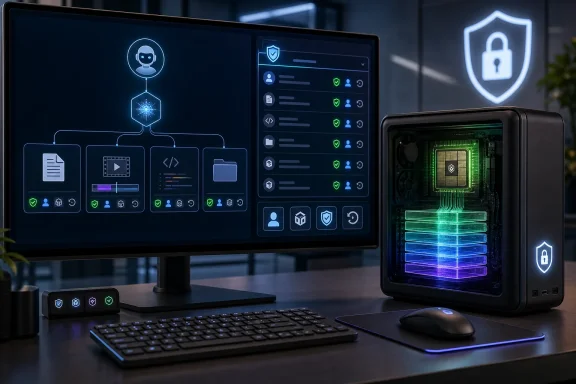 The AI PC Finally Gets a Job Description
For the last two years, the “AI PC” has been a category in search of a use case. Microsoft, Intel, AMD, Qualcomm, and the OEM ecosystem have sold neural processing units as if a TOPS figure were a reason to upgrade, but many users have mostly seen webcam effects, transcription, and a Copilot key that opens a cloud service. The hardware arrived before the everyday workflow did.RTX Spark is trying to fix that mismatch by making the agent, rather than the chatbot, the centerpiece. A chatbot answers. An agent acts. That difference is why the Windows angle matters: if an AI system is expected to open apps, read documents, move data, execute code, prepare media, or coordinate a chain of tasks, the operating system becomes part of the product.
Nvidia’s contribution is the local horsepower. Microsoft’s contribution is the permission model, development surface, and enterprise vocabulary needed to make such horsepower less terrifying. The interesting part is not that either company can say “agentic” on stage. It is that the PC industry is inching toward a machine designed around delegation.
That is also where the danger lives. A faster local model does not automatically become a trustworthy colleague. Without containment, identity, auditability, and user control, an agent is just automation with a larger blast radius.
Nvidia Wants the GPU to Become the Agent’s Desk
RTX Spark appears to borrow from Nvidia’s DGX Spark and Grace Blackwell story: a compact, high-bandwidth, unified-memory machine that can run large models locally rather than relying on a cloud round trip. Nvidia has claimed up to one petaflop of FP4 AI performance and up to 128GB of unified memory, with model support in the 120-billion-parameter range for the Windows-oriented RTX Spark pitch. Those numbers are not incidental; they define what kind of agent the companies want users to imagine.Today’s mainstream AI PCs are not built for that. NPUs are efficient, but they are not magic. They are well suited to smaller models, background inference, and low-power features, not necessarily to a long-running assistant coordinating a video project, a coding task, a spreadsheet cleanup, and a browser research session.
A large unified memory pool changes the shape of the problem. Agents need context. They need room for the model, the tool calls, the active files, the embeddings, and the application state they are manipulating. When Nvidia talks about 1-million-token context windows and large local models, it is selling something closer to a workstation-class agent environment than a glorified autocomplete engine.
But Nvidia is also doing what Nvidia does best: making the future sound as if it depends on buying Nvidia silicon. That may be partly true for demanding local agents, especially those working with graphics, video, code, and large models. It is not automatically true for every user. Many agent tasks are I/O-bound, permission-bound, or reliability-bound rather than compute-bound.
This distinction matters because the PC industry has a habit of turning every new workload into a hardware race. If agents become practical, performance will matter. But if agents become trusted, the operating system will matter more.
Windows Is the Real Battleground
Windows has always been powerful because applications could do almost anything. That openness made it the default platform for business, gaming, development, and creative work. It also made Windows historically messy, vulnerable, and hard to police.Agents sharpen that old trade-off. A normal app can misbehave, but it usually acts within a recognizable interface and a known workflow. An agent is designed to cross boundaries. It may read from Outlook, summarize a PDF, rename files, run a script, change settings, and paste the result into Teams or Word. That is useful precisely because it violates the old mental model of one app, one window, one user action.
Microsoft’s recent agent work on Windows is therefore less about giving Copilot a new personality and more about building guardrails below the assistant layer. The company has been talking about Windows agent connectors, an on-device registry, Model Context Protocol support, and execution containers that can isolate agent activity. The language is dry, but the implication is radical: Windows needs to know when software is acting as an agent, what it is allowed to touch, and how administrators can govern it.
That is the missing ingredient in most consumer agent demos. The demo shows a task completed. The admin asks what credentials were used, what files were read, what logs were kept, what data left the machine, what happens when the model hallucinates a command, and whether the user can undo the damage. The gap between those two perspectives is the gap between novelty and deployment.
If RTX Spark becomes merely a powerful box for running local models, it will be interesting but niche. If Windows gains a credible agent security model, RTX Spark becomes part of a larger platform shift. The OS stops being a passive host for apps and becomes the traffic controller for AI actions.
Local AI Is About Latency, Privacy, and Blame
The case for running agents locally is stronger than the case for running chat locally. A cloud chatbot can tolerate a little latency. A system that is clicking through apps, editing timelines, compiling code, or searching a folder tree cannot always afford that delay. The more interactive and stateful the task, the more local execution starts to look like a feature rather than a luxury.Privacy is the cleaner marketing argument. If the model, files, and tool calls stay on the device, users and companies have a simpler story to tell about data exposure. That does not make local AI automatically private; telemetry, plug-ins, cloud fallbacks, and app integrations can still leak sensitive context. But it gives administrators a better starting point than shipping every prompt and attachment to a remote service.
The deeper issue is blame. When a cloud agent fails, the vendor can point to model limits, tool integrations, or user prompts. When a local Windows agent deletes the wrong folder, commits bad code, or sends a confidential draft to the wrong contact, the failure lands on the user’s machine. That makes containment and audit trails essential.
This is why Microsoft’s security primitives may matter more than Nvidia’s petaflop. A petaflop can make a bad decision faster. A secure execution model can make the decision reversible, observable, and bounded. The future of agents on Windows will be determined by whether those controls feel built-in or bolted-on.
Power users already know how brittle automation can be. A script that assumes one path, one window title, or one version of an app can break spectacularly. Agents promise to be more flexible because they can reason and adapt, but that flexibility also makes them less predictable. Reliability will not come from intelligence alone. It will come from constrained environments, clear permissions, and boring administrative controls.
The Creative Workstation Is the First Believable Market
The most plausible early RTX Spark user is not someone asking a PC to book a vacation. It is a developer, video editor, designer, researcher, or engineer who already juggles expensive software and high-value local files. For that user, an agent that can prepare assets, generate drafts, check code, batch-process media, or search across project context has obvious utility.Nvidia knows this. Its platform story blends AI and graphics because the workloads overlap. A creator might ask an agent to generate background plates, upscale clips, prepare captions, organize takes, and assemble a rough cut. A developer might ask an agent to reproduce a bug, modify tests, compile the project, and explain the result. A researcher might ask an agent to index local notes and produce a structured briefing without uploading a document archive to the cloud.
These are not science-fiction scenarios. Pieces of them exist today in coding agents, media tools, and local model workflows. The difference RTX Spark promises is that the user does not need to be an amateur infrastructure engineer to make the stack work. Install the agent, give it governed access, and let the machine do the heavy lifting.
That is the dream. The reality will be uneven. Creative apps vary wildly in how scriptable they are. Many professional workflows involve plug-ins, custom folders, proprietary formats, network storage, licensing tools, and legacy utilities. An agent that works beautifully in a vendor demo may stall the moment it encounters a studio’s real project structure.
Still, this is where the pitch has traction. The ROI is clearer when a machine saves hours in a billable workflow. Consumers may not pay a premium for an AI agent that occasionally helps with errands. Professionals might pay if the agent reliably takes friction out of work they already do every day.
The ARM Problem Is Not a Footnote
One awkward detail in the RTX Spark story is architecture. Nvidia’s Grace CPU lineage is Arm-based, and Windows on Arm has improved dramatically, but the Windows software universe is still full of x86 assumptions. Emulation helps. Native Arm64 apps help more. Neither erases decades of accumulated compatibility baggage.For casual users, this may not matter much. Browsers, Office, collaboration apps, and many modern creative tools are increasingly Arm-aware. For enthusiasts and IT pros, it matters a lot. The weird driver, the old VPN client, the niche backup utility, the hardware dongle, the line-of-business app, the forgotten plug-in—these are the things that turn platform transitions into support tickets.
Agents make compatibility more important, not less. If the agent’s value is that it can act across the user’s real workflow, then “almost all the apps work” is not enough. The one app that does not work may be the exact app that makes the workflow valuable.
This is a place where Microsoft’s participation is crucial. Windows on Arm cannot remain a premium curiosity if the company wants agent-first PCs to matter beyond demos and developer boxes. The platform needs native tooling, predictable drivers, enterprise deployment support, and a compatibility story that does not require every buyer to become a beta tester.
Qualcomm has already pushed Windows on Arm into a more credible phase with Snapdragon X machines. Apple proved years ago that a consumer platform can migrate architectures if the hardware is good, the translation layer is strong, and the software ecosystem has incentives to follow. Nvidia and Microsoft now have to show that the agent pitch is enough of an incentive.
Microsoft Is Quietly Reframing Copilot’s Role
The original Copilot-in-Windows story was too vague. Was it a search box, a chatbot, a settings helper, a productivity layer, or an operating-system assistant? Microsoft tried to make it feel central before it had enough local authority to be central. Users noticed.The newer agent story is more disciplined. Rather than pretending that one assistant can safely control the whole PC tomorrow, Microsoft is building surfaces where agents can connect to tools under policy. That is less flashy than a floating chatbot that promises to do everything. It is also more realistic.
This shift matters because the agent ecosystem will not be Microsoft-only. OpenAI, Anthropic, Google, Nvidia, Adobe, Blackmagic, JetBrains, GitHub, and countless smaller vendors all want agents near user workflows. Windows cannot win by insisting every agent be Copilot. It can win by being the platform where agents are discoverable, containable, and manageable.
That is very Microsoft. The company’s most durable platform moves have often been about turning chaos into an enterprise-friendly abstraction. Win32 standardized desktop software. Active Directory standardized identity and policy. Azure standardized cloud procurement for Microsoft shops. An agent registry and execution model could become the same kind of boring but powerful layer.
The danger is fragmentation. If every vendor ships its own agent runtime, permission UI, connector model, and cloud fallback behavior, Windows users will face a new version of startup-app hell. The PC will not feel intelligent. It will feel haunted.
The Security Model Has to Be Visible Without Becoming Annoying
A practical agent PC needs a user interface for trust. That interface cannot be a wall of prompts, because users will approve anything if the system nags them enough. It also cannot be invisible, because invisible automation is indistinguishable from malware when something goes wrong.Windows already struggles with this balance. User Account Control trained people to click through prompts. Browser permission dialogs became background noise. App privacy settings are often discovered only after a breach of expectation. Agents will amplify all of those failures.
A good agent permission system needs to describe intent, scope, and duration in human terms. “Let this agent edit files in this project folder for the next hour” is understandable. “Allow connector access to filesystem resource provider” is not. Enterprise administrators need even more: policy templates, logs, revocation, data-loss-prevention hooks, and integration with identity systems.
The hardest design problem may be partial autonomy. Users do not want to approve every step in a 40-step workflow. They also do not want an agent to improvise beyond the original request. The system needs checkpoints at moments of consequence: spending money, sending messages, deleting data, changing system settings, publishing content, or executing untrusted code.
If Microsoft gets this right, Windows could become the safest mainstream place to run powerful local agents. If it gets it wrong, RTX Spark machines could become expensive cautionary tales.
The Hardware Hype Conceals a Software Readiness Test
Nvidia’s numbers are impressive, but they are not the whole product. One petaflop at FP4 is a specialized AI-performance figure, not a universal guarantee of speed. A 120-billion-parameter model running locally may still be constrained by quantization, memory bandwidth, thermals, battery life, and the quality of the agent framework around it.The first RTX Spark systems will likely be judged by the wrong metrics. Reviewers will benchmark models, games, battery life, thermals, and app performance. Those are necessary tests, but they will not answer the core question. The real question is whether an agent can complete useful, multi-app work with fewer errors than a human would tolerate.
That is difficult to measure. A benchmark can say how fast a model generated tokens. It cannot easily say whether an agent handled a messy Photoshop project, a broken Python environment, or a folder full of badly named invoices. The agent PC needs new tests that look more like office work, sysadmin work, and creative production than traditional synthetic benchmarks.
IT departments will run their own version of the test. They will ask whether RTX Spark systems can be imaged, managed, patched, monitored, and locked down like ordinary PCs. They will ask whether local models create new data-retention obligations. They will ask whether agents respect least privilege. They will ask whether support desks can diagnose agent-caused mistakes without becoming forensic AI investigators.
That is where the hype will meet procurement. Enthusiasts can forgive rough edges. Enterprises buy risk reduction.
Apple, Qualcomm, and Google Are Not Standing Still
Nvidia and Microsoft are not inventing the local-AI race from scratch. Apple has already shown the advantage of unified memory, tight hardware-software integration, and a developer ecosystem that can be pushed toward native acceleration. Qualcomm has helped make Windows on Arm more credible. Google is weaving Gemini deeper into Android, ChromeOS, Workspace, and developer tools.The difference is that Windows remains the world’s messy productivity layer. If agents are supposed to manipulate the software people actually use for work, Windows has an enormous installed-base advantage. It also has an enormous legacy burden.
Apple can offer a more controlled environment. Google can offer cloud-connected agents with deep web and Android integration. Microsoft has to make agents work in the place where business users keep decades of habits, files, macros, utilities, and half-modernized workflows. That is harder, but it is also more valuable if solved.
Nvidia’s role is to give Windows a high-end local-AI story that neither Qualcomm nor Intel can fully match today in raw GPU-centric AI ambition. But the long-term market will not belong only to the most powerful chip. It will belong to the platform that makes agents useful at a tolerable cost, with a tolerable support burden, and a tolerable failure rate.
That may produce a split market. Lightweight agents may run on mainstream NPUs and cloud services. Heavy local agents may run on RTX Spark-class machines. Enterprise agents may run partly on device, partly in managed cloud environments. The PC will not become agentic all at once; it will become agentic unevenly.
The Old Desktop Metaphor Is Starting to Bend
The Windows desktop was built around files, windows, menus, and applications. Users learned to translate goals into app operations: open this, copy that, export here, upload there. Agents invert that relationship. The user states a goal, and software chooses the path.This does not mean apps disappear. That prediction has been wrong many times. Apps are contracts: they define capabilities, interfaces, file formats, and business models. What may disappear is the assumption that the user must personally drive every app interaction.
The agent becomes a new layer above applications, but below the user’s intent. That is why Nvidia and Microsoft are talking about the PC itself rather than just a better assistant. The machine needs enough local intelligence to understand the work, enough system access to act, and enough restraint not to become a liability.
For Windows enthusiasts, this is both exciting and uncomfortable. The PC has always been the user-controlled machine, the box where you can install what you want and make it do strange things. Agents could extend that tradition by making automation more accessible. They could also undermine it if vendors use agents as another way to steer users into closed ecosystems and subscription services.
The best version of RTX Spark and agentic Windows is not a PC that hides everything behind a chatbot. It is a PC that lets users delegate without surrendering control. That is a subtle distinction, and it will separate useful agent platforms from patronizing ones.
The RTX Spark Bet Comes Down to Trust, Not Teraflops
The concrete promise is easy to summarize, but the consequences are not. RTX Spark-class Windows machines are supposed to bring large local models, unified memory, Nvidia graphics, and Microsoft-governed agent access into one personal computer. If the pieces work, users could move from manually operating apps to supervising outcomes.The practical lessons are already visible:
- RTX Spark’s most important feature is not peak AI performance; it is the possibility of running capable agents locally with enough memory to maintain meaningful context.
- Microsoft’s Windows agent security work is the difference between a useful automation platform and a dangerous demo environment.
- Professional creative, development, and research workflows are more credible early markets than casual consumer errands.
- Windows on Arm compatibility remains a major test because agents are only useful when they can operate the user’s actual software stack.
- The first generation should be judged by completed workflows, recoverability, and administrative control, not only by model benchmarks.
- Local AI improves the privacy and latency story, but it does not eliminate the need for logging, permissions, and data-governance policy.
Nvidia and Microsoft are betting that the next Windows upgrade cycle will not be driven by a prettier shell or a faster boot time, but by a new division of labor between person and machine. If they are right, the PC’s future is not the disappearance of apps or the triumph of a single assistant; it is a more governed, more local, more powerful form of delegation. The companies still have to prove that users can trust it, but for the first time in the AI PC era, the sales pitch points toward a real change in how work gets done.
References
- Primary source: How-To Geek
Published: Fri, 05 Jun 2026 13:01:17 GMT
This is how RTX Spark and Windows will finally make AI agents practical for your PC
RTX Spark's real superpower isn't speed—it's the AI agent that understands your workflow www.howtogeek.com
- Related coverage: tomshardware.com
Microsoft unveils Project Solara AI, a chip-to-cloud platform built to power a new generation of 'agent-first' enterprise devices — hardware designed to run AI agents instead of traditional apps | Tom's Hardware
Microsoft ditches Windows to build OS on Androidwww.tomshardware.com - Related coverage: windowscentral.com
Microsoft is making a Surface mini PC for AI developers: Meet the Surface RTX Spark Dev Box, featuring 128GB RAM and one petaflop of AI compute power | Windows Central
Coming later this year, Microsoft is shipping its first Surface branded mini PC, aimed solely at AI developers looking to adopt NVIDIA's new RTX Spark platform.www.windowscentral.com - Related coverage: nvidia.com
NVIDIA DGX Spark: AI Supercomputer on Your Desk
Build and run autonomous AI agents securely and locally with up to 200 billion parameters. 128GB of unified system memory. Preloaded with the NVIDIA AI software stack. On your desktop.www.nvidia.com - Official source: microsoft.com
Microsoft unveils Microsoft Security Copilot agents and new protections for AI | Microsoft Security Blog
Learn more about the next evolution of Security Copilot with AI agents designed to autonomously assist with phishing, data security, and identity management.www.microsoft.com - Official source: support.microsoft.com
Experimental Agentic Features | Microsoft Support
Experimental Agentic Featuressupport.microsoft.com
- Official source: blogs.windows.com
Windows platform security for AI agents
Making Windows the trustworthy OS for agents AI agents are no longer just answering questions, they are taking actions across systems with increasing autonomy. As they become persistent participants in how software runs, they introduce new rblogs.windows.com - Official source: blogs.microsoft.com
Microsoft Build 2025: The age of AI agents and building the open agentic web - The Official Microsoft Blog
TL;DR? Hear the news as an AI-generated audio overview made using Microsoft 365 Copilot. You can read the transcript here. We’ve entered the era of AI agents. Thanks to groundbreaking advancements in reasoning and memory, AI models are now more capable and efficient, and we’re seeing how...blogs.microsoft.com - Related coverage: digitalapplied.com
NVIDIA RTX Spark: 1-Petaflop Local AI Agent Box Guide
NVIDIA's RTX Spark superchip runs 120B-parameter agents on-device with 128GB unified memory. Inside the silicon, the bandwidth math, and OpenShell security.www.digitalapplied.com - Related coverage: techradar.com
Microsoft unveils MDASH, its AI agent-driven security platform — and it's already spotted a host of new Windows flaws | TechRadar
100 AI agents worked in unison to discover 16 flawswww.techradar.com - Related coverage: banklesstimes.com
Nvidia, Microsoft Unveil RTX Spark: 1-Petaflop AI PC Chip | BanklessTimes
NVIDIA has unveiled RTX Spark, a new superchip for a new generation of Windows PCs built around personal AI agents.www.banklesstimes.com - Related coverage: devcrunch.com
Windows 11 MCP AI Agents - DevCrunch - DevCrunch
Quick Take: Microsoft is building a secure, OS-level communication layer called the Model Context Protocol (MCP) directly into Windows 11. Announced at Builddevcrunch.com - Related coverage: blogs.nvidia.de
NVIDIA und Microsoft erfinden Windows-PCs für das Zeitalter der persönlichen KI neu
NVIDIA RTX Spark treibt die weltweit ersten Windows-PCs an, die speziell für persönliche Agenten entwickelt wurden.blogs.nvidia.de - Related coverage: acecomputers.com
- Related coverage: hub.tdsynnex.com
- Related coverage: docs.nvidia.com
