

MediaTek said on June 1, 2026, that it collaborated with NVIDIA on RTX Spark, a new Windows 11 PC platform for slim laptops and compact desktops aimed at local AI agents, creators, developers, and gamers, with first systems expected in fall 2026. The announcement matters less because MediaTek has attached its name to another partner chip and more because it puts a longtime mobile silicon supplier inside the premium Windows PC argument. NVIDIA is trying to make the AI PC feel like an RTX machine first and a Windows-on-Arm machine second. MediaTek’s role is the quiet engineering wager behind that pitch: if the platform cannot stay fast, cool, connected, and battery-friendly, the branding will not save it.
The PC industry has spent the past two years trying to decide what an AI PC actually is. Microsoft pushed Copilot+ PCs as a baseline of neural processing, Qualcomm used Snapdragon X chips to reopen the Windows-on-Arm conversation, and Intel and AMD raced to add larger NPUs to familiar x86 platforms. NVIDIA’s RTX Spark pitch is more aggressive: put the company’s AI and graphics stack at the center of the machine and let Windows become the operating environment around it.
That makes MediaTek’s contribution strategically important. The company is not being presented as the consumer-facing brand of the device in the way Qualcomm is with Snapdragon. Instead, MediaTek is supplying the sort of foundational SoC work that determines whether the machine behaves like a polished PC or a technology demo.
According to MediaTek, its role spans CPU and cache design, system integration, memory controller work, power delivery, and wireless connectivity. That is not a small assist. It is the list of subsystems that make or break a thin laptop when the GPU vendor wants desktop-class AI claims in a chassis that must still pass the coffee-shop test.
The key phrase in the announcement is not “personal agents” or “local AI supercomputing,” although both are doing the expected marketing labor. The key phrase is system integration. NVIDIA can bring CUDA, RTX, TensorRT, DLSS, Reflex, and Blackwell-era AI acceleration to the table, but a Windows laptop is not a PCIe card. It is a thermal budget, a battery curve, a driver stack, an app compatibility story, a sleep-resume experience, and a memory architecture all negotiating with one another at once.
MediaTek knows that negotiation from phones, tablets, Chromebooks, routers, TVs, and connected devices. The open question is whether that background scales cleanly into premium Windows PCs, where users expect not just efficiency but a very specific kind of predictability.
That is why the announcement leans on creators, developers, gamers, and “personal agents.” Those audiences are not accidental. They are the groups most likely to accept a new silicon architecture if the performance upside is obvious and the software support is credible.
For creators, NVIDIA’s pitch is familiar. RTX acceleration already matters in Adobe workflows, 3D rendering, video effects, AI denoising, upscaling, and generative tools. For developers, the company’s advantage is even more direct: CUDA remains a gravitational force in AI and high-performance compute. For gamers, NVIDIA can point to the existing RTX ecosystem rather than asking players to believe in a new graphics stack from scratch.
But the PC is still a Windows PC. That means the platform must survive ordinary expectations before it can win extraordinary workloads. Printers, docks, VPN clients, game launchers, external monitors, backup tools, peripheral utilities, old Win32 applications, and enterprise agents all matter. A premium laptop cannot be great only when running the demo NVIDIA prefers.
This is where Microsoft’s parallel work becomes crucial. The company has been improving emulation, native Arm support, gaming compatibility, and Windows performance foundations, but the burden is still heavier than it is on x86. RTX Spark can be a breakthrough only if users stop noticing the architectural transition during ordinary use.
The danger for NVIDIA is that the RTX brand raises expectations rather than lowering them. If a thin RTX Spark laptop struggles with a popular x86 game launcher, a hardware monitoring tool, or a niche creative plug-in, the buyer will not blame the abstract difficulty of platform transitions. They will blame the expensive PC in front of them.
Apple taught the broader consumer market to take unified memory seriously, even when buyers did not use the term. A MacBook with a large unified memory pool can feel disproportionately capable in media and AI-adjacent workloads because the CPU, GPU, and accelerators are not fighting over the same boundaries in the old discrete way. NVIDIA appears to be aiming at a similar conceptual target, but with its own graphics and AI ecosystem as the differentiator.
For Windows users, this could be more disruptive than another NPU spec bump. The first wave of AI PCs often treated the NPU as a sidecar: useful for webcam effects, background tasks, and some local inference, but not necessarily the heart of the machine. RTX Spark suggests a different model in which the memory architecture, GPU, CPU, and software stack are designed around sustained local AI capability from the start.
That does not mean every buyer will suddenly run frontier-scale models locally. The practical use cases will be narrower at first: coding assistants with larger context windows, local document agents, creative tools that keep assets and model operations on device, game AI features, search over personal files, and privacy-sensitive workflows that benefit from not round-tripping every request to the cloud.
The risk is that “up to 128 GB” becomes a halo specification while shipping systems cluster at lower capacities. The Windows laptop market has a long habit of advertising the platform ceiling and then selling the mainstream configuration with much less memory than the story implies. If RTX Spark’s most interesting features depend on large unified memory pools, OEM configurations will matter as much as the silicon.
RTX Spark gives MediaTek a different door into the room. It does not need to convince Best Buy shoppers that a MediaTek-branded Windows laptop is the new premium default. It only needs to prove that its engineering can help NVIDIA and Microsoft deliver a machine that feels premium under load.
That is a clever route because it avoids the hardest version of the branding problem. Consumers may buy an RTX Spark PC because it says NVIDIA, because it comes from Surface, Dell, HP, Lenovo, ASUS, MSI, Acer, or GIGABYTE, or because it promises better AI and graphics in a thin form factor. MediaTek can still gain credibility with OEMs, developers, and analysts without carrying the whole retail narrative.
The company’s statement points to prior NVIDIA collaborations in automotive, data center AI infrastructure, NVLink Fusion, and the GB10 SoC. That is not just résumé padding. It is an attempt to frame the PC move as part of a longer NVIDIA-MediaTek convergence rather than a one-off supplier relationship.
That framing matters because premium Windows PCs are unforgiving. A vendor can ship millions of mobile chips and still fail to satisfy the weird mix of expectations that defines the PC market. Users want long battery life, instant wake, cool surfaces, quiet fans, game compatibility, driver reliability, firmware updates, enterprise manageability, and enough legacy support to make the machine boring when it needs to be boring.
MediaTek’s challenge is not whether it can design efficient silicon. It is whether it can help deliver the kind of platform continuity Windows buyers expect after years of Intel and AMD muscle memory.
The local-compute angle is the strongest part of the pitch. If more AI work happens on the device, users may get lower latency, better offline behavior, and potentially stronger privacy boundaries than a cloud-only model. A local assistant that can reason over a project folder, edit media, summarize a codebase, or automate a workflow without constantly shipping data elsewhere is a meaningful improvement over many current assistant experiences.
But the word “agent” raises the stakes because agents do things. They are not just autocomplete boxes. They may read across applications, invoke tools, modify files, interact with services, or maintain state across sessions. That requires not only fast silicon but trust architecture, permissions, logging, reversibility, and user control.
Windows has been here before in miniature. Every attempt to make the PC more proactive runs into the same problem: the computer knows enough to be helpful but not enough to be safely autonomous. The more capable the local model becomes, the more important it is that Microsoft, NVIDIA, OEMs, and app developers make its boundaries understandable.
For IT departments, “local AI supercomputing” is not automatically a selling point. It is also a governance question. Which models are allowed? Where is data stored? Can agents access regulated documents? Are prompts logged? Can endpoint management tools see what happened? Can a user disable a feature without breaking the experience the device was sold around?
RTX Spark’s success in business environments will depend less on launch-stage spectacle than on administrative plumbing. If the platform becomes a black box of GPU-accelerated agents and vendor-specific services, conservative organizations will treat it cautiously. If it exposes clear controls, policy hooks, and auditability, it has a path beyond enthusiast and creator machines.
The Windows gaming ecosystem is a compatibility minefield. It includes ancient DirectX titles, modern engines, kernel-level anti-cheat, storefront overlays, mod managers, launchers, controller utilities, capture tools, RGB utilities, and drivers that users barely know exist until they fail. Arm translation adds another layer of complexity, even if the GPU side is NVIDIA’s home turf.
Microsoft has been improving this story, and support from anti-cheat vendors is a meaningful milestone. But gamers are not patient beta testers when a $60 title or a competitive match is on the line. A game that technically launches but stutters, refuses multiplayer, breaks an overlay, or behaves oddly under emulation will be counted as a failure.
NVIDIA can soften that risk by focusing RTX Spark systems on games and creator workloads that are native, validated, or GPU-bound enough to shine. It can lean on DLSS, Reflex, G-SYNC, and mature GeForce tooling. It can work with Microsoft and game studios to certify the catalog that matters most.
Still, the company must avoid overpromising. If RTX Spark is sold as a universal replacement for x86 gaming laptops, it will be judged against the broadest and messiest version of the PC catalog. If it is sold as a new class of efficient AI-and-creator Windows machines that also run a strong and growing set of games, the platform gets room to mature.
That distinction may sound like marketing nuance, but it is product survival. Windows enthusiasts remember the difference between “this runs Windows” and “this runs my Windows.”
Intel and AMD still have enormous advantages. They own the default x86 compatibility story, deep OEM relationships, corporate fleet familiarity, and decades of platform iteration. Their latest chips include NPUs, stronger integrated graphics, and increasingly serious efficiency work. For most buyers, the safe Windows laptop will remain x86 for some time.
Qualcomm has a different problem. Snapdragon X helped make Windows on Arm respectable in modern premium laptops, but NVIDIA is entering with a stronger claim to creator, developer, and gaming mindshare. If the Windows-on-Arm conversation becomes not just “battery life like a MacBook” but “CUDA-adjacent local AI and RTX graphics in a thin PC,” Qualcomm’s differentiation becomes more complicated.
That does not mean Qualcomm loses by default. It still has modem expertise, mobile efficiency credibility, and a head start in Copilot+ devices. But NVIDIA can bring something Qualcomm cannot easily replicate: a massive installed developer culture around its GPU software stack.
For Intel and AMD, the threat is not immediate volume collapse. It is narrative erosion at the high end. If premium Windows buyers begin associating next-generation AI PCs with NVIDIA-led platforms, x86 vendors risk being cast as the incumbents adding accelerators to yesterday’s architecture rather than defining tomorrow’s machine.
That may be unfair, especially because x86 systems will likely remain better for many workflows. But platform battles are not decided only by benchmark truth. They are decided by developer enthusiasm, OEM shelf placement, user perception, and whether the machine feels like it belongs to the future.
NVIDIA and MediaTek can describe power efficiency, optimized integration, and intelligent power management, but thin laptops are physical objects before they are strategy documents. A chip that looks transformative in a controlled demo can become ordinary if fans ramp loudly, surface temperatures climb, or performance drops sharply during long workloads.
The same is true for compact desktops. Small form factor PCs sound easier because they do not carry the same battery burden, but they still face thermal limits, acoustic expectations, and price pressure. If RTX Spark desktops become expensive developer boxes rather than mainstream premium PCs, their impact will be narrower.
OEM execution will also matter. The difference between a great platform and a great product often comes down to display quality, keyboard feel, firmware polish, port selection, repairability, sleep reliability, and update discipline. NVIDIA and MediaTek can build the silicon foundation, but ASUS, Dell, HP, Lenovo, Microsoft Surface, MSI, Acer, and GIGABYTE will determine how that foundation reaches buyers.
There is also the question of Windows versioning and platform support. If RTX Spark requires special OS builds, bespoke drivers, or carefully staged firmware updates, administrators will want to know how long those branches are supported and how quickly security fixes arrive. Enthusiasts may tolerate early-platform rough edges. Enterprise buyers usually do not.
The lesson from previous Windows-on-Arm efforts is blunt: the second month matters more than the keynote. Launch reviews will test benchmarks and battery life, but long-term confidence will be built through driver updates, app compatibility improvements, OEM firmware fixes, and whether Microsoft treats the platform as a first-class Windows citizen rather than a showcase category.
Developers will need stable APIs, clear performance targets, and enough installed base to justify optimization. Creators will need application-level acceleration that saves time in workflows they already use. Gamers will need compatibility that feels broad enough to trust. IT admins will need manageability. Ordinary users will need the machine to feel fast and quiet when they are doing unglamorous work.
This is why MediaTek’s lower-profile contribution may prove more consequential than the launch rhetoric. A proprietary memory controller, integrated connectivity, power management, and SoC-level tuning do not make for the most clickable headline. They do, however, determine whether the computer can sustain the workloads NVIDIA wants to popularize.
There is a plausible version of the next few years in which RTX Spark becomes the premium Windows AI platform that makes Copilot+ feel underpowered and traditional gaming laptops feel inefficient. There is also a plausible version in which it becomes a niche creator-and-developer platform with impressive demos, high prices, and uneven compatibility.
The difference will not be settled by whether the chip contains the right buzzwords. It will be settled by repeatable user experience: open the lid, run the apps, play the games, use the agent, dock the machine, update the driver, resume from sleep, and do it again without thinking about the architecture underneath.
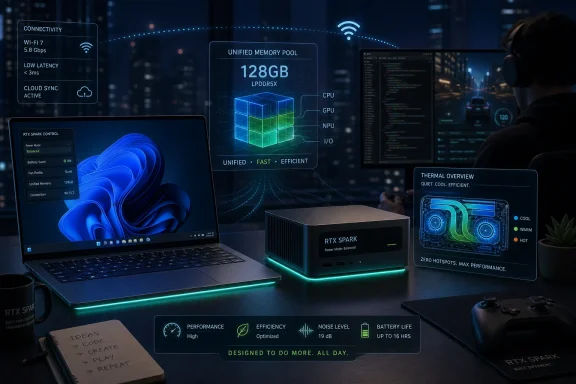 NVIDIA’s PC Ambition Now Has a MediaTek Engine Room
The PC industry has spent the past two years trying to decide what an AI PC actually is. Microsoft pushed Copilot+ PCs as a baseline of neural processing, Qualcomm used Snapdragon X chips to reopen the Windows-on-Arm conversation, and Intel and AMD raced to add larger NPUs to familiar x86 platforms. NVIDIA’s RTX Spark pitch is more aggressive: put the company’s AI and graphics stack at the center of the machine and let Windows become the operating environment around it.That makes MediaTek’s contribution strategically important. The company is not being presented as the consumer-facing brand of the device in the way Qualcomm is with Snapdragon. Instead, MediaTek is supplying the sort of foundational SoC work that determines whether the machine behaves like a polished PC or a technology demo.
According to MediaTek, its role spans CPU and cache design, system integration, memory controller work, power delivery, and wireless connectivity. That is not a small assist. It is the list of subsystems that make or break a thin laptop when the GPU vendor wants desktop-class AI claims in a chassis that must still pass the coffee-shop test.
The key phrase in the announcement is not “personal agents” or “local AI supercomputing,” although both are doing the expected marketing labor. The key phrase is system integration. NVIDIA can bring CUDA, RTX, TensorRT, DLSS, Reflex, and Blackwell-era AI acceleration to the table, but a Windows laptop is not a PCIe card. It is a thermal budget, a battery curve, a driver stack, an app compatibility story, a sleep-resume experience, and a memory architecture all negotiating with one another at once.
MediaTek knows that negotiation from phones, tablets, Chromebooks, routers, TVs, and connected devices. The open question is whether that background scales cleanly into premium Windows PCs, where users expect not just efficiency but a very specific kind of predictability.
RTX Spark Is a Windows-on-Arm Story Wearing an RTX Jacket
NVIDIA and Microsoft are not pitching RTX Spark as merely another Arm PC. That is deliberate. Windows on Arm has a long history of being evaluated through what it cannot run, what it cannot emulate well, and what drivers or anti-cheat systems remain out of reach. RTX Spark tries to flip the framing: start with the workloads NVIDIA already dominates, then ask Windows to meet them there.That is why the announcement leans on creators, developers, gamers, and “personal agents.” Those audiences are not accidental. They are the groups most likely to accept a new silicon architecture if the performance upside is obvious and the software support is credible.
For creators, NVIDIA’s pitch is familiar. RTX acceleration already matters in Adobe workflows, 3D rendering, video effects, AI denoising, upscaling, and generative tools. For developers, the company’s advantage is even more direct: CUDA remains a gravitational force in AI and high-performance compute. For gamers, NVIDIA can point to the existing RTX ecosystem rather than asking players to believe in a new graphics stack from scratch.
But the PC is still a Windows PC. That means the platform must survive ordinary expectations before it can win extraordinary workloads. Printers, docks, VPN clients, game launchers, external monitors, backup tools, peripheral utilities, old Win32 applications, and enterprise agents all matter. A premium laptop cannot be great only when running the demo NVIDIA prefers.
This is where Microsoft’s parallel work becomes crucial. The company has been improving emulation, native Arm support, gaming compatibility, and Windows performance foundations, but the burden is still heavier than it is on x86. RTX Spark can be a breakthrough only if users stop noticing the architectural transition during ordinary use.
The danger for NVIDIA is that the RTX brand raises expectations rather than lowering them. If a thin RTX Spark laptop struggles with a popular x86 game launcher, a hardware monitoring tool, or a niche creative plug-in, the buyer will not blame the abstract difficulty of platform transitions. They will blame the expensive PC in front of them.
The 128 GB Unified Memory Claim Is the Real Shot Across the Bow
The most consequential technical promise in the MediaTek announcement may be the proprietary memory controller supporting up to 128 GB of unified memory. That figure matters because local AI workloads are not just about raw TOPS or flashy model demos. They are about keeping enough model state, context, assets, and application memory close to the compute engine without turning the system into a pagefile furnace.Apple taught the broader consumer market to take unified memory seriously, even when buyers did not use the term. A MacBook with a large unified memory pool can feel disproportionately capable in media and AI-adjacent workloads because the CPU, GPU, and accelerators are not fighting over the same boundaries in the old discrete way. NVIDIA appears to be aiming at a similar conceptual target, but with its own graphics and AI ecosystem as the differentiator.
For Windows users, this could be more disruptive than another NPU spec bump. The first wave of AI PCs often treated the NPU as a sidecar: useful for webcam effects, background tasks, and some local inference, but not necessarily the heart of the machine. RTX Spark suggests a different model in which the memory architecture, GPU, CPU, and software stack are designed around sustained local AI capability from the start.
That does not mean every buyer will suddenly run frontier-scale models locally. The practical use cases will be narrower at first: coding assistants with larger context windows, local document agents, creative tools that keep assets and model operations on device, game AI features, search over personal files, and privacy-sensitive workflows that benefit from not round-tripping every request to the cloud.
The risk is that “up to 128 GB” becomes a halo specification while shipping systems cluster at lower capacities. The Windows laptop market has a long habit of advertising the platform ceiling and then selling the mainstream configuration with much less memory than the story implies. If RTX Spark’s most interesting features depend on large unified memory pools, OEM configurations will matter as much as the silicon.
MediaTek Is Buying Its Way Out of the Cheap-Chip Corner
MediaTek’s PC significance has historically been easy to underestimate. The company is enormous in phones, connectivity, embedded systems, and Chromebooks, but it has not had the same premium Windows identity as Intel, AMD, Qualcomm, or Apple’s silicon team. Its brand, at least in many Western PC conversations, has often been associated with cost-effective platforms rather than aspirational laptops.RTX Spark gives MediaTek a different door into the room. It does not need to convince Best Buy shoppers that a MediaTek-branded Windows laptop is the new premium default. It only needs to prove that its engineering can help NVIDIA and Microsoft deliver a machine that feels premium under load.
That is a clever route because it avoids the hardest version of the branding problem. Consumers may buy an RTX Spark PC because it says NVIDIA, because it comes from Surface, Dell, HP, Lenovo, ASUS, MSI, Acer, or GIGABYTE, or because it promises better AI and graphics in a thin form factor. MediaTek can still gain credibility with OEMs, developers, and analysts without carrying the whole retail narrative.
The company’s statement points to prior NVIDIA collaborations in automotive, data center AI infrastructure, NVLink Fusion, and the GB10 SoC. That is not just résumé padding. It is an attempt to frame the PC move as part of a longer NVIDIA-MediaTek convergence rather than a one-off supplier relationship.
That framing matters because premium Windows PCs are unforgiving. A vendor can ship millions of mobile chips and still fail to satisfy the weird mix of expectations that defines the PC market. Users want long battery life, instant wake, cool surfaces, quiet fans, game compatibility, driver reliability, firmware updates, enterprise manageability, and enough legacy support to make the machine boring when it needs to be boring.
MediaTek’s challenge is not whether it can design efficient silicon. It is whether it can help deliver the kind of platform continuity Windows buyers expect after years of Intel and AMD muscle memory.
The Personal Agent Pitch Is Both the Vision and the Vulnerability
NVIDIA and Microsoft are presenting RTX Spark as a platform for “personal agents,” a phrase that sounds futuristic until it runs into the ordinary anxieties of personal computing. A PC agent that can search files, take actions, interpret context, and coordinate with cloud services could be genuinely useful. It could also be intrusive, confusing, resource-hungry, and difficult for administrators to govern.The local-compute angle is the strongest part of the pitch. If more AI work happens on the device, users may get lower latency, better offline behavior, and potentially stronger privacy boundaries than a cloud-only model. A local assistant that can reason over a project folder, edit media, summarize a codebase, or automate a workflow without constantly shipping data elsewhere is a meaningful improvement over many current assistant experiences.
But the word “agent” raises the stakes because agents do things. They are not just autocomplete boxes. They may read across applications, invoke tools, modify files, interact with services, or maintain state across sessions. That requires not only fast silicon but trust architecture, permissions, logging, reversibility, and user control.
Windows has been here before in miniature. Every attempt to make the PC more proactive runs into the same problem: the computer knows enough to be helpful but not enough to be safely autonomous. The more capable the local model becomes, the more important it is that Microsoft, NVIDIA, OEMs, and app developers make its boundaries understandable.
For IT departments, “local AI supercomputing” is not automatically a selling point. It is also a governance question. Which models are allowed? Where is data stored? Can agents access regulated documents? Are prompts logged? Can endpoint management tools see what happened? Can a user disable a feature without breaking the experience the device was sold around?
RTX Spark’s success in business environments will depend less on launch-stage spectacle than on administrative plumbing. If the platform becomes a black box of GPU-accelerated agents and vendor-specific services, conservative organizations will treat it cautiously. If it exposes clear controls, policy hooks, and auditability, it has a path beyond enthusiast and creator machines.
Gaming Could Be the Trust Test NVIDIA Cannot Dodge
NVIDIA’s decision to include gaming in the RTX Spark story is both obvious and dangerous. Obvious because RTX is one of the strongest brands in PC gaming. Dangerous because gaming exposes every weakness in a platform faster than almost any other consumer workload.The Windows gaming ecosystem is a compatibility minefield. It includes ancient DirectX titles, modern engines, kernel-level anti-cheat, storefront overlays, mod managers, launchers, controller utilities, capture tools, RGB utilities, and drivers that users barely know exist until they fail. Arm translation adds another layer of complexity, even if the GPU side is NVIDIA’s home turf.
Microsoft has been improving this story, and support from anti-cheat vendors is a meaningful milestone. But gamers are not patient beta testers when a $60 title or a competitive match is on the line. A game that technically launches but stutters, refuses multiplayer, breaks an overlay, or behaves oddly under emulation will be counted as a failure.
NVIDIA can soften that risk by focusing RTX Spark systems on games and creator workloads that are native, validated, or GPU-bound enough to shine. It can lean on DLSS, Reflex, G-SYNC, and mature GeForce tooling. It can work with Microsoft and game studios to certify the catalog that matters most.
Still, the company must avoid overpromising. If RTX Spark is sold as a universal replacement for x86 gaming laptops, it will be judged against the broadest and messiest version of the PC catalog. If it is sold as a new class of efficient AI-and-creator Windows machines that also run a strong and growing set of games, the platform gets room to mature.
That distinction may sound like marketing nuance, but it is product survival. Windows enthusiasts remember the difference between “this runs Windows” and “this runs my Windows.”
Intel, AMD, and Qualcomm Now Face a Different Kind of Rival
RTX Spark does not neatly fit into the existing PC silicon contest. It is not simply another CPU entrant. It is NVIDIA using its software ecosystem to pressure the CPU market from the side.Intel and AMD still have enormous advantages. They own the default x86 compatibility story, deep OEM relationships, corporate fleet familiarity, and decades of platform iteration. Their latest chips include NPUs, stronger integrated graphics, and increasingly serious efficiency work. For most buyers, the safe Windows laptop will remain x86 for some time.
Qualcomm has a different problem. Snapdragon X helped make Windows on Arm respectable in modern premium laptops, but NVIDIA is entering with a stronger claim to creator, developer, and gaming mindshare. If the Windows-on-Arm conversation becomes not just “battery life like a MacBook” but “CUDA-adjacent local AI and RTX graphics in a thin PC,” Qualcomm’s differentiation becomes more complicated.
That does not mean Qualcomm loses by default. It still has modem expertise, mobile efficiency credibility, and a head start in Copilot+ devices. But NVIDIA can bring something Qualcomm cannot easily replicate: a massive installed developer culture around its GPU software stack.
For Intel and AMD, the threat is not immediate volume collapse. It is narrative erosion at the high end. If premium Windows buyers begin associating next-generation AI PCs with NVIDIA-led platforms, x86 vendors risk being cast as the incumbents adding accelerators to yesterday’s architecture rather than defining tomorrow’s machine.
That may be unfair, especially because x86 systems will likely remain better for many workflows. But platform battles are not decided only by benchmark truth. They are decided by developer enthusiasm, OEM shelf placement, user perception, and whether the machine feels like it belongs to the future.
The Fall 2026 Launch Window Leaves Little Room for Half Measures
The first RTX Spark laptops are expected in fall 2026, which is close enough to feel real and far enough away for several hard questions to remain unanswered. Pricing is one. Battery life under sustained AI and creative loads is another. Thermal behavior in 14-millimeter-class chassis may be the most practical question of all.NVIDIA and MediaTek can describe power efficiency, optimized integration, and intelligent power management, but thin laptops are physical objects before they are strategy documents. A chip that looks transformative in a controlled demo can become ordinary if fans ramp loudly, surface temperatures climb, or performance drops sharply during long workloads.
The same is true for compact desktops. Small form factor PCs sound easier because they do not carry the same battery burden, but they still face thermal limits, acoustic expectations, and price pressure. If RTX Spark desktops become expensive developer boxes rather than mainstream premium PCs, their impact will be narrower.
OEM execution will also matter. The difference between a great platform and a great product often comes down to display quality, keyboard feel, firmware polish, port selection, repairability, sleep reliability, and update discipline. NVIDIA and MediaTek can build the silicon foundation, but ASUS, Dell, HP, Lenovo, Microsoft Surface, MSI, Acer, and GIGABYTE will determine how that foundation reaches buyers.
There is also the question of Windows versioning and platform support. If RTX Spark requires special OS builds, bespoke drivers, or carefully staged firmware updates, administrators will want to know how long those branches are supported and how quickly security fixes arrive. Enthusiasts may tolerate early-platform rough edges. Enterprise buyers usually do not.
The lesson from previous Windows-on-Arm efforts is blunt: the second month matters more than the keynote. Launch reviews will test benchmarks and battery life, but long-term confidence will be built through driver updates, app compatibility improvements, OEM firmware fixes, and whether Microsoft treats the platform as a first-class Windows citizen rather than a showcase category.
The Fine Print Will Decide Whether This Is a Platform or a Moment
RTX Spark’s most interesting promise is that it could make local AI feel like a native PC capability rather than a cloud service squeezed into a desktop shell. That is a real ambition. It is also the kind of ambition that fails if the ecosystem does not align.Developers will need stable APIs, clear performance targets, and enough installed base to justify optimization. Creators will need application-level acceleration that saves time in workflows they already use. Gamers will need compatibility that feels broad enough to trust. IT admins will need manageability. Ordinary users will need the machine to feel fast and quiet when they are doing unglamorous work.
This is why MediaTek’s lower-profile contribution may prove more consequential than the launch rhetoric. A proprietary memory controller, integrated connectivity, power management, and SoC-level tuning do not make for the most clickable headline. They do, however, determine whether the computer can sustain the workloads NVIDIA wants to popularize.
There is a plausible version of the next few years in which RTX Spark becomes the premium Windows AI platform that makes Copilot+ feel underpowered and traditional gaming laptops feel inefficient. There is also a plausible version in which it becomes a niche creator-and-developer platform with impressive demos, high prices, and uneven compatibility.
The difference will not be settled by whether the chip contains the right buzzwords. It will be settled by repeatable user experience: open the lid, run the apps, play the games, use the agent, dock the machine, update the driver, resume from sleep, and do it again without thinking about the architecture underneath.
The RTX Spark Bet Comes Down to Five Unforgiving Tests
RTX Spark is not just a chip announcement; it is a stress test for the next era of Windows PCs. The platform’s promise is unusually large, which means the concrete evidence will need to arrive quickly once systems ship.- MediaTek’s role is central because CPU, cache, memory, connectivity, and power delivery determine whether NVIDIA’s AI and graphics stack can fit inside thin Windows PCs without compromising the basics.
- The 128 GB unified memory ceiling is one of the platform’s most important claims because serious local AI workloads often need memory capacity and bandwidth as much as headline compute.
- Windows-on-Arm compatibility remains the unresolved practical challenge, especially for games, creative plug-ins, device drivers, enterprise tools, and older Win32 applications.
- NVIDIA’s software ecosystem gives RTX Spark an advantage over earlier Arm PC efforts, but it also raises expectations for gaming, CUDA-adjacent development, and creator acceleration.
- The fall 2026 hardware wave will be judged less by keynote demos than by pricing, battery life, thermals, fan noise, app support, driver maturity, and OEM execution.
- IT departments will treat personal agents cautiously unless Microsoft, NVIDIA, and OEMs provide clear controls for data access, model behavior, policy enforcement, and auditability.
References
- Primary source: TechPowerUp
Published: Mon, 01 Jun 2026 17:11:38 GMT
MediaTek Collaborates with NVIDIA on RTX Spark to Power the Next Wave of Windows PC Experiences | TechPowerUp
MediaTek today announced its role in enabling NVIDIA RTX Spark, introduced today as a new class of processors powering Windows 11 PCs purpose-built for personal agents. It's designed to build the future, unlock creative power, and run the latest games in slim laptops and small...www.techpowerup.com - Related coverage: axios.com
Microsoft debuts Nvidia-powered Microsoft Surface Ultra laptop
Microsoft is trying again to redefine the PC for the AI era.www.axios.com
- Related coverage: tomshardware.com
Nvidia lays out RTX Spark roadmap for laptops and desktop PCs at Computex 2026 — three generations outlined, Rubin with LPDDR6 memory, followed by Rosa Feynman | Tom's Hardware
Nvidia is fully committed to transforming Windows on Arm into an agentic AI platformwww.tomshardware.com - Related coverage: techradar.com
Watch out, Apple — Nvidia just unveiled its RTX Spark Arm 'superchip' to take on the M5 at Computex 2026 | TechRadar
Things are hotting up in Taiwanwww.techradar.com - Related coverage: mediatek.com
MediaTek Collaborates with NVIDIA on RTX Spark to Power the Next Wave of Windows PC Experiences
MediaTek Collaborates with NVIDIA on RTX Spark to Power the Next Wave of Windows PC Experienceswww.mediatek.com - Related coverage: nvidianews.nvidia.com
NVIDIA and Microsoft Reinvent Windows PCs for the Age of Personal AI | NVIDIA Newsroom
NVIDIA today unveiled NVIDIA RTX Spark™, a new superchip that reinvents Windows PCs for the era of personal AI agents — offering a new class of computer that moves from tool to teammate.nvidianews.nvidia.com
- Related coverage: tecnoblog.net
MediaTek ajudou a criar o Nvidia RTX Spark, e explica como • Tecnoblog
Direcionado a PCs de alto desempenho focados em IA, RTX Spark é um chip que reúne CPU e GPU. Projeto contou com participação da MediaTek. tecnoblog.net
- Official source: blogs.windows.com
Introducing a powerful new chapter for Windows PCs, accelerated by NVIDIA RTX Spark
Today at NVIDIA GTC, Microsoft and NVIDIA announced the world’s most powerful and efficient thin-and-light Windows PCs ever. Accelerated by NVIDIA RTX Sparkblogs.windows.com - Related coverage: techspot.com
Nvidia RTX Spark CPU is now official: "superchip" will power Windows laptops and desktops | TechSpot
Ryan Shrout is a longtime technology analyst and industry veteran who has spent over two decades covering PC hardware, graphics, and semiconductors. He previously led technical marketing...www.techspot.com - Related coverage: techcrunch.com
Nvidia chases $200B CPU market with AI agent PCs from Microsoft, Dell, and HP | TechCrunch
If Nvidia has cracked a way to bring AI agents easily, safely, and usefully to the masses, it could — and should — be big.techcrunch.com - Related coverage: letsdatascience.com
MediaTek Joins NVIDIA to Build RTX Spark Superchip | Let's Data Science
According to NVIDIA's May 31, 2026 press release, NVIDIA unveiled **RTX Spark**, a new Arm-based superchip for Windows PCs that combines a 20-core **Grace** CPU, up to **6,144 Blackwell CUDA cores**, and up to **128GB** of unified memory, delivering roughly **1 petaflop** of AI performance... letsdatascience.com
- Related coverage: investor.nvidia.com
NVIDIA Corporation - NVIDIA and Microsoft Reinvent Windows PCs for the Age of Personal AI
RTX Spark — a 1-Petaflop Superchip, the Full CUDA and RTX Ecosystem, and Windows-Native Agents — a New Beginning for Personal Computers News Summary: NVIDIA RTX Spark powers the world’s first Windows PCs purpose-built for personal agents, featuring 1 petaflop of AI performance, industry-leading...investor.nvidia.com - Related coverage: windowscentral.com
Windows 11 version 26H1: Everything you need to know about Microsoft's special OS release now shipping on new hardware | Windows Central
Microsoft has confirmed that Windows 11 version 26H1 is now shipping exclusively on new PCs that ship with Qualcomm's new Snapdragon X2 SoC. Here's what you need to know.www.windowscentral.com - Related coverage: pcgamer.com
Further details of Nvidia's GB10 'superchip' shine light on the complex collaboration with MediaTek | PC Gamer
Though folks who have ordered one would probably have preferred to get the actual chip rather than just a tech breakdown.www.pcgamer.com
