

Verdict: ship a limited production pilot now only when structured output is non-critical, observable, reversible, validated before use, and backed by a fallback path. Keep Windows App SDK 2.1.4-Experimental8 behind a feature flag, and do not make its structured-JSON API the sole dependency for business-critical workflows because Microsoft is still changing the result and status contract.
Windows App SDK 2.1.3, released May 21, 2026, remains the latest stable servicing release in the 2.1 line. Microsoft shipped 2.1.4-Experimental8 alongside it on the same day, carrying forward the stable release’s changes while adding an experimental refinement to structured JSON generation, according to Microsoft’s release notes and Windows App SDK release information.
The practical deployment choice is therefore not “AI in production” versus “no AI in production.” It is whether the application can contain an experimental API’s failures and future changes without corrupting data, blocking users, or forcing an emergency client update.
A production pilot is reasonable when the application treats generated JSON as an untrusted proposal rather than an authoritative transaction. The feature should remain optional, and every response should pass application-controlled validation before it reaches storage, automation, or another system.
Teams evaluating 2.1.4-Experimental8 should use this operating model:
The pilot should also be reversible at the workflow level. If disabling the AI feature leaves users stranded halfway through a process, the feature flag is only cosmetic. A genuine rollback path returns the user to a supported, non-AI route without losing work or requiring an administrator to repair application state.
The response exposes
Microsoft also removed
That separation is a useful design direction because it gives developers a cleaner place to implement retries, fallbacks, diagnostics, and user messaging. It also delivers the strongest warning in the release: the contract is still moving.
The issue is not simply that the API carries an experimental label. Microsoft has changed which result object is returned and where an important failure state lives. Any application compiled directly against the experimental surface must assume another experimental release could require more adaptation before the design reaches stable form.
This is why 2.1.4-Experimental8 is suitable for learning from real use but unsuitable as an irreplaceable control point. The new contract improves error handling, yet the act of introducing that contract shows Microsoft is still hardening the boundary between structured generation and general language-model responses.
Good candidates include drafting metadata, preparing a reviewable form, extracting optional classifications, or accelerating a task whose final decision remains with a user. The generated object can be rejected, edited, regenerated, or ignored without preventing the underlying work.
Poor candidates include workflows where generated JSON directly authorizes an action, changes an entitlement, becomes the only stored record, or feeds an unattended process with no recovery path. The release notes do not establish that the experimental API can carry those responsibilities, and the changing status contract argues against making that assumption.
For sysadmins, the key question is not whether a model usually returns valid JSON. It is whether the organization can explain what happens when it does not. A supportable pilot needs a known failure state, visible diagnostics, a user-facing escape route, and an owner who can disable the feature.
Developers should also avoid flattening every failure into the same generic error message.
A sensible architecture keeps the bulk of the application aligned with stable assumptions while isolating the experimental integration behind a narrow adapter. The rest of the codebase should consume an application-owned result that can represent success, invalid output, a general failure, and fallback activation without exposing Microsoft’s experimental types throughout the program.
That layer reduces migration cost if Microsoft changes names, statuses, or return types again. It also makes it possible to test the application’s failure policy independently from the model and to remove the experimental implementation without rewriting the workflow.
This is the same broader tension appearing across Microsoft’s desktop AI push. WindowsForum has previously examined the Windows App SDK’s experimental Copilot Runtime direction and how local Windows AI APIs can lower the barrier to adding on-device features. Lower integration friction, however, does not remove the need for conventional release engineering.
The Windows App SDK also ships independently of the Windows operating system. For the 2.1 line, Microsoft lists support beginning with Windows 10 version 1809, build 17763, rather than tying the SDK solely to one Windows 11 feature update. That broad OS baseline can help application reach, but it does not turn every experimental API into a stable enterprise contract.
Wait for a stable surface when structured output is the workflow rather than an enhancement to it. If a schema-compliant response must arrive every time for the application to complete a business-critical operation, 2.1.4-Experimental8 is the wrong sole dependency today.
The next meaningful milestone is not merely another experimental package. It is Microsoft stabilizing the dedicated structured-output result and status model—or changing it again in a way that reveals which assumptions early adopters must discard. Until then, pilot the capability, not the dependency.
Windows App SDK 2.1.3, released May 21, 2026, remains the latest stable servicing release in the 2.1 line. Microsoft shipped 2.1.4-Experimental8 alongside it on the same day, carrying forward the stable release’s changes while adding an experimental refinement to structured JSON generation, according to Microsoft’s release notes and Windows App SDK release information.
The practical deployment choice is therefore not “AI in production” versus “no AI in production.” It is whether the application can contain an experimental API’s failures and future changes without corrupting data, blocking users, or forcing an emergency client update.
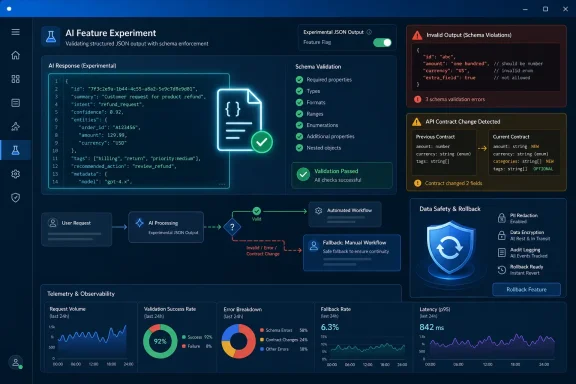 The Safe Pilot Has Five Guardrails
A production pilot is reasonable when the application treats generated JSON as an untrusted proposal rather than an authoritative transaction. The feature should remain optional, and every response should pass application-controlled validation before it reaches storage, automation, or another system.Teams evaluating 2.1.4-Experimental8 should use this operating model:
- Put the structured-output feature behind a remotely controllable feature flag so it can be disabled without removing the entire application.
- Validate every generated response against the expected schema and the application’s own business rules.
- Handle invalid JSON separately from other model failures by using the structured-output-specific status returned by the experimental API.
- Provide a deterministic fallback, such as the existing manual workflow, a conventional parser, or an unstructured response that the user must review.
- Record enough operational telemetry to distinguish schema failures, broader model failures, validation rejections, fallback use, and user abandonment.
The pilot should also be reversible at the workflow level. If disabling the AI feature leaves users stranded halfway through a process, the feature flag is only cosmetic. A genuine rollback path returns the user to a supported, non-AI route without losing work or requiring an administrator to repair application state.
Microsoft Is Giving Invalid JSON Its Own Failure Lane
Structured JSON generation first appeared in Windows App SDK 2.0 Experimental 7. In 2.1.4-Experimental8,LanguageModelExperimental.GenerateStructuredJsonResponseAsync now returns a dedicated GenerateStructuredJsonResponseResult rather than the generic language-model result type.The response exposes
GenerateStructuredJsonResponseStatus, a status contract built specifically for schema-constrained generation. Its ResponseInvalidJson value lets an application distinguish output that failed the requested JSON schema from a generic language-model failure.Microsoft also removed
ResponseInvalidJson from the stable LanguageModelResponseStatus enum. Code that previously looked for that condition through the general language-model status must move the check to the new structured-output-specific result.That separation is a useful design direction because it gives developers a cleaner place to implement retries, fallbacks, diagnostics, and user messaging. It also delivers the strongest warning in the release: the contract is still moving.
The issue is not simply that the API carries an experimental label. Microsoft has changed which result object is returned and where an important failure state lives. Any application compiled directly against the experimental surface must assume another experimental release could require more adaptation before the design reaches stable form.
This is why 2.1.4-Experimental8 is suitable for learning from real use but unsuitable as an irreplaceable control point. The new contract improves error handling, yet the act of introducing that contract shows Microsoft is still hardening the boundary between structured generation and general language-model responses.
Production Means More Than Running on User PCs
A carefully constrained feature can run in a production build without becoming a production dependency. That distinction is particularly important for desktop AI, where product teams may want realistic feedback but IT departments still need predictable support and rollback behavior.Good candidates include drafting metadata, preparing a reviewable form, extracting optional classifications, or accelerating a task whose final decision remains with a user. The generated object can be rejected, edited, regenerated, or ignored without preventing the underlying work.
Poor candidates include workflows where generated JSON directly authorizes an action, changes an entitlement, becomes the only stored record, or feeds an unattended process with no recovery path. The release notes do not establish that the experimental API can carry those responsibilities, and the changing status contract argues against making that assumption.
For sysadmins, the key question is not whether a model usually returns valid JSON. It is whether the organization can explain what happens when it does not. A supportable pilot needs a known failure state, visible diagnostics, a user-facing escape route, and an owner who can disable the feature.
Developers should also avoid flattening every failure into the same generic error message.
ResponseInvalidJson is valuable precisely because it distinguishes schema failure from broader model trouble. Preserving that distinction in logs and operational dashboards will reveal whether the schema is too ambitious, the generated output is unreliable, or the underlying request failed for another reason.Stable Foundation, Experimental AI Edge
Windows App SDK 2.1.3 and 2.1.4-Experimental8 should be treated as different deployment commitments even though the experimental build carries forward the stable release’s changes. One is the serviced 2.1 foundation; the other adds an API surface whose shape is explicitly open to revision.A sensible architecture keeps the bulk of the application aligned with stable assumptions while isolating the experimental integration behind a narrow adapter. The rest of the codebase should consume an application-owned result that can represent success, invalid output, a general failure, and fallback activation without exposing Microsoft’s experimental types throughout the program.
That layer reduces migration cost if Microsoft changes names, statuses, or return types again. It also makes it possible to test the application’s failure policy independently from the model and to remove the experimental implementation without rewriting the workflow.
This is the same broader tension appearing across Microsoft’s desktop AI push. WindowsForum has previously examined the Windows App SDK’s experimental Copilot Runtime direction and how local Windows AI APIs can lower the barrier to adding on-device features. Lower integration friction, however, does not remove the need for conventional release engineering.
The Windows App SDK also ships independently of the Windows operating system. For the 2.1 line, Microsoft lists support beginning with Windows 10 version 1809, build 17763, rather than tying the SDK solely to one Windows 11 feature update. That broad OS baseline can help application reach, but it does not turn every experimental API into a stable enterprise contract.
The Pilot Decision Comes Down to Failure Containment
Ship the pilot if invalid output is detectable before use, users retain a working fallback, administrators can shut the feature off, and no irreversible action depends solely on the generated JSON. Keep it in internal testing if the application cannot yet observe those failures or recover cleanly from them.Wait for a stable surface when structured output is the workflow rather than an enhancement to it. If a schema-compliant response must arrive every time for the application to complete a business-critical operation, 2.1.4-Experimental8 is the wrong sole dependency today.
The next meaningful milestone is not merely another experimental package. It is Microsoft stabilizing the dedicated structured-output result and status model—or changing it again in a way that reveals which assumptions early adopters must discard. Until then, pilot the capability, not the dependency.
References
- Primary source: learn.microsoft.com
Windows App SDK 2.0 release notes - Windows apps | Microsoft Learn
Provides information about what's new in Windows App SDK 2.0.learn.microsoft.com - Independent coverage: github.com
Releases · microsoft/WindowsAppSDK · GitHub
The Windows App SDK empowers all Windows desktop apps with modern Windows UI, APIs, and platform features, including back-compat support, shipped via NuGet. - Releases · microsoft/WindowsAppSDK github.com
- Primary source: WindowsForum
Unlocking AI Innovation: Windows App SDK Experimental Release with Copilot Runtime | Windows Forum
Microsoft is once again stirring the waters of desktop innovation by rolling out an experimental release of the Windows App SDK, now armed with artificial...windowsforum.com
