

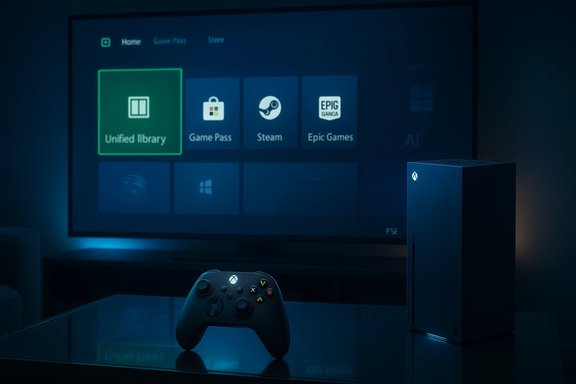
Microsoft’s experiment of running a console-style front end on top of Windows has moved from experiment to strategic roadmap: Microsoft is reportedly preparing “major updates” to the Xbox PC app and the Windows 11 Full Screen Experience (FSE) so the next full-size Xbox can present a TV-optimised, controller-first dashboard while running a full Windows stack underneath. This is a deliberate shift that ties the Xbox console UX to Windows 11’s FSE tooling, leans on Microsoft’s multi-year silicon partnership with AMD, and promises greater cross‑store discoverability — but it also opens a host of technical, commercial, and policy questions that will shape how gamers, developers, and retailers respond. Recent coverage from Pure Xbox and long-form reporting in industry press amplifies the claim that Microsoft is working to transform the Xbox PC app into a living‑room-ready launcher; this work builds on the ROG Xbox Ally handhelds that already ship Windows 11 with an Xbox full‑screen shell as the default experience.
Microsoft’s “Windows‑first” console concept is the culmination of several years of product moves: the Xbox PC app’s evolution into an aggregated library, the shipping of the Xbox Full Screen Experience (FSE) on Windows handhelds such as the ASUS ROG Xbox Ally, and a publicised strategic partnership with AMD to co‑engineer silicon across consoles, handhelds, and cloud instances. Together these pieces form a plausible engineering path for a living‑room device that behaves like a console at first boot but exposes the full flexibility of Windows under the hood.
Source: Pure Xbox https://www.purexbox.com/news/2026/...pdates-to-pc-app-for-next-consoles-dashboard/
 Background / Overview
Microsoft’s “Windows‑first” console concept is the culmination of several years of product moves: the Xbox PC app’s evolution into an aggregated library, the shipping of the Xbox Full Screen Experience (FSE) on Windows handhelds such as the ASUS ROG Xbox Ally, and a publicised strategic partnership with AMD to co‑engineer silicon across consoles, handhelds, and cloud instances. Together these pieces form a plausible engineering path for a living‑room device that behaves like a console at first boot but exposes the full flexibility of Windows under the hood. - The Xbox Full Screen Experience is already shipped on the ROG Xbox Ally family and is rolling out as a Windows Insider preview to other devices; it’s a controller‑first session posture designed to defer non‑essential desktop services and dedicate more runtime to gaming.
- The Xbox PC app has been moving toward an aggregated library model that discovers installed titles from other PC launchers and surfaces Game Pass and Microsoft Store content in a unified view. This capability is central to the “one place to find all my games” vision Microsoft appears to be extending to TV‑connected devices.
- Microsoft has announced a multi‑year partnership with AMD to co‑engineer silicon across a portfolio of devices — a partnership positioned as critical to delivering the next generation of Xbox hardware and the AI/graphics features Microsoft is promising.
What the reports say — and what’s verified
The claim in plain language
Recent reporting — most prominently the Windows Central account that industry outlets have amplified — argues that Microsoft plans to ship its next‑generation living‑room device with Windows 11 at its core and the Xbox FSE as the default dashboard. The system would boot into a TV‑optimised Xbox shell while retaining the ability to exit to the full Windows desktop, letting users run third‑party PC storefronts (Steam, Epic, GOG, Battle.net, etc. or productivity apps if they choose. To enable that experience, Microsoft is reported to be making “major updates” to the Xbox PC app so it behaves like a console‑ready launcher on a TV.What is already public and verifiable
- The Xbox Full Screen Experience exists and has shipped on the ASUS ROG Xbox Ally and Ally X handhelds; Microsoft is expanding FSE to other Windows 11 form factors through Insider channels. This is announced on Xbox Wire and demonstrable on shipping hardware.
- Microsoft publicly announced a co‑engineering partnership with AMD to design silicon across consoles, handhelds, PCs and cloud infrastructure; Xbox leadership has framed future hardware as “very premium, very high‑end” in public statements. These corporate announcements are on the record.
- The Xbox PC app’s aggregated library and discovery features are in active development and have appeared in Insider builds, moving the app closer to the sort of unified launcher the reports reference.
What remains speculative or unverified
- Whether a future Microsoft retail console will ship with unrestricted native installation and operation of every third‑party storefront or whether certain publishers or anti‑cheat systems will limit that capability is not confirmed. DRM and kernel‑level anti‑cheat technologies create practical constraints that are decided on a title‑by‑title basis by publishers and middleware vendors.
- Exact hardware specifications (APU topology, unified memory size, NPU capacity, TDP, retail SKUs) and final pricing remain leaked or reported as rumours and are not currently fixed by any official Microsoft spec sheet. Treat numerical hardware leaks as provisional until Microsoft publishes them.
- Launch timing and retail availability windows (including the oft‑repeated “2027” target) are clouded by supply‑chain factors and remain speculative; multiple outlets warn that component shortages — especially DRAM — could shift timelines or force pricing changes.
How the new model would work technically
The layered experience
At the core of Microsoft’s plan is a layered model: Windows 11 remains the underlying runtime (kernel, drivers, anti‑cheat, DRM frameworks), while the Full Screen Experience acts as a controller‑first session shell designed for living‑room use. This shell minimises background desktop noise and presents the Xbox PC app as the central home UI. If a user needs to access the Windows desktop or third‑party applications, they can exit the shell into a full Windows session. The ROG Xbox Ally proves the concept in handheld form; Microsoft’s challenge is tuning the layout and inputs for TV use.The Xbox PC app as a discovery and orchestration layer
The updated Xbox PC app could play three roles:- Aggregator: show Game Pass, Microsoft Store purchases, and discovered installs from Steam, Epic, GOG, Battle.net, and others in a single unified library.
- Orchestrator: launch a game while preserving DRM and anti‑cheat requirements — sometimes by handing off to a native client, sometimes by launching executables directly when allowed.
- Controller‑first UX: present a TV‑friendly, gamepad‑centric interface with curated landing pages, large art, and console‑style onboarding.
Strengths and benefits
1. Developer and platform convergence
A Windows‑based console removes a major friction for developers porting PC games to Xbox. Shipping on the same runtime simplifies testing, reduces platform divergence, and can speed up release cadence. Studios that already target Windows can reuse code paths, drivers and toolchains more directly.2. Consumer flexibility and library continuity
Running Windows under a console shell enables players to access a far broader catalog — including PC exclusives and titles available via competing PC storefronts — while preserving the console‑style simplicity when desired. Microsoft also emphasises backward compatibility: the company says existing Xbox libraries will carry forward, which aligns with consumer expectations around library preservation.3. Faster innovation cadence
Windows and the Xbox PC app can be updated outside of historic console OS cadence. This makes incremental UX, store aggregation, and feature improvements faster to ship and test via Insider channels, which benefits Microsoft’s ability to iterate the living‑room experience before a full retail launch.4. Hardware and software co‑engineering
The AMD partnership is a strategic advantage: Microsoft and AMD co‑designing silicon allows Microsoft to target capabilities (unified memory size, differential performance modes, NPU features) that align with Windows‑first console goals. This tight hardware/software coupling is historically how consoles achieved strong price/performance ratios.Risks, unresolved problems, and why they matter
1. Anti‑cheat and DRM interoperability
The easiest way to break the model is at the title level. Some popular multiplayer titles depend on kernel‑level anti‑cheat drivers that are not trivial to support across multiple store launchers or on alternative hardware configurations. Publishers could decide to restrict matchmaking or refuse certification for configurations that deviate from their anti‑cheat expectations, leading to fragmentation. The Xbox PC app’s orchestration model helps, but it cannot unilaterally force third‑party vendors to adapt.2. Support and certification complexity
A Windows‑first console introduces a spectrum of user experiences: the default FSE shell, the full Windows desktop, and mixed behaviours when third‑party launchers are invoked. Supporting that breadth raises QA costs, complicates retailer support scripts, and expands customer service flows. Microsoft will need to publish clear certification matrices that say which scenarios are “console‑certified” and which are user‑managed Windows behaviours.3. Price pressure from components — particularly RAM
A Windows‑rooted console that needs to run PC titles and large desktop workloads will likely require more main memory than prior Xbox generations. The global DRAM market is currently strained by AI datacenter demand, and multiple trade outlets report that memory shortages could push component costs higher and extend through 2026 or beyond. That supply pressure could force Microsoft either to raise MSRP, reduce on‑device specs, or delay a launch. All three outcomes affect adoption. Treat timeline speculation and leaked RAM numbers with caution; component markets are volatile.4. Store economics and discovery friction
If Xbox becomes a discovery surface that shows titles from competing stores, the economics of promotion and discovery shift. Microsoft must balance being a neutral aggregator with preserving incentives for its own store ecosystem. Publishers and store operators will watch for any preferential treatment or discoverability imbalances — all of which will shape publisher relations and potential content deals.5. User expectations vs. reality
Console buyers expect a turnkey living‑room device: simple setup, automatic updates, and consistent parental controls. A device that is technically a Windows PC in disguise must hide the complexity well; if the Windows layer is too visible (or too fragile), mainstream consumers may prefer a traditional console instead. Early ROG Ally feedback shows the FSE concept can work, but handheld-to‑TV translation needs careful UX polish.What this means for different stakeholders
For gamers
- Expect greater flexibility: a future Xbox could surface your PC purchases alongside Game Pass and Microsoft Store games, but don’t assume perfect compatibility for every title at launch.
- Verify anti‑cheat support for competitive favourites before assuming local installs will match console matchmaking guarantees.
- Be prepared for higher initial prices if Microsoft targets a “very premium” hardware profile; component markets (notably DRAM) could push MSRPs upward in the short term.
For developers and publishers
- A Windows runtime reduces porting overhead, but publishers still need to coordinate on anti‑cheat, DRM, and controller mappings to ensure consistent player experiences across storefronts.
- Track Microsoft’s developer guidance for certification and matchmaking rules; those matrices will determine whether your game is “console‑certified” on a Windows‑first device.
For retailers and channels
- Premium positioning changes stocking decisions and promotional strategies. Retailers will demand clarity on SKUs, warranty terms, and the degree of OS lock‑down (i.e., how much of Windows the buying public can or should access).
Practical checklist: what to watch next
- Official Microsoft product announcements that explicitly confirm the retail device’s OS posture (e.g., “Windows 11 with FSE” vs. “custom retail image”).
- The Xbox PC app roadmap and Insider release notes describing exactly what “major updates” will change in the UI and launch flow.
- AMD and Microsoft technical disclosures about APU topology, unified memory size, and NPU features — these numbers will define performance and price trade‑offs.
- Publisher guidance on anti‑cheat and DRM compatibility for the new hardware; pay particular attention to competitive multiplayer titles.
- Supply chain and memory market reports indicating whether DRAM availability and pricing will stabilise before any 2027–2028 launch window. If prices remain elevated, expect either delayed launches or higher MSRPs.
Strategic analysis: how Microsoft could make this work — and where it could fail
Pathways to success
- Lean into the FSE experience: ship a default, locked‑down FSE boot path that satisfies mainstream buyers while offering an opt‑in Windows mode for enthusiasts. This preserves the console simplicity many buyers expect while enabling power users to access Windows features when needed.
- Build strong anti‑cheat partnerships: working with major anti‑cheat vendors early to certify Windows‑first consoles will limit publisher friction and protect the platform’s competitive titles.
- Use the AMD partnership to lock in supply and tune silicon: co‑engineering could give Microsoft influence over the parts bill and performance targets, reducing the chance that memory constraints force a compromised product.
Failure modes to watch
- Over‑openness without support: if the Windows layer becomes the default and consumers frequently see Windows quirks on a living‑room box, retail adoption could suffer.
- Fragmented certification: if publishers retain too many exceptions for DRM or anti‑cheat, the “one device to play all your games” promise will be undermined.
- Price miscalculation: over‑investing in high memory budgets and premium silicon without an affordable tier risks slowing adoption and damaging Game Pass growth assumptions. Market data and DRAM trends suggest this is a realistic danger.
Recommendations for readers and community members
- If you’re a mainstream console buyer: wait for Microsoft’s retail UX and pricing announcement and prioritise the default console experience. The added flexibility matters most to enthusiasts; mainstream buyers benefit from a polished, consistent living‑room UI.
- If you’re a PC gamer or early adopter: consider testing the FSE experience via Insider channels or on Windows handhelds (ROG Xbox Ally) to evaluate how well the aggregated library and orchestration work for your favourite stores and titles.
- If you’re a developer: engage with Microsoft’s developer communications early and request clear guidelines for certification, anti‑cheat support, and recommended system specs. Prepare for mixed distribution models (store aggregation + native client handoff).
- If you sell or service hardware: plan for variations in warranty flows and user support if the console offers both a locked FSE mode and a full Windows mode. Clarify return‑to‑factory and support scripts ahead of launch.
Conclusion
The story of the next Xbox is no longer just a rumor — it’s a coherent product play built from the Xbox Full Screen Experience experiments, the Xbox PC app’s aggregated library work, and a confirmed silicon partnership with AMD. Microsoft has stitched together a plausible technical path to a living‑room device that can be both a console and a Windows PC. That ambition carries real upside: tighter developer pipelines, richer cross‑store discoverability, and a living‑room device that can genuinely unify PC and console libraries. At the same time, substantial practical hurdles remain. Anti‑cheat and DRM compatibility, customer support complexity, and volatile component markets (especially DRAM) create meaningful execution risk — and they could materially affect price and timing. Until Microsoft publishes final product details, hardware specs, and developer certification guidance, many of the most consequential questions remain open. Readers should treat timelines and leaked hardware numbers as provisional, follow official Microsoft and AMD disclosures closely, and expect Microsoft to refine the Xbox PC app and FSE in the coming months as the company prepares its next major reveal. The next Xbox will be judged on whether it can deliver the familiar, plug‑and‑play living‑room simplicity of a console while genuinely expanding player choice — and that balancing act is now the central design question for Microsoft, AMD, publishers, and the wider gaming ecosystem.Source: Pure Xbox https://www.purexbox.com/news/2026/...pdates-to-pc-app-for-next-consoles-dashboard/
