

Microsoft's latest push to broaden and accelerate the Windows gaming story on Arm represents a clear inflection point: the company is not merely tinkering at the edges, but actively changing the platform stack — from emulator capabilities and anti-cheat to graphics delivery and the Xbox app — to make Windows gaming on Arm a credible, mainstream option for more players and developers.
The last two years have seen renewed energy from Microsoft around gaming on Windows — and a notable pivot toward handhelds and Arm-based PCs. That work, announced across Microsoft’s Windows Experience and platform blogs and amplified by independent outlets, bundles several technical threads: emulator enhancements for x86 compatibility, native anti-cheat support on Arm hardware, integration of new graphics delivery systems (Advanced Shader Delivery), and OS-level innovations aimed at improving latency, power efficiency, and shader/runtime behavior. These changes are part of a broader strategic bet. Microsoft wants Windows to remain the primary platform for gaming in an era where handheld devices, heterogeneous silicon, and cloud streaming are reshaping how people play. That ambition means making Arm-based Windows devices — from light ultraportables to handhelds like the ROG Xbox Ally family — viable for both casual and competitive gaming.
That said, the story is pragmatic, not magical: compatibility will improve faster than raw parity. Emulation gains unlock titles; native optimization and hardware evolution will be required to close the performance gap for high-frame-rate competitive play. Consumers should expect a steadily improving catalog and experience over the coming months, but buyers targeting maximum FPS-per-dollar or esports-level responsiveness will still find x64 hardware a safer bet today.
For enthusiasts, developers, and OEMs, the key takeaway is simple: Windows on Arm gaming is no longer a curiosity. It is a prioritized platform with technical investments and ecosystem partnerships behind it. The next phase will be the most important — independent benchmarks, developer adoption, and real-world battery/sustained-performance measurements will determine whether Arm becomes a mainstream gaming pillar—or an important niche for ultra-portable play.
Source: TechPowerUp https://www.techpowerup.com/343980/...ersify-windows-gaming-experience-on-arm/?amp=
 Background
The last two years have seen renewed energy from Microsoft around gaming on Windows — and a notable pivot toward handhelds and Arm-based PCs. That work, announced across Microsoft’s Windows Experience and platform blogs and amplified by independent outlets, bundles several technical threads: emulator enhancements for x86 compatibility, native anti-cheat support on Arm hardware, integration of new graphics delivery systems (Advanced Shader Delivery), and OS-level innovations aimed at improving latency, power efficiency, and shader/runtime behavior. These changes are part of a broader strategic bet. Microsoft wants Windows to remain the primary platform for gaming in an era where handheld devices, heterogeneous silicon, and cloud streaming are reshaping how people play. That ambition means making Arm-based Windows devices — from light ultraportables to handhelds like the ROG Xbox Ally family — viable for both casual and competitive gaming. What Microsoft announced (the essentials)
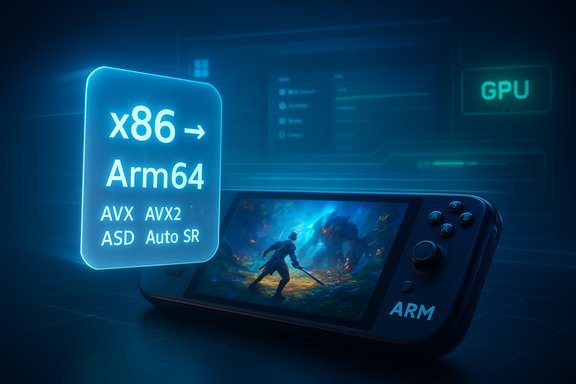
- Prism emulator upgrades: Windows’ Prism x86/x64-to-Arm64 translator now supports additional x86 extensions (notably AVX and AVX2), widening compatibility for modern games and creative apps. This update has rolled out to Windows 11 24H2+ devices.
- Xbox PC app: local installs for Arm: The Xbox app on Windows on Arm now allows Insiders to download and install supported titles locally, moving beyond cloud-only play and enabling Game Pass titles to run natively or under improved emulation on Arm hardware.
- Native anti-cheat support: Anti-cheat vendors including Easy Anti-Cheat (and broader ecosystem support from partners such as Epic and Qualcomm) now provide native Windows on Arm support, unlocking multiplayer/competitive titles that were previously blocked on Arm clients.
- Graphics/runtime improvements: Microsoft is expanding Advanced Shader Delivery (ASD) and exploring OS-level upscaling (Auto Super Resolution) and DirectX runtime improvements (DXR 1.2 and neural rendering previews) to reduce shader stutter, accelerate load times, and improve ray-tracing performance on supported GPUs.
- System-level optimizations: Microsoft’s roadmap calls out background workload management, power/scheduler improvements, and driver/graphics stack tuning designed to reduce latency and create a more “console-like” consistent experience on Windows devices, whether Arm or x64.
Why the Prism AVX/AVX2 update matters
What was the blocker
Many modern games and creative workloads assume the presence of wider SIMD instruction sets — AVX/AVX2 — on x86 CPUs. Historically, Arm CPUs lack these exact instructions in hardware, so binaries compiled for x86 would either not run or fall back to slow code paths. Games that use physics, high-performance math, or SIMD-accelerated code paths were therefore poor citizens on Arm Windows devices.What Microsoft did
Prism’s update brings emulation support for AVX and AVX2 (plus related extensions), meaning more 64-bit x86 titles can launch and execute functionally on Arm devices. This is an engineering-heavy fix: the emulator must translate SIMD-heavy instruction sequences into Arm64 equivalents and manage correctness, latency, and register mapping without breaking compatibility. Microsoft states this update shipped for devices running Windows 11 version 24H2 or later.Real-world impact and limits
- Immediate benefit: more games will run on Arm; titles that formerly refused to start due to unsupported instructions can now launch under Prism. That includes some major titles that were previously blocked.
- Performance caveat: AVX/AVX2 in this case are emulated or translated — not executed on dedicated hardware — so raw performance will not match native x86 silicon. Emulation incurs overheads that vary widely by game and CPU microarchitecture. Independent reporting and tests show compatibility leaps but variable frame rates and higher CPU utilization depending on workload. Treat the AVX/AVX2 support as a compatibility win first, a performance win second.
- Power and thermal trade-offs: translation work consumes CPU cycles and power. On thin, thermally constrained Arm laptops or handhelds, heavy emulation could reduce battery life or force frequency scaling, impacting sustained framerates. This is why Microsoft’s simultaneous focus on power/scheduler improvements is important.
Anti-cheat and multiplayer: the gating factor finally addressed
The historic problem
Kernel-level anti-cheat systems have been the single most stubborn barrier preventing competitive PC titles from running on Arm devices. Those systems expect certain kernel and driver models that were historically x64-centric, and vendors often lacked Arm-native builds. As a result, even if a game could run, its multiplayer features—ranked matchmaking, anti-cheat protected servers—were often unavailable.What changed
Microsoft, Qualcomm, Epic, and anti-cheat providers collaborated to ship native Arm support for widely used anti-cheat solutions. Easy Anti-Cheat’s Arm support, combined with updated platform tooling, enabled titles like Fortnite to run with anti-cheat protections on Windows on Arm. This is a practical, industry-level unlock: multiplayer-enabled titles can now be played fairly and securely on Arm devices.Implications
- Player access: Games that were previously single-player-only on Arm due to anti-cheat restrictions can now offer the full online experience.
- Developer adoption: Anti-cheat support removes a major impediment for studios considering Arm as a supported platform target for builds or testing.
- Security foundations: Microsoft highlights that features such as Virtualization-Based Security (VBS), TPM 2.0, and Secure Boot underpin anti-cheat trust models on Windows, which should reassure publishers. However, the interplay of these technologies with third-party anti-cheat software will require ongoing validation across hardware SKUs.
Xbox PC app local installs: from streaming-only to local play
The Xbox app on Arm previously leaned heavily on cloud streaming for a playable catalog. Microsoft has moved to let Windows on Arm Insiders download and install supported Game Pass titles locally, enabling either native Arm binaries or better-emulated x64 binaries to run from local storage. This change aligns Game Pass with a native-like installation experience on Arm devices and reduces reliance on always-on connectivity for playable performance. Benefits include:- Reduced input latency vs. cloud streaming in many scenarios.
- Offline play and full local asset access (patches, modulation of graphics settings).
- Compatibility with local tools such as shader pre-caching and Advanced Shader Delivery.
- The catalog of games available for local install on Arm remains a subset, driven by developers and anti-cheat compatibility.
- Storage, thermal, and CPU constraints on smaller Arm devices may still limit the practical set of playable titles.
Advanced Shader Delivery, Auto Super Resolution, and DirectX improvements
Advanced Shader Delivery (ASD)
ASD allows shader code to be delivered or precompiled alongside game content, reducing in-game shader compilation stutters and dramatically shortening first-run load times. Microsoft’s measured results (shared publicly) show significant reductions in first-run shader stutter for supported titles. Expanding ASD across storefronts and devices is a material quality-of-life improvement for players on all architectures.Auto Super Resolution (Auto SR)
Microsoft has teased Auto SR — an OS-level upscaling technique designed to boost frame rates and image fidelity without developer integration, initially landing on select handheld hardware. Auto SR aims to operate similarly to third-party upscalers (DLSS/FSR) but as an OS-provided feature, potentially simplifying support across games. Early availability on the Ally X indicates Microsoft intends to push system-level upscaling on devices with on-chip AI accelerators. Vendor-provided numbers should be treated cautiously until independent benchmarks are widely available.DirectX runtime advances (DXR 1.2 and neural rendering)
Microsoft’s DirectX stack received updates targeted at practical ray-tracing improvements (e.g., Opacity Micromaps, Shader Execution Reordering), which the company says can yield meaningful performance gains in supported scenarios. Microsoft is also preparing for neural rendering pipelines that combine ML models with rendering workflows for denoising, upscaling, and material enhancement. Again, vendor-provided performance figures are encouraging but context-specific.System-level optimizations: scheduling, power, and background workloads
Microsoft’s announced intent to optimize Windows at the OS level for gaming is notable because it recognizes that system behavior — not just driver or shader tech — affects frame stability and latency. Planned improvements include:- Smarter background workload isolation to reduce jitter.
- Power and scheduler tweaks to maintain higher sustained frequency in short bursts (important on handhelds).
- Graphics driver and runtime changes to reduce CPU-side overhead and improve responsiveness.
What this means for developers and studios
- Lower barrier to entry: Prism improvements and the Arm Advisory Service (App Assure/Arm Advisory) reduce friction for developers who want their games to run on Arm. Microsoft’s outreach and tooling assistance aim to make porting or producing Arm-native binaries more straightforward.
- Multi-target testing complexity: Supporting Arm as a first-class platform increases QA surface area. Studios must test emulation paths, native Arm builds, anti-cheat integration, and performance across a wide range of devices.
- Opportunity for optimization: For developers willing to ship Arm-native builds or ship with shader delivery and runtime-aware optimizations, there’s an opportunity to reach a differentiated segment — handheld and long-battery ultraportable users — with improved battery/perf trade-offs.
- Distribution implications: Expanded support for ASD and Xbox app local installs means that studios and storefronts will need to consider new packaging and delivery pipelines for shader assets and Arm binaries.
Practical advice for consumers and enthusiasts
- Expect growing compatibility, not instant parity. More games will run on Arm; however, performance will remain workload-dependent. For many players, the trade-off (longer battery life and portability vs. absolute FPS) may be acceptable.
- Use the Xbox app and Game Pass to identify Arm-compatible titles. The catalog is expanding, but not all titles are currently available for local install on Arm devices.
- Follow Insider channels for early access and testing. Microsoft’s Prism updates and certain Xbox app capabilities have landed in Insider rings first; enthusiasts who want to test compatibility should enroll carefully and be prepared for rough edges.
- Beware of vendor claims on performance. Microsoft and partners will publish impressive-sounding numbers (for example, ray-tracing gains or shader-loading improvements). Those should be validated against independent benchmarks on the actual hardware you plan to buy.
Strengths of Microsoft’s approach
- Platform-level fixes are durable. Strengthening emulation, driver models, and anti-cheat support addresses deep compatibility issues that had long blocked Arm adoption for gaming.
- Holistic stack optimization. Microsoft is not relying solely on faster silicon; it’s tuning scheduler, power, graphics runtime, and delivery systems together. This systems approach can produce perceptible improvements even when raw IPC is lower.
- Ecosystem partnerships. Working with Qualcomm, Epic, anti-cheat vendors, and OEMs accelerates real-world availability; Fortnite running on Arm with anti-cheat is a symbolic and technical milestone.
- Developer enablement. Microsoft’s App Assure and Arm Advisory Service lower porting friction and reduce the operational risk for studios exploring Arm support.
Risks, unanswered questions, and areas to watch
- Emulation overhead remains real. AVX/AVX2 support in Prism is a major compatibility fix, but emulation cannot fully substitute for native hardware instruction sets. Expect mixed performance depending on game engines, multi-threading, and SIMD use.
- Catalog limitations. Even with anti-cheat and emulator improvements, the set of fully optimized Arm-ready titles will grow gradually. Timely developer adoption is not guaranteed.
- Hardware fragmentation. Arm devices vary widely in NPU capability, GPU performance, memory subsystems, and thermal envelopes. A feature optimized for a high-end Copilot+ PC or Ally X handheld may not translate to every Snapdragon X-based laptop. Customers must match hardware to use-cases.
- Vendor-provided numbers vs. independent testing. Microsoft’s performance claims (DXR 1.2 multipliers, ASD or Auto SR gains) come with caveats. Independent, third-party benchmarks across multiple titles and devices will be essential to validate the user-facing benefit. Treat promotional numbers as directional.
- Long-term developer economics. Maintaining separate Arm binaries or extra shader pipelines introduces recurring costs for studios; the financial incentive to support Arm must match the expected user base on these devices. Microsoft’s App Assure and advisory services mitigate this but do not eliminate it.
The competitive angle: SteamOS, Linux, and console-like systems
Microsoft’s strategy is partly defensive and partly offensive. Valve’s SteamOS and Linux gaming improvements continue to gain momentum, especially in the handheld market, where Valve’s integrated approach and Linux driver stack present competition. Microsoft’s bet is that by delivering a more consistent, feature-rich Windows experience across x64 and Arm (console-like UX, ASD, Auto SR, Local Game Installs), it can retain its dominant position while expanding into new form factors. How that competition plays out depends on raw performance, developer support, and the user experience across stores and services.Conclusion
Microsoft’s coordinated moves to diversify and harden Windows gaming on Arm are meaningful and, in many respects, overdue. The Prism AVX/AVX2 update, native anti-cheat solutions, Xbox app local installs, and system-level optimizations together form a credible roadmap toward making Arm a serious gaming platform — especially for portable and handheld scenarios.That said, the story is pragmatic, not magical: compatibility will improve faster than raw parity. Emulation gains unlock titles; native optimization and hardware evolution will be required to close the performance gap for high-frame-rate competitive play. Consumers should expect a steadily improving catalog and experience over the coming months, but buyers targeting maximum FPS-per-dollar or esports-level responsiveness will still find x64 hardware a safer bet today.
For enthusiasts, developers, and OEMs, the key takeaway is simple: Windows on Arm gaming is no longer a curiosity. It is a prioritized platform with technical investments and ecosystem partnerships behind it. The next phase will be the most important — independent benchmarks, developer adoption, and real-world battery/sustained-performance measurements will determine whether Arm becomes a mainstream gaming pillar—or an important niche for ultra-portable play.
Source: TechPowerUp https://www.techpowerup.com/343980/...ersify-windows-gaming-experience-on-arm/?amp=
