

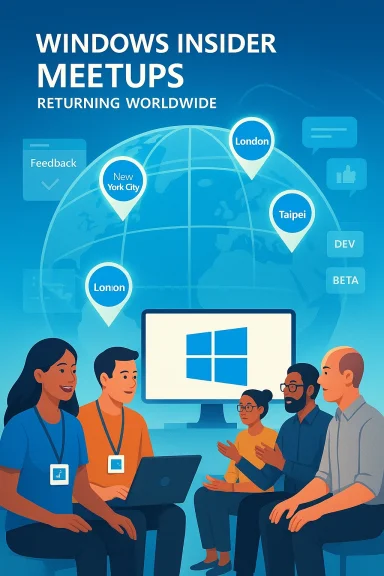
Windows is taking a more hands-on approach to its most passionate user base, and the timing matters. In a new Windows Insider Blog post dated April 8, 2026, Microsoft says Insider meetups are returning, with events planned in New York City, Hyderabad, Taipei, San Francisco, and London over the coming months. The announcement arrives just weeks after the company laid out a broader quality push for Windows 11, including clearer Insider channel definitions, a redesigned Feedback Hub, and more direct engagement with the community. (blogs.windows.com)
The Windows Insider Program has always been more than a preview channel. It is Microsoft’s public lab for Windows, a place where feature ideas, UX decisions, driver behavior, update cadence, and device compatibility all get stress-tested before they reach the mainstream. For years, that relationship has been mediated largely through builds, feedback forms, blog posts, and the occasional conference appearance, which made the program effective but often impersonal. (blogs.windows.com)
That is why the return of in-person meetups is notable. Microsoft is not just shipping code; it is signaling that the Insider community is worth direct investment, direct listening, and direct explanation. The Seattle gathering in March served as the first proof point of that renewed approach, with Pavan Davuluri describing it as a chance to listen, answer questions, and share where Windows is headed. The April 8 post says that Seattle event was only the first stop in a wider effort to meet Insiders around the world. (blogs.windows.com)
This move also sits inside a broader Windows reset. In the March 20 “Our commitment to Windows quality” post, Microsoft promised a simpler Insider program, stronger feedback loops, and a major redesign of Feedback Hub. It also outlined a more disciplined emphasis on performance, reliability, and craft, from File Explorer and Windows Update to Start, Taskbar, and Windows Hello. The meetup program should be read as the community-facing arm of that same agenda. (blogs.windows.com)
In other words, these meetups are not nostalgia. They are part of a larger attempt to make the Windows development process feel less like a distant product pipeline and more like a conversation. That matters because Windows is still a platform with enormous breadth: consumer laptops, enterprise desktops, gaming handhelds, developer boxes, and cloud-connected experiences all live under one operating system. A forum thread or feedback ticket can capture a bug, but a live discussion can capture frustration, intent, and context in ways telemetry alone cannot. (blogs.windows.com)
The timing also reflects a competitive reality. Windows is no longer judged only against other desktop operating systems. It competes with the frictionlessness of mobile platforms, the polish of premium hardware ecosystems, and the consistency users now expect from AI-era software. The more Microsoft can show that Insider feedback influences product direction, the easier it becomes to defend Windows as a living platform rather than a legacy one. (blogs.windows.com)
The post also frames the events as two-way sessions, not presentations. Microsoft says attendees will get a preview of work tied to the commitments Pavan shared last month, while the company listens for feedback on how the Insider Program itself can improve. That distinction is important: the emphasis is not simply on showing features, but on strengthening the relationship between builders and testers. (blogs.windows.com)
A few implications follow from that choice:
The blog also makes room for candor. Marcus says the Seattle meetup involved sharing what is working well and being candid about what can be improved. That is a useful detail because it suggests these events are meant to surface uncomfortable truths, not just celebrate product wins. If the company follows through, the meetups could become one of the few places where Windows leadership gets unfiltered feedback in real time. (blogs.windows.com)
That context is essential because Insiders have long asked for more predictability. Preview channels can be useful, but they only work if users understand what each channel is for and how much instability to expect. Microsoft’s language suggests it has heard the complaint that the program can feel too noisy, too inconsistent, and too opaque for both enthusiasts and professionals who want to contribute without becoming unpaid QA staff. (blogs.windows.com)
This matters because the Windows Insider Program has always walked a line between openness and usability. Too little openness, and the community feels ignored. Too much instability, and people disengage. Microsoft appears to be trying to move toward a model where the preview process is still ambitious, but the signal-to-noise ratio is better. That is exactly the sort of change that can make a forum, a meetup, and a feedback app reinforce one another. (blogs.windows.com)
The redesign of Feedback Hub is especially important. A better interface sounds mundane, but feedback systems only work when they are visible, understandable, and low-friction. If Microsoft can make it easier for users to file issues, see what others are reporting, and track how their input influences changes, then the meetups become part of a broader, more credible loop rather than a one-off community gesture. (blogs.windows.com)
A live event changes the tone of feedback. People speak differently when they can demonstrate a problem in person, see the team react, and hear follow-up questions from the people who actually own the code or design. That interaction can uncover details that are often flattened in web forms, especially around accessibility, workflow, onboarding, and edge-case device behavior. (blogs.windows.com)
The Seattle meetup likely served as a proof of concept for that kind of exchange. The April 8 post implies that the company saw enough value to expand the format quickly. That suggests the internal takeaway was not just that attendees liked the event, but that leadership found the conversations useful enough to justify a more ambitious rollout. (blogs.windows.com)
There is also a symbolism problem Microsoft is trying to solve. For years, many Windows users have felt that feedback arrived too late in the cycle or that major decisions had already been made before the community weighed in. Meetups are a way of saying the process is not closed. They cannot fix everything, but they can soften the perception that Windows evolves in a sealed room.
This spread suggests Microsoft is trying to avoid a purely U.S.-centric narrative. Windows is still one of the world’s most important client operating systems, and the company knows that feedback from gamers, developers, students, enterprise admins, and enthusiasts looks different depending on region and device mix. A broader roadshow helps the program reflect that diversity. (blogs.windows.com)
A regional approach also gives Microsoft a chance to spot patterns that are otherwise easy to miss. If a feature is well received in one market but confusing in another, the issue may be onboarding, terminology, or default settings rather than the core capability itself. That kind of nuance is hard to capture in telemetry alone, which is why the physical event format still has value.
That is especially important at a time when feature velocity alone is not enough to win users. Many people do not want a larger number of features so much as a smaller number of features that work better, behave consistently, and do not get in the way. Microsoft appears to be recognizing that the Windows brand will benefit more from confidence than from novelty. (blogs.windows.com)
For enterprise customers, the stakes are different but equally significant. Microsoft’s emphasis on update control, reliability, and stronger feedback signals could mean fewer surprises in managed environments, better predictability around rollout timing, and a more stable foundation for device fleets. That is especially important for organizations that have learned to treat every Windows update as a change-management exercise. (blogs.windows.com)
Developers also stand to benefit. Microsoft’s quality post highlighted work on the Windows Subsystem for Linux, system performance, and app reliability. If the Insider community can report more nuanced issues at meetups and through a better Feedback Hub, Windows may become a more appealing platform for development workflows that span Windows and Linux tooling. (blogs.windows.com)
This is also a recognition that quality is not a single metric. A build can be technically stable and still feel wrong. A feature can be powerful and still be unpopular because it is hard to discover or difficult to trust. Direct interaction with users helps Microsoft detect those mismatches earlier, before they calcify into product decisions that are expensive to reverse. (blogs.windows.com)
The company’s statement that it wants more visibility into how feedback shapes Windows is also notable. Users are more likely to keep contributing when they feel heard, and more likely to trust the program when they can see action following comments. The redesigned Feedback Hub and the meetup roadshow together suggest Microsoft understands that participation needs a visible payoff. (blogs.windows.com)
In practice, that could mean better tag taxonomy, clearer build notes, more responsive issue triage, and a stronger sense that feature toggles and channel changes are not arbitrary. Even if Microsoft does not spell out every operational change, the public message is that the Insider pipeline is being made more legible.
If Microsoft gets this right, it can turn Insider goodwill into a moat. A healthier, more transparent feedback ecosystem makes Windows more resilient against criticism, more adaptable to changing user expectations, and more attractive to the power users whose opinions influence broader perceptions. That is important at a time when operating system loyalty is increasingly tied to convenience and confidence rather than inertia alone.
That may sound soft, but it has hard consequences. A platform perceived as listening is a platform people are more willing to stay invested in, troubleshoot with, and recommend to others. The ability to say “we changed this because Insiders told us to” is powerful public proof that the ecosystem still has a dialogue, not just a product cycle. (blogs.windows.com)
It also gives Microsoft a chance to repair some of the program’s rough edges. If the company can make the Insider experience easier to understand, more transparent, and more rewarding, it may attract better-quality engagement from the right people rather than just more comments from everyone. In product terms, that is a major win.
There is also the danger of over-indexing on highly vocal enthusiasts. The people who attend meetups are usually the most invested users, which is valuable, but not always representative. Microsoft will need to balance that input with telemetry, enterprise requirements, accessibility needs, and broad consumer behavior if it wants to avoid building for a tiny but loud subset.
What makes this moment interesting is that Microsoft appears to be pairing product discipline with community intimacy. That is a smart combination. In a world where operating systems must be both powerful and calm, the companies that listen best may end up shipping the most trusted software.
Source: Microsoft - Windows Insiders Blog You’re invited. Windows Insiders meetups are back
 Background
The Windows Insider Program has always been more than a preview channel. It is Microsoft’s public lab for Windows, a place where feature ideas, UX decisions, driver behavior, update cadence, and device compatibility all get stress-tested before they reach the mainstream. For years, that relationship has been mediated largely through builds, feedback forms, blog posts, and the occasional conference appearance, which made the program effective but often impersonal. (blogs.windows.com)That is why the return of in-person meetups is notable. Microsoft is not just shipping code; it is signaling that the Insider community is worth direct investment, direct listening, and direct explanation. The Seattle gathering in March served as the first proof point of that renewed approach, with Pavan Davuluri describing it as a chance to listen, answer questions, and share where Windows is headed. The April 8 post says that Seattle event was only the first stop in a wider effort to meet Insiders around the world. (blogs.windows.com)
This move also sits inside a broader Windows reset. In the March 20 “Our commitment to Windows quality” post, Microsoft promised a simpler Insider program, stronger feedback loops, and a major redesign of Feedback Hub. It also outlined a more disciplined emphasis on performance, reliability, and craft, from File Explorer and Windows Update to Start, Taskbar, and Windows Hello. The meetup program should be read as the community-facing arm of that same agenda. (blogs.windows.com)
In other words, these meetups are not nostalgia. They are part of a larger attempt to make the Windows development process feel less like a distant product pipeline and more like a conversation. That matters because Windows is still a platform with enormous breadth: consumer laptops, enterprise desktops, gaming handhelds, developer boxes, and cloud-connected experiences all live under one operating system. A forum thread or feedback ticket can capture a bug, but a live discussion can capture frustration, intent, and context in ways telemetry alone cannot. (blogs.windows.com)
The timing also reflects a competitive reality. Windows is no longer judged only against other desktop operating systems. It competes with the frictionlessness of mobile platforms, the polish of premium hardware ecosystems, and the consistency users now expect from AI-era software. The more Microsoft can show that Insider feedback influences product direction, the easier it becomes to defend Windows as a living platform rather than a legacy one. (blogs.windows.com)
What Microsoft Announced
The headline announcement is straightforward: Windows Insider meetups are back. Marcus, who leads Design and Research across Windows and Devices, says he will join members of the Insider team and Windows product makers at five cities over the next few months, with more events to come. The first stops are New York City, Hyderabad, Taipei, San Francisco, and London. (blogs.windows.com)The post also frames the events as two-way sessions, not presentations. Microsoft says attendees will get a preview of work tied to the commitments Pavan shared last month, while the company listens for feedback on how the Insider Program itself can improve. That distinction is important: the emphasis is not simply on showing features, but on strengthening the relationship between builders and testers. (blogs.windows.com)
The five-city road map
The city list reveals Microsoft’s intent to spread the program across multiple time zones and user communities. New York and San Francisco give the company strong U.S. anchor points, while Hyderabad, Taipei, and London broaden the reach across regions that matter deeply to Windows adoption, engineering, hardware manufacturing, and enterprise usage. This is not a single-market fan event; it is a geographically distributed listening tour. (blogs.windows.com)A few implications follow from that choice:
- Global community recognition is part of the message.
- Hardware and software feedback can be gathered closer to regional realities.
- Enterprise and enthusiast voices are both likely to be represented.
- Insider trust benefits when Microsoft is visibly present.
- Regional ecosystems get a more direct line to the Windows team.
Why the language matters
Marcus’ note leans heavily on phrases like listen more closely, engage more directly, and more of a voice. That language is deliberate. Microsoft is trying to reposition the Insider community as a co-design partner, not just an audience for preview bits. In a mature platform, that kind of language is not cosmetic; it is how the company signals that user sentiment can change roadmap priorities. (blogs.windows.com)The blog also makes room for candor. Marcus says the Seattle meetup involved sharing what is working well and being candid about what can be improved. That is a useful detail because it suggests these events are meant to surface uncomfortable truths, not just celebrate product wins. If the company follows through, the meetups could become one of the few places where Windows leadership gets unfiltered feedback in real time. (blogs.windows.com)
The Quality Reset Behind the Events
The meetup announcement cannot be separated from Microsoft’s March 20 quality message. In that post, the company said it was working on a simpler, more transparent Windows Insider Program with clearer channel definitions, easier access to new features, higher-quality builds, and better visibility into how feedback shapes Windows. It also said the redesigned Feedback Hub would make it faster and easier to submit feedback and engage with the community. (blogs.windows.com)That context is essential because Insiders have long asked for more predictability. Preview channels can be useful, but they only work if users understand what each channel is for and how much instability to expect. Microsoft’s language suggests it has heard the complaint that the program can feel too noisy, too inconsistent, and too opaque for both enthusiasts and professionals who want to contribute without becoming unpaid QA staff. (blogs.windows.com)
A more disciplined Insider model
The quality post also points to stronger validation before builds reach Insiders. Microsoft said it wants deeper testing across real hardware and usage scenarios before new experiences are exposed, along with a more intentional approach to where and how capabilities are introduced. That is a subtle but meaningful shift away from the old assumption that broad exposure alone is the best path to feedback. (blogs.windows.com)This matters because the Windows Insider Program has always walked a line between openness and usability. Too little openness, and the community feels ignored. Too much instability, and people disengage. Microsoft appears to be trying to move toward a model where the preview process is still ambitious, but the signal-to-noise ratio is better. That is exactly the sort of change that can make a forum, a meetup, and a feedback app reinforce one another. (blogs.windows.com)
The redesign of Feedback Hub is especially important. A better interface sounds mundane, but feedback systems only work when they are visible, understandable, and low-friction. If Microsoft can make it easier for users to file issues, see what others are reporting, and track how their input influences changes, then the meetups become part of a broader, more credible loop rather than a one-off community gesture. (blogs.windows.com)
Why In-Person Still Matters
In 2026, many tech companies would have been satisfied with livestreams, surveys, and Discord channels. Microsoft is doing something more old-fashioned and arguably more effective: putting product people in the same room with users. That may seem quaint, but it is often the fastest way to understand where a product feels polished, where it feels broken, and where the company has simply lost the plot. (blogs.windows.com)A live event changes the tone of feedback. People speak differently when they can demonstrate a problem in person, see the team react, and hear follow-up questions from the people who actually own the code or design. That interaction can uncover details that are often flattened in web forms, especially around accessibility, workflow, onboarding, and edge-case device behavior. (blogs.windows.com)
The value of face-to-face trust
Trust is now one of the most important currencies in platform development. Windows users have not only opinions about design; they have memories of update issues, compatibility headaches, feature regressions, and changing policies. In that environment, meeting users face to face is less about marketing and more about credibility. It says Microsoft is willing to be challenged, not merely praised. (blogs.windows.com)The Seattle meetup likely served as a proof of concept for that kind of exchange. The April 8 post implies that the company saw enough value to expand the format quickly. That suggests the internal takeaway was not just that attendees liked the event, but that leadership found the conversations useful enough to justify a more ambitious rollout. (blogs.windows.com)
There is also a symbolism problem Microsoft is trying to solve. For years, many Windows users have felt that feedback arrived too late in the cycle or that major decisions had already been made before the community weighed in. Meetups are a way of saying the process is not closed. They cannot fix everything, but they can soften the perception that Windows evolves in a sealed room.
What the Cities Tell Us
The choice of cities is revealing. Hyderabad and Taipei are especially meaningful because they connect the Insider community to major regions of Microsoft’s global engineering and hardware ecosystem. San Francisco and New York are obvious U.S. hubs, but they also anchor the program in the tech and media centers where Windows is often judged by comparison with the broader product industry. London, meanwhile, gives Microsoft a strong European touchpoint. (blogs.windows.com)This spread suggests Microsoft is trying to avoid a purely U.S.-centric narrative. Windows is still one of the world’s most important client operating systems, and the company knows that feedback from gamers, developers, students, enterprise admins, and enthusiasts looks different depending on region and device mix. A broader roadshow helps the program reflect that diversity. (blogs.windows.com)
Regional feedback, different priorities
Different regions tend to surface different concerns. In one market, reliability and battery life may dominate. In another, language support, input methods, and local app compatibility may matter more. In enterprise-heavy regions, update policy and device manageability take center stage. Meetups can help Microsoft hear those priorities in context rather than as abstract survey results. (blogs.windows.com)A regional approach also gives Microsoft a chance to spot patterns that are otherwise easy to miss. If a feature is well received in one market but confusing in another, the issue may be onboarding, terminology, or default settings rather than the core capability itself. That kind of nuance is hard to capture in telemetry alone, which is why the physical event format still has value.
- Regional relevance can sharpen product decisions.
- Local language and workflow concerns surface more naturally in person.
- Hardware diversity becomes more visible at live events.
- Enterprise needs differ widely by market.
- Community confidence rises when Microsoft shows up locally.
How This Fits the Windows 11 Strategy
The meetups are also a customer-facing extension of Microsoft’s current Windows 11 narrative. The March quality post stressed performance, reliability, craft, and secure-by-default improvements, and it specifically called out more control over updates, stronger biometric sign-in, better Start and Taskbar behavior, and reduced distractions in the user experience. Those are not random priorities; they are a signal that Microsoft wants Windows to feel more predictable and more polished. (blogs.windows.com)That is especially important at a time when feature velocity alone is not enough to win users. Many people do not want a larger number of features so much as a smaller number of features that work better, behave consistently, and do not get in the way. Microsoft appears to be recognizing that the Windows brand will benefit more from confidence than from novelty. (blogs.windows.com)
Enterprise and consumer impact
For consumers, the likely upside is a steadier, less distracting Windows experience. The company has already talked about quieter setup flows, improved personalization, and more control over core surfaces like Start and Taskbar. If the meetup feedback influences that work, ordinary users may see the most visible results in everyday friction points rather than headline-grabbing features. (blogs.windows.com)For enterprise customers, the stakes are different but equally significant. Microsoft’s emphasis on update control, reliability, and stronger feedback signals could mean fewer surprises in managed environments, better predictability around rollout timing, and a more stable foundation for device fleets. That is especially important for organizations that have learned to treat every Windows update as a change-management exercise. (blogs.windows.com)
Developers also stand to benefit. Microsoft’s quality post highlighted work on the Windows Subsystem for Linux, system performance, and app reliability. If the Insider community can report more nuanced issues at meetups and through a better Feedback Hub, Windows may become a more appealing platform for development workflows that span Windows and Linux tooling. (blogs.windows.com)
The Insider Community as a Product Sensor
One of the most interesting parts of this announcement is how explicitly it treats the Insider community as a sensor network. Microsoft is not just asking Insiders to test builds; it is inviting them to shape the direction of the program itself. That is a much stronger statement than the usual “please send feedback” language common in product blogs. (blogs.windows.com)This is also a recognition that quality is not a single metric. A build can be technically stable and still feel wrong. A feature can be powerful and still be unpopular because it is hard to discover or difficult to trust. Direct interaction with users helps Microsoft detect those mismatches earlier, before they calcify into product decisions that are expensive to reverse. (blogs.windows.com)
From bug reports to product direction
The distinction between bug reporting and product direction is crucial. Bug reports tell you what broke. Product direction tells you whether the user experience is heading toward something people actually want. Meetups can help the Windows team hear not just what failed, but what should exist instead. That is a more ambitious and much more valuable form of feedback. (blogs.windows.com)The company’s statement that it wants more visibility into how feedback shapes Windows is also notable. Users are more likely to keep contributing when they feel heard, and more likely to trust the program when they can see action following comments. The redesigned Feedback Hub and the meetup roadshow together suggest Microsoft understands that participation needs a visible payoff. (blogs.windows.com)
In practice, that could mean better tag taxonomy, clearer build notes, more responsive issue triage, and a stronger sense that feature toggles and channel changes are not arbitrary. Even if Microsoft does not spell out every operational change, the public message is that the Insider pipeline is being made more legible.
Competitive Implications
The return of meetups also has competitive significance. Apple, Google, and smaller platform players all cultivate developer and enthusiast communities, but Microsoft has a special challenge because Windows must support a much wider range of hardware, software, and deployment models. In that environment, community trust becomes a strategic asset, not just a branding exercise. (blogs.windows.com)If Microsoft gets this right, it can turn Insider goodwill into a moat. A healthier, more transparent feedback ecosystem makes Windows more resilient against criticism, more adaptable to changing user expectations, and more attractive to the power users whose opinions influence broader perceptions. That is important at a time when operating system loyalty is increasingly tied to convenience and confidence rather than inertia alone.
Why rivals should pay attention
Microsoft’s competition is not only with other desktop operating systems, but with the expectations set by modern software ecosystems. Users now assume that software should be polished, adaptive, and responsive to feedback. A more visible Insider program helps Microsoft argue that Windows is not static, and that it is evolving with more humility and user involvement. (blogs.windows.com)That may sound soft, but it has hard consequences. A platform perceived as listening is a platform people are more willing to stay invested in, troubleshoot with, and recommend to others. The ability to say “we changed this because Insiders told us to” is powerful public proof that the ecosystem still has a dialogue, not just a product cycle. (blogs.windows.com)
- Community trust becomes a competitive advantage.
- Faster feedback loops can shorten product missteps.
- Transparency helps offset skepticism about new AI and UX choices.
- Regional engagement broadens Microsoft’s platform legitimacy.
- Public listening strengthens the Windows brand in the long term.
Strengths and Opportunities
The strongest part of this move is that it is concrete. Microsoft is not merely saying it values feedback; it is taking the time to meet people in person, publish a broader quality roadmap, and redesign the systems that collect that feedback. That combination makes the effort feel more credible than a standalone blog post ever could. (blogs.windows.com)It also gives Microsoft a chance to repair some of the program’s rough edges. If the company can make the Insider experience easier to understand, more transparent, and more rewarding, it may attract better-quality engagement from the right people rather than just more comments from everyone. In product terms, that is a major win.
- Stronger trust between Microsoft and Insiders.
- Better-quality feedback from more engaged participants.
- Clearer channel positioning for Dev, Beta, Canary, and Release Preview users.
- More useful validation before broad release.
- Improved community sentiment around Windows quality.
- Stronger global representation across regions and device categories.
- A better story for Windows as an evolving platform.
Risks and Concerns
The obvious risk is expectation management. Once Microsoft says it is listening more closely and giving Insiders more of a voice, users will expect visible results quickly. If the events feel staged or if the promised program changes arrive slowly, the goodwill could fade faster than it was built. (blogs.windows.com)There is also the danger of over-indexing on highly vocal enthusiasts. The people who attend meetups are usually the most invested users, which is valuable, but not always representative. Microsoft will need to balance that input with telemetry, enterprise requirements, accessibility needs, and broad consumer behavior if it wants to avoid building for a tiny but loud subset.
- Raised expectations may outpace delivery.
- Community fatigue could set in if change is slow.
- Overrepresentation of power users may skew priorities.
- Regional events may still miss many remote Insiders.
- Feedback overload could become harder to manage, not easier.
- Messaging gaps could create confusion about what is actually changing.
Looking Ahead
The next few months should show whether Microsoft’s Insider reset is real or just well-marketed. The company has already promised more details on program changes later this week, which means the April 8 meetup announcement is only one part of a larger story still unfolding. If those changes meaningfully improve clarity, control, and feedback visibility, the roadshow will look like the start of something durable. (blogs.windows.com)What makes this moment interesting is that Microsoft appears to be pairing product discipline with community intimacy. That is a smart combination. In a world where operating systems must be both powerful and calm, the companies that listen best may end up shipping the most trusted software.
- More details on Insider changes are expected soon.
- Additional meetup cities are likely to be announced.
- Feedback Hub adoption will be a key indicator of success.
- Build quality improvements will determine whether the strategy resonates.
- Community attendance and engagement will show how much trust remains.
Source: Microsoft - Windows Insiders Blog You’re invited. Windows Insiders meetups are back
