

Microsoft’s NTLM retirement plan means IT teams should stop treating every remaining NTLM dependency as one problem. The practical decision now is to sort each path into four buckets: move it to standard Kerberos, test IAKerb for domain access without a reachable domain controller, test LocalKDC for local or workgroup-style authentication, or document a tightly controlled temporary exception. Neither IAKerb nor LocalKDC is a universal NTLM replacement, and assuming otherwise is the fastest route to a disruptive default-disablement rollout.
Microsoft’s roadmap places IAKerb, LocalKDC, and an upgrade to hard-coded Negotiate behavior in the second half of 2026. The company has also said NTLM is planned to be disabled by default in most cases with the next Windows Server release, although that schedule remains subject to change. That leaves a meaningful preparation window, but not much room for organizations that still discover authentication dependencies only after a policy change breaks a production workflow.
Microsoft’s June 2, 2026 Canary preview announcement provides the clearest immediate signal: IAKerb is enabled by default in that preview, while LocalKDC is disabled by default. Both are initially configured through registry settings, not Group Policy or MDM. That makes these features important for lab validation now, but not yet a normal enterprise deployment control plane.
An NTLM authentication event does not automatically mean IAKerb or LocalKDC is the answer. The right remediation depends on the identity involved, the target resource, whether the device is domain-joined, and why Kerberos was unavailable or bypassed.
Start by classifying each observed NTLM path before making changes:
That distinction matters because IAKerb does not repair a broken domain configuration. If a line-of-business application connects to a server through an IP address, uses an unmanaged DNS alias, has no appropriate SPN, or forces NTLM in its own settings, the missing direct domain-controller path may not be the true cause. Testing IAKerb before fixing those fundamentals could produce a misleading result: a successful test in one workflow and continued NTLM elsewhere.
LocalKDC addresses a different historical compromise. Its target is authentication that involves local accounts, workgroup arrangements, and standalone systems—patterns where there may be no Active Directory domain relationship to supply normal Kerberos tickets. The promise is not “make every local-account connection enterprise-ready.” It is to bring Kerberos-based behavior into scenarios that were traditionally coupled to NTLM.
For administrators, the simple comparison is this: IAKerb preserves a domain-authentication intent when direct domain-controller access is absent; LocalKDC addresses authentication designs that were never domain-based to begin with. A remote employee connecting to a domain resource through an unusual network path belongs in the IAKerb investigation lane. A standalone operational device authenticating with a local account belongs in the LocalKDC lane.
Do not confuse either capability with the separate effort to remove NTLMv1 or with SMB client controls that block outbound NTLM. Those are related stages of a broader Kerberos-first program, but they have different blast radii and different remediation paths. WindowsForum’s earlier coverage of Microsoft’s broader NTLM phase-out correctly frames the strategic direction; the new work is about deciding which technical escape route applies to each remaining dependency.
A useful pilot sequence is:
IT teams should also avoid declaring victory based on SMB results alone. Blocking outbound NTLM from the SMB client is an important reduction measure, but it only addresses one protocol path. A successful SMB-focused program can coexist with NTLM use in application protocols, management tooling, web services, remote access components, or custom integrations.
Likewise, the retirement of NTLMv1 is not the same as broad NTLM disablement. NTLMv1 removal eliminates an especially outdated form of the protocol; it does not prove that NTLMv2 dependencies have been remediated. Broader default disablement is the event that forces organizations to know whether each remaining path has a viable Kerberos alternative or must remain temporarily excepted.
The harder cases are likely to be named-server aliases, appliances with local identities, applications that embed authentication choices, and services whose owners no longer understand their original account configuration. Those are not failures of IAKerb or LocalKDC. They are the backlog those features cannot erase.
For a domain service, the likely long-term answer is usually conventional Kerberos hygiene: correct DNS, correct SPNs, supported service identities, and application settings that allow Negotiate to select Kerberos. For a local-account or workgroup dependency, LocalKDC may become a viable bridge, but only after testing confirms its behavior for that exact workflow. For a domain scenario blocked from direct domain-controller access, IAKerb may be the most relevant new option, provided the underlying service configuration is sound.
That framing changes the conversation from “Can we keep NTLM working?” to “What is the shortest credible route away from this exact NTLM use?” It also produces a cleaner risk report for leadership: the remaining exposure is a finite set of named dependencies, not an unknowable property of the Windows estate.
The key milestone for the rest of 2026 is not a date on Microsoft’s roadmap; it is the point at which every NTLM event in an organization can be assigned to a tested Kerberos path or a shrinking, accountable exception list. When default disablement advances, that evidence—not optimism about a preview feature—will determine whether the change is routine or disruptive.
Microsoft’s roadmap places IAKerb, LocalKDC, and an upgrade to hard-coded Negotiate behavior in the second half of 2026. The company has also said NTLM is planned to be disabled by default in most cases with the next Windows Server release, although that schedule remains subject to change. That leaves a meaningful preparation window, but not much room for organizations that still discover authentication dependencies only after a policy change breaks a production workflow.
Microsoft’s June 2, 2026 Canary preview announcement provides the clearest immediate signal: IAKerb is enabled by default in that preview, while LocalKDC is disabled by default. Both are initially configured through registry settings, not Group Policy or MDM. That makes these features important for lab validation now, but not yet a normal enterprise deployment control plane.
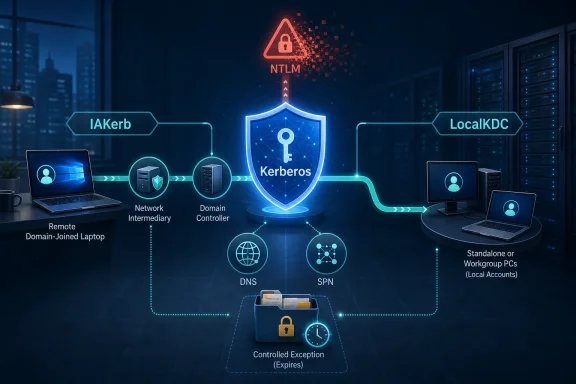 The first decision is identifying why NTLM is still appearing
An NTLM authentication event does not automatically mean IAKerb or LocalKDC is the answer. The right remediation depends on the identity involved, the target resource, whether the device is domain-joined, and why Kerberos was unavailable or bypassed.Start by classifying each observed NTLM path before making changes:
- Use standard Kerberos remediation when a domain identity is accessing a domain resource and a domain controller should be reachable. Investigate missing or duplicate service principal names, DNS and name-resolution failures, aliases that do not map cleanly to the service identity, stale computer accounts, and applications that explicitly request NTLM or rely on old Negotiate behavior.
- Evaluate IAKerb when the client is domain-authenticated but does not have direct line of sight to a domain controller. This is the scenario Microsoft is targeting: a client still needs domain authentication, yet the classic Kerberos path is obstructed in a way that historically pushed Windows toward NTLM fallback.
- Evaluate LocalKDC when the authentication pattern is fundamentally local-account, workgroup, or standalone. These are environments and device relationships where NTLM has long been the default because conventional Active Directory Kerberos was not part of the design.
- Create a documented temporary exception when the dependency is outside the new features’ scope. That exception should name the application, owner, affected identities, affected hosts, technical reason, compensating controls, test evidence, and retirement date. “Legacy compatibility” is not a useful exception reason.
IAKerb and LocalKDC solve different traffic problems
IAKerb is for a domain-authentication problem. In the intended flow, the user or device is operating in a domain context, but the client cannot directly communicate with a domain controller when Kerberos authentication is needed. Rather than accepting NTLM fallback as the practical outcome, IAKerb is designed to let the authentication process continue through an intermediary path.That distinction matters because IAKerb does not repair a broken domain configuration. If a line-of-business application connects to a server through an IP address, uses an unmanaged DNS alias, has no appropriate SPN, or forces NTLM in its own settings, the missing direct domain-controller path may not be the true cause. Testing IAKerb before fixing those fundamentals could produce a misleading result: a successful test in one workflow and continued NTLM elsewhere.
LocalKDC addresses a different historical compromise. Its target is authentication that involves local accounts, workgroup arrangements, and standalone systems—patterns where there may be no Active Directory domain relationship to supply normal Kerberos tickets. The promise is not “make every local-account connection enterprise-ready.” It is to bring Kerberos-based behavior into scenarios that were traditionally coupled to NTLM.
For administrators, the simple comparison is this: IAKerb preserves a domain-authentication intent when direct domain-controller access is absent; LocalKDC addresses authentication designs that were never domain-based to begin with. A remote employee connecting to a domain resource through an unusual network path belongs in the IAKerb investigation lane. A standalone operational device authenticating with a local account belongs in the LocalKDC lane.
Do not confuse either capability with the separate effort to remove NTLMv1 or with SMB client controls that block outbound NTLM. Those are related stages of a broader Kerberos-first program, but they have different blast radii and different remediation paths. WindowsForum’s earlier coverage of Microsoft’s broader NTLM phase-out correctly frames the strategic direction; the new work is about deciding which technical escape route applies to each remaining dependency.
Build a pilot around authentication journeys, not server lists
Because the June Canary preview exposes IAKerb and LocalKDC through registry settings, the first pilots should be deliberately narrow. There is no published basis here for treating either feature as broadly manageable through existing Group Policy or MDM workflows, and Canary availability is not a production servicing commitment.A useful pilot sequence is:
- Build an NTLM dependency register. Record the client, server or service, account type, network location, protocol, application owner, business criticality, and observed reason for NTLM. Separate domain, local-account, workgroup, and unknown cases immediately.
- Choose a small test ring that represents difficult paths. Include one domain scenario with limited direct domain-controller connectivity for IAKerb evaluation and one local or standalone scenario for LocalKDC evaluation. Do not start with the most business-critical workload or a broad device collection.
- Establish a baseline before changing feature state. Capture whether the workflow succeeds, which identity is used, whether NTLM is observed, whether Kerberos is observed, and what users experience when the network path is degraded or restored.
- Test IAKerb and LocalKDC independently. IAKerb being enabled by default in the June 2 Canary preview does not prove it improves every failure case. LocalKDC being disabled by default is an equally clear signal that it requires intentional validation rather than casual rollout.
- Repeat realistic edge conditions. Test aliases, DNS names, direct host names, resource access after credential renewal, reconnection after network interruption, service restarts, and access from devices that are not configured identically to the lab’s reference client.
- Record rollback evidence as carefully as success evidence. Since the initial controls are registry-based, the rollback should be tested as a specific configuration reversal, followed by a verification that the old workflow returns to its baseline state.
What not to assume from the preview
The first mistake will be assuming that a feature enabled in a Canary build is ready for fleet-wide deployment. The second will be assuming that a registry control today guarantees a future policy, MDM, servicing, or support model. Microsoft’s current roadmap says these capabilities are arriving in the second half of 2026, but it does not turn a preview feature into a final deployment standard.IT teams should also avoid declaring victory based on SMB results alone. Blocking outbound NTLM from the SMB client is an important reduction measure, but it only addresses one protocol path. A successful SMB-focused program can coexist with NTLM use in application protocols, management tooling, web services, remote access components, or custom integrations.
Likewise, the retirement of NTLMv1 is not the same as broad NTLM disablement. NTLMv1 removal eliminates an especially outdated form of the protocol; it does not prove that NTLMv2 dependencies have been remediated. Broader default disablement is the event that forces organizations to know whether each remaining path has a viable Kerberos alternative or must remain temporarily excepted.
The harder cases are likely to be named-server aliases, appliances with local identities, applications that embed authentication choices, and services whose owners no longer understand their original account configuration. Those are not failures of IAKerb or LocalKDC. They are the backlog those features cannot erase.
Treat exceptions as a retirement program, not a compatibility setting
A temporary NTLM exception should have an owner and an exit condition from the day it is approved. That means assigning a remediation choice—standard Kerberos, IAKerb, LocalKDC, redesign, replacement, or retirement—and revisiting it on a defined schedule.For a domain service, the likely long-term answer is usually conventional Kerberos hygiene: correct DNS, correct SPNs, supported service identities, and application settings that allow Negotiate to select Kerberos. For a local-account or workgroup dependency, LocalKDC may become a viable bridge, but only after testing confirms its behavior for that exact workflow. For a domain scenario blocked from direct domain-controller access, IAKerb may be the most relevant new option, provided the underlying service configuration is sound.
That framing changes the conversation from “Can we keep NTLM working?” to “What is the shortest credible route away from this exact NTLM use?” It also produces a cleaner risk report for leadership: the remaining exposure is a finite set of named dependencies, not an unknowable property of the Windows estate.
Frequently Asked Questions
Is IAKerb a replacement for conventional Active Directory Kerberos?
No. IAKerb is intended for domain-authentication situations where the client lacks direct line of sight to a domain controller. Normal Kerberos configuration remains the preferred answer when domain connectivity, DNS, SPNs, and application settings can be corrected.Should LocalKDC be enabled across all workgroup and standalone devices?
Not yet. Microsoft’s June 2, 2026 Canary preview has LocalKDC disabled by default and initially controlled through registry settings, so it should be validated in narrowly defined pilots before any broader decision.Does removing NTLMv1 mean an organization is ready for NTLM default disablement?
No. NTLMv1 retirement and broader NTLM disablement are separate milestones. NTLMv2 and other remaining NTLM fallback paths still need to be inventoried and remediated.Can IAKerb or LocalKDC fix applications that force NTLM?
Not necessarily. Microsoft says the new features cover only a subset of NTLM fallback scenarios. Applications that explicitly choose NTLM, or environments with SPN, DNS, and legacy configuration problems, still require direct remediation.The key milestone for the rest of 2026 is not a date on Microsoft’s roadmap; it is the point at which every NTLM event in an organization can be assigned to a tested Kerberos path or a shrinking, accountable exception list. When default disablement advances, that evidence—not optimism about a preview feature—will determine whether the change is routine or disruptive.