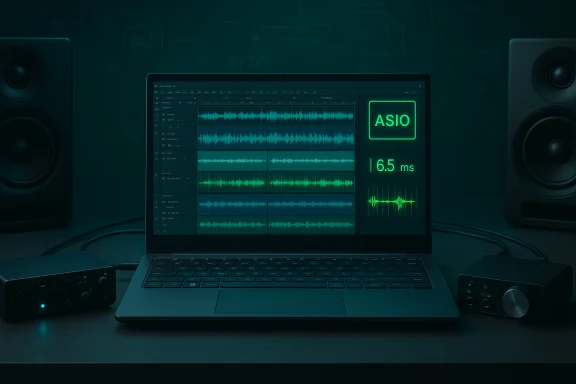
Microsoft’s move to build a native, low‑latency USB Audio Class 2 driver that exposes an ASIO interface for Windows on Arm marks one of the most consequential platform-level changes for music production on Windows in years — it promises plug‑and‑play ASIO on Arm64 systems while changing how vendors, DAWs, and end users will approach driver support and compatibility.
Microsoft’s engineering team announced a project to create a brand‑new, in‑box USB Audio Class 2 driver for Windows that includes both WaveRT endpoints and a native ASIO interface, developed in collaboration with Qualcomm and Yamaha. The stated aim is to deliver an option optimized for low‑latency musician scenarios and high I/O counts, with the first target being Arm64 devices and x86‑64 to follow after maturity checks. For decades, professional audio on Windows has relied on ASIO (Audio Stream Input/Output) to achieve predictable, low round‑trip latencies for DAWs, live monitoring, and instrument performance. Historically, ASIO access on Windows required vendor‑supplied kernel drivers, which created friction for plug‑and‑play workflows and left many class‑compliant devices reliant on third‑party wrappers or legacy drivers. Microsoft’s plan is to reduce that friction by providing a robust platform implementation that can be shipped in‑box with Windows.
Source: Windows Report Windows on Arm to Get Microsoft’s New Low-Latency Audio Driver in 2026
 Background / Overview
Microsoft’s engineering team announced a project to create a brand‑new, in‑box USB Audio Class 2 driver for Windows that includes both WaveRT endpoints and a native ASIO interface, developed in collaboration with Qualcomm and Yamaha. The stated aim is to deliver an option optimized for low‑latency musician scenarios and high I/O counts, with the first target being Arm64 devices and x86‑64 to follow after maturity checks. For decades, professional audio on Windows has relied on ASIO (Audio Stream Input/Output) to achieve predictable, low round‑trip latencies for DAWs, live monitoring, and instrument performance. Historically, ASIO access on Windows required vendor‑supplied kernel drivers, which created friction for plug‑and‑play workflows and left many class‑compliant devices reliant on third‑party wrappers or legacy drivers. Microsoft’s plan is to reduce that friction by providing a robust platform implementation that can be shipped in‑box with Windows. What Microsoft announced (the technical summary)
The driver architecture — what to expect
- A USB Audio Class 2 class driver that continues to support existing class‑compliant devices while offering a low‑latency mode targeted at musicians.
- An ASIO interface alongside WaveRT so DAWs can access hardware with minimal intermediate buffering.
- Implementation built using the ACX framework (modern Windows driver model), with attention to power management on modern Arm CPUs — an important consideration for mobile laptops.
Key capabilities Microsoft has signalled
- Support for class‑compliant USB Audio Class 2 devices out of the box.
- An option or driver mode optimized for low round‑trip latency and high channel counts.
- The ability, where possible, for Windows and a DAW to use the same interface concurrently (reducing the long-standing single‑app lock that made some workflows painful).
Why this matters: the practical implications for musicians and studios
Lower friction onboarding
For many musicians and engineers, the most immediate benefit is simplified setup: plug in a USB Audio Class 2 device and get ASIO‑grade access without hunting vendor installers. That changes field‑recording, live‑performance, and second‑machine workflows where quick setup is essential. Reduced friction could also improve the adoption rate of Arm‑based laptops for on‑the‑road creatives.Reduced driver fragmentation
Publishing a high‑quality, open reference reduces the burden on smaller vendors who historically lacked resources to produce and maintain kernel drivers across architectures. Vendors can still ship optimized drivers for advanced features or absolute lowest latency, but baseline compatibility should rise significantly. This is a platform‑level win for long‑tail and legacy devices.Better multi‑app and live workflows
Microsoft’s design explicitly contemplates scenarios where system audio and a DAW share the device simultaneously — useful for streaming musicians who need system sounds, conference audio, or browser playback to coexist with a DAW session without device‑hand‑offs. This will reduce the number of workflow workarounds professionals currently depend on.Ecosystem response: hardware vendors and DAWs
Vendors shipping Arm64 support now
Several major audio vendors have already published Arm64 drivers or previews to align with the platform shift. Focusrite, for example, published Arm64 drivers across its USB interface lineup and explicitly called out Windows on Arm compatibility as available via downloads and release notes, illustrating vendor readiness to support Arm‑native drivers. Steinberg (Yamaha) also posted Arm64 preview builds for key DAW software and signaled driver previews, reflecting a coordinated industry effort to make Arm64 a first‑class citizen for audio production workflows.DAW support and the plugin matrix
Early Arm64 previews of major DAWs (Cubase, Nuendo, REAPER, Bitwig, and other ports) reduce emulation overhead and unlock platform efficiency, but plugin compatibility remains the biggest wild card. Many plugins — especially older or non‑updated binaries — may still run under emulation or require bridging. That means studios should continue validating plugin chains on Arm64 before committing mission‑critical sessions.Claims to treat carefully
There are repeated industry mentions that Ableton Live will launch an Arm64 version in 2026. that claim has proliferated in coverage, but at the time of writing there is no public, verifiable Ableton announcement explicitly committing to a 2026 Arm64 Windows release. Treat the Ableton 2026 claim as plausible industry speculation rather than a confirmed shipping date, and confirm directly with Ableton for production timelines.Timeline and what “in‑box” means
Microsoft’s stated milestones
Microsoft has said previews of the new in‑box driver will appear throughout 2025, with the initial target being Arm64 devices and follow‑up x86‑64 ports after quality validation. The company has been careful not to hard‑commit to an exact retail ship date, instead promising to ship the driver in‑box “when we reach our quality targets.”Why 2026 shows up in coverage
Independent outlets and analyst timelines have reasonably tied broader OEM preload or retail prominence to 2026, linked to the next wave of Arm silicon and Windows refresh cycles (for example new Snapdragon X Elite platforms and Windows 11 refreshes). Those retail timing ties are plausible — OEM image refresh schedules and silicon launches commonly determine when a new in‑box component appears on shipping hardware — but they are not an explicit Microsoft promise of a 2026 date. In short: previews in 2025, wider OEM preload or retail presence likely in 2026, but not guaranteed as a single global ship date.Technical tradeoffs and performance realities
Latency vs. battery life and thermal envelope
Achieving single‑digit millisecond round‑trip latency requires frequent small buffer fills, which increases CPU wakeups and power draw — a real constraint on battery‑focused Arm laptops. The kernel, driver, scheduler, and SoC power management layers must be tuned to balance latency with practical battery life and thermal limits. Microsoft acknowledges these tradeoffs and plans to expose options optimized for musician scenarios rather than a single one‑size‑fits‑all mode. Expect per‑device tuning and vendor guidance for optimal results.Why vendor drivers will still matter
An in‑box class driver aims to cover the majority of class‑compliant features and ensure broad compatibility, but premium vendor drivers can and will deliver the “last mile” of performance: firmware‑assisted monitoring, DSP offload, proprietary routing, and highly tuned interrupt handling. For pro rigs and broadcast/live use, vendor drivers and hardware control panels will remain essential for achieving absolute lowest latency and deterministic behavior.ASIO is a tool, not a panacea
ASIO is a highly effective block‑level interface for low‑latency audio, but it does not natively address features like device aggregation, complex routing, or multi‑client orchestration. Microsoft’s approach is pragmatic — provide ASIO support where musicians already rely on it, then iterate on APIs and drivers for the advanced scenarios. Expect additional platform work to follow for those advanced use cases.Security, update cadence, and maintainability
Shipping a kernel driver in‑box makes Microsoft responsible for its maintenance surface area: code quality, security patching, and Windows servicing cadence all matter. The plan to publish the class driver source on GitHub improves transparency and allows vendor feedback and audits, but it doesn’t remove the need for rigorous QA and fast update paths when regressions are discovered. In‑box drivers will be updated via Windows servicing channels, which helps distribution but amplifies the importance of pre‑release testing to avoid systemic regressions.How professionals and studios should prepare — a practical checklist
- Inventory audio gear and confirm whether your interfaces are USB Audio Class 2 compliant. Class‑compliant devices are the prime candidates for the in‑box driver.
- For mission‑critical live and broadcast setups, retain vendor drivers and test them against preview drivers—don’t rely on a single new stack until it’s verified end‑to‑end.
- Prioritize Arm64 systems with proven thermal design and high‑performance SoCs (for example Snapdragon X‑class family) for sustained low‑latency workloads.
- Start testing now with vendor Arm64 preview drivers and Arm‑native DAW builds where available to identify plugin compatibility gaps and performance hotspots. Steinberg and Focusrite have already published previews and drivers to help with validation.
- Measure round‑trip latency, CPU load, and stability under real projects. Use consistent test patches and buffering scenarios to compare vendor drivers vs. the in‑box preview.
Developer and vendor opportunities
- Publishing the in‑box class driver source provides a reference implementation vendors can study and adapt. This lowers the barrier for smaller manufacturers and hobbyist projects that previously could not maintain kernel drivers for multiple architectures.
- DAW and plugin developers should prioritize Arm64 native builds or Arm64EC bridge strategies for critical plugin chains to avoid emulation performance cliffs. Microsoft’s initiative reduces one layer of friction — the audio driver — but plugin compatibility remains a developer task.
- Driver authors can use the published implementation as a starting point for device‑specific optimisations, focusing QE for power‑vs‑latency tradeoffs and advanced routing features that a generic class driver can’t provide.
Risks, limitations, and open questions
- Timing uncertainty: Microsoft committed to previews in 2025 and Arm64 first, but the notion that the driver will fully appear in shipping retail images in 2026 is an industry inference tied to hardware and OS refresh cycles, not a formal Microsoft ship date guarantee. Plan purchases and critical rollouts conservatively.
- Power and thermals: Achieving the lowest possible latency on a thin, battery‑conscious laptop will require tradeoffs; expect per‑device guidance from OEMs and SoC partners.
- Plugin compatibility: The heterogeneity of VST/AU/AAX ecosystems means many plugins require explicit porting or testing; legacy x86‑only binaries may run under emulation but with potential performance/behavior differences. Comprehensive compatibility testing remains essential.
- Vendor ecosystems: Some vendors may still prefer shipping their own kernel drivers for parity and features; the in‑box driver is not a forced replacement but a baseline solution. Expect a hybrid world where both in‑box and vendor drivers coexist.
- Unverified claims: Repeated press statements and aggregators have suggested Ableton Live will ship a native Arm64 Windows version in 2026; that claim appears in secondary coverage but lacks an official Ableton public confirmation at the time of reporting and should be treated as speculative. Validate such major app roadmaps directly with vendors before relying on them for project planning.
Early hands‑on expectations and recommended test scenarios
- Use a simple latency measurement chain: DAW → Direct monitor off → audio loopback (if hardware supports) → measure round‑trip using a known test patch. Compare vendor Arm64 drivers vs. Microsoft preview driver under identical buffer sizes.
- Stress test high channel counts (multi‑mic capture, multi‑output monitoring) to identify CPU scaling and thermal throttling thresholds on candidate Arm64 laptops.
- Test mixed multi‑app workflows (DAW + streaming encoder + Teams/Zoom) to ensure the driver’s multi‑client semantics match real user scenarios.
- For live use, run the driver through a full‑performance dress rehearsal on battery power and AC power to observe differences in CPU frequency scaling and audio stability.
Verdict: meaningful progress with pragmatic caveats
Microsoft’s in‑box low‑latency USB Audio Class 2 driver with a native ASIO interface is a strategic and pragmatic move that removes a major usability hurdle for Windows on Arm. The partnership with Qualcomm and Yamaha, the public GitHub intent, and vendor Arm64 drivers from players like Focusrite and Steinberg together paint a picture of coordinated ecosystem maturation. For many users, this reduces friction, improves plug‑and‑play expectations, and strengthens Arm64’s position as a viable platform for professional audio work. At the same time, the professional audio ecosystem is complex. Ultra‑low latency, absolute determinism, and advanced routing features still favor vendor drivers and careful per‑device QA. The path to broad retail availability will likely be staged, with previews in 2025 and wider OEM preorder/retail visibility likely clustered around 2026 platform refreshes — a plausible but not guaranteed timeline tied to hardware and OS refresh cycles.Final recommendations for audio professionals and IT managers
- Begin lab validations now: install vendor Arm64 drivers and early DAW previews where available, and run representative sessions to expose plugin and driver edge cases.
- Keep vendor drivers available as fallbacks for mission‑critical shows and recordings. The in‑box driver will lower friction but won’t eliminate the need for device‑specific optimizations.
- For procurement, prioritize Arm64 systems with robust thermal designs and high‑performance SoCs if you plan to rely on low‑latency workloads on battery.
- Track the Microsoft preview releases and GitHub repo as they appear; early feedback from professionals can materially shape stability and features before the in‑box ship.
Source: Windows Report Windows on Arm to Get Microsoft’s New Low-Latency Audio Driver in 2026